SEOUL · NAMSAN
The Wednesday evening of Cheollyu Seonmu: Lulu and Maya walk Namsangol first and meet Elena in the Gugakdang yard
Wednesday 25 November 2026, 7.30 p.m., Crown Haitai Hall at Seoul Namsan Gugakdang · all seats 30,000 won · cancel or change seats by 5 p.m. the day before · Chungmuro Station Exit 4 · what Yeonhwadae, Oyangseon and Heonseondo are about
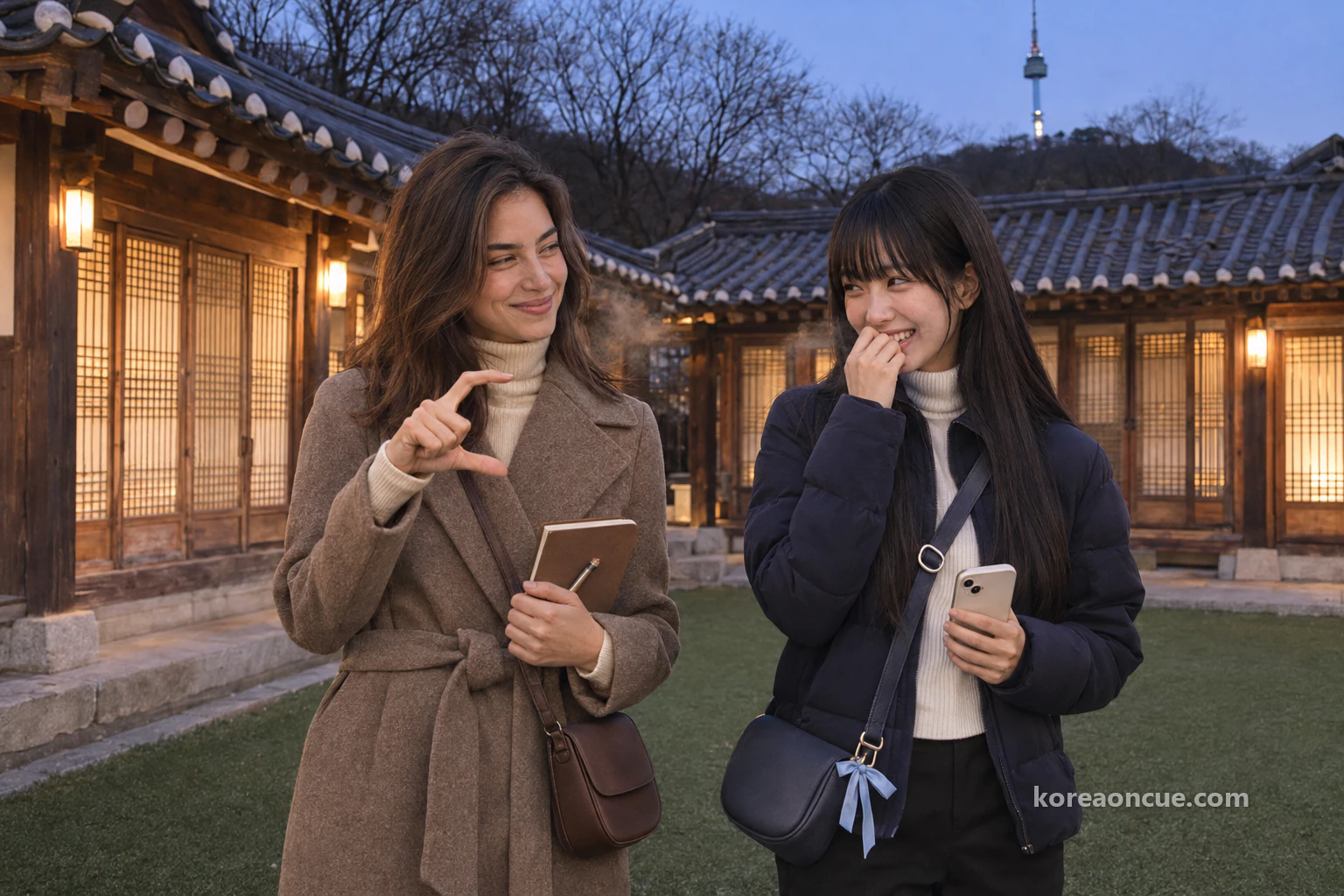
Lulu, off to her first court dance performance, has learned the stories of all three dances. Maya has decided to take photos only as far as the theatre door. Behind Maya, stepping backwards in the Gugakdang yard to fit the same roof into her frame, stood Elena with her notebook of square brackets.
How to get there
It was just past 5 p.m. on Wednesday 25 November 2026 when Lulu and Maya came up out of Exit 4 of Chungmuro Station on Lines 3 and 4. Today they were heading for Seoul Namsan Gugakdang, inside Namsangol Hanok Village. At 7.30 that evening the court dance performance Cheollyu Seonmu would go on in its underground auditorium. The cold had set in and both of them had got their thick coats out, and the moment they stepped out of the exit Maya pulled the collar of her white turtleneck up to her chin.
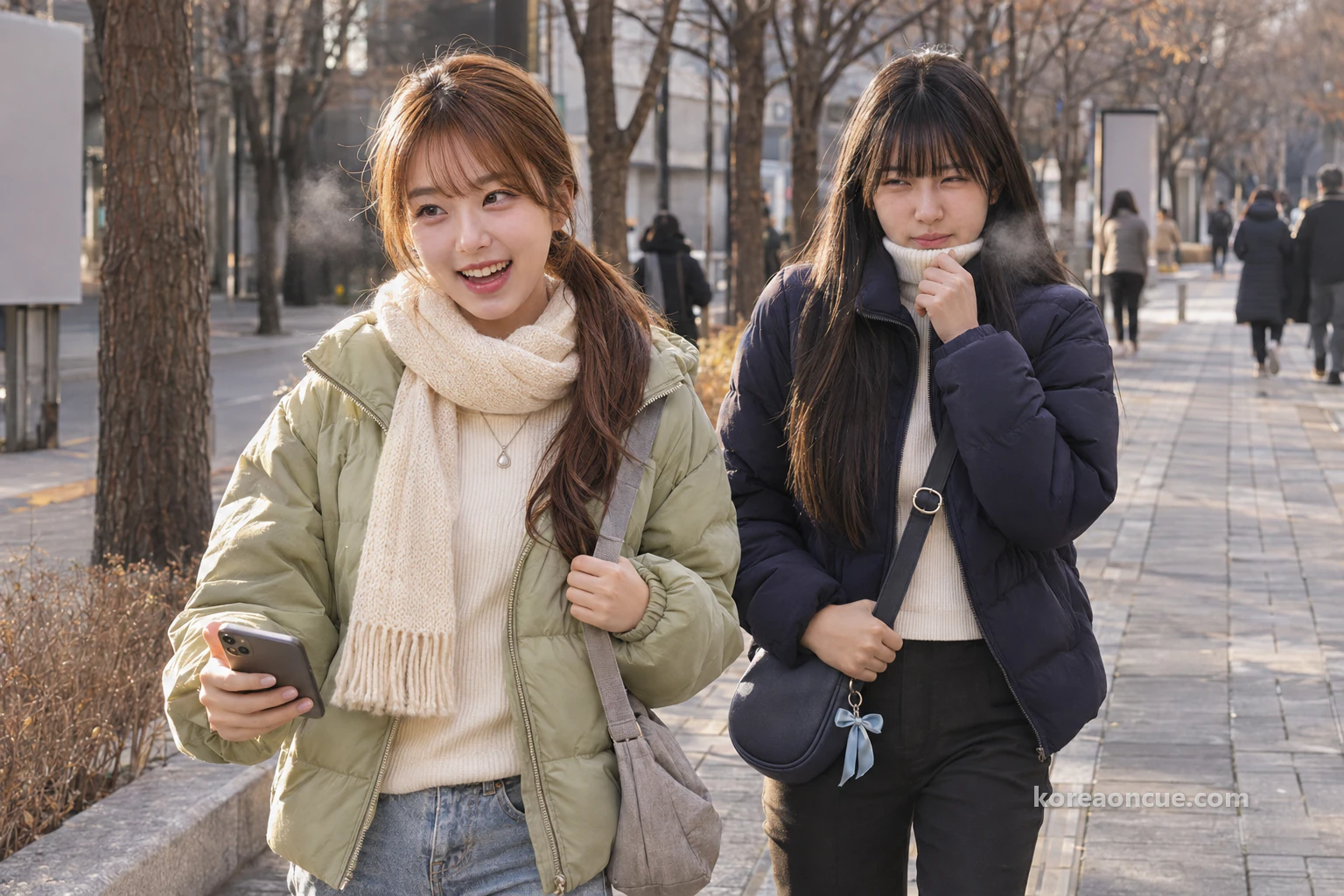
Lulu and Maya were friends before Maya ever came to Seoul, and they never bother with formalities. Lulu, twenty, born and raised in Seoul, is the one who works out the order of the videos she shows her friends, and Maya, twenty-one and from Singapore, always takes a step back and shoots wide, wherever she is. Eighteen days earlier, on a Saturday night, they had finished the Namsan Night Festival’s Autumn Leaf Walk right here in this hanok village. Afterwards Maya sent a message, “Next time we come without the festival, you choose the way up,” and Lulu answered not with a path up the mountain but with a performance in a courtyard at its foot.
This piece starts with the date and time of Cheollyu Seonmu, the ticket price and booking deadline, and the way from Chungmuro Station to the Gugakdang. Then it follows the two of them through their evening in order: the time to spend in Namsangol before the show, and what the three dances, Yeonhwadae, Oyangseon and Heonseondo, are about. That evening they meet someone for the first time in the Gugakdang yard: Elena from Spain, who writes scene directions in her notebook. It is the evening before the show begins, so the story ends at the theatre door.
The Cue — At a glance
Cheollyu Seonmu is a court dance performance on a single evening, Wednesday 25 November, so it is best to book tickets in advance on the Gugakdang website. The auditorium and box office are on B1 of the Gugakdang building inside Namsangol Hanok Village, and the right order is to see the hanok houses before the show and walk the garden after it. The three dances go on stage in the order Yeonhwadae, Oyangseon, Heonseondo, so learn their stories in that order too.
- Where: Crown Haitai Hall, Seoul Namsan Gugakdang, 28 Toegye-ro 34-gil, Jung-gu, Seoul (inside Namsangol Hanok Village). Box office and auditorium on B1.
- Station and exit: Chungmuro Station (Lines 3 and 4) Exit 4, then follow the signs for the hanok village.
- Bring: Your booking details. Bottled water is the only food or drink you can take into the auditorium.
- Enquiries: Seoul Namsan Gugakdang, 02-6358-5500.
Cheollyu Seonmu: when, where and how much — Wednesday 25 November at 7.30 p.m., all seats 30,000 won
Cheollyu Seonmu starts at 7.30 p.m. on Wednesday 25 November 2026. It runs for about 70 minutes and is open to ages 5 and over. It takes place in Crown Haitai Hall at Seoul Namsan Gugakdang, and every seat costs the same 30,000 won. The performance is produced by the Seoul Gyeonggi Dance Research Society and supported by the Seoul Foundation for Arts and Culture. With only one evening on the calendar, the first step is to keep this Wednesday evening free in your Seoul plans.
Open in Kakao Map — Chungmuro Station
Seoul Namsan Gugakdang is a venue for gugak, Korean traditional music, inside Namsangol Hanok Village, and from outside it looks like a traditional hanok. Its auditorium sits underground, beneath a single-storey hanok building. It was built in 2007, and the auditorium has 302 seats. That layout was part of why Lulu chose this performance. Under the same hanok roofs of the village they had walked down through that night, this time she wanted to go all the way below ground.

It was Lulu who found the performance. After Maya’s message she went looking for evening plans around Namsan and spotted Cheollyu Seonmu on 25 November in the Gugakdang’s list of performances. The words “court dance” made her hesitate for a moment. Born and raised in Seoul, she had still never seen court dance in a theatre, and without knowing the stories she did not trust herself to explain it to her friends in order. So from the night she bought two tickets, Lulu began looking up the stories of the three dances and reading them one by one.
Booking and cancelling for Cheollyu Seonmu — on the Gugakdang website, cancel by 5 p.m. the day before
Tickets are booked on the Seoul Namsan Gugakdang website. You sign up as a member, log in, choose the performance, date, time, seats and number of tickets, and pay, and that is it. Online and phone booking close at 5 p.m. the day before the performance, except for some performances, so for this one, take 5 p.m. on Tuesday 24 November as your deadline. Lulu bought two tickets early, one of them for Maya, and after paying she read the cancellation rules to the very last line. If either of their plans suddenly changed, she wanted to know how long they had to get their money back.
| When | Booking | Cancelling |
|---|---|---|
| Until Mon 23 November | Online and phone booking open | No fee |
| Until 17:00 Tue 24 November | Online and phone booking open | Fee of 30% of the ticket price |
| After 17:00 Tue 24 November | Online and phone booking closed (some performances excepted) | No cancellations or seat changes |
| From 18:30 Wed 25 November | Remaining seats only, first come first served, at the box office | — |
The row where Lulu’s finger stopped was 5 p.m. on Tuesday 24 November. Cancellations and seat changes both close at that moment, and after it, getting a ticket means waiting for whatever seats are left at the box office on the day. Those on-the-day sales go ahead without any separate notice, so if you plan to buy on the day, ring Seoul Namsan Gugakdang on 02-6358-5500 first and ask about remaining seats. Groups of ten or more should ring the same number, and for twenty or more the price is 15,000 won per person (organiser’s information).
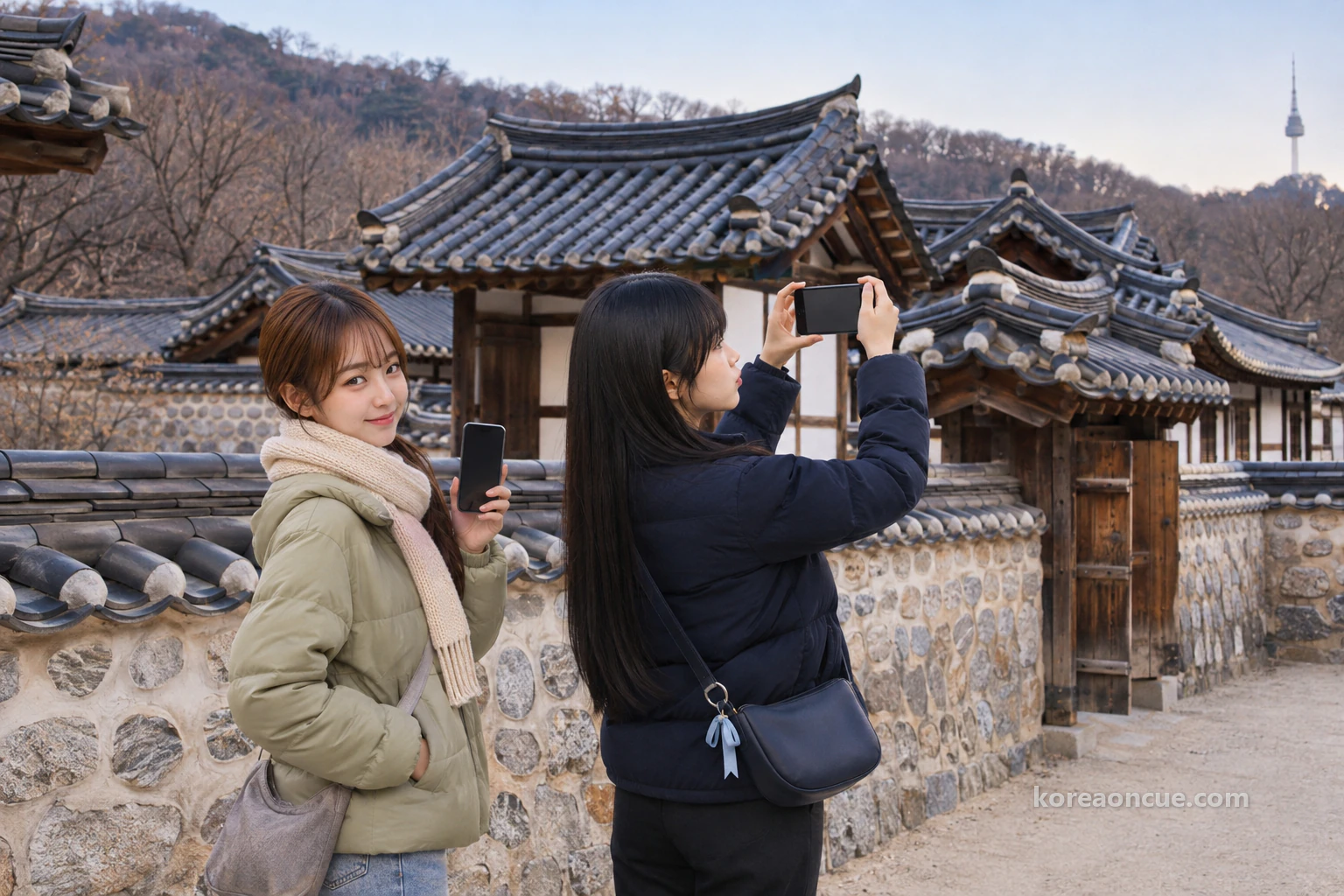
From Chungmuro Station Exit 4 to Seoul Namsan Gugakdang — inside Namsangol Hanok Village, auditorium on B1
To reach the Gugakdang, come out of Exit 4 at Chungmuro Station on Lines 3 and 4. The Gugakdang is inside Namsangol Hanok Village and shares the village’s address, 28 Toegye-ro 34-gil, Jung-gu, Seoul. From the exit, just follow the signs for the hanok village. By bus, get off at the Toegye-ro 3-ga, Hanok Village stop, served by buses 7011, 104, 105, 140 (towards Gangnam), 421, 463, 507 and 604.
This was not their first time on this route. Eighteen days earlier, after the Autumn Leaf Walk, they had walked down from the hanok village to this same Exit 4. Walking it the other way now, Lulu held her phone low and started filming from the pavement. On the Namsan night walk she had only noted the order they walked in and had not filmed a single scene. “I didn’t film anything last time, so today this is the first shot.”
What confuses first-time visitors most is that you cannot see the auditorium from above ground. What you see in the village is a hanok building, while the auditorium, lobby and box office are all below it on B1. Chimsangwon, the stepped garden linked to the lobby, lets sunlight and air reach down even though it is underground. It brings out the feel of Gyotaejeon Hall at Gyeongbokgung and is normally used, together with the lobby, as the place where the audience waits. If you are going to collect tickets, don’t look for a ticket window in the hanok courtyard — go down to B1.
Namsangol Hanok Village before the show — the hanok houses first, the garden after
If you plan to look round Namsangol Hanok Village before the show, the order matters. The village’s traditional houses charge no admission, and they close in the evening. The show starts at 7.30 p.m. and runs for about 70 minutes, so it makes sense to visit the houses before the show. They are closed on Mondays, but 25 November is a Wednesday, so that is nothing to worry about. The traditional garden is open 24 hours a day, so once the show is over you can take your time walking there.
Lulu’s first plan was the exact opposite. Her phone memo read, in order, “box office → dinner → show → hanok houses → garden”. In video terms it was a neat enough structure, with the show in the middle and the rest split either side. At the village entrance Maya peered at the memo and tapped two lines with her finger. “It’ll be night when we come out of the show. Let’s see the houses now and walk the garden afterwards.”
Lulu went quiet for a moment, then dragged “hanok houses” to the top of the memo. That squeezed dinner down to a quick bite before the show, and only the garden stayed at the end. The garden is open at night too, so it was a place they could walk late, like last time. Looking at the rewritten memo, Maya teased her that she had never seen someone who builds videos get the order wrong before. Lulu insisted to the end that nothing was wrong, because she hadn’t filmed it yet.
They wandered slowly along the village lanes as the sun went down, past the courtyards of a few traditional houses. Maya stepped back from each gate a pace at a time, looking for the spot where the whole roof line fitted into one frame, and Lulu filmed Maya’s back from behind. Last time they had agreed to keep their phones away while they walked, so today it was as if they were filming that share too. November days are short, the lanes soon turned blue-grey, and the roof photos piled up one by one on Maya’s phone.
The outdoor yard at Seoul Namsan Gugakdang — meeting Elena while framing a hanok roof
Go through the Gugakdang’s gate and the outdoor yard is right in front of you. Hanok buildings surround a yard of artificial turf that stays green all year, and anyone visiting the hanok village can come in. It measures roughly 15 by 17 metres, about 75 pyeong in the Korean unit for floor area. From November to March the yard is open until 8 p.m., and on performance days that changes with the time the show ends.
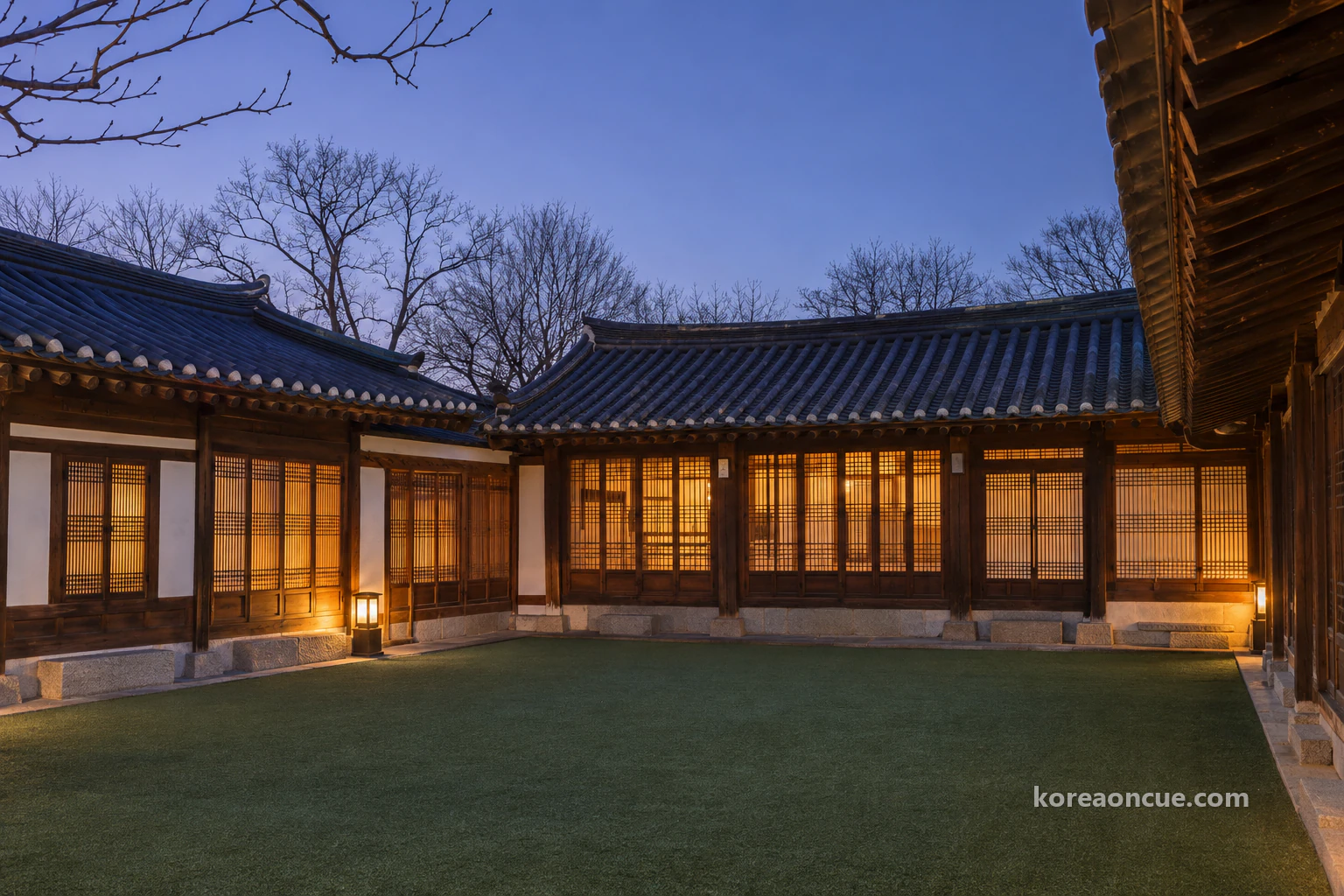
Maya followed the line of the Gugakdang roof backwards, one step, then another. Then a small “Oh.” came from behind her. She turned round to find someone holding a rectangle in front of her eyes, made with the thumbs and index fingers of both hands, standing almost back to back with her. The stranger had been stepping backwards just like Maya, trying to fit the same roof into the same rectangle. Seeing the two of them turn round at the same moment, Lulu could not stop laughing.
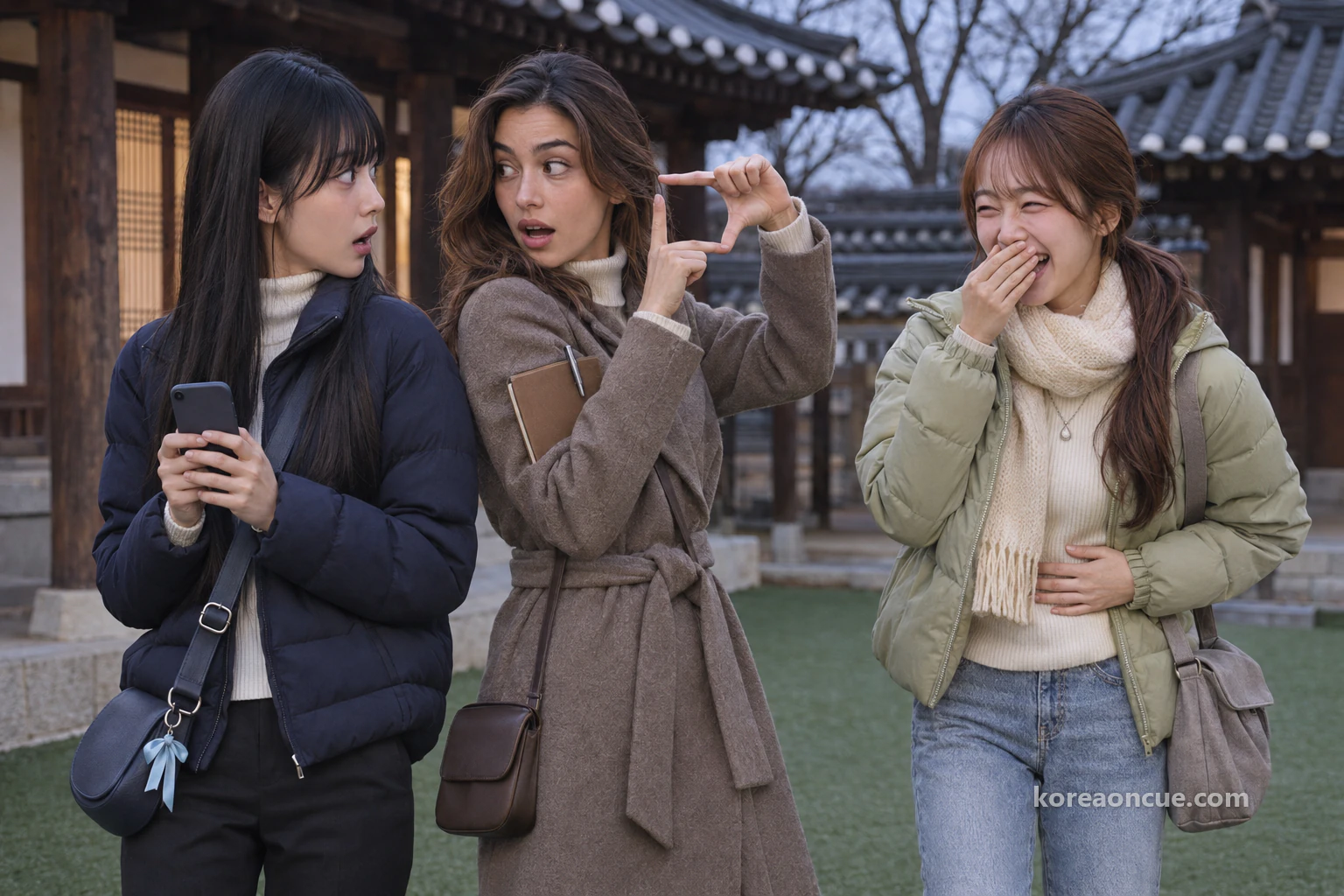
“When you step back, look at your feet first — remember?” Lulu brought out the line she used on Namsan, her voice full of laughter, and Maya ducked her head, red in the face. The stranger lowered her finger frame and apologised first, smiling. “I didn’t look behind me. This is the only spot where the whole roof fits.” When Maya showed her phone screen for a second and said that was exactly why she had ended up there too, the two of them laughed again.
They only learned it later, but her name was Elena. Elena, 27 and from Spain, is someone who holds scenes from Korean dramas up against the real Seoul. She reads places as if they were stages and always carries a notebook in which she writes camera directions inside square brackets. On a Thursday night earlier that month, Elena had spent an evening in one of the hanok houses in this same village. The first line on today’s fresh page read “[Wednesday night — alone, one seat]”, and after a quick laugh the three of them turned and left the yard in different directions.
Where to collect tickets for Cheollyu Seonmu — the B1 box office, from 6.30 p.m.
Booked tickets are collected at the auditorium box office from an hour before the show. For this performance, that means from 6.30 p.m. The box office is on B1 of Seoul Namsan Gugakdang, so have your booking details ready to show. So as not to keep the people behind her waiting while she hunted for the screen, Lulu had found her booking details in advance.
At first Lulu assumed the ticket window would be somewhere beside the hanok gate. When a full lap of the yard turned up no window, Maya opened the information page on her phone and held out the line that said “B1”. They went down to B1, took off their coats and draped them over their arms, and there at the end of the box office queue stood the owner of that finger frame. Elena recognised them first and gave a little wave. This time Maya glanced behind her once before taking her place in the queue.
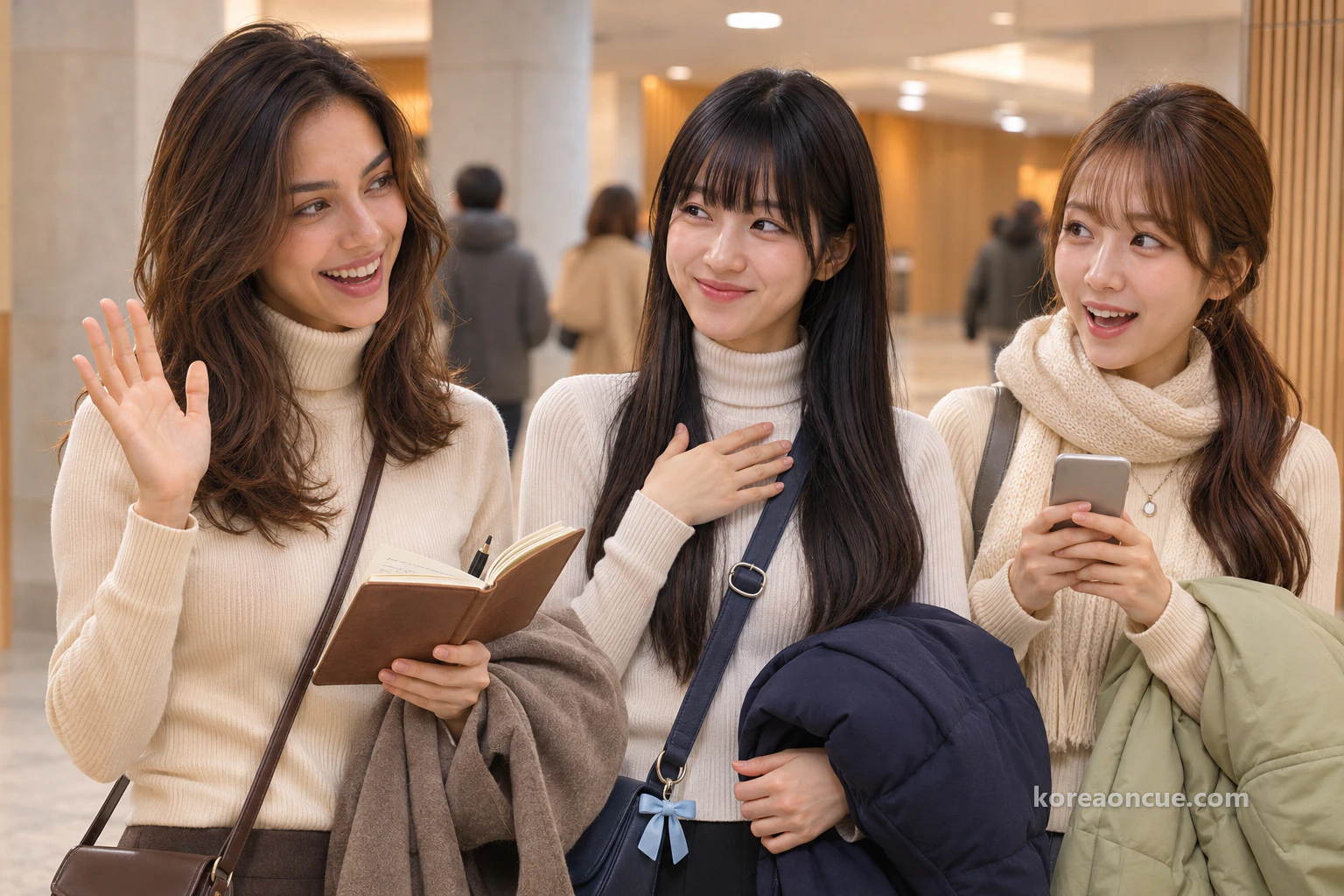
The running order of Cheollyu Seonmu — prologue, Yeonhwadae, Oyangseon, Heonseondo, epilogue
Cheollyu Seonmu opens with a prologue, moves through Yeonhwadae, Oyangseon and Heonseondo, and closes with an epilogue. Each of the three dances has its own section title, so knowing the titles along with the order makes the flow easier to follow. The stories handed down with the three dances are cut to one line each in the table below, so reading them beside the section titles brings each dance straight to mind.
| Order | Section title | Dance | The story handed down |
|---|---|---|---|
| Prologue | The Rite of Heaven (하늘의 예) | — | — |
| First | As Clear Fragrance Opens (청향(淸香)이 트이고) | Yeonhwadae | A girl born from a lotus comes from Bongnae to give joy with song and dance |
| Second | As Cloud and Mist Seep In (운무(雲霧)가 스미고) | Oyangseon | Five immortals bring grain with six ears and pray for good harvests and long, healthy lives |
| Third | The Vow Arrives (서원(誓願)이 닿다) | Heonseondo | The Queen Mother of the West comes down and offers a peach that ripens once in three thousand years |
| Epilogue | The Beauty of the Court (궁중의 미) | — | — |
While they queued, Elena opened her notebook and copied the order down in square brackets. Under “[Prologue — The Rite of Heaven]” came “[1. Yeonhwadae]”, “[2. Oyangseon]” and “[3. Heonseondo]”, one after another. Glancing at the lines over her shoulder, Lulu blurted out, “Oh, isn’t Heonseondo first?” Her memo had the three dances as Heonseondo, Oyangseon, Yeonhwadae. The peach story had been the easiest to remember, so she had looked it up first and then written that reading order down as if it were the running order.
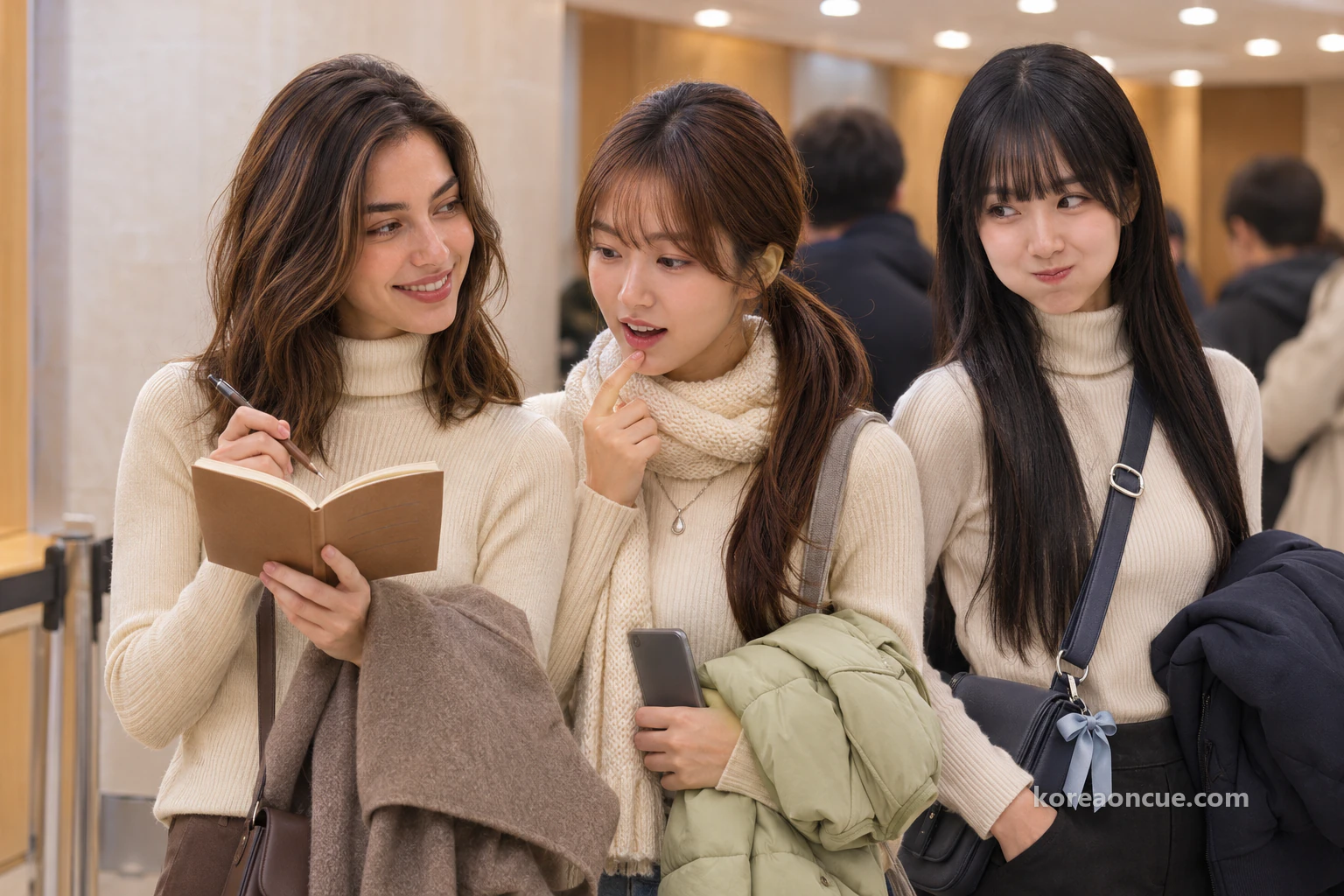
When Elena opened the performance page on her phone and showed it to her, Lulu swapped the first and third lines of her memo there and then. Maya’s shoulders shook as she pointed out that Lulu had got the order wrong twice in one day, and Lulu said it was fine again because she hadn’t filmed anything yet. Listening to the two of them, Elena laughed and added one more line at the bottom of her notebook: “[The stage decides the order]”. If you want to know the running order before you go, remember it by this table, not by the order in which you learned the dance names.
Only after collecting their tickets did the three of them exchange names. “I’m Elena. I’m from Spain.” “I’m Lulu. This is Maya — she’s from Singapore.” Lulu and Maya kept to polite Korean with Elena as they said hello, and Elena told them she had come on her own today. When Maya apologised once more for bumping into her in the yard, Elena waved it away, saying they had simply picked the same spot.
What jeongjae is — “presenting a talent”, and dangak and hyangak jeongjae
Jeongjae (呈才) is the combined art of music, song and dance once performed at the royal courts of Goryeo and Joseon, and at local government offices. The word originally meant presenting a talent or skill, not just dance, but over time it came to be used almost as the name for court dance. Most of the dangak jeongjae staged today has been revived from a record called the Jeongjae Mudo Holgi.
Jeongjae falls broadly into dangak jeongjae and hyangak jeongjae. Dangak jeongjae are court banquet dances that came from Song-dynasty China during Goryeo and were handed down, or were newly created by borrowing that form. Hyangak jeongjae are Korea’s own jeongjae, the term that pairs with dangak jeongjae. Five dangak jeongjae belong to the Song-dynasty grand suites brought in during Goryeo: Heonseondo, Suyeonjang, Oyangseon, Pogurak and Yeonhwadae. All three dances in Cheollyu Seonmu are among these five.
| What sets them apart | Dangak jeongjae | Hyangak jeongjae (generally) |
|---|---|---|
| Opening and close | A jukganja, who leads the whole dance, comes out and calls the opening verse, and ceremonial objects appear | Dancers bow low at the start and the end, rise and step back |
| Accompaniment | Dangak music | Hyangak music, centred on Korean instruments |
| Sung text | Chieo and changsa with lyrics in pure Classical Chinese | Changsa with lyrics in Korean |
Towards the late Joseon period, the line between the two gradually blurred. The first record of dangak jeongjae being performed dates from the second month of the 27th year of King Munjong of Goryeo (1073), when women pupils of the royal music office asked to use Dapsahaeng Gamu at the Lantern Festival and the king gave his permission. When Lulu mentioned the year, Elena’s pen paused, and then she wrote just four digits, large, in the corner of her notebook: “[1073]”. Seeing a kind of dance that appears in a record from nearly a thousand years ago on an underground stage this very evening was not something a person who holds scenes up against reality could let slip by.
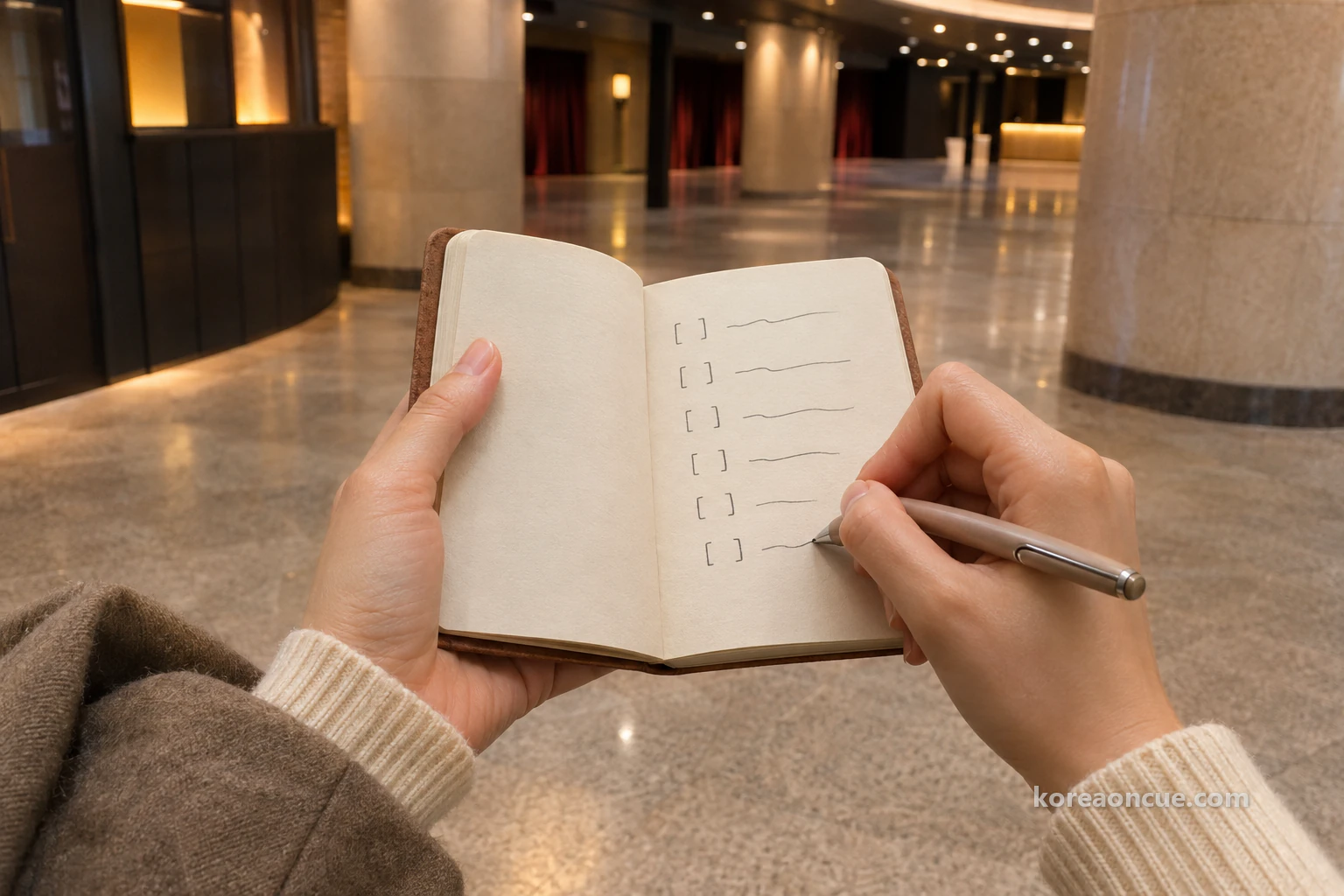
This conversation had started with Elena’s question, over by Chimsangwon next to the lobby. She had wondered, she said, whether this was the kind of dance that always stayed at the back of the screen in palace banquet scenes in historical dramas. Every time she watched one, the dancers flashed by for a moment before the camera cut to the lead’s face, and she had always found that a shame, Elena said with a laugh. Today the background was coming to the centre of the stage, so she had bought a ticket even on her own, and at that Lulu knew it was her turn to bring out everything she had memorised up to last night. Meanwhile Elena had written “[The one who opens — jukganja, opening verse]” in her notebook.
What Yeonhwadae is about — a girl born from a lotus comes from Bongnae
The first dance, Yeonhwadae, is a dangak jeongjae handed down since Goryeo. In it, the dancers sing that a lovely girl born from the stamens of a lotus has come from Bongnae, moved by a king who civilised his country through virtue, to give him joy with song and dance. This girl, the heroine, is called the dongnyeo, and she wears a hat hung with golden bells and dances as if leaping. Old records say the girl hid inside a lotus and rose to dance once the flower burst open. In Korea, instead, the dancers lined up in the palace courtyard first and then began.
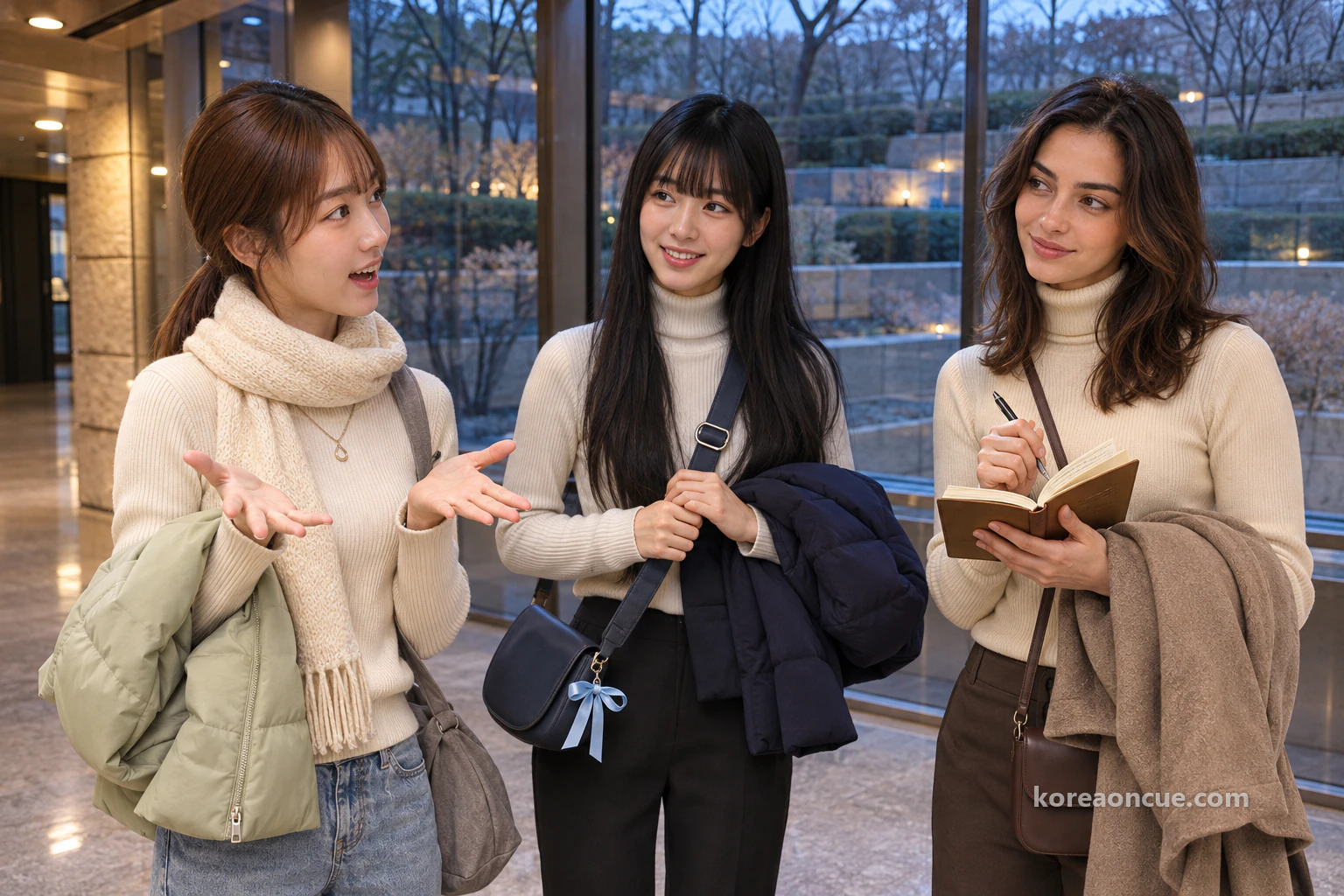
As Lulu told the story, Elena wrote fast. Under “[1. Yeonhwadae — the child from a flower, from Bongnae]” came one more line: “[Hat with bells]”. Elena said she liked that the heroine of the dance opening the banquet was a child. A small person from a flower opening a banquet for grown-ups was, she said, a beginning that catches the audience’s eye at once, like the first shot of a film. Listening, Lulu thought her own video might be better opening on something small rather than something big.
What Oyangseon is about — five immortals bring grain with six ears on one stalk
The second dance, Oyangseon, is a jeongjae based on a Song-dynasty tale that came to Goryeo and was handed down there. It tells of five immortals who come down to the human world and bring yuksugeo, a grain with six ears on a single stalk. The immortals praise the king’s virtue, pray for good harvests and long, healthy lives, and then go back. The name contains the character for sheep (羊), which also makes the dance easy to remember.
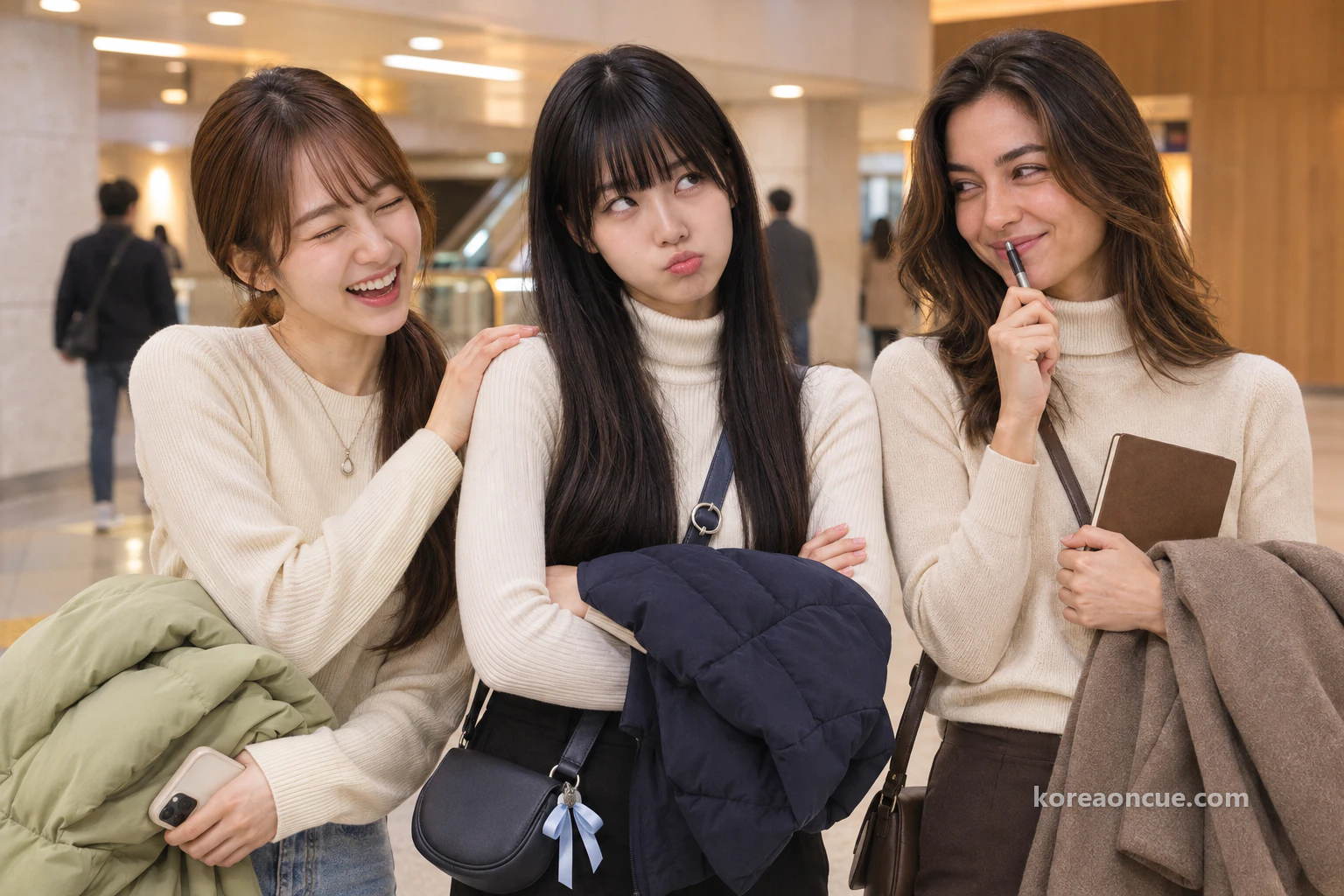
Oyangseon has one thing that sets it apart from other jeongjae. As in the others, a jukganja steps forward and calls the opening verse at the start, but where other jeongjae end once the jukganja withdraws calling the closing verse, in Oyangseon the wangmo, the lead role, steps forward again afterwards and sings. When Lulu said it was like a video with one more scene after the end credits, Elena wrote “[One more after the exit]” in her notebook and underlined it. Watching the two of them laugh at the same moment, Maya said it was a bit unfair being the only photo person there.
What Heonseondo is about — offering a peach that ripens once in three thousand years
The third dance, Heonseondo, means “presenting the immortal peach” and is a dangak jeongjae handed down since Goryeo. It tells of the Queen Mother of the West, the goddess who rules over human lifespans, coming down from the world of the immortals to the palace to offer the guest of honour at a banquet a peach of eternal youth. This peach, the seondo, is an immortal’s peach that ripens once in three thousand years, and it is offered on a silver tray with wishes for long life. Song carries much of the dance, with dancing slipped in between the sung parts, and its most important gesture is the offering of the peach. It was danced at royal birthday celebrations and other court banquets.
Heonseondo was the very first dance Lulu memorised. A peach that ripens once in three thousand years was a phrase she could not forget once she had heard it. When she said the gesture of offering the peach was the heart of the dance, Maya said that in photo terms that moment would be the dance’s key shot. Then she added that today she would take that key shot with her eyes only. Maya had already read before coming that, apart from official filming, no photos or recordings are allowed inside the auditorium.

Why do the immortals come down? — what the visitors in the three dances bring
Having heard all three stories, Elena closed her notebook and asked, “So why do they all come down from the sky?” Lulu had wondered exactly the same thing the night before. Put the three dances side by side and each is the story of a visitor from somewhere beyond where people live, a lotus, Bongnae, the world of the immortals, coming down with something in hand. Yeonhwadae’s girl brings the joy of song and dance, Oyangseon’s immortals bring grain with six ears, and Heonseondo’s Queen Mother of the West brings the peach of long life.
Yeonhwadae’s girl comes because she is moved by a king who civilised his country through virtue, and Heonseondo’s Queen Mother of the West offers her peach to the guest of honour at the banquet. Oyangseon’s immortals bring their grain to the human world, praise the king’s virtue and pray for good harvests and long, healthy lives. Remember that jeongjae were dances for court banquets, and the immortals coming down reads as if they were carrying the wishes of everyone gathered at the banquet. Elena copied the question into the top margin of her notebook and left the space for the answer blank.
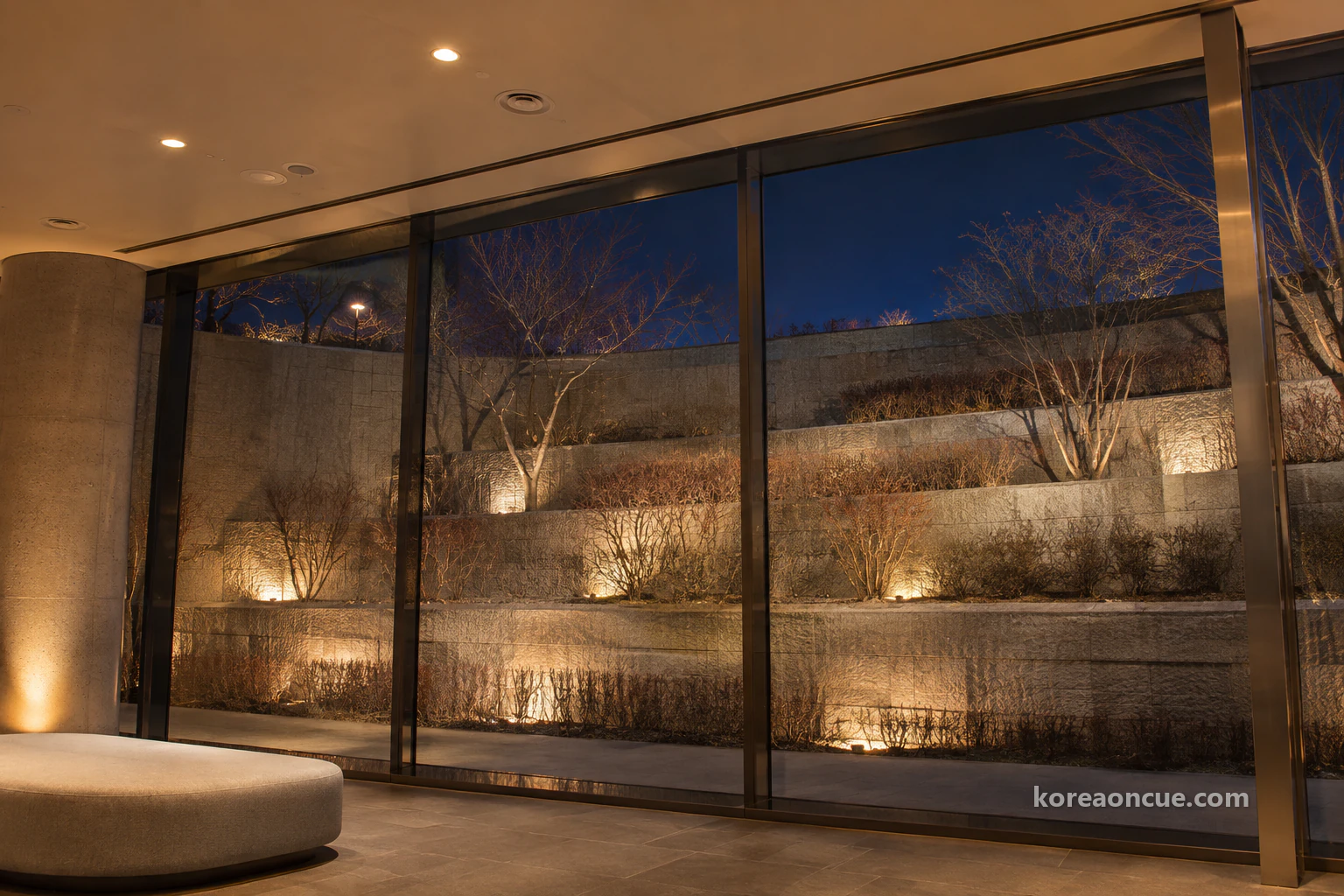
What time to be where on the day — box office at 6.30 p.m., seated by 7.20 p.m., bottled water only
On the day the times sit close together, so Lulu copied just the times onto separate lines at the bottom of her phone memo. Laid out from the box office opening to the start of the show, they look like this. It surprised Lulu a little that the café’s closing time sat right in the middle of the table.
| Time | What |
|---|---|
| 18:30 | B1 box office opens — collect booked tickets, remaining seats sold on the spot |
| 19:00 | Gugakdang café closes (closed on Mondays) |
| 19:10 | 20 minutes before — arrive and collect your tickets by now |
| 19:20 | 10 minutes before — take your seat |
| 19:30 | Show starts, about 70 minutes |
The line Lulu circled in her memo was 7.20 p.m. Entry after the show starts is restricted as a rule, so treat this time as the real start and move accordingly. Bottled water is the only food or drink you can take into the auditorium, so café drinks cannot be brought in either. If you want tea or coffee to warm up, buy it before the café closes at 7 p.m. and finish it before you go through the auditorium door. Lulu finished the tea she had been carrying round the village before joining the box office queue, and Maya left just one bottle of water in her bag.
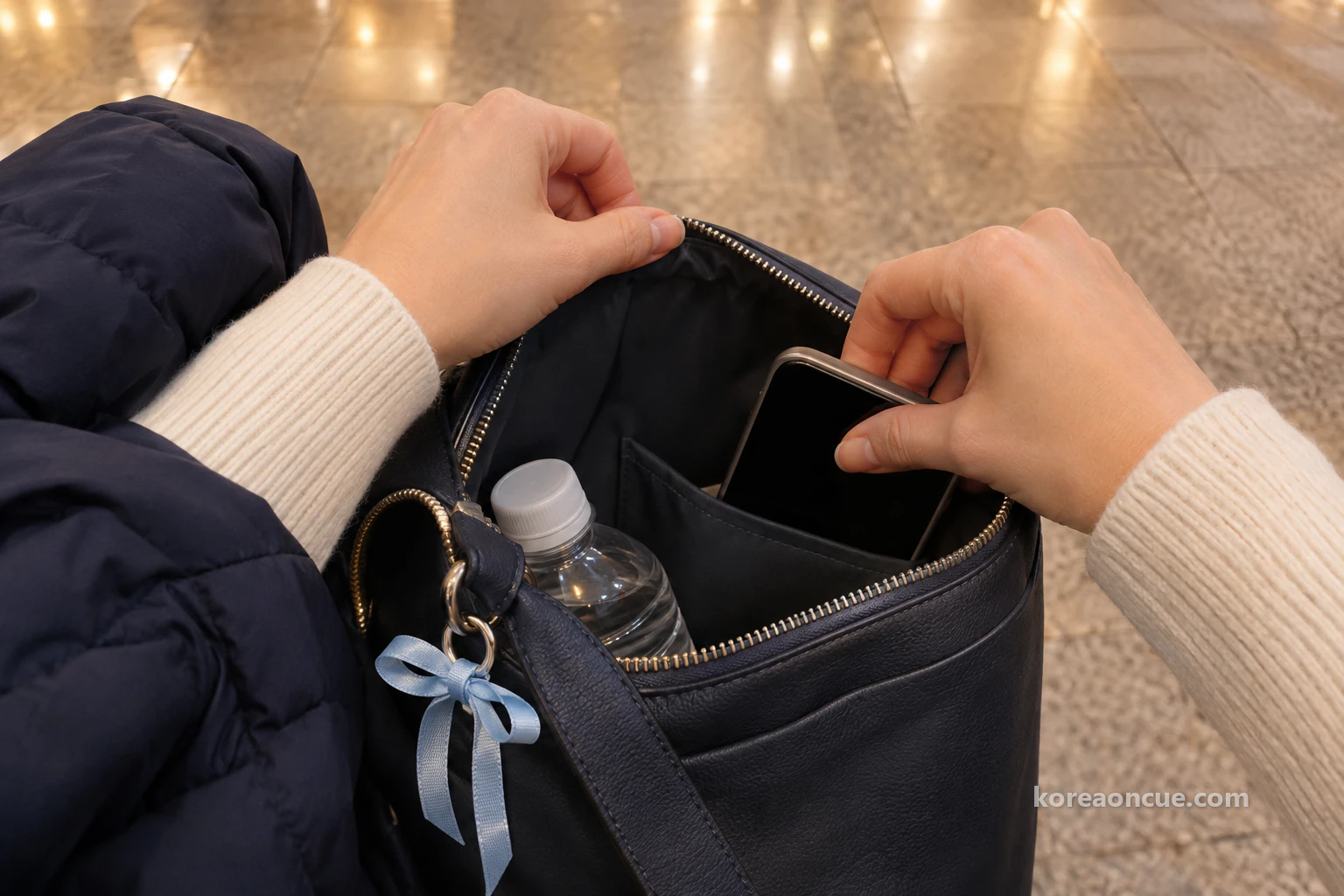
Maya had read the photo rules beforehand and decided that today’s photos would stop at the door. So she took her share in the village lanes and the Gugakdang yard, and after coming down underground she barely took her phone out. Before switching it off, Maya gathered the day’s photos into one set and named it “Below Namsan, evening, up to the door”. It was her third Namsan set, next to “Namsan, night, not one shot” from the night walk and “Namsan, day, two routes” from the cable car day. She planned to climb Bugaksan tomorrow, so when she got back to her lodging tonight she meant to look up that route once more.
Before taking their seats, at the door of Crown Haitai Hall
After 7.10 p.m. the people in the lobby began drifting slowly towards the auditorium doors. Lulu opened her phone memo one last time and silently read the three corrected lines, “Yeonhwadae, Oyangseon, Heonseondo”. The order of the video for her friends was still blank, but she was now sure she would not get the order of tonight’s stage wrong. Lulu switched off her phone and pushed it deep into the pocket of the coat over her arm.
At the door, before putting her notebook away in her bag, Elena wrote one last line. Under the first line, “[Wednesday night — alone, one seat]”, came a new one: “[At the door — before the curtain, three of us]”. When Maya saw it and laughed softly, Elena laughed too and closed the notebook.
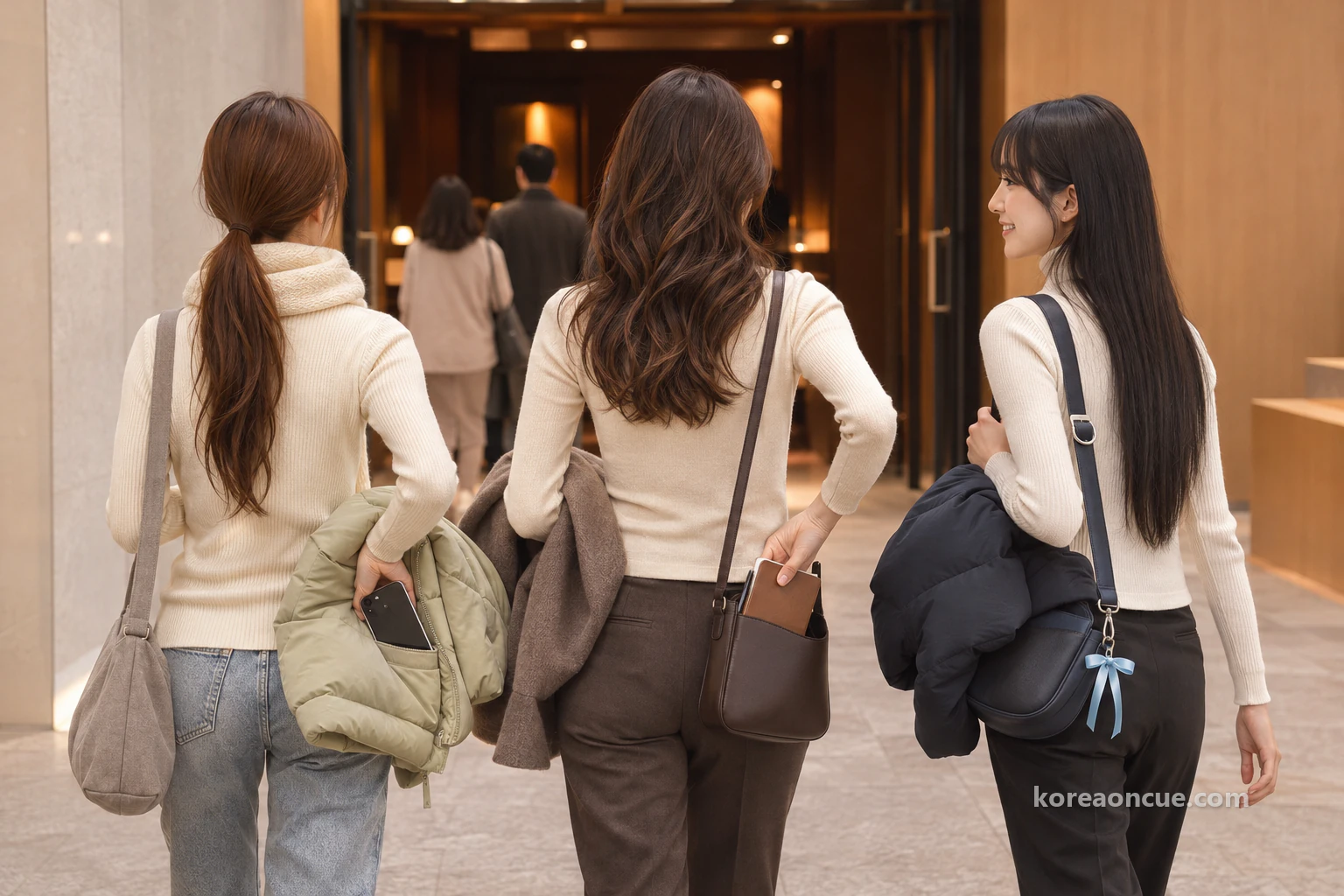
With a few minutes to go before seating time, the three of them stood side by side at the door of Crown Haitai Hall. Maya folded the coat over her arm neatly, Lulu ran through the three lines of her memo once more in her head, and Elena settled the bag with her notebook in it back on her shoulder. On the way here, through the village, the yard and the underground lobby, the stories of the three dances had settled in all three of their heads in the same order. One step at a time, they walked in towards the light beyond the door.
Common Mistakes
Putting the hanok houses after the show
That was Lulu’s first memo. Only after Maya tapped two lines did she move the houses to the top and leave just the garden, open at night, for the end.
Looking for the box office in the hanok yard
Lulu thought the ticket window would be beside the hanok gate and walked a full lap of the yard. Only after Maya found “B1” in the information did she go down the stairs.
Writing down the order you learned as the running order
The peach story was easiest to remember, so Lulu read Heonseondo first and wrote that order down as the running order. Only when she saw Elena’s notebook in the box office queue did she correct it to Yeonhwadae, Oyangseon, Heonseondo.
Stepping back without looking
Trying to frame the same roof, Maya and Elena ended up back to back in the yard. It led to a hello, but in the box office queue Maya glanced behind her once before stepping into line.
FAQ
Are there wheelchair spaces?
Yes, there are wheelchair spaces separate from the 302 seats.
Can I come by car?
The Gugakdang has no car park. If you bring a car, you will need to use a paid car park nearby.
Recap — 30 seconds before you go
- There is only one evening, Wednesday 25 November, so buy tickets early on the Gugakdang website and settle any cancellation or seat change by 5 p.m. on the 24th.
- Come out of Chungmuro Station Exit 4, look round the hanok houses first, and collect your tickets at the B1 box office.
- Be in your seat by 7.20 p.m., and take no food or drink in except bottled water.
Sources
- Seoul Namsan Gugakdang — Cheollyu Seonmu performance page (Korean)Wednesday 25 November 2026, 19:30 · about 70 minutes · Crown Haitai Hall · ages 5 and over · all seats 30,000 won · detailed poster: prologue “The Rite of Heaven”, Yeonhwadae, Oyangseon, Heonseondo, epilogue “The Beauty of the Court” · produced by the Seoul Gyeonggi Dance Research Society, supported by the Seoul Foundation for Arts and Culture · Seoul Namsan Gugakdang performance enquiries 02-6358-5500checked 2026-11-11
- Seoul Namsan Gugakdang — Ticket booking guide (Korean)Visit the website → sign up and log in → choose performance, date, time, seats and number → pay · online and phone booking close at 17:00 the day before (some performances excepted) · on the day, remaining seats only, first come first served at the box office from an hour before · tickets collected from an hour before the start, box office on B1checked 2026-11-11
- Seoul Namsan Gugakdang — FAQ (Korean)Arrive and collect tickets 20 minutes before, be seated 10 minutes before · late entry restricted in principle · no food or drink except bottled water · no photography or recording except official filming · cancel or change seats until 17:00 the day before, free until two days before, 30% the day before · ring to check remaining seats before buying on the day · groups of 10 or more by phone · no car park · outdoor yard open until 20:00 in winter (November–March), closed Mondays, hours change on performance dayschecked 2026-11-11
- Seoul Namsan Gugakdang — About the theatre (Korean)A venue for gugak built in 2007 · auditorium set underground beneath a single-storey hanok building · Chimsangwon, a sunken garden linked to the B1 lobby, a stepped garden with the feel of Gyotaejeon Hall at Gyeongbokgungchecked 2026-11-11
- Namsangol Hanok Village website — Visitor information / Directions (Korean)Chungmuro Station (Lines 3 and 4) Exit 4, following the signs · Toegye-ro 3-ga, Hanok Village bus stop: 7011, 104, 105, 140 (towards Gangnam), 421, 463, 507, 604 · traditional houses free, closed every Monday · traditional garden open 24 hours · 28 Toegye-ro 34-gil, Jung-guchecked 2026-11-11
- National Gugak Center Gugak Dictionary — Dangak jeongjae (Korean)Court banquet dances brought from Song China and handed down, or newly made in their form, set against hyangak jeongjae · the five from the Song grand suites brought in under Goryeo: Heonseondo, Suyeonjang, Oyangseon, Pogurak, Yeonhwadae · the jukganja’s opening verse and ceremonial objects, dangak accompaniment, sung texts in Classical Chinese · first record: Dapsahaeng Gamu at the Lantern Festival in the second month of 1073 (King Munjong 27)checked 2026-11-11
- National Gugak Center Gugak Dictionary — Yeonhwadae (Korean)A dangak jeongjae handed down since Goryeo · a girl born from the stamens of a lotus, moved by a king who civilised his country through virtue, comes from Bongnae to give joy with song and dance · danced leaping, in a hat hung with golden bells · how the lotus entrance in old records differed in Koreachecked 2026-11-11
- National Gugak Center Gugak Dictionary — Oyangseon (Korean)Based on a Song-dynasty tale and handed down after reaching Goryeo · five immortals come down to the human world with yuksugeo, a grain with six ears on one stalk, praise the king’s virtue and pray for good harvests and long, healthy lives · after the jukganja’s closing verse, the Queen Mother steps forward to sing againchecked 2026-11-11
- National Gugak Center Gugak Dictionary — Heonseondo (Korean)“Presenting the immortal peach”, a dangak jeongjae handed down since Goryeo · the Queen Mother of the West comes down from the world of the immortals to offer the guest of honour a peach that ripens once in three thousand years · a silver tray, wishes for long life · song carries much of it, and offering the peach is the key gesture · royal birthday banquets and other court banquetschecked 2026-11-11
A Seoul story told with our AI characters. Place details are checked against public sources; the photos are AI-made illustrative images. How we use AI