
SEOUL · DONGMYO
The weekday column and the weekend column: Ethan walks Dongmyo Flea Market twice, on a Thursday evening and a Saturday morning, and visits Dongmyo Shrine, a national Treasure
Right outside Exit 3 of Dongmyo Station on Lines 1 and 6. Shops and a few stalls on weekdays, all day at weekends, and from November Dongmyo Shrine closes at 17:00
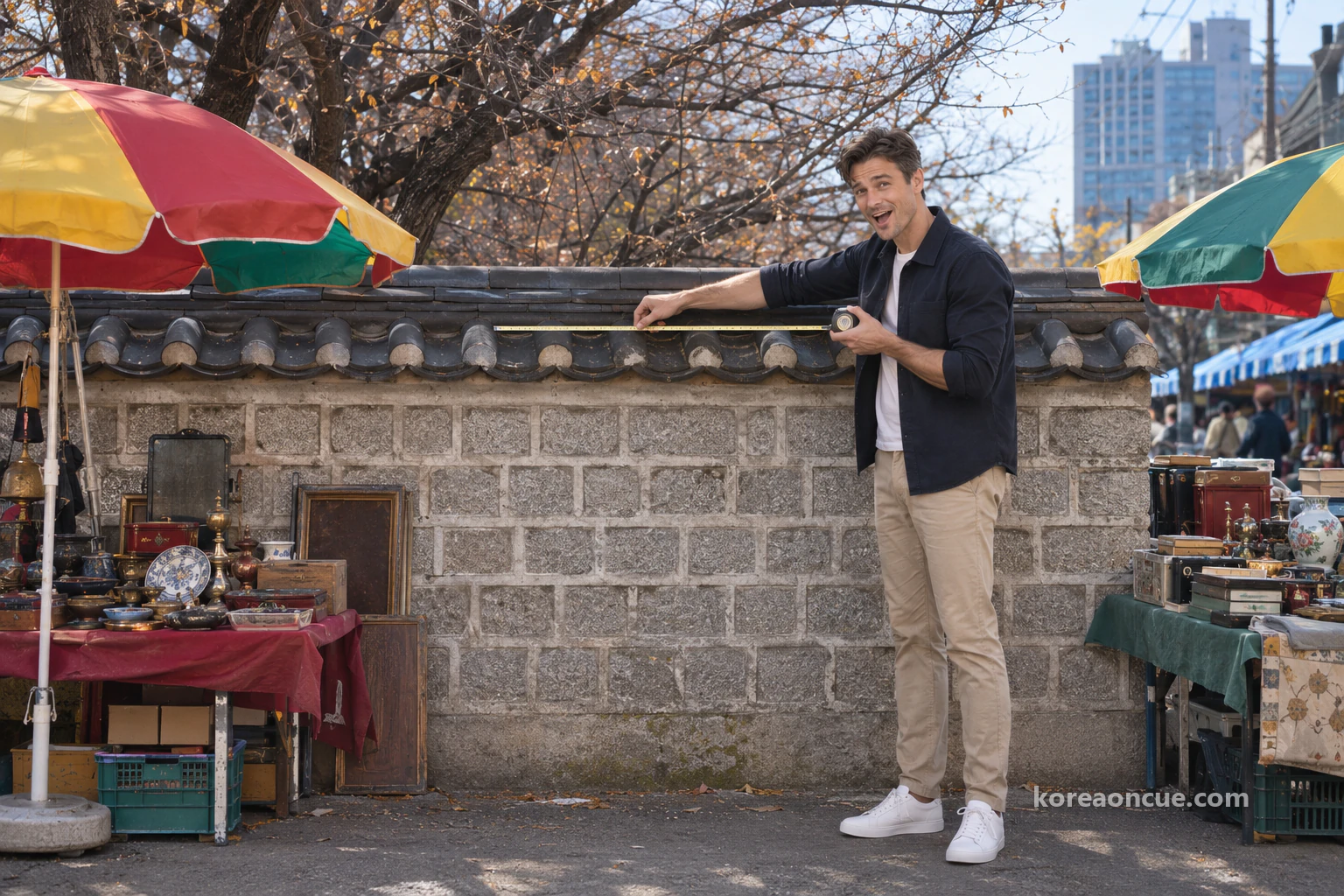
The answer for Dongmyo Flea Market came down to one line: partly open on weekdays, all day at weekends. Learning that this market runs by the day of the week rather than the clock, Ethan decides to measure the same place twice, on a Thursday evening and a Saturday morning.
How to get there
In the last week of November, Ethan is back in Seoul on a short, three-day business trip. When his Thursday afternoon meeting finishes earlier than planned, he closes his laptop and opens his notebook before anything else. Ethan, a 44-year-old engineer who designs machines in Seattle, counts everything by switching it into another unit. Even the schedules he hears in meetings change in his notebook, hours into minutes and distances into steps. That day, at the top of a fresh page, he has written two short lines.

The first line is “Dongmyo — weekday column”, and the second is “Dongmyo — weekend column”. Ethan lived in Seoul for six years, but he has only ever heard of Dongmyo as “the market you go to at weekends”. This trip, though, starts on a Thursday and ends on a Saturday. When he looks up whether the market is on during the week, the answer is short. It is partly open on weekdays and runs all day at weekends, and opening hours and days off vary from shop to shop.
So this is not a market that runs by a single clock. Every shop keeps its own. That means the first question is not “What time should I go?” but “Which day should I go?” Ethan decides to measure the same place twice, once on Thursday evening and once on Saturday morning. Measuring the same thing twice and changing only the conditions is how a difference shows up, and it was the first habit Ethan learned in his design work.
The Cue — At a glance
Dongmyo Flea Market is partly open on weekdays, when shops and a few stalls trade, and runs all day at weekends, Sundays included. Opening hours and days off vary by shop. The market starts right outside Exit 3 of Dongmyo Station on Lines 1 and 6 and runs along the stone wall around Dongmyo Shrine (Donggwanwangmyo), a national Treasure, continuing in front of shopping arcades, beside the pavements and into the alleys. From November to February, Dongmyo Shrine closes at 17:00 (18:00 from March to October), so if you want to see the market and the shrine together in November, visit the shrine first.
- Station and exit: Dongmyo Station (Lines 1 and 6) Exit 3 — the market is right outside, and Dongmyo Shrine is inside the market.
- When the market is on: Weekdays, shops and a few stalls (partly open) · Saturdays and Sundays, all day. Opening hours and days off vary by shop.
- Dongmyo Shrine opening hours: November–February 09:00–17:00 · March–October 09:00–18:00 · open every day of the year · free · enquiries 02-2148-2034.
- Address: Dongmyo Shrine, 84 Nangye-ro 27-gil (Sungin-dong), Jongno-gu, Seoul · the market fills the surrounding area of Sungin-dong.
- Parking: There is no parking at the market or the shrine. The subway is easier.
- Worth seeing: The main hall, two buildings joined front to back, and its brick walls · the Geumjabinbi and Hamabi steles either side of the middle gate · a clothes shop that sells by weight on a scale.
When is Dongmyo Flea Market on? Shops and a few stalls on weekdays, all day at weekends
Dongmyo Flea Market changes size with the day of the week. On weekdays, shops and a few stalls open, so the market is only partly up and running. At weekends, the shops are joined by stalls in full swing, and the market runs all day. That is also why more people come at weekends than on weekdays. Sunday is part of the weekend, so on a Sunday you can see the market running all day.
Open in Kakao Map — Dongmyo Station
Opening hours and days off vary by shop. This is not a place where the whole market opens and closes at one time, but one where each shop keeps its own hours. At first, Ethan tries to turn this into a percentage. Of the seven days in a week, the market runs all day on two, so two-sevenths, he reckons. But once he realises that one number cannot describe a market where every shop has a different clock, he rubs out the fraction.
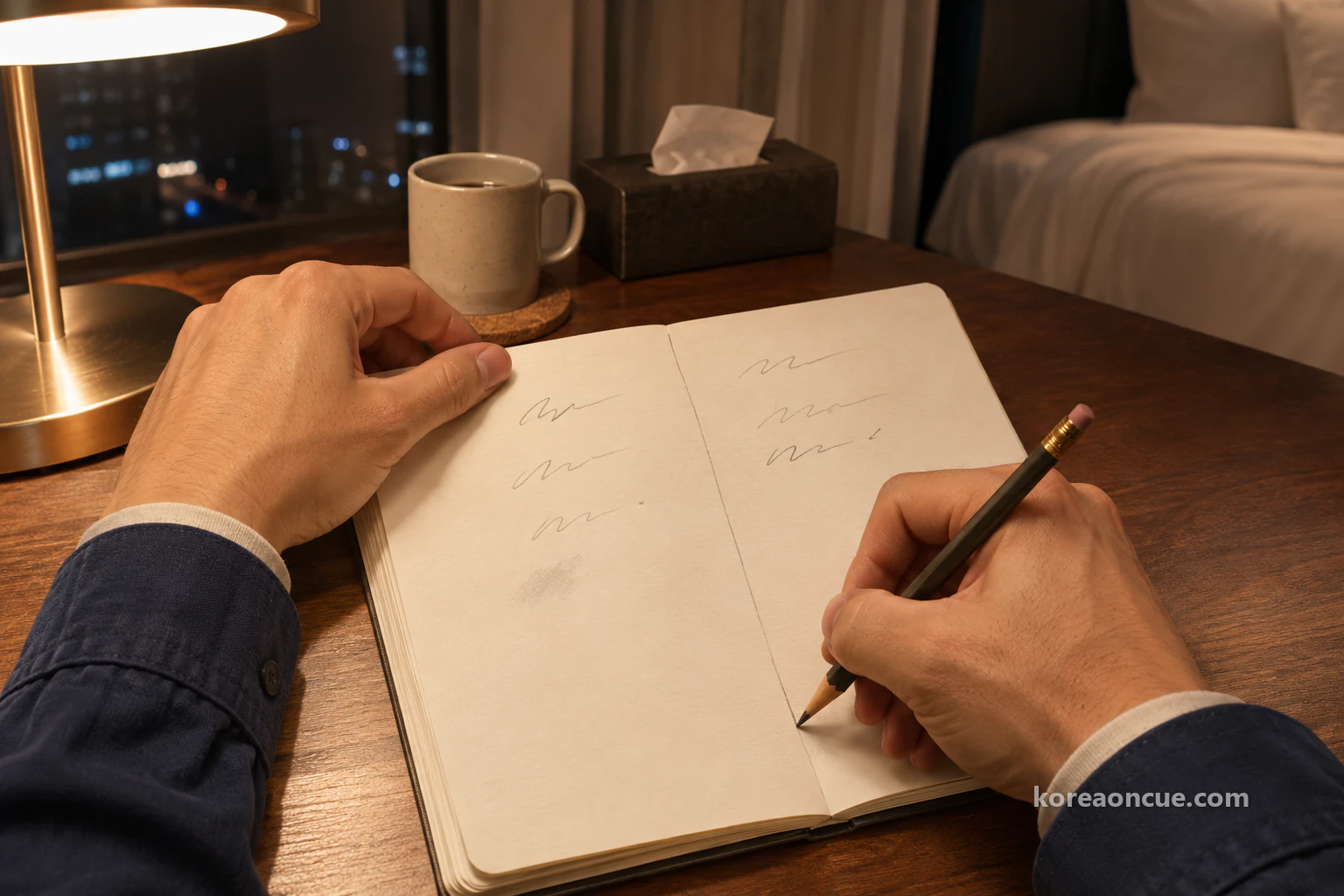
Instead, Ethan splits his notebook with a single vertical line. The left side is the weekday column, and the right side is the weekend column. In each column he will note what was open, how many people were about and what the walking was like, always in the same order. Only by writing the same items in the same order can he set the two side by side later. When you choose a day to go, it helps to picture these two columns too.
Coming out of Exit 3 of Dongmyo Station — the market starts right outside
Dongmyo Flea Market starts right in front of you when you come out of Exit 3 of Dongmyo Station on Lines 1 and 6. The exit and the market meet, so as soon as you step out, shops and stalls come into view. Dongmyo Shrine is inside the market. The market lies between Jongno-gu and Dongdaemun-gu, around Sungin-dong in Jongno-gu. If it is your first visit, don’t worry about the other exits. Exit 3 is the only one you need to remember.
On Thursday evening, when Ethan comes out of Exit 3, the sun has only just gone down. The shops have their lights on, and here and there between them a few stalls have laid out their goods. Stretches of goods alternate with empty spots, and to Ethan it looks like a comb with missing teeth. Even so, people keep arriving to pick through things. The first line in the weekday column reads “Shop lights on, only a few stalls”.
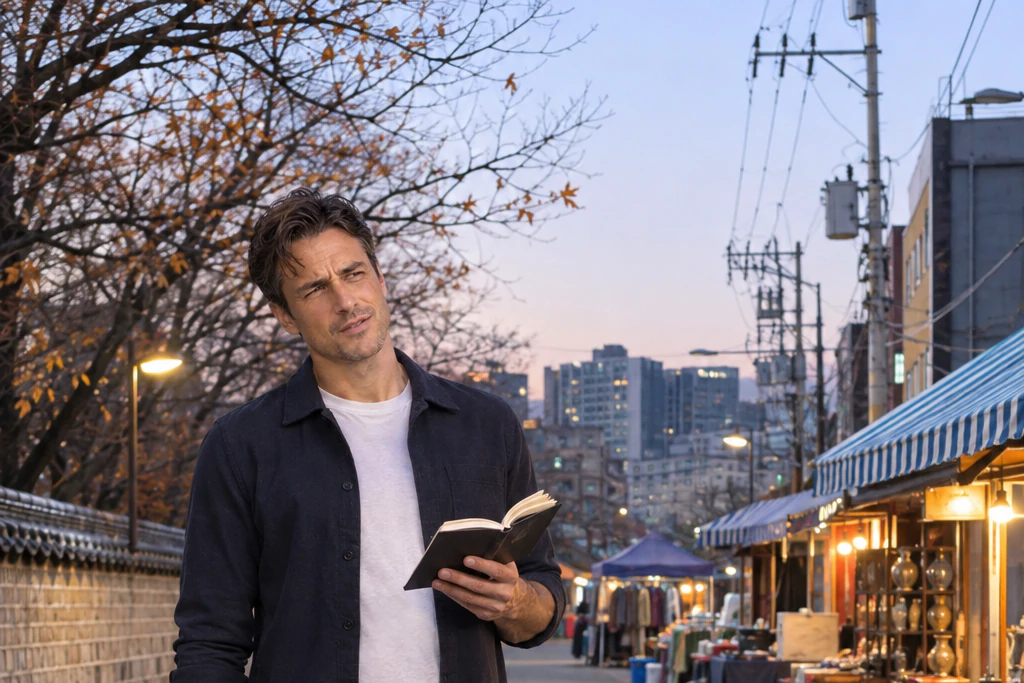
It is best to leave the car behind when you go to the market. There is no parking at Dongmyo Flea Market or at Dongmyo Shrine. With the exit and the market meeting, the subway is also the simplest way in. Ethan, too, came straight by subway from where his meeting finished. If you plan to carry bags of secondhand finds, having both hands free makes things much easier, which is something else he learns that first evening.
After 5 p.m. on a weekday — in November, Dongmyo Shrine closes at 17:00
To see Dongmyo Shrine as well in November, aim to arrive well before 5 p.m. The shrine is open 09:00–18:00 from March to October and 09:00–17:00 from November to February. November falls in the winter hours, so it closes an hour earlier. Ethan only finds this out at the gate. That morning, looking up the opening hours, he read only the summer line at the top and wrote “18:00” in his notebook.
By the time he has walked halfway round the market and reaches the shrine gate, it is a little after five. The gate is already shut. Ethan checks the opening hours on his phone again, and only then sees the lower line, “Winter 09:00–17:00”. He presses his palm to his forehead and laughs out loud. An engineer who read a number off the wrong line — he decides never to tell his colleagues.
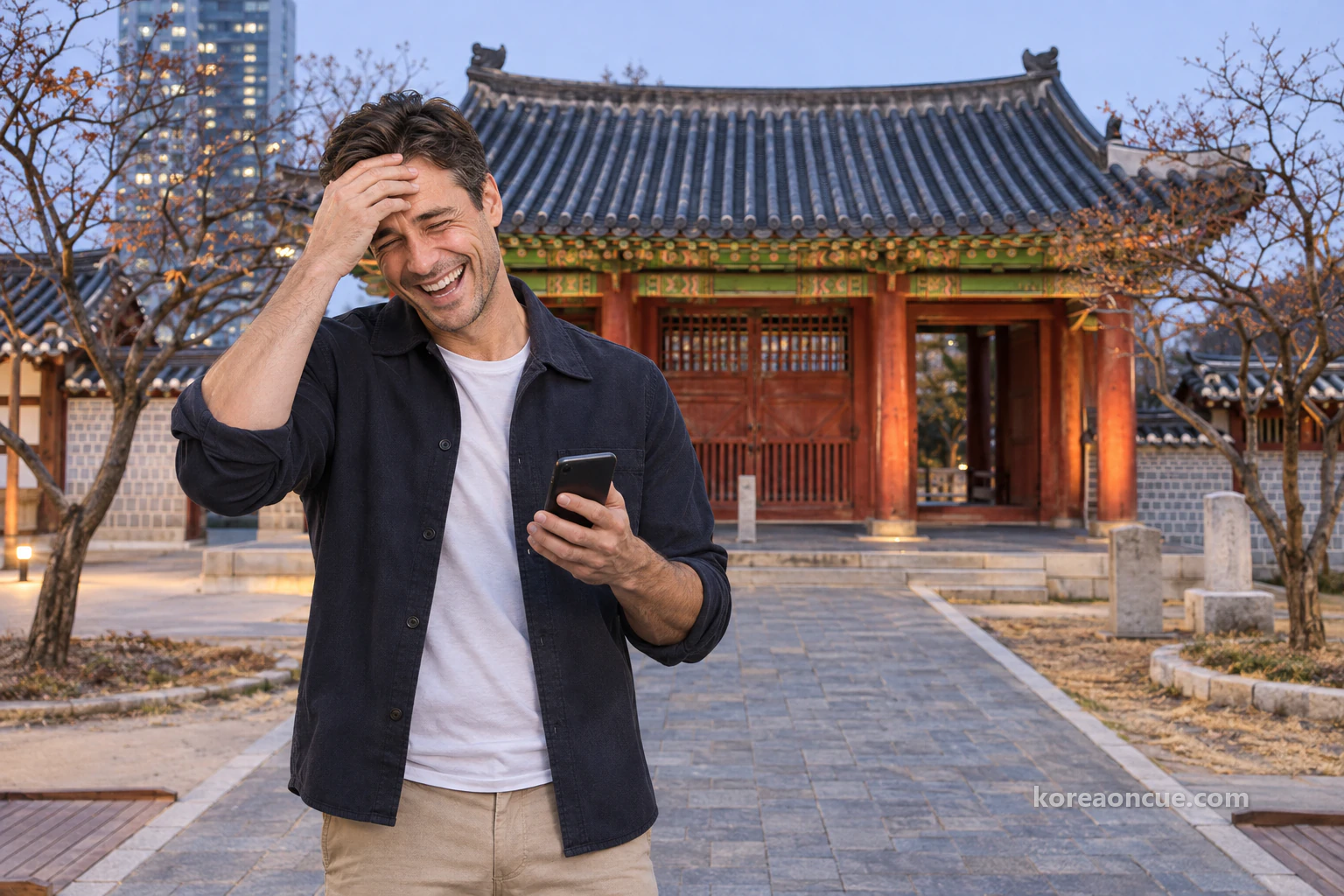
When the laughter settles, Ethan does what he always does and counts the numbers again in another unit. In summer, 9:00 to 18:00 is 540 minutes, and in winter, 9:00 to 17:00 is 480 minutes. When the season changes, 60 minutes drop out of the shrine’s day. Ethan strikes through “18:00” in his notebook and writes beside it “Nov–Feb 17:00, −60 min”. If you plan to browse the market first and see the shrine afterwards in November, switch the order and go to the shrine first, and you can relax.
The disappointment doesn’t last. Dongmyo Shrine is open every day of the year, so there is no closing day to plan around, only a day to come back. Ethan decides to return at 9 a.m. on Saturday, the time the shrine opens. If he sees the shrine first at the weekend, when the market runs all day, and then heads out into the market, he can fill in the weekend column on the same day.
What is open on weekdays — shops, a few stalls and a clothes shop that sells by weight
Even on a weekday, there is plenty to look at in Dongmyo Flea Market, because the shops are open. The range of goods is huge, from clothes, shoes and wallets to watches and electronics, old books and film posters. All Thursday evening, Ethan walks mostly past the shops rather than the stalls. The second line in his weekday column gets a note: “The shops are the market’s frame”.
Then one shop stops Ethan in his tracks. Among Dongmyo’s clothes shops, some don’t count garments one by one but set the price by weighing them on a scale. For someone who counts by switching units, no shop could be more welcome. Ethan picks up two hanging shirts, one in each hand, and reckons the one in his left hand is about 50 grams heavier. The difference between a thick cotton shirt and a thin one turns into a number in his palms.

While he is at it, Ethan works out the weight of the navy overshirt he is wearing, too. It is about the same as the thick shirt he just held, so he jots a figure in the corner of his notebook, then simply circles it and hangs the shirts back up. Today is for measuring, not buying. A shop that sells by weight is especially fun if you are choosing several pieces at once. Instead of asking the price of each one, you put what you have chosen on the scale, so the weight in your hands as you browse becomes the bill.
Walking through the market on a weekday evening is relaxed. With fewer people than at weekends, lingering in front of a shop doesn’t block the way. On the other hand, there are only a few stalls, so there is less fun in rummaging through secondhand things laid out by the road. If you want to browse the shops slowly, go on a weekday, and if you want more stalls, go at the weekend. At the bottom of the weekday column, Ethan writes two short phrases, “Relaxed · few stalls”, and closes Thursday evening.
Which alleys to walk? Shops and stalls run along the stone wall of Dongmyo Shrine
Dongmyo Flea Market spreads out around Dongmyo Shrine at its centre. With Dongmyo in the middle, shops and stalls selling things to wear, things to use and things to eat are packed in front of shopping arcades, beside roads and pavements and along the alleys. The shrine is enclosed by a wall built of earth and stone, and the market runs along that wall. So rather than memorising street names one by one, take the shrine’s stone wall as your reference and you will get lost much less.
On Thursday evening, Ethan draws a plan of the market as he walks. He marks Exit 3 as the origin and draws the shrine’s stone wall as a thick reference line. The shops and stalls he draws as branches reaching out from that line. Each time the road forks, Ethan first checks which side the wall is on. As long as he knows whether the wall is on his left or his right, he can tell at once where on the plan he is standing.
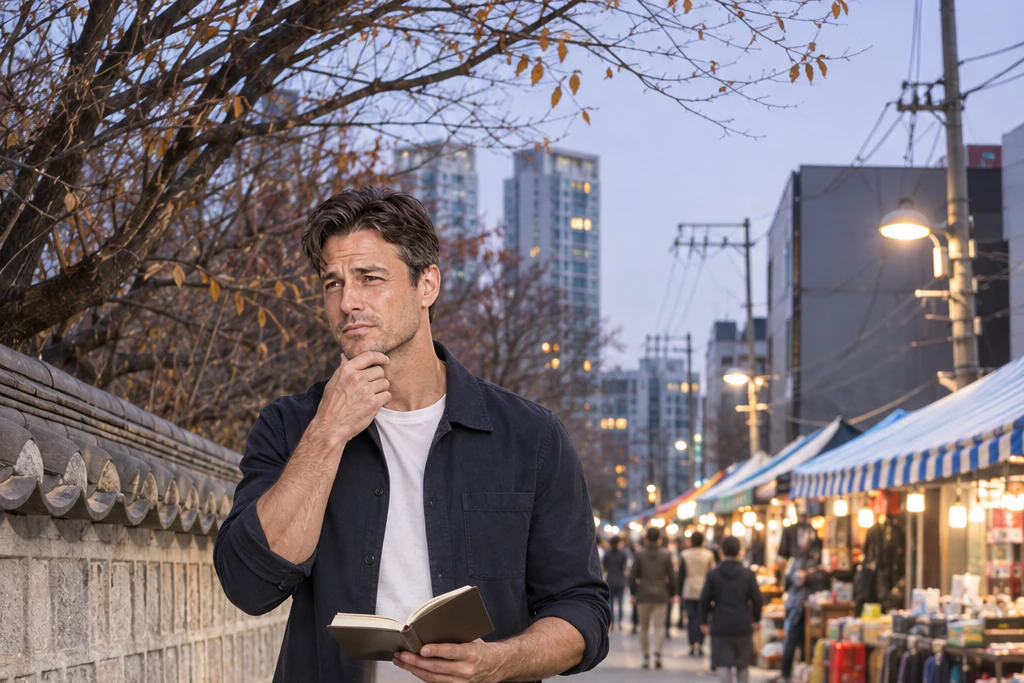
Along the roadside, the range of goods is so wide that there seems to be nothing you can’t find. There are leather and fur jackets, used appliances, ceramics and wristwatches, kitchen dishes, CD players and bicycles. Suitcases and tools, trainers, hiking gear, toys, vinyl records, laptops and old books are laid out too. Ethan doesn’t write down every item, and marks just three branches at the ends of his plan: “Clothes”, “Things that make sound” and “Tools”. That is Ethan’s rule: a plan has to be short to be readable on the move.
If you feel lost, come back to the stone wall. How far the stalls spread out differs from day to day, but the shrine wall is always in the same place. Ethan thinks that fact is the most reliable number in this market. As long as one reference line is accurate, the plan holds up even if the other lines wobble a little. On the subway back to his hotel on Thursday night, Ethan writes at the very bottom of his plan: “Reference line = stone wall”.
Saturday at 9 a.m., Dongmyo Shrine first — the place with a fixed closing time goes first
At 9 a.m. on Saturday, timed to the shrine’s opening, Ethan comes out of Exit 3 again. The shrine’s official name is Donggwanwangmyo Shrine, Seoul, and it was designated a Treasure on 21 January 1963. The address is 84 Nangye-ro 27-gil, Jongno-gu, Seoul. It is state-owned heritage, and Jongno-gu looks after it. Ethan counts from the year of designation to this year and writes 63 years.

Through the gate, the air is different from outside. The market sounds he heard beyond the wall on Thursday evening fade once he has crossed that one wall. Unlike the noise outside, it is quiet within, and stone steps worn round with age and a courtyard made for resting greet Ethan. Because it is Saturday morning, he can already hear stalls laying out their goods beyond the wall. How different the inside and outside of the same wall can be is the first line Ethan writes in his weekend column.
Ethan has a reason for choosing the shrine first besides Thursday’s mistake. The market runs all day, but in November the shrine closes at 17:00. Putting the place with a fixed end time at the front is an order Ethan has followed ever since he started planning business trips. If you go on a Saturday or Sunday, try the same order: the shrine in the morning, then out into the market. That way, however long you stay in the market, you won’t miss the shrine’s hours.
Inside the shrine, Ethan finds that his two-column notebook doesn’t fit. Dongmyo Shrine is open every day of the year, so it opens and closes at the same times on weekdays and weekends alike. What divides the shrine is not the day of the week but the season. March to October is one column, and November to February is another. For the shrine alone, Ethan draws a small separate table, “Summer column · winter column”, and circles the winter column for today.
What to see inside Dongmyo Shrine — Guan Yu’s shrine, two buildings joined front to back and brick walls
Dongmyo Shrine is a shrine where rites are held for Guan Yu, a general of Shu Han in China. It stands outside Heunginjimun in Seoul, and the name Dongmyo means the Gwanwangmyo, the shrine to Guan Yu, in the east (dong) of Seoul. Here, myo (廟) means not a tomb but a shrine. Ethan admits honestly in his notebook that until now he had taken Dongmyo for the name of an old tomb. Dongmyo Station takes its name from standing in front of this shrine, and this neighbourhood was once Dongmyo-dong, named after it.
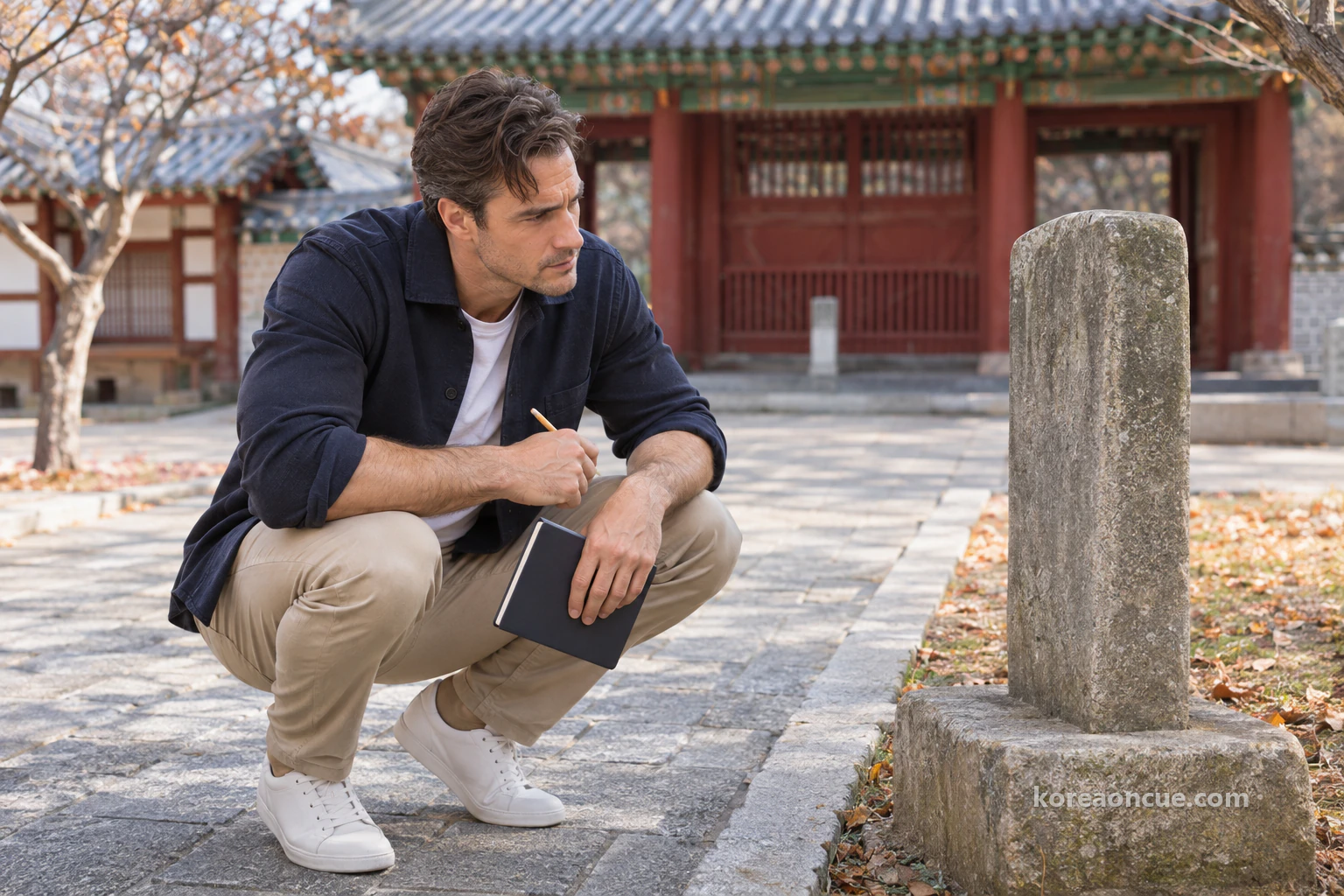
Dongmyo Shrine is made up of five buildings. They are the outer gate, Oesammun, which is the main gate, the inner gate, Naesammun, which is the middle gate, the main hall, Jeongjeon, which houses the statue of Guan Yu, and the west and east wings, Seomu and Dongmu. Through the main gate, there is an altar to the east, a building where the people preparing the rites stayed to the west, and the middle gate opposite, to the north. Either side of the middle gate stand two steles. One is the Geumjabinbi, which bars entry except for rites or worship, and the other is the Hamabi, which tells everyone, whatever their rank, to get down from their horse.
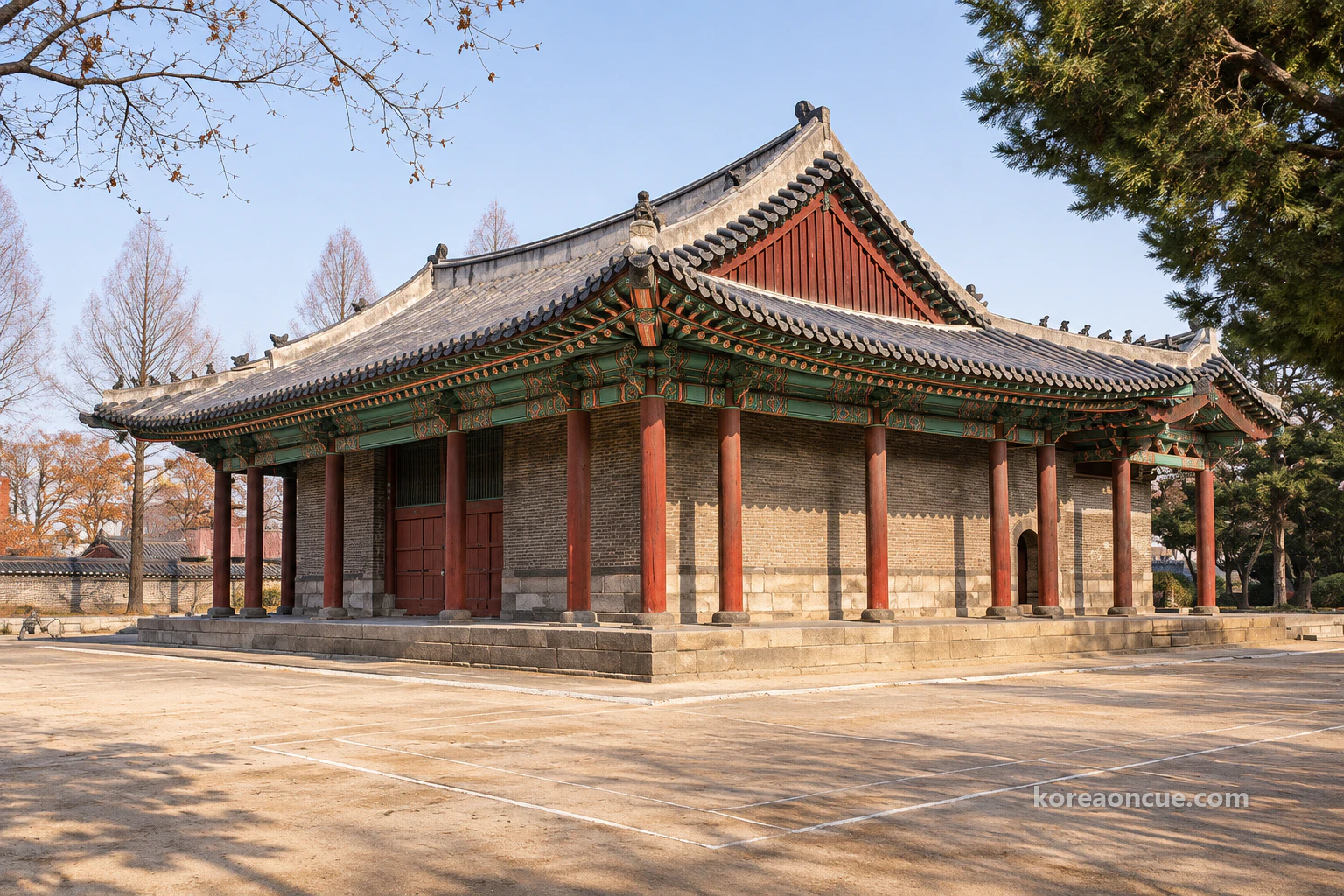
Past the middle gate is the main hall. It is a single-storey building in the Chinese style, rarely seen in Korea. It is five bays across the front and six bays along the side, and its roof has an unusual T-shaped form. Its plan is a long rectangle from front to back, and the side and rear walls are built of brick. These features show Chinese influence, and they look quite different from other old buildings in Korea.
What Ethan looks at longest is the roof. The central building is two buildings joined front to back, a structure often seen in Chinese temples and shrines. The front is the front hall for rites, and the back is the main room that holds the statues of Guan Yu and his generals. The brackets that bear the weight of the roof are in the ikgong style, reaching out like a bird’s beak. Ethan multiplies 5 bays by 6 and writes 30 bays, then sketches the line where the roofs of the front and back buildings meet, as if it were a cross-section.
Inside the main hall remain plaques written by a Ming envoy and by Kings Sukjong, Yeongjo and Gojong. The relics handed down at Dongmyo Shrine are also protected as a group, designated by the Seoul Metropolitan Government. In front of the buildings, Ethan lowers his voice, and he takes his photos from the edge of the courtyard, a step back. Rites are still held at this shrine. In front of the Hamabi, he bends his knees to bring his eyes level with the stele and studies it for a long time.
When was Dongmyo built? Work began in 1599 and finished in 1601
Dongmyo Shrine was built after the Imjin War. It went up because Joseon and Ming China believed they owed their victory over the Japanese army to the virtue of General Guan Yu. The Ming emperor himself wrote a plaque and sent it, and construction went ahead. Work began in 1599, the 32nd year of King Seonjo’s reign, and was completed two years later, in 1601. Ethan writes that two years is about 730 days, then adds the thought that there must have been two winters in between.
Next, Ethan sets two numbers side by side in his notebook. From 1601, when the shrine was completed, to this year is 425 years. Dongmyo Flea Market took shape in the late 1980s, so the market is a little under 40 years old. The shrine inside the wall is more than ten times older than the market outside it. Ethan likes that ratio, so he writes “425” inside the stone-wall reference line and “nearly 40” outside it.
The neighbourhood’s name holds one more number. The present name, Sungin-dong, came about in 1914, when neighbourhood names were set. It takes the “Sung” from Sungsin-bang and the “In” from Inchang-bang, wards of Hanseong-bu that had existed since early Joseon. At the same time, Dongmyo-dong, named after the shrine, was merged into Sungin-dong. Ethan writes that 1914 to this year is 112 years, and is amused that the shrine’s name has vanished from the neighbourhood’s name but lives on in the station’s.
The market at the weekend — all day, and haggling instead of price tags
Leaving the shrine and stepping outside the wall, Ethan finds the weekend market spread out before him. At weekends, on top of the shops, stalls are laid out all along the road, and the empty spots of Thursday evening are almost all filled. To Ethan, it looks as if the comb with missing teeth has grown a full set. There are far more people than on a weekday, too, and his pace slows by itself. The second line in the weekend column reads “No empty spots, half walking speed”.
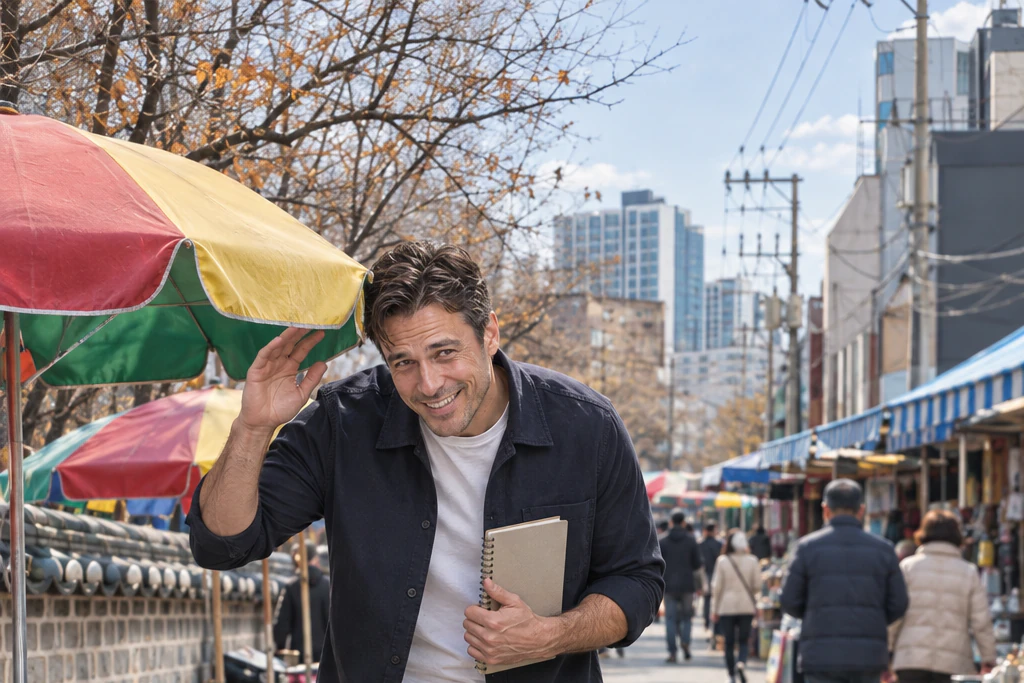
In the weekend market, Ethan measures his own height again. At 193 cm, he has to bend at the waist every time he passes a stall with a low-hung parasol. Once he bends, his eye level drops a long way, and he jokes in his notebook that under a parasol he is about 170 cm. With his eyes lower, he actually sees the goods laid out on the stall floors better. If you are tall, mind your head now and then as you walk at the weekend.
At Dongmyo Flea Market, it is common for things to have no price tag. So haggling naturally goes back and forth between seller and buyer. At a stall laid out with tools, Ethan picks up an old tape measure. It has inches marked on one side and centimetres on the other. Ethan asks the price in Korean, and after a few exchanges, holding up his fingers, he puts the tape measure in his pocket.
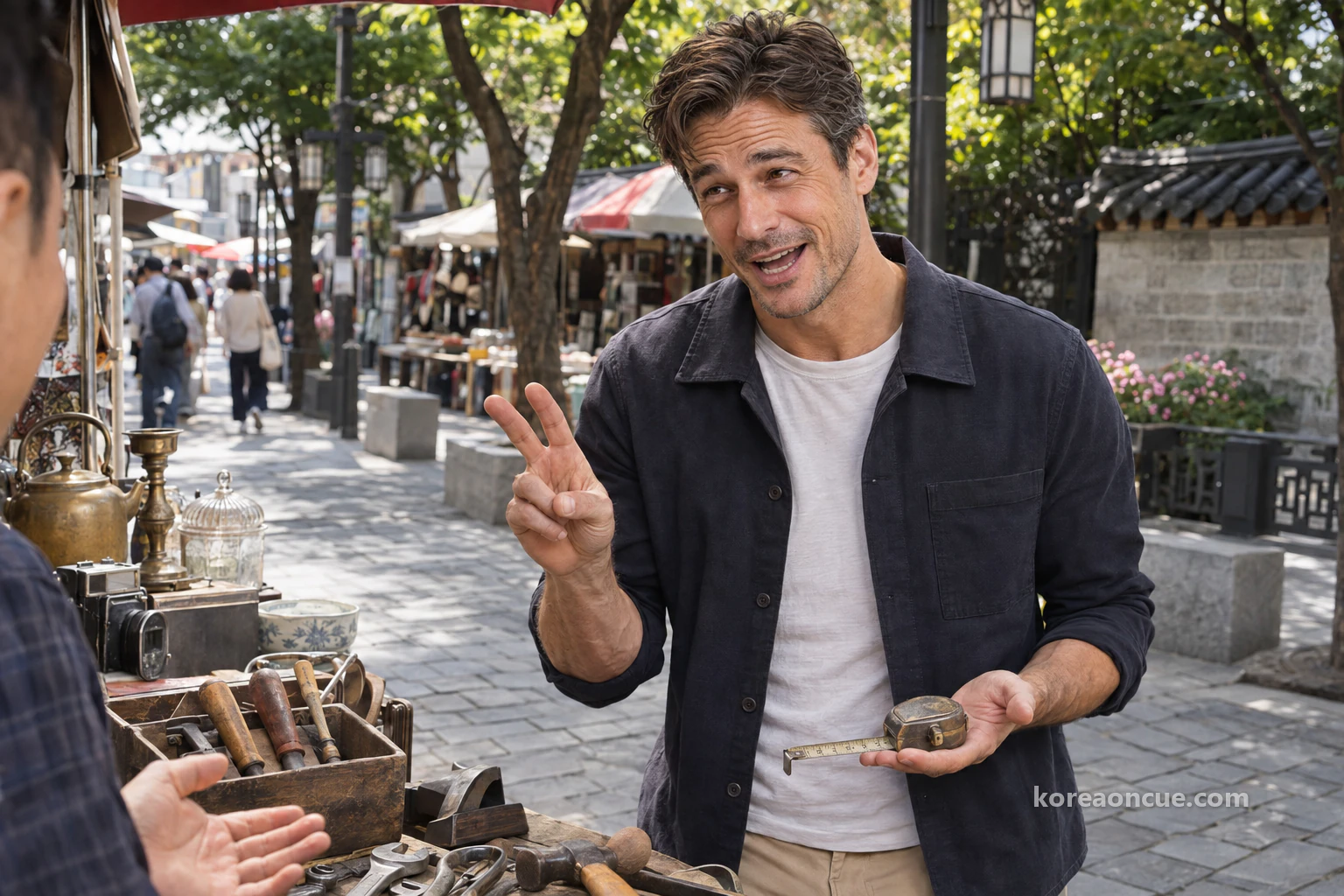
With the tape measure in hand, Ethan checks again on its markings that 1 inch is 2.54 centimetres. For a man who has turned every number in his notebook into another unit, no souvenir could suit him better than one with two units marked side by side on a single strip. Getting peckish, Ethan buys some toast, Dongmyo’s signature snack, and stands by the road for a moment. Toast draws plenty of people, weekend or weekday. The third line in the weekend column reads “No price tag → ask”.
How long has the market been here? Since the late 1980s, and on to Seoul Folk Flea Market
Dongmyo Flea Market took shape in the late 1980s. In the 1980s, dealers in secondhand goods of every kind gathered here and formed a trading area. Later, the market grew when traders from Hwanghak-dong Flea Market, who had to move because of the Cheonggyecheon restoration project, came in. That is why the names Hwanghak-dong Flea Market and Dongmyo Flea Market are both still used. Some people call it Dongmyo Dokkaebi Market, Dongmyo Traditional Market or Dongmyo Vintage Market, too.
Across Cheonggyecheon, these alley markets stretch a long way, all the way to Seoul Folk Flea Market in Sinseol-dong. Seoul Folk Flea Market was set up by Hwanghak-dong Flea Market traders displaced by the Cheonggyecheon restoration, and it officially opened on 26 April 2008. The address is 21 Cheonho-daero 4-gil, Dongdaemun-gu, Seoul. Unlike Dongmyo, it has fixed hours, opening 10:00–19:00 from Wednesday to Monday and closing on Tuesdays. The outdoor market is held only on Saturdays and Sundays, so if you want to see Seoul Folk Flea Market’s outdoor market as well, choose a weekend.
The weekday and weekend columns side by side — the way back and the two columns left in the notebook
In the afternoon, Ethan wanders slowly back towards Exit 3. In front of the exit he stops, opens his notebook and reads the two columns side by side. The weekday column says “Shop lights on, only a few stalls” and “Relaxed”, and the weekend column says “No empty spots, half walking speed” and “No price tag”. Measuring the same place twice, two days apart, has turned one market into two different plans. On the vertical line between the columns, Ethan writes “Reference line = stone wall, same in both”.
Ethan’s advice for anyone choosing a day is short. If you want to browse the shops slowly, go on a weekday, and if you want more stalls, go on a Saturday or Sunday. Opening hours vary by shop, so if there is a shop you have in mind, check that shop’s hours separately. Between November and February, the shrine closes at 17:00, so go there first. In the end, the biggest lesson left in Ethan’s notebook is simply not to read a number off the wrong line.
While waiting for the train, Ethan posts a photo of the two columns in his notebook and one line in the four friends’ group chat. “I measured the same market twice in two days and got two plans.” Lulu replies first, saying the photo of the weekend column alone would make a whole video. Seeing her reply, Ethan touches the tape measure in his pocket once. Whoever he comes with next time, he feels the reference line he drew today will still work.

Back at the hotel, Ethan puts the tape measure on his notebook and draws one last line beneath the two columns. Above the line go the shrine’s numbers, and below it the market’s. Above are 1601, 425 and 17:00, and below are the late 1980s, weekdays and weekends. Two places, one that runs by the clock and one that runs by the day of the week, sit in the same neighbourhood with a single stone wall between them. Closing the notebook, Ethan thinks this trip has given him the plan with the most units of all.
Common Mistakes
Looking for a single opening time for the market
at Dongmyo Flea Market, opening hours and days off vary by shop. Decide on the day first: on weekdays, shops and a few stalls, at weekends, all day.
Going on a weekday and expecting every stall to be out
stall trading is in full swing at weekends. Make a weekday visit a day mainly for the shops.
Thinking the shrine is open until 18:00 in November
Dongmyo Shrine closes at 17:00 from November to February. 18:00 is the closing time from March to October.
Seeing the whole market before going to the shrine
the market runs all day, but the shrine closes first. See the shrine in the morning, then head out into the market.
Bringing a car
there is no parking at the market or the shrine. Exit 3 of Dongmyo Station on Lines 1 and 6 is the simplest way.
Taking Dongmyo for a tomb
myo (廟) means shrine. It is a place where rites are held for Guan Yu, so keep your voice down.
FAQ
When is Dongmyo Flea Market on?
On weekdays it is partly open, with shops and a few stalls, and on Saturdays and Sundays it runs all day. Opening hours and days off vary by shop.
Is it open on Sundays?
Sunday is part of the weekend, so the market runs all day.
Which exit should I use?
Exit 3 of Dongmyo Station on Lines 1 and 6. The market is right outside, and Dongmyo Shrine is inside the market.
Which alleys should I walk?
The market runs around Dongmyo Shrine, in front of shopping arcades, beside roads and pavements and along the alleys. Walk with the shrine’s stone wall as your reference and you will get lost less.
How late is Dongmyo Shrine open?
It closes at 17:00 from November to February and at 18:00 from March to October. In November, visit the shrine before the market.
What is Dongmyo Shrine?
A shrine where rites are held for Guan Yu, designated a Treasure on 21 January 1963. Work on it began in 1599 and finished in 1601.
Is there another secondhand market nearby?
Seoul Folk Flea Market in Sinseol-dong. It is closed on Tuesdays, and its outdoor market is held only on Saturdays and Sundays.
Recap — 30 seconds before you go
- Dongmyo Station Exit 3 on Lines 1 and 6 → the market right outside → Dongmyo Shrine (84 Nangye-ro 27-gil) inside the market
- Market: shops and a few stalls on weekdays, all day on Saturdays and Sundays · hours and days off vary by shop
- Dongmyo Shrine closes at 17:00 from November to February — shrine first
- Use the shrine’s stone wall as your reference · no price tag? Ask
- No parking — take the subway
Sources
- Korea Heritage Service, National Heritage Portal — Donggwanwangmyo Shrine, Seoul (Treasure)Designated 21 Jan 1963 · 84 Nangye-ro 27-gil, Jongno-gu (Sungin-dong) · Joseon, 34th year of King Seonjo (1601) · state-owned, managed by Jongno-guchecked 2026-11-03
- Jongno-gu tourism — Donggwanwangmyo Shrine, SeoulA shrine for rites to Guan Yu, the Shu Han general · begun in the 32nd year of King Seonjo (1599) and finished in 1601 · five bays across and six deep under a T-shaped roof · brick side and rear walls, a Chinese-influenced featurechecked 2026-11-03
- Seoul Media Hub — Dongmyo, a city refuge reopened after three years“Myo (廟)” here means shrine, not tomb · two buildings joined front to back · the Geumjabinbi and Hamabi steles either side of the middle gate · plaques by a Ming envoy and Kings Sukjong, Yeongjo and Gojong inside the main hall; the shrine’s collection is designated as a group by Seoul · open every day, free admissionchecked 2026-11-03
- Seoul Media Hub — Dongmyo Market, now popular with young Koreans tooFive buildings: outer gate, inner gate, main hall, and the west and east wingschecked 2026-11-03
- Seoul Media Hub — An outing to Dongmyo Flea MarketThe market meets Exit 3 of Dongmyo Station (Lines 1 and 6) · weekdays: shops and a few stalls; weekends: stalls in full swing · started in the late 1980s · goods from leather jackets to tools, records and old bookschecked 2026-11-03
- Seoul Media Hub — A visit to Dongmyo Flea Market (2026)Partly open on weekdays, all day at weekends · steady shoppers even on weekdays · price tags often missing, so people haggle · toast as the signature snackchecked 2026-11-03
- Seoul Media Hub — Dongmyo vintage market, a treasure box in the cityKnown as both Hwanghak-dong and Dongmyo Flea Market · formed by second-hand dealers in the 1980s, then grew as Hwanghak-dong traders moved inchecked 2026-11-03
- Seoul Media Hub — Where 10,000 won still buys happinessShops and stalls in front of arcades, beside roads and pavements and in alleys around Dongmyo · a clothes shop that prices by weight on a scale · lane markets running on to Seoul Folk Flea Marketchecked 2026-11-03
- Jongno-gu tourism — Sungin-dongDongmyo-dong and others merged into Sungin-dong in 1914 · the name takes one character each from Sungsin-bang and Inchang-bangchecked 2026-11-03
- Seoul Media Hub — Three routes for a time trip to Sinseol-dong, DongdaemunSeoul Folk Flea Market officially opened on 26 Apr 2008, founded by Hwanghak-dong flea-market traders · Wed–Mon 10:00–19:00, closed Tuesdays · outdoor market on Saturdays and Sundays onlychecked 2026-11-03
A Seoul story told with our AI characters. Place details are checked against public sources; the photos are AI-made illustrative images. How we use AI
More from this area
Bangsan Market: the order for finding packaging materials
This market is closed on Sundays and done by 3 p.m. on Saturdays. With her last day in Seoul falling on a Saturday, Mali draws up a timetable before she looks at a map. The winter-issue colours a palm-sized card couldn’t settle will now go up against real paper and real boxes.
Changsin-dong Stationery and Toy Market: which days to go
Under a video of nothing but a hand squeezing a malangi, the comments kept asking “Is it open on Sundays?” Lulu decides to film the order that comes before the hand: starting at a subway exit, going through lanes stacked with toys, and ending on that final shot of the hand.