
SEOUL · BANGSAN MARKET
The Saturday that ends at 3 p.m.: Mali plans her way round the paper, box and print shops of Bangsan Market
Bangsan Market — closed on Sundays and public holidays, until 15:00 on Saturdays (hours vary by shop), Euljiro 4-ga Station Exit 6, and the order for finding packaging, printing and baking supplies
This market is closed on Sundays and done by 3 p.m. on Saturdays. With her last day in Seoul falling on a Saturday, Mali draws up a timetable before she looks at a map. The winter-issue colours a palm-sized card couldn’t settle will now go up against real paper and real boxes.
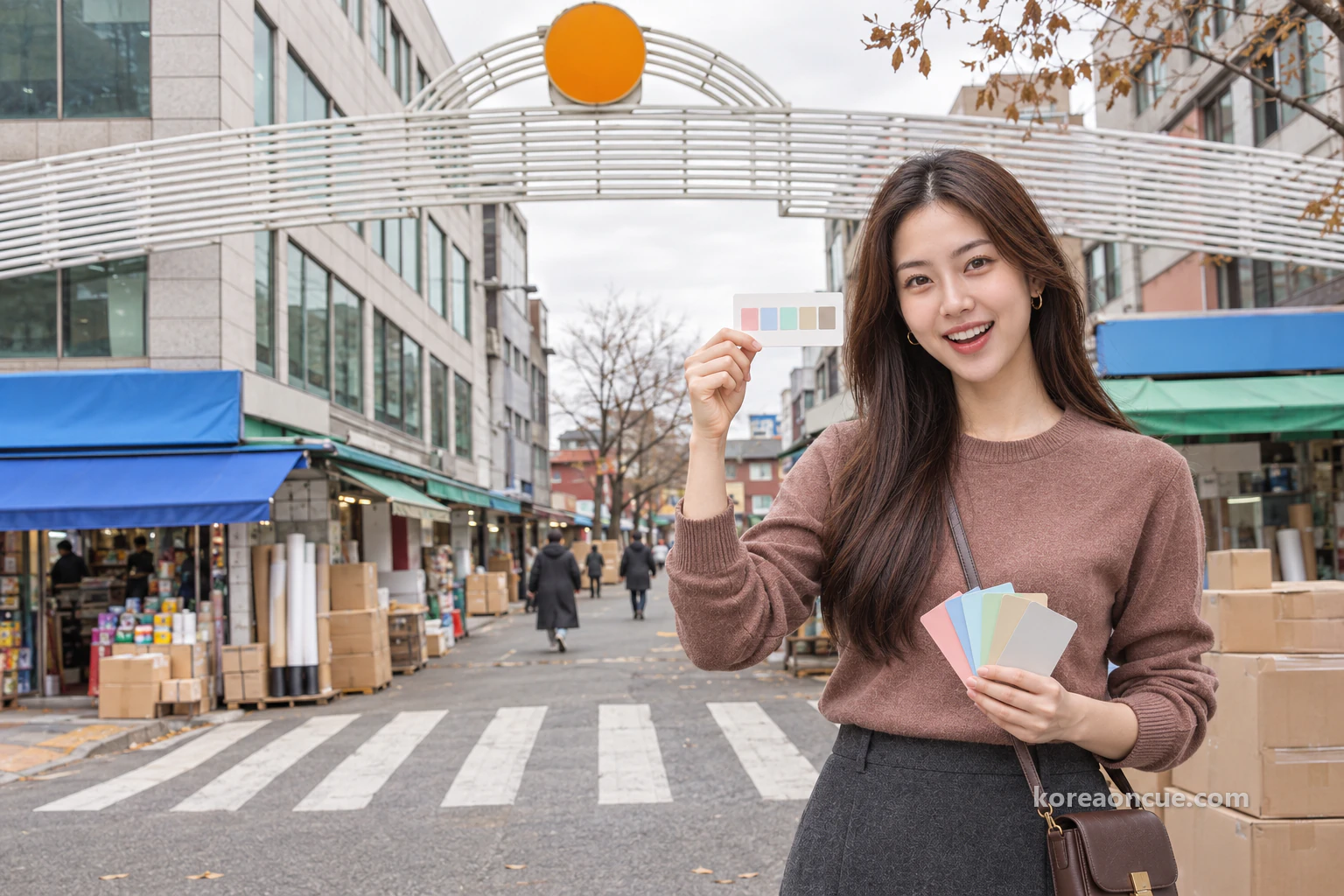
How to get there
Saturday is the last day of Mali’s seventh work trip to Seoul. She is 23, works for a beauty magazine in Bangkok, and is often the one sent to find colours for a shoot. Two days ago, working on her winter-issue homework at a museum, she left one odd line in her notebook: “17 m — the card is too small”. A card the size of her palm can’t settle the colour of a big room, and that homework is still open.

She photographs the note and sends it to her editor, and the reply comes quickly. “Then skip the cards and try real paper. The boxes for the gift shot too.” The winter issue has pages of end-of-year gift sets. Before the trip ends she has to settle the colours of the wide background paper, the boxes and the shopping bags, and carry them back to Bangkok. The colleague who handles the photography also asks for some small sprinkles to scatter over a cookie shot.
Looking for a market full of printing and packaging shops, Mali comes across the name Bangsan Market. The problem is time. She flies back to Bangkok in the evening, so all she has is Saturday daytime. Just as Rina taught her with “checking the finish”, she looks up closing times before the map. Learning that it is closed on Sundays and runs until 3 p.m. on Saturdays, she writes “Sat 15:00 — done” at the top of her notebook and builds her timetable backwards from there.
Today’s destination is Bangsan Market in Jung-gu, Seoul, a market of small shops dealing in printing and packaging supplies, promotional goods and even wallpaper. Head for Exit 6 of Euljiro 4-ga Station. Mali works through paper, boxes, baking supplies and print shops in that order and leaves before 3 p.m.
The Cue — At a glance
Bangsan Market is closed on Sundays. Public holidays are closing days too. On Saturdays it runs until 15:00, and each shop’s hours are worth asking about in advance. Choose what you need on Saturday morning first. Head for Exit 6 of Euljiro 4-ga Station. You find things here by type of shop — paper, boxes, printing — rather than by alley name, and whether you can buy small quantities is something to ask shop by shop.
- Station and exit: Euljiro 4-ga Station Exit 6. From the Gwangjang Market side, walk through the Food Alley and cross the bridge over Cheonggyecheon, and the market arch comes into view.
- Hours: Until 15:00 on Saturdays, and ask each shop about its hours in advance. On weekdays the market stays open later than on Saturdays.
- Closed: Sundays and public holidays (including Seollal and Chuseok).
- Address: Bangsan Market, around 18-1 Eulji-ro 33-gil, Jung-gu, Seoul · Bangsan Wholesale Market (방산종합시장), 20 Dongho-ro 37-gil, Jung-gu, Seoul. They are two names for the same market.
- Enquiries: Bangsan Market Merchants’ Association, 02-2266-8765.
- Finding shops: “업체찾기” (Find a Business, by item and by trade) on the Merchants’ Association website.
- Worth seeing: Box, shopping bag and plastic packaging shops · print shops making labels and stickers · the bakery alley.
- Parking and access: Parking is available. There is no step up to the main entrance, so wheelchair users can get in.
Is Bangsan Market open on Sundays? — Closed on Sundays and public holidays
Bangsan Market is closed on Sundays. Public holidays are closing days too, and it also shuts over Seollal and Chuseok. So rather than spending time hunting for a shop that’s open on a Sunday, it is quicker to move the day in your plans. If your Seoul trip spans a weekend, put Bangsan Market in the Saturday slot, not the Sunday one. A weekday is better still if you can manage it, since the market stays open later than on Saturdays and fits into an afternoon as well.
Open in Kakao Map — Euljiro 4-ga Station
The first thing Mali does on reading this answer is open her calendar. Thursday had meetings and the museum, and Friday was set aside for a walk with Rina. By Sunday morning she has to be back in Bangkok getting ready for the winter-issue shoot. With the weekdays and Sunday gone, the one slot left is Saturday. A single slot means less to agonise over, as seven work trips have taught her.
There is one more thing to check with closing days. Closing days and opening hours follow the same broad pattern, but they differ a little from shop to shop. This is a market of small shops, so it is as if one market runs on many clocks. If there is a shop you must visit, it’s safer to ask that shop directly before you go. If you don’t yet know which one, call the Merchants’ Association (02-2266-8765).
How late does it open on Saturdays? — It ends at 3 p.m.
Saturday at Bangsan Market ends at 3 p.m. On weekdays the market stays open later, but each shop keeps its own hours, so it’s safer to ask in advance. Choose what you need on Saturday morning first. With the important shops in the morning, you are less likely to feel rushed in the afternoon. That is the first thing Mali settles when she draws up her timetable.
Opening times differ by shop too. One shop selling baking supplies opens 10 a.m. to 5 p.m. on weekdays and 10 a.m. to 3 p.m. on Saturdays. Seeing this line, Mali moves the baking slot from near the start to after 11 and reorders her timetable. She has separated the places to drop by early from the places to visit after 10. Had she missed that line, she would have put baking in the first morning slot and ended up waiting outside a closed door.
| Day | Market | One baking supplies shop |
|---|---|---|
| Weekdays | Later than Saturday, varies by shop | 10:00–17:00 |
| Saturday | Until 15:00 | 10:00–15:00 |
| Sunday, public holidays | Closed | Closed |
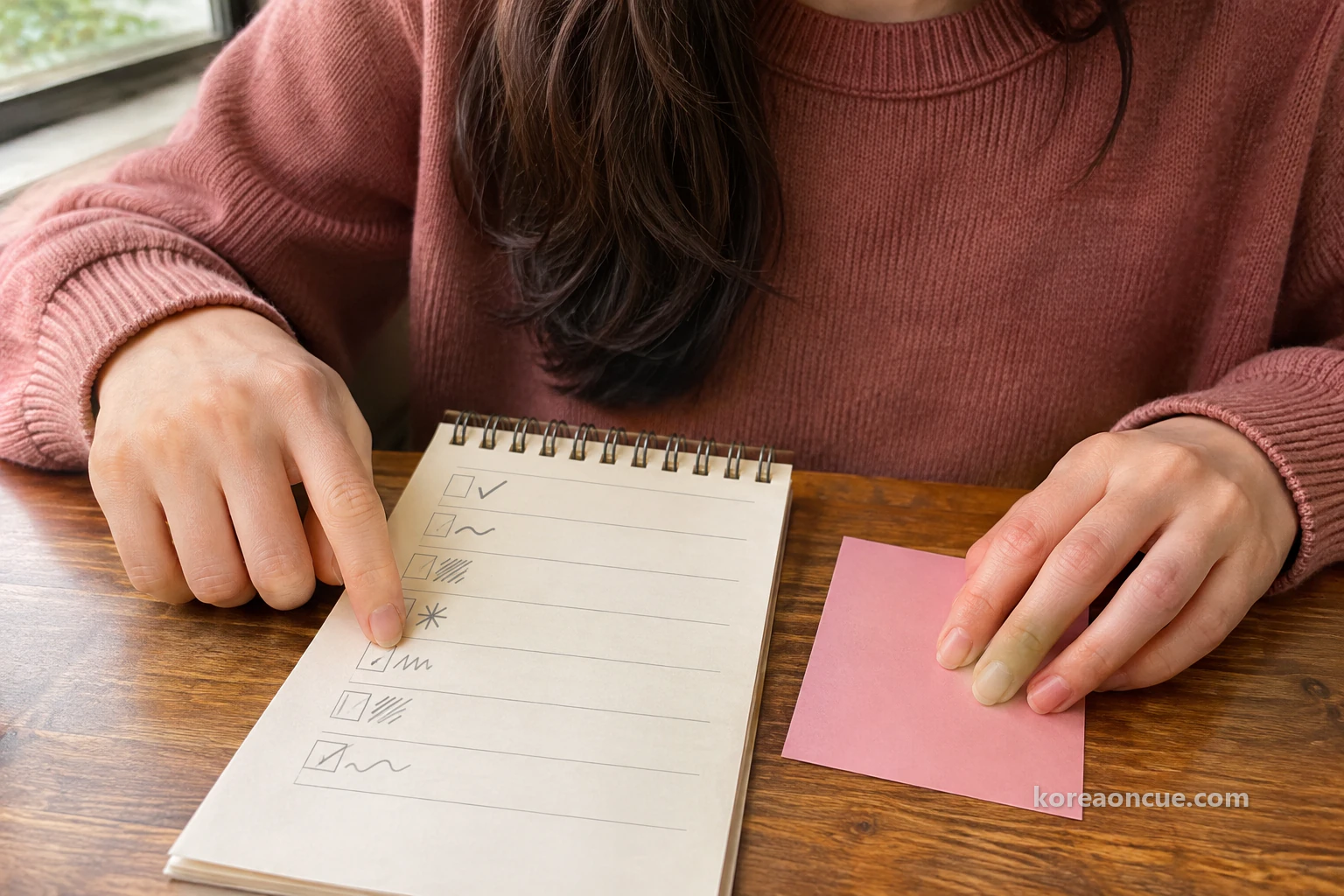
Mali’s timetable has five lines.
| Time | What |
|---|---|
| 09:00 | Paper |
| 10:30 | Boxes |
| 11:30 | Baking |
| 12:30 | Printing |
| 14:30 | Out |
Paper comes first because the background colour has to be settled before she can pick box colours. Writing 14:30 instead of 15:00 for leaving is a habit borrowed from Rina. Rina, she feels, would draw a private deadline of her own a little ahead of the real one.
The same method works for your own timetable. First cut what you must buy down to two or three things, and put the most important at the top. On a Saturday, do those shops in the morning and leave the afternoon for whatever remains. If you want more time, a weekday is better. The market stays open later on weekdays than on Saturdays, so even arriving in the afternoon leaves time to look round the shops.
Which exit to use — Euljiro 4-ga Station Exit 6
By subway, come out of Exit 6 at Euljiro 4-ga Station. Mali has “Euljiro 4-ga — 6” written in the first box of her notebook too. Thanks to an early start, she’s through the ticket gates in time for the first line of her timetable. Outside the exit, she follows the market’s name pinned on her phone’s map. The morning air is cold, so her right hand stays in her coat pocket and only her left holds the phone.
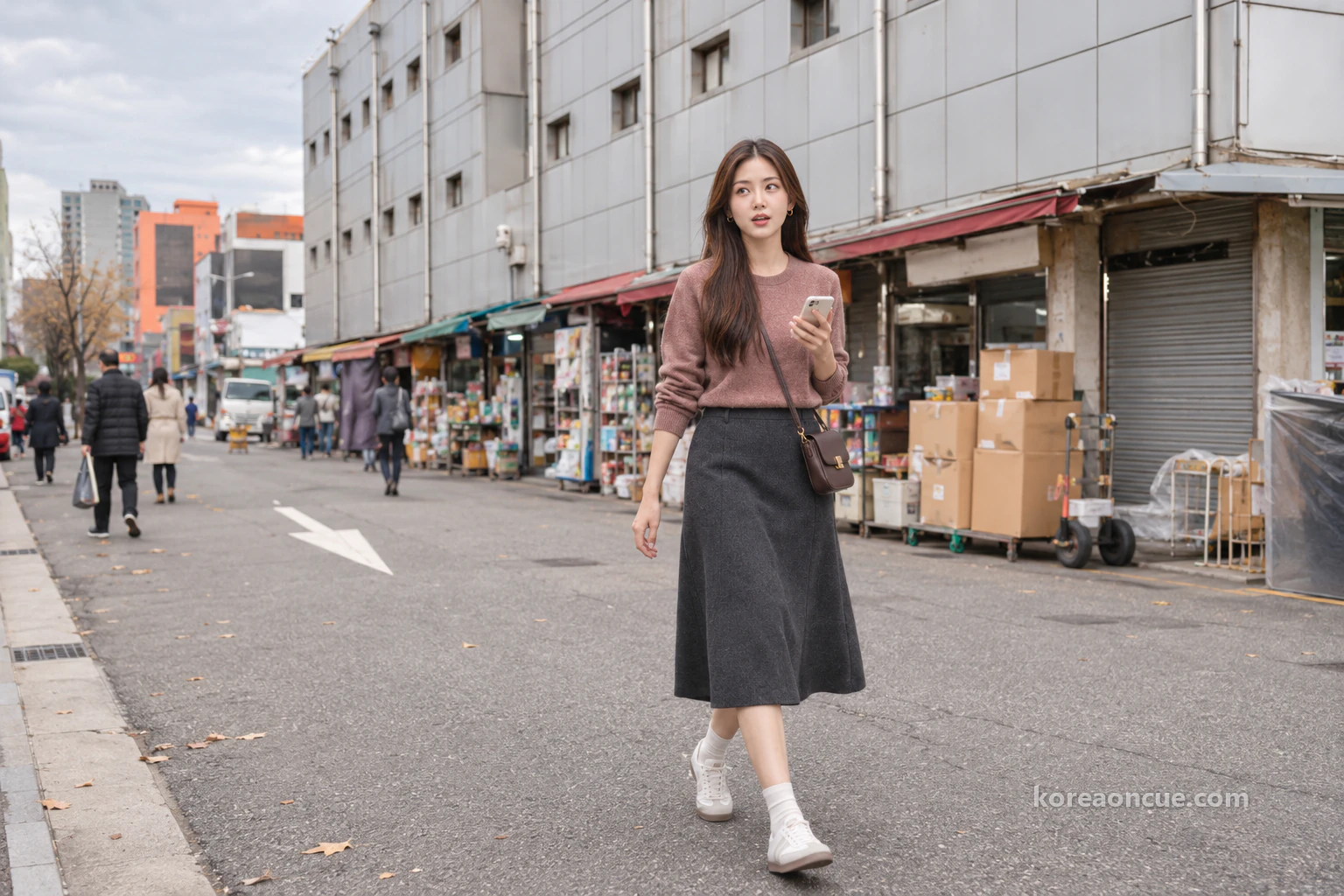
You can park here if you come by car. But this is a market where goods come and go, and boxes and materials pile up along the narrow roads. On the road Mali walks along, stacks of boxes line the front of every shop. Unless you are carrying off a load of boxes, the subway is easier on the nerves than turning a car round in a tight space. Wheelchair users can get in, as there is no step up to the main entrance.
It is a little after 9 when Mali enters the market. Shops with their shutters up alternate with shops still shuttered. Without a timetable she might have wondered whether she had the time wrong and looked it up again. But having already read that every shop runs on its own clock, she decides to work through the open shops first. Shutters down in the morning are nothing to be surprised at.
Coming from Gwangjang Market — cross the Cheonggyecheon bridge and the arch appears
Walking from the Gwangjang Market side makes the market easier to find. From the Jongno 5-ga side, go straight through Gwangjang Market’s Food Alley, cross the bridge over Cheonggyecheon, and an arch with the market’s name appears. The entrance is easier to spot this way than from the Euljiro side. On a day you have already seen Gwangjang Market, the two markets join up well on one walk.
Mali comes in by Euljiro 4-ga Station, but decides to leave through the arch and walk towards Cheonggyecheon. After the market, she wants to rearrange her bags in the breeze off the stream. Her route suits her mood that day, so choose whichever side fits your own plans. If it’s your first time and you have no bags, coming in through the arch is less confusing. If you want to go straight from Euljiro 4-ga Station, Exit 6 is the simple way.
Are Bangsan Market and Bangsan Wholesale Market different places? — Two names, one market
Bangsan Market and Bangsan Wholesale Market (방산종합시장) are two names for the same market. Seeing the names, Mali at first takes them for two markets. The night before, in her room, she made two boxes on her timetable, then found they were the same place and crossed one out. The arch at the market entrance carries the name 방산종합시장. The Merchants’ Association uses the name Bangsan Market, so that one is easier when you phone.
The address also comes in two forms, depending on the name. Bangsan Market is around 18-1 Eulji-ro 33-gil, Jung-gu, Seoul, and Bangsan Wholesale Market is 20 Dongho-ro 37-gil, Jung-gu, Seoul. In a map app, enter one name together with that name’s address. Mix names and addresses and the pin seems to land somewhere else, which makes it easy to think, as Mali did, that there are two places. From here on, this piece simply calls it Bangsan Market.
What is sold where? — The business list beats alley names
At Bangsan Market, it’s quicker to search by type of shop than by alley name. On the Merchants’ Association website, “업체찾기” (Find a Business) lets you pick shops by item and by trade. The list holds 363 businesses in all, so you can see at a glance what kinds of shop are common. Packaging materials lead with 40, and plastic packaging and silk-screen and speciality printing have 28 each. Boxes of all kinds (20) and stickers (16) are on there too.
Mali copies these numbers onto the backs of her colour cards. On the blue card she writes “Paper — paper merchants 9”, and on the orange card “Boxes 20 · shopping bags 11”. The green card gets “Labels 12 · stickers 16”. Instead of memorising road names, she has sorted the shops she wants by card colour. Each time she passes a shop she reads the sign and moves the matching card to the front, so she seldom needs to open her notebook.

This is a list of the Merchants’ Association’s member businesses, so it isn’t a map of the whole market. Like baking supplies, which come up later, some trades are in the market yet barely show on the list. Even so, it is very useful for learning the names of the trades you want. Before you go, write down two or three trade names for what you are after. Matching them against shop signs on the spot gets much easier.
It helps to know what else is here besides packaging. The list also has 22 garment-trimmings businesses, 7 for towels and promotional goods, and 6 for wallpaper and flooring. Binding and craft materials, stationery and fancy goods can all be bought here in one place. Restaurants are on the list too, 18 of them. Mali’s finger stops at the garment trimmings line, but one look at her timetable makes her smile and push that line to the next trip.
What makes this market useful to travellers is seeing and comparing things in person. Photos online can’t tell you the grain of a paper or the thickness of a box. With small shops clustered together, you can weigh up the same item a few steps apart and choose what suits your needs. It works well for anyone running a small shop or wanting to wrap gifts by hand. For Mali, being able to hold the colours in her hands is reason enough to come.
Where to buy wrapping paper and paper — trying colours at the paper merchants
For paper, go to a paper merchant (지업사), a shop that deals in paper. The list has 9 of them. At the first open shop, Mali takes out a few candidate colour cards and holds them one by one against a pile of paper. The answer to the note from two days ago now spreads out in front of her. When a wide sheet opens out, she can see the weight of the colour and the way the surface takes the light, neither of which showed on a palm-sized card.
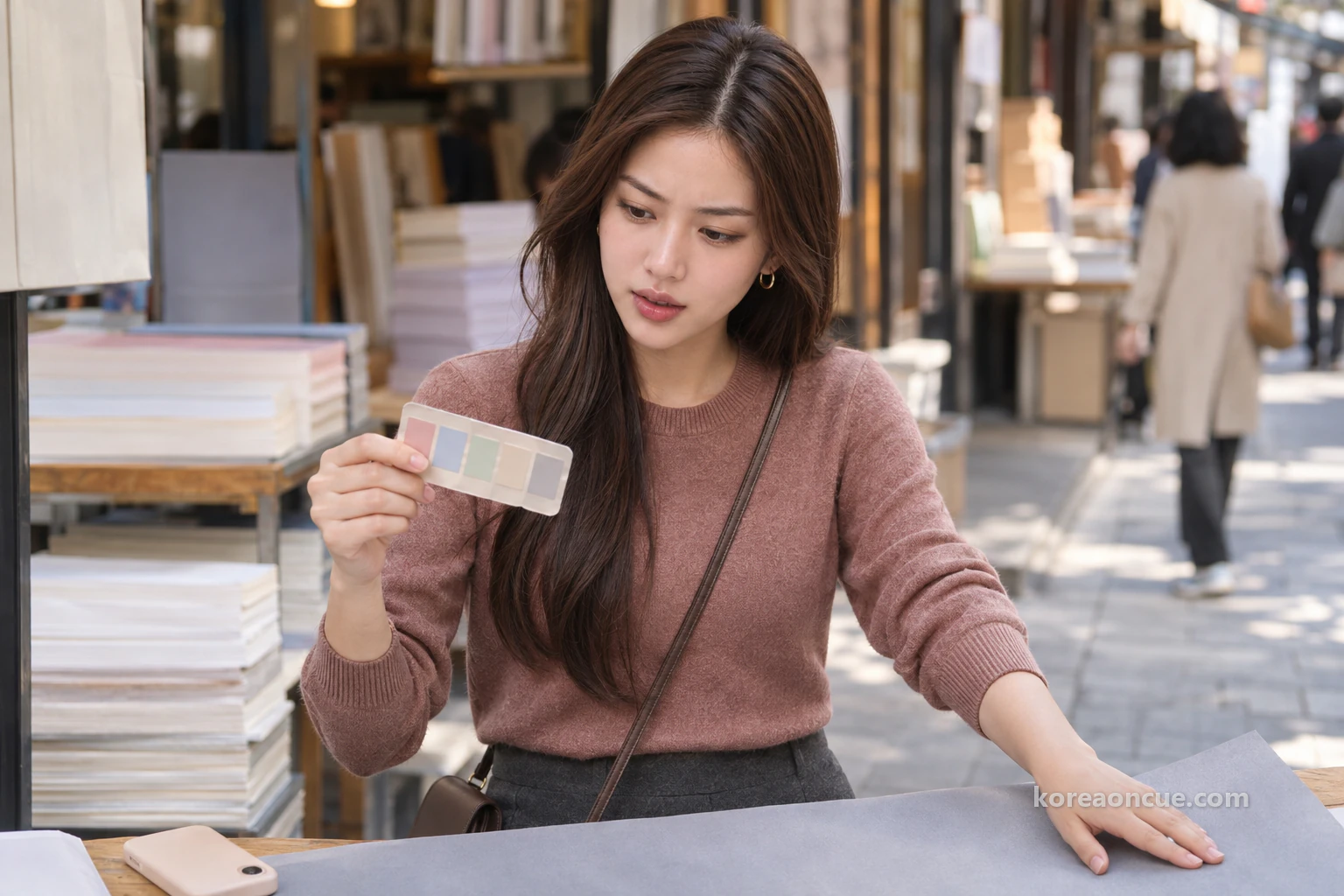
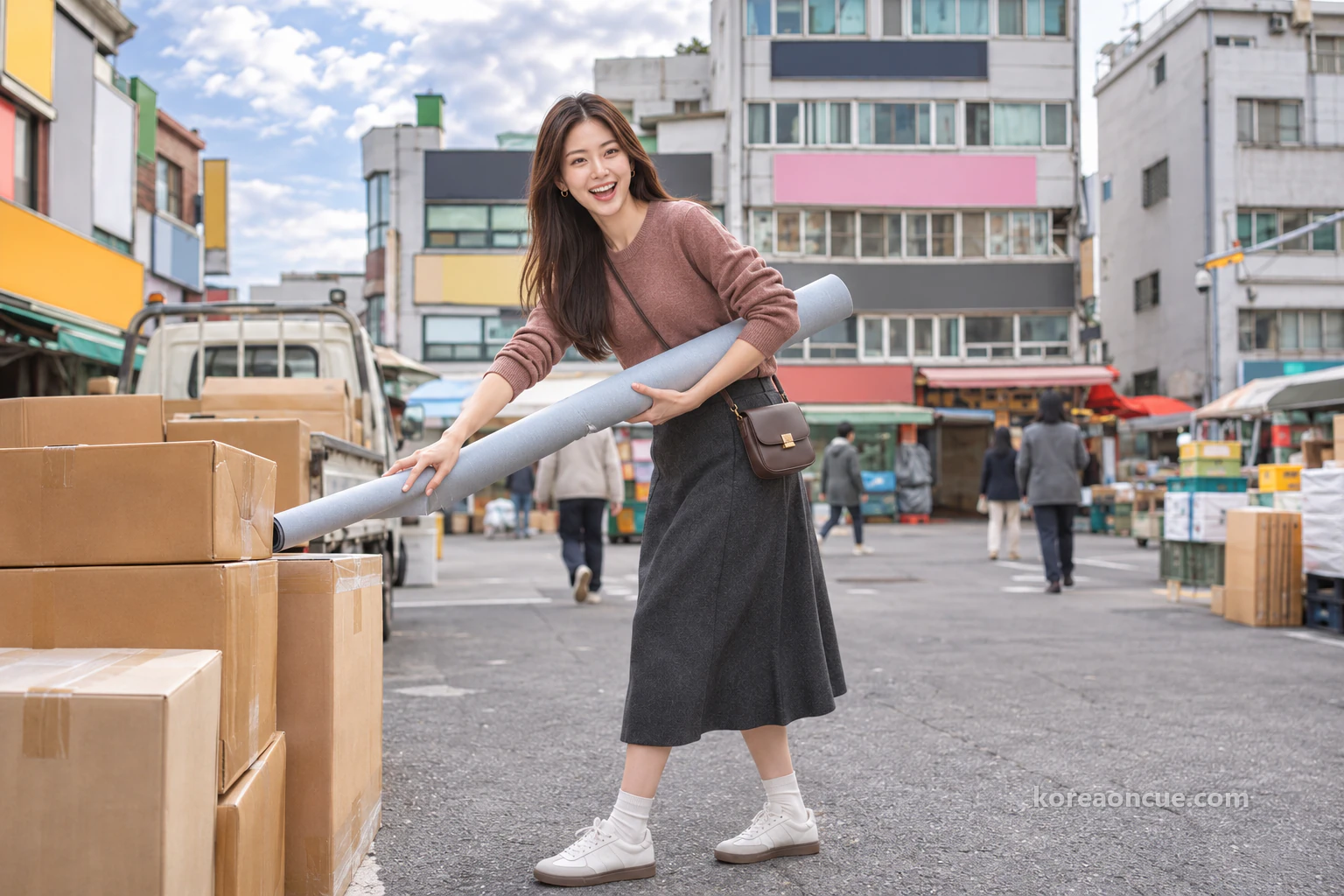
The one she picks is a grey paper with a bluish tinge, like the sky before snow. Mali names it “before-snow grey”. She asks the person in the shop, “Can I buy just one sheet?”, and the answer is yes. Pleased with herself, she rolls the wide sheet and tucks it under her arm. Crossing off the first line of her timetable ahead of schedule is the easy part.
The trouble comes next: the market’s alleys are narrow, boxes are piled in front of every shop, and vans carrying goods pass through. The rolled paper is longer than she thought and catches on something every time she turns. In the end it hits the corner of a box, and one edge gets slightly creased. Buy large sheets and big boxes last. Photograph the colour first and drop back in on your way out.
Where to buy boxes, shopping bags and plastic packaging — packaging shops, the biggest group on the list
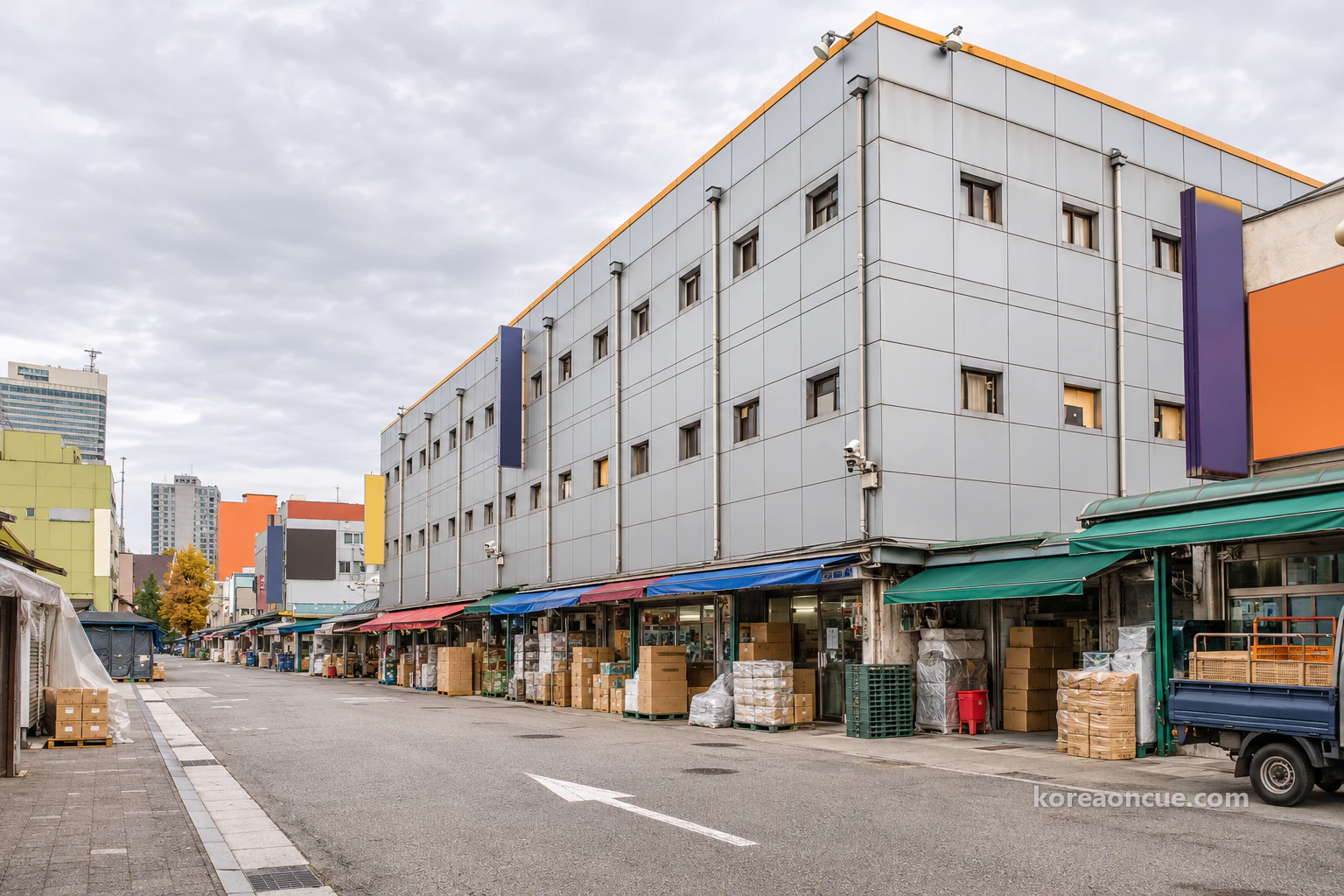
Boxes and shopping bags are easy to find at Bangsan Market. The list alone shows 40 packaging-materials businesses, 20 for boxes, 28 for plastic packaging and 11 for bags and shopping bags. There are 4 tape shops as well. With small shops side by side, it is easy to compare goods and prices across several. So rather than buying at the first shop, look round two or three and take photos of the size and colour of the boxes you like.
At 10:30, Mali brings the orange card to the front. In a photo, the colour of a gift box is the first thing the eye lands on. She smooths out the creased corner of the grey paper and sets each box on top of it. A red box shouts against the grey and a white one vanishes into it. When an orange-tinged box from the third shop sits on the grey, she says quietly to herself, “This is it.”
It is the colour of gotgam, dried persimmon, so Mali names it “dried-persimmon orange”. But when she photographs it, the inside of the box turns out to be a different colour again. For a shot with the lid off, the inside colour matters too. Only after opening the lid and holding a card to the inside does she nod and put this box in her notebook as the day’s first candidate. If you choose gift boxes yourself, look past the outside to the colour and size inside the lid.
Shopping bags and plastic packaging are far quicker to find once you have decided on a size. Measure the width, depth and height of what goes in and write them down. Mali measured the box for the shoot in hand spans, and at the shopping bag shop she shows that same span. Even with halting Korean, showing the size by hand makes the exchange quick and easy. If Korean is hard, a photo of the item and its size on your phone screen works well too.
Where to buy baking supplies — the bakery alley, more than the list
If you are after baking supplies, don’t rely on the business list alone. Select the “제과/축산/식품” (confectionery/livestock/food) category and only 3 entries appear. Seeing that number the night before, Mali too wondered whether to give up on the sprinkles. But Bangsan Market is known for its bakery alley, where shops dealing in baking machines and tools cluster together. A low count on the list doesn’t mean the market lacks them, so don’t give up over a number.
Baking ingredients, raw materials for making chocolate, all sorts of tools and handmade craft supplies can all be found here. It was once a market for patissiers and is now better known as a bakery street. Mali moves towards the baking side in time for 11:30. The shop that opens at 10 will be open by then, so there is less risk of a wasted trip. Reordering her timetable earlier pays off here.
Finding the alley is quicker by asking on the spot than by memorising the way. Leaving a packaging shop, Mali asks, “Which way for baking supplies?” The person in the shop raises a hand and points. Following that fingertip, she cranes her neck and looks first for the moulds and tools set out in front of the shops. Even if you can’t read every sign, the tools out front soon tell you what kind of shop it is.

Some ingredients come in small packs too, so it also works for someone baking once or twice at home. The online product sizes of one baking supply shop alone run from sprinkles in 12 g and 200 g to pistachios in 200 g and 1 kg. For a single cookie shot, a small amount of the sprinkles Mali wants is plenty. She holds a small bag to the light and puts a card against the coloured grains. To her colleague she sends a photo with the note “White grains next to dried-persimmon orange”.
Where to order printing, labels and stickers — take the trade names with you
Print shops are places that make things rather than sell them. Bangsan Market has been kept going by people who run the machines themselves and make products by hand. The list has 28 silk-screen and speciality printing businesses, 12 for labels and hang tags, 8 for offset printing and 5 for foil stamping. So rather than browsing as if at a display shelf, decide what you want made before you go. Start by saying what you need, whether printed matter, packaging, promotional goods or souvenirs, and the talk moves faster.
Some of the trade names are words you may never have seen. The list has 12 businesses under 라벨/행택 (labels and hang tags), 6 under 도무송 (domusong) and 13 under 고주파 (gojupa). Mali writes these three words on the back of the green card and reads them aloud under her breath each time she matches one to a sign. When she can’t tell what a shop does, she points at the word and asks, “What do you make here?” With the names in hand, even an unfamiliar word gives you something to ask.
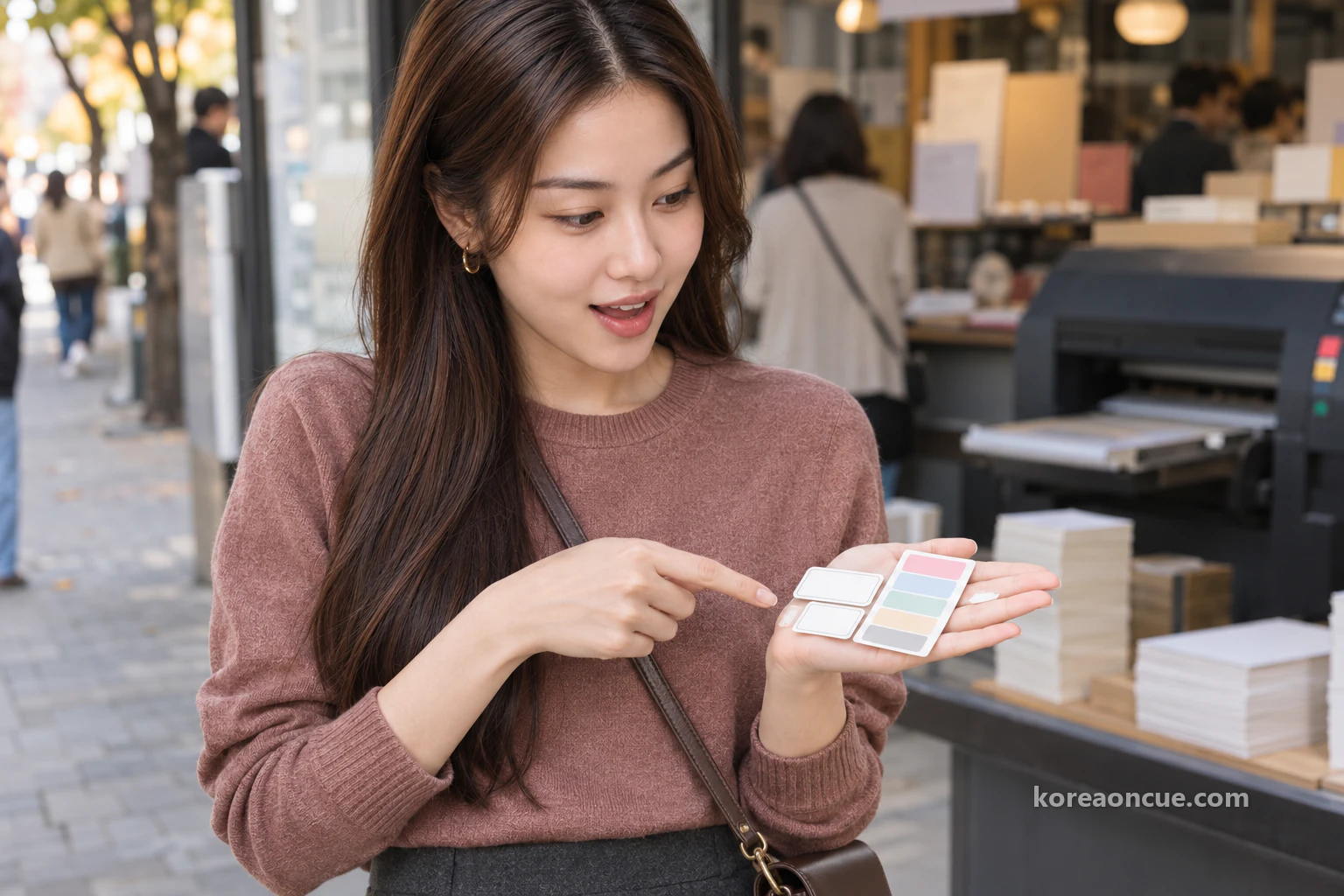
At 12:30, the sound of machines comes from the back of the label shop Mali stops at. She wonders whether small labels for the gift boxes can be stamped in gold. Easy custom orders are one of this market’s strengths, but custom work is hard for someone flying out this evening. She doesn’t push for an order and just photographs the sample colours. Then she takes the shop’s contact details and copies them into the “Next trip” box in her notebook.
If you plan to order printing, work out your schedule first. Things made to order are different from things you carry out on the spot, so they need a timetable of their own. If your trip is short, start by asking when you can collect. If Saturday is your last day, picking up samples and contact details is more realistic than ordering. If you can prepare your file in advance, a weekday with time to spare is far easier.
Can you buy small quantities? — It depends on the shop, so ask first
At Bangsan Market, many shops sell in small quantities. Some shops, though, deal only in bulk. So before choosing, ask how many you have to buy. Mali writes “Can I buy just one?” (한 개도 살 수 있어요?) in Korean in her notebook and reads it out at each shop. That one line saves time for the shop and for her, which helps most on a short day like Saturday.
The answers at the shops she visits really do vary. Some nod, and some look apologetic and say they only sell in bundles. A no is nothing to be disappointed about. Shops selling similar things are close together, so a few steps bring you to another place to ask. Mali photographs the colour of a shopping bag at a bundle-only shop and finds something similar next door.
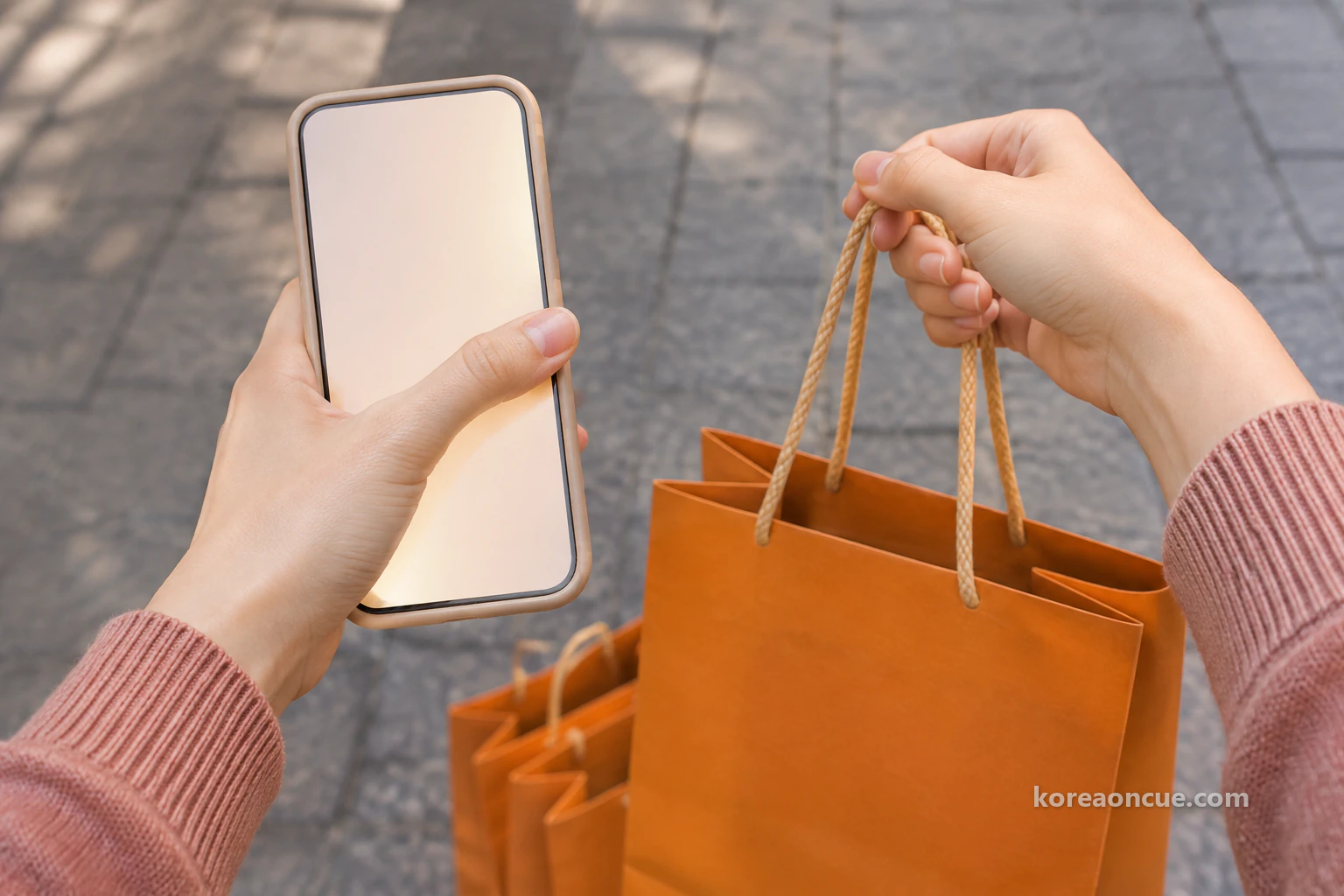
For small purchases, it helps to bring one big bag. Buying little things at several shops soon multiplies your carrier bags, and in a narrow road even one bag gets in the way. By shortly after noon, Mali’s hands are full as well. So she pushes the small bags into one shopping bag, and one hand comes free. With a hand free, pulling out a card or lifting goods at the next shop becomes far easier.
Bangsan Market on a Saturday afternoon — how Mali got out before 3 p.m.
As 2 p.m. approaches, the sound of the market begins to change. People carrying boxes back inside catch her eye, and one shop has its shutter half down. She looks once at the last line of her timetable and closes her notebook. Mali goes back round the shops for the things she has left until now. Holding up the sample she had only photographed earlier, she finds the colour a good deal calmer than it looked on the screen.
The last thing Mali buys is a dark chestnut paper to line the bottom of the box. It looks like the evening trees outside her window, so she names it “evening-tree chestnut”. This time she rolls it as soon as she has paid and heads straight for the arch. Having made the morning’s mistake once, she now looks behind her every time she turns. The creased corner of the grey paper, as it happens, catches the light and brings out the grain, so she decides to shoot that corner just as it is.
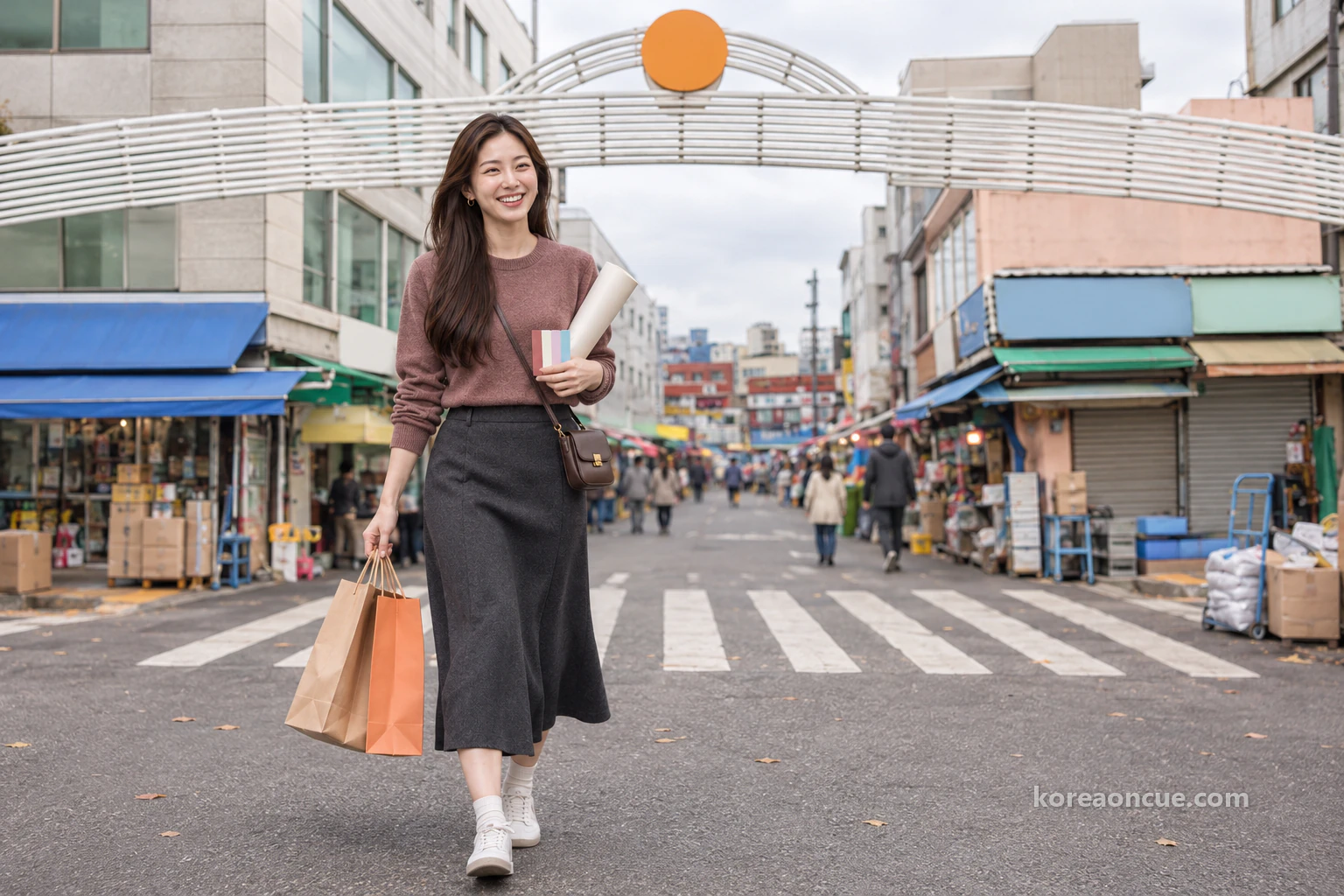
When she passes the arch, the clock says 14:34. She is 4 minutes behind the deadline she set herself, but she already has everything she needs. On the bridge over Cheonggyecheon she stops for a moment and takes out her notebook. Under “17 m — the card is too small” she adds one line, “So, paper”. Two days of big-room homework close like that, on three colour names.
Without setting down her bags, Mali sends Rina a short message. “Today’s finish was 15:00. I drew the line at 14:30, Rina-style, and got everything.” Then she puts the phone away and shifts her grip on the long roll of paper. Getting it onto the plane uncreased is the day’s last piece of homework. Looking down at the “Next trip” box in her notebook, she writes “Ask opening hours first” in small letters beside the label shop’s contact details.
Common Mistakes
Going on a Sunday
Bangsan Market is closed on Sundays and public holidays. For a weekend trip, choose Saturday.
Turning up at your leisure on a Saturday afternoon
Saturday ends at 15:00. Choose what you need in the morning first.
Assuming every shop is open in the morning
Hours differ by shop. Some open at 10:00.
Assuming that what isn’t on the business list isn’t in the market
The “제과/축산/식품” category has 3 entries, but the market is known for its bakery alley.
Buying large paper or boxes first
The roads are narrow and piled with boxes. Photograph the colour and buy last.
Mixing up the two names and two addresses
Pair Bangsan Market with 18-1 Eulji-ro 33-gil and Bangsan Wholesale Market with 20 Dongho-ro 37-gil.
FAQ
Is Bangsan Market open on Sundays?
No. Sundays and public holidays are closing days.
How late does it stay open on Saturdays?
Until 15:00. Ask each shop about its hours in advance.
Which exit do I use?
Euljiro 4-ga Station Exit 6.
Are Bangsan Market and Bangsan Wholesale Market different?
They are two names for the same market.
Can I buy small quantities or just one?
Many shops sell small quantities, but some deal only in bulk. Ask first at each shop.
Are there baking supplies too?
Yes. The market is known for its bakery alley, where shops dealing in baking machines and tools cluster together.
How do I find shops?
“업체찾기” on the Merchants’ Association website lets you search by item and by trade.
Recap — 30 seconds before you go
- Closed on Sundays and public holidays · until 15:00 on Saturdays
- Euljiro 4-ga Station Exit 6
- Write down two or three trade names for what you want (paper merchants, boxes, labels, stickers)
- For baking supplies, the bakery alley more than the list
- Ask each shop “how many do I have to buy?” first, and buy big things last
Sources
- Bangsan Market Merchants’ Association — Business hours noticeClosed Sundays and public holidays · Saturday until 15:00checked 2026-11-04
- Korea Tourism Organization, VISITKOREA — Bangsan Wholesale MarketSaturday until 15:00, closed Sundays, Seollal and Chuseok · hours differ by shop · parking availablechecked 2026-11-04
- Korea Tourism Organization, Open Tourism — Bangsan Wholesale MarketHours and closing days differ by shop · small shops make price comparison and made-to-order buying easy · no step to the main entrance, wheelchair accessiblechecked 2026-11-04
- Bangsan Market Merchants’ Association — DirectionsThe Association’s address (18-1 Eulji-ro 33-gil) · main phone 02-2266-8765checked 2026-11-04
- Jung-gu Office — Traditional markets and alley shopping zonesBangsan Market (around 18-1 Eulji-ro 33-gil) and Bangsan Wholesale Market (20 Dongho-ro 37-gil): two names and two addresses for the same marketchecked 2026-11-04
- Bangsan Market Merchants’ Association — Find a Business (by item)363 listings · packaging materials 40 · boxes 20 · plastic packaging 28 · “confectionery/livestock/food” 3checked 2026-11-04
- Bangsan Market Merchants’ Association — Manufacturing by field: baking ingredientsBaking ingredients, chocolate raw materials and many tools are found in the marketchecked 2026-11-04
- Seoul Media Hub — A bakery-filled market in pretty packaging, Bangsan Market (2017)Famous for a bakery alley of shops dealing in baking machines and toolschecked 2026-11-04
- Seoul Media Hub — A market for a girls’ day out (2013)A contributor’s piece saying some shops sell only in bulk but most allow small purchaseschecked 2026-11-04
A Seoul story told with our AI characters. Place details are checked against public sources; the photos are AI-made illustrative images. How we use AI
More from this area

Changsin-dong Stationery and Toy Market: which days to go
Under a video of nothing but a hand squeezing a malangi, the comments kept asking “Is it open on Sundays?” Lulu decides to film the order that comes before the hand: starting at a subway exit, going through lanes stacked with toys, and ending on that final shot of the hand.
Dongdaemun wholesale malls: a timetable of opening hours
For six years, Ethan heard that Dongdaemun stays open all night.