
SEOUL · GANGDONG
0.96 km and 6,000 years: Ethan spends the last Sunday of his trip among the ginkgo trees of Gangdong’s Autumn Foliage Road (Olympic-ro) and at the Seoul Amsa-dong Prehistoric Settlement Site
A 10-minute walk from Amsa Historic Site Station Exit 3 on Line 8. Open 09:30–18:00 (last entry 17:30), closed on Mondays, 500 won for adults, and the small exhibition “Memories of Amsa-ri, Gucheon-myeon” runs until 20 December 2026
Out of the 110 autumn foliage roads Seoul picked, what caught Ethan’s eye was a single number with a decimal point: 0.96 km. When he learns that a 6,000-year-old village sits beside that short ginkgo road, Ethan decides to spend the last Sunday of his extended business trip there.

How to get there
On Sunday morning, Ethan sits at the desk in his hotel room, scrolling down a long list on his phone. It is Seoul’s 110 Autumn Foliage Roads, chosen by the Seoul Metropolitan Government. Put end to end, the 110 roads come to 167 km. Ethan is a 44-year-old engineer who designs machines in Seattle, and he reads a list by its numbers before its names. So he runs down the length column, and his finger stops at one number written to two decimal places.

It is number 138, the Autumn Foliage Road (Olympic-ro) in Gangdong-gu. The trees are ginkgo, and the length is 0.96 km, just 40 m short of a kilometre. Ethan is not disappointed by the missing 40 m. What pleases him first is that somebody measured it down to the last digit. Reading the description, he stops again. One line says this short ginkgo road runs beside a prehistoric site.
That site is the Seoul Amsa-dong Prehistoric Settlement Site, the remains of houses where Neolithic people lived around 6,000 years ago. At the top of a fresh page in his notebook, Ethan writes two numbers side by side: “0.96 km” and “6,000 years”. One is a length and the other is a time, so even the units differ. For an engineer, two numbers like that sitting next to each other in one neighbourhood are a pair that is hard to leave alone.
Yesterday he walked Garak Market with Lulu. The sweet persimmons he bought for Rina and Maya went with Lulu, and his notebook still holds a market plan filled with Lulu’s order drawn as arrows. Ethan has decided to spend the last Sunday of his extended trip in Seoul on his own. On days he walks alone, he always sets himself one goal. Today’s goal is to join two numbers with different units into one line, using a single day of walking.
This is the story of that Sunday, and a guide for anyone who wants to walk the same way. It starts with how to get from Exit 3 of Amsa Historic Site Station on Line 8 to the Seoul Amsa-dong Prehistoric Settlement Site. The site’s opening hours, admission and Monday closing are here too. Inside the site, we see the reconstructed pit houses, the museum’s permanent exhibition hall and a small exhibition that runs until 20 December. At the end, we walk the ginkgo road on Olympic-ro beside the site.
The Cue — At a glance
The Autumn Foliage Road (Olympic-ro) is a ginkgo road in Gangdong-gu, number 138 on the Seoul Metropolitan Government’s list of Seoul’s 110 Autumn Foliage Roads, and it is 0.96 km long. The road runs beside the Seoul Amsa-dong Prehistoric Settlement Site. The site (875 Olympic-ro, Gangdong-gu, Seoul) holds the remains of houses where Neolithic people lived around 6,000 years ago. It is open 09:30–18:00. Tickets are sold until 17:30. It is closed on 1 January and every Monday. When a Monday is a public holiday, it closes on the first weekday after the holiday instead. Admission is 500 won for adults and 300 won for children. It is a 10-minute walk from Amsa Historic Site Station (Line 8) Exit 3, or a 15-minute walk from Amsa Station (Line 8) Exit 4. The 2026 special small exhibition “Memories of Amsa-ri, Gucheon-myeon” runs from 16 October to 20 December 2026.
- Station and exit: Amsa Historic Site Station (Line 8) Exit 3 → 10 minutes on foot towards the site · Amsa Station (Line 8) Exit 4 → 15 minutes on foot · From Amsa Station Exit 1, village bus 02 drops you right in front of the site’s main gate.
- Bus: Bus 3324 to the “Amsa Historic Site Station Exit 3” stop (암사역사공원역3번출구) · Buses 340, 3411 and 3318 to the “Samsung Gwangnaru Apartment” stop (삼성광나루아파트), then 10 minutes on foot towards the site.
- Site opening hours: 09:30–18:00, tickets until 17:30 (the same all year, January to December).
- Closed: 1 January and every Monday (when a Monday is a public holiday, the first weekday after the holiday).
- Admission: Adults (19–64) 500 won · children (7–18) 300 won · groups of 30 or more 400 won and 200 won. Free for children aged 6 and under, people aged 65 and over, persons of national merit and others.
- Free early opening for morning exercise: winter season (October–March) 06:00–09:00 · summer season (April–September) 05:30–09:00.
- Worth seeing: Reconstructed pit houses · the museum’s permanent exhibition hall (comb-pattern pottery, history of the excavations) · the small exhibition “Memories of Amsa-ri, Gucheon-myeon” (16 October–20 December 2026) · 0.96 km of ginkgo trees on Olympic-ro beside the site.
- Contact: Site visits 02-3425-6520 · the ginkgo road 02-3425-6464 (Gangdong-gu Office, Green City Division).
What kind of road is the Autumn Foliage Road (Olympic-ro)? Number 138 of 110, 0.96 km of ginkgo trees
The Autumn Foliage Road (Olympic-ro) is a ginkgo road that runs beside the Seoul Amsa-dong Prehistoric Settlement Site. It is number 138 on Seoul’s 110 Autumn Foliage Roads, which the Seoul Metropolitan Government announced on 30 October 2026. On the list it carries two names together, “Olympic-ro” and “Autumn Foliage Road (Olympic-ro)” (가을단풍길(올림픽로)). In a map app, the easiest thing is to search for the site’s address, “875 Olympic-ro”. Ethan writes both names in his notebook and puts the address into his map.
Open in Kakao Map — Amsa Historic Site Station
The description of the road is one line. It says that in autumn you can see golden ginkgo foliage. The small photo on the list shows tall ginkgo trees turned yellow, standing in rows on both sides of a road. Yellow leaves have piled up along the edge of the pavement, and cars are passing on the road. Ethan zooms in on the photo and notices first that this is not a park path. It is a walk along the pavement beside a main road.

The Seoul Metropolitan Government expects Seoul’s autumn colours to be at their best from late October to early and mid-November. That forecast is for Seoul as a whole. The 110 roads include many kinds of trees, such as ginkgo, zelkova, Korean flowering cherry and metasequoia. Ethan has one more reason for picking this road. The tree column lists only one name, ginkgo, so he expects to follow the same tree for the full 0.96 km.
The road has its own number for questions, too. For the ginkgo road, call the Gangdong-gu Office Green City Division on 02-3425-6464. For visiting the site, the number is 02-3425-6520, a different number for a different job. Ethan writes the two numbers one above the other in his notebook and labels them “path” and “site”. It is a habit he borrowed from Rina on the evening the four of them first got together at Bangi Matgol.
When does the site open, and how much is it? 09:30–18:00, tickets until 17:30, closed on Mondays
The Seoul Amsa-dong Prehistoric Settlement Site is open from 9:30 a.m. to 6 p.m. Tickets are sold until 5:30 p.m. The hours do not change with the seasons — they are the same all year, from January to December. Ethan uses those two numbers to decide whether to do the ginkgo road or the site first. Putting the place with a fixed closing time at the front of the schedule is a habit he picked up planning business trips.
It is closed on 1 January and every Monday. When a Monday is a public holiday, it closes on the first weekday after the holiday instead. So if you go to see the ginkgo trees on a Monday that is not a public holiday, you cannot go inside the site that day. Ethan has come on a Sunday because of his work schedule, but under the “site” label in his notebook he writes a big “Mon X”. If he ever tells someone else about this road, it is the first condition he will mention.

Admission is 500 won for adults (19–64) and 300 won for children (7–18). Groups of 30 or more pay 400 won for adults and 200 won for children. Children aged 6 and under, people aged 65 and over, persons of national merit and people with disabilities get in free. So do recipients of basic livelihood support and holders of the Seoul multi-child family card. Ethan smiles for a moment at the number 500. He likes the sum: one coin to walk into a 6,000-year-old village.
The site also opens free of charge for morning exercise. In the winter season, from October to March, that is from 6 a.m. to 9 a.m. In the summer season, from April to September, it is from 5:30 a.m. to 9 a.m. As the name says, these hours are for people out for their morning exercise. Ethan decides to arrive at 9:30, the first time tickets go on sale today. It is a round number, which makes it a good first line for his schedule.
This autumn, the site has one more thing to see. The 2026 special small exhibition “Memories of Amsa-ri, Gucheon-myeon” (구천면 암사리의 기억) runs from 16 October to 20 December 2026. It looks at the discovery and research of the Amsa-dong site, which first came to light because of the Great Flood of the Eulchuk year, about 100 years ago. If you walk this road in November, you are within the exhibition dates. Seeing the dates, Ethan puts the small exhibition right after the permanent exhibition, to finish off today’s route.
Which exit? Amsa Historic Site Station Exit 3 on Line 8, then a 10-minute walk
By subway, Exit 3 of Amsa Historic Site Station on Line 8 is the closer way in. Come out of Exit 3 and walk towards the Seoul Amsa-dong Prehistoric Settlement Site for 10 minutes. If you get off at Amsa Station on Line 8, take Exit 4 and walk for 15 minutes. Ethan draws the two routes as two parallel lines in his notebook and labels the short one “10” and the long one “15”. Today, to make the 9:30 ticket opening, he picks the short line, which saves five minutes.
Amsa Historic Site Station is on the Line 8 extension, the Byeollae Line. The Byeollae Line is a 12.9 km section linking Amsa Station in Seoul with Byeollae Station in Namyangju. Of the six new stations on that section, Amsa Historic Site Station is the only one inside Seoul. Ethan likes that the station’s name has the word “Historic” in it. For a day spent visiting a 6,000-year-old village, there could be no better first sign.
The story of the site begins inside the station. The concourse was designed to reflect the image of the Amsa-dong prehistoric site, and there is an artwork on the theme of comb-pattern pottery. The colour of the platform walls also echoes the colour of comb-pattern pottery. Getting off the train, Ethan stands in front of the platform wall for a long while before heading for the exit. He has not seen a single pot yet, but he has already met their colour.
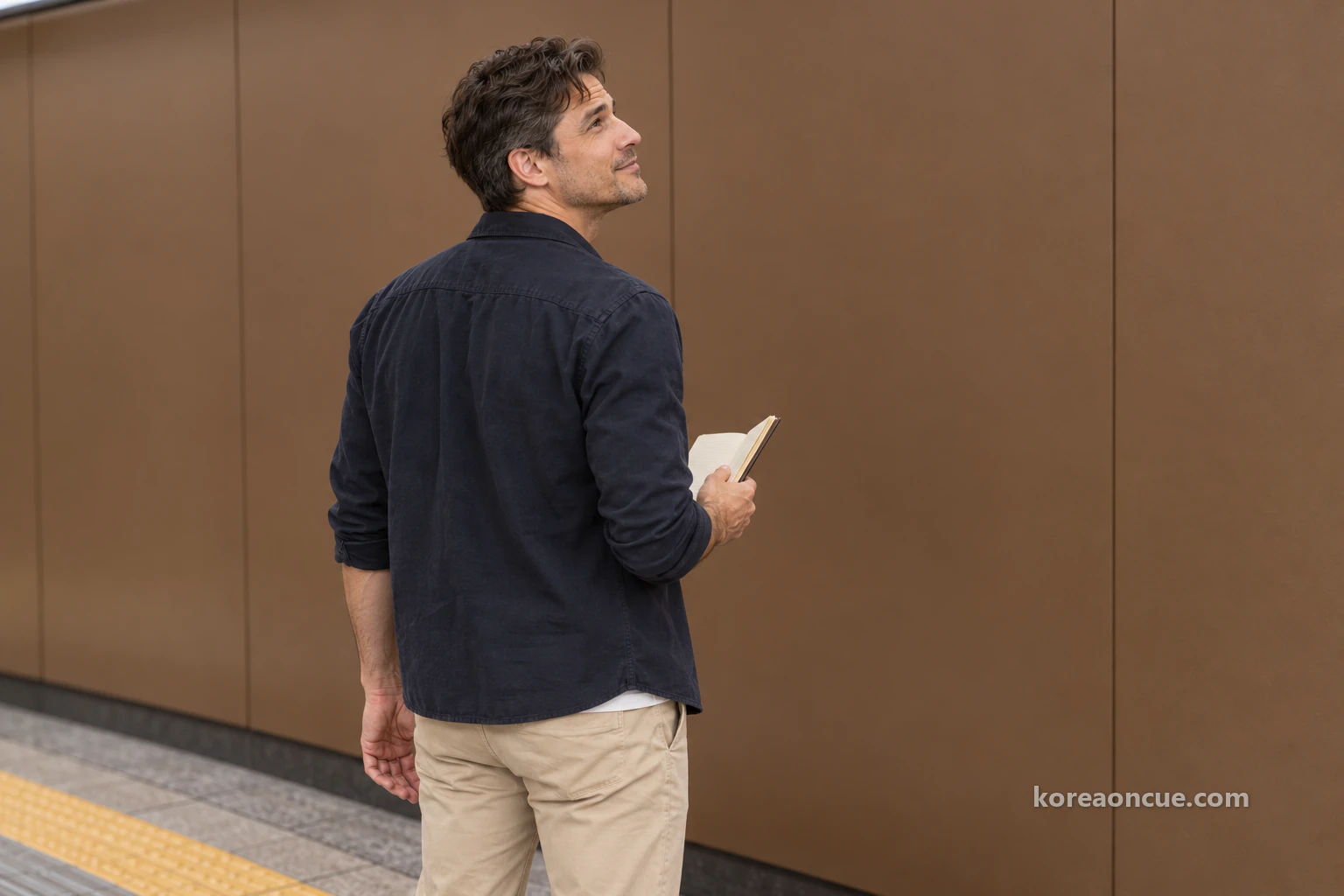
You can also come by bus. On bus 3324, get off at the “Amsa Historic Site Station Exit 3” stop and walk towards the site for 10 minutes. On buses 340, 3411 and 3318, get off at the “Samsung Gwangnaru Apartment” stop and walk for 10 minutes. From Amsa Station Exit 1, village bus 02 drops you in front of the main gate of the Seoul Amsa-dong Prehistoric Settlement Site. Ethan came by subway today, but thinking of the next person he might tell, he reads the two stop names out loud once.
At the main gate and ticket office: dividing the site by the 17 numbers on the site map
Inside the site, you get lost less if you remember it by the numbers on the site map. The map numbers 17 places, from 1, the car park and café, to 17, the prehistoric experience classroom. Number 2 is the main gate, 3 is the ticket office, 4 is the Remains Protection Hall and 5 is the reconstructed pit houses. Number 7 is the museum, and there are names such as 9, the Path of Time, and 11, the Waterway of Memory. As soon as he sees the numbers, Ethan draws 17 circles in his notebook.
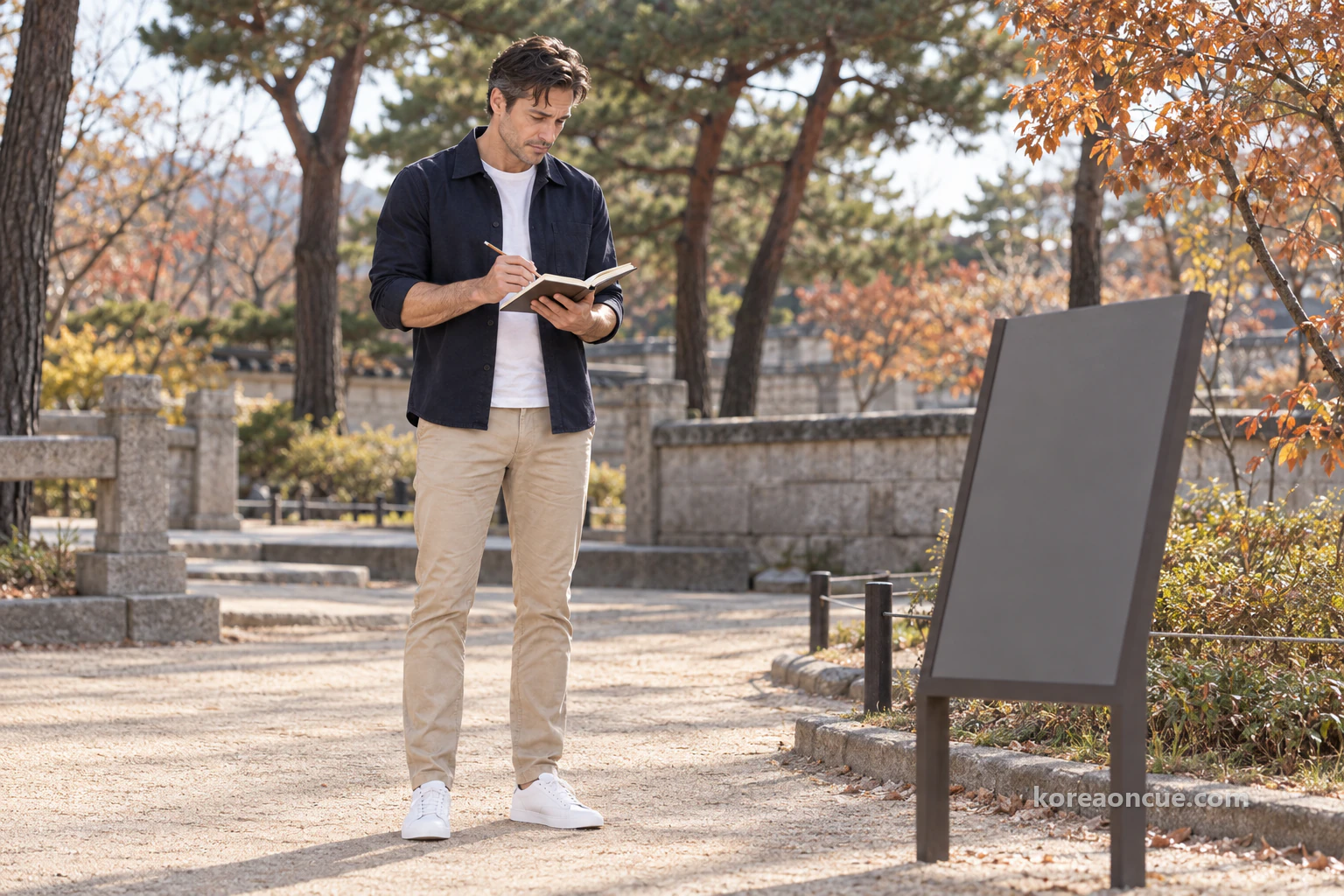
He shades five of them first: 2, the main gate, 3, the ticket office, 4, the Remains Protection Hall, 5, the reconstructed pit houses, and 7, the museum. The hands-on spots, such as 6, the hands-on pit house, 12, the fishing area, 13, the hunting area and 14, the excavation area, he leaves as empty circles. Number 15 has the name “Baekje dwelling site”. For Ethan, finding the name of a house site from another era inside a Neolithic village is a small discovery.
After paying 500 won at the ticket office, Ethan first reads the wheelchair loan notice by the window. You can borrow one wheelchair free of charge at the ticket office. The service runs from 9:30 to 5:30, and if you leave your ID, you can keep it for up to two hours. For enquiries, call 02-3425-6532 or 6520. Checking the spots other people will use before anything else is a habit Ethan has kept since he started drawing factory equipment.
There are rules to know before you go in, too. The Seoul Amsa-dong Prehistoric Settlement Site is not a park, so sports such as badminton and ball games are not allowed. Bicycles, kick scooters, inline skates and shoes with wheels are also restricted. Pets other than guide dogs cannot come in, and cooking and drinking alcohol are not allowed. Every part of the site is non-smoking, and Ethan gathers these rules in a corner of his notebook, each marked briefly with an “X”.
What is the Seoul Amsa-dong Prehistoric Settlement Site? A Neolithic village from around 6,000 years ago
The Seoul Amsa-dong Prehistoric Settlement Site holds the remains of houses where Neolithic people lived around 6,000 years ago. It is the largest Neolithic communal settlement found in Korea so far. A communal settlement is the site of a village made up of many houses together. Walking through the main gate, Ethan shortens that long phrase to one word in his notebook: “village”. A plan has to be short to be readable on your feet, and that is a principle he kept even when drawing market plans.
The site was designated Historic Site No. 267 on 26 July 1979. After that, nine rounds of restoration work rebuilt Neolithic pit houses and added a prehistoric life exhibition hall. It has been open to the public since August 1988. Full-scale excavations in the 1970s turned up house sites and everyday objects such as comb-pattern pottery, net sinkers, grinding stones, grinding slabs and arrowheads. Gangdong-gu is working towards having the site inscribed as a UNESCO World Heritage Site.
In the shade by the ticket office, Ethan opens his notebook and does a sum. Spread 6,000 years over the 0.96 km of the ginkgo road, and 1 m comes to 6.25 years. Then 1925 sits about 16 m from the end of the road, and the 1979 designation a little over 7 m from it. From the 1988 opening to 2026 is roughly the last 6 m. If 6,000 years were 960 m, the time since people noticed this village again would be the last twenty steps or so.

When the sum is done, Ethan draws a line for the first time between the two numbers at the top of his notebook. A length and a time have different units and cannot sit on one line, and nobody knows that better than Ethan. Still, this makeshift ruler turns out to be quite useful for planning today’s walking. On the ginkgo road, he decides to take the last twenty steps slowly on purpose. Beside the line, he writes in small letters “1 m = 6.25 years”.
At the reconstructed pit houses: looking at the row rather than the count
The first place Ethan heads for inside the site is number 5, the reconstructed pit houses. These are Neolithic pit houses rebuilt over nine rounds of restoration work. Their low, cone-shaped roofs stand in a row, drawing a picture of the word “village” he wrote in his notebook earlier. Instead of counting the houses one by one, Ethan follows the line the roofs make with his eyes. He has made today a day for looking at layout, not numbers.

There are rules for taking photos, too. Photography with flash or a tripod, and photography for commercial use, are not allowed. Ethan never carries a tripod anyway, so he just takes out his phone. He keeps the flash off from the start, stands outside the fence and finds a spot where the roofs fit into one frame at an angle. He sets one of those photos aside to post in the four friends’ group chat that evening.
There are hands-on programmes at the weekend, too. Programmes such as “Prehistoric Angler”, “Neolithic Riverside Village Workshop”, “Polished Stone Tool Workshop” and “Prehistoric Hunter School” run on Saturdays and Sundays. On weekdays, groups take part by booking in advance. Reading the programme names, Ethan laughs at “Prehistoric Angler”. A colleague in Seattle who takes his fishing rod down to the lake every weekend comes straight to mind.
What to see in the museum’s permanent exhibition hall: from comb-pattern pottery to the history of the excavations
In the museum’s permanent exhibition hall, you can see this village’s pottery, tools and excavation story in one place. The hall is divided into the information area and lobby, comb-pattern pottery, a change to a warmer age, and the ecology of the Han River in the Neolithic. There are also sections called an invitation to the Neolithic village of Amsa-dong, new techniques and tools, and Neolithic pottery culture. The last two are the comb-pattern pottery of the Amsa-dong site and the history of the Amsa-dong excavations. Ethan decides to look at the pottery first and read the excavation history last.
At the lobby entrance stands a work of contemporary art. It was made in collaboration with the artist Jang Seung-hyo and shows the past and future of the site. For Ethan, a museum about a 6,000-year-old village opening with contemporary art is an interesting order. It puts the newest thing at the entrance of a building that explains the oldest. Ethan stands in front of the work for a long while, then writes only “past → future, entrance” in his notebook.

The section where Ethan stays longest is comb-pattern pottery. Here he sees, now as pottery, the colour he met first on the platform wall that morning. It feels as if a line that started at the station has gone round inside the museum and closed. Ethan steps back so his face does not touch the glass of the display case and looks for a long time. Next to his sketch of the platform, two new words appear: “same colour”.
In front of the last section, the history of the Amsa-dong excavations, Ethan thinks of the 16 m he worked out earlier. At the spot 16 m from the end of 6,000 years, in 1925, this village began to reappear. The story is told in more detail by this autumn’s small exhibition. Even after the permanent exhibition, Ethan does not close his notebook. He knows the next box, the small exhibition, follows straight on.
The small exhibition “Memories of Amsa-ri, Gucheon-myeon”: the site revealed by the Great Flood of 1925
The site has been known since the Eulchuk-year flood of 1925. That year’s flood badly scoured the sand dunes along the Han River, and countless shards of comb-pattern pottery were exposed. From then on, people began to learn that this was a leading Neolithic site. Ethan finds it strange that water pulled a buried village into the open. For someone who designs things, a flood has always been a number to keep out.
The 2026 special small exhibition “Memories of Amsa-ri, Gucheon-myeon” introduces exactly that discovery and the research that followed. It runs from 16 October to 20 December 2026. The exhibition includes glass plate photographs left by the Japanese Government-General of Korea when it surveyed the Amsa-ri area. Images of old maps and administrative documents are on show as well. Ethan writes “Amsa-ri” from the exhibition title in his notebook and places it next to the name of the station where he got off today.
In front of the glass plate photographs, Ethan keeps his head bowed for a long time. At the words “photographs on glass plates”, the engineer thinks first of the recording device. What tools people used 100 years ago to record this land interests him as much as the scenery in the pictures. Next to “1925” in his notebook, Ethan adds one word: “glass plate”. Putting a name next to a number is a habit he picked up on this trip.

By the time he has seen the exhibition and comes out, the afternoon is just beginning. Ethan did the site first because of its closing time. The site closes at 6 p.m. and sells tickets only until 5:30. If you plan to arrive late in the afternoon, keep the number 5:30 in mind first. Ethan draws an arrow at the end of the line in his notebook, passes the main gate and walks out towards the main road.
The 0.96 km ginkgo road on Olympic-ro beside the site: no timing, and the last twenty steps slowly
Leaving the main gate, Ethan heads for the main road in the site’s address, Olympic-ro. The Autumn Foliage Road (Olympic-ro) is a 0.96 km ginkgo road that runs beside the site. Tall ginkgo trees stand in rows on both sides of the road, their leaves turned yellow. Fallen leaves lie in a thin layer along the edge of the pavement. Every time a car passes, a few leaves are pushed over towards the pavement.
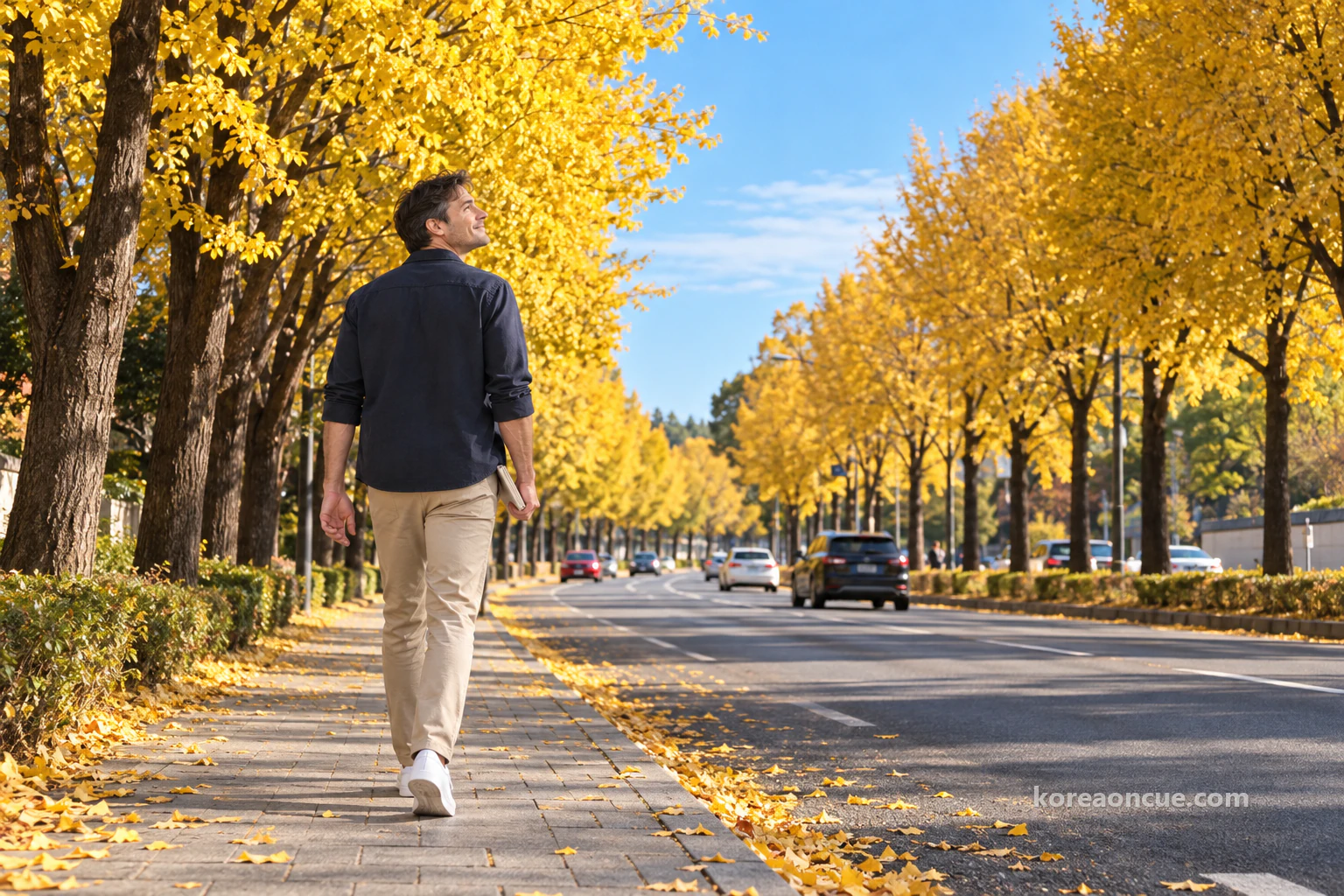
Before he starts walking, Ethan decides one thing. Today, he will not time himself on this road. Instead of noting how many minutes the 0.96 km takes, he brings out the makeshift ruler from the morning again. If 1 m is 6.25 years, how many years is one step? Ethan works it out in his head without opening his notebook. Walking without writing a number down is quite rare for Ethan.
This road is a walk along the pavement beside a main road. When you take photos, stand on the inner side of the pavement and don’t step out towards the road. Ethan, too, stands on the inner side of the pavement between two trees and raises his phone towards the stretch of road running into the distance. With yellow trees lining both sides, the two rows narrowing into the distance fit into a single shot. Looking at the screen, Ethan murmurs that it is like the vanishing point on a drawing.
Beyond one side of the road is the site he has just left. Between a 6,000-year-old village and a main road full of traffic, one yellow line has been drawn. To Ethan, that picture is the biggest plan of everything he has seen today. The two numbers he wrote separately at the top of his notebook this morning turn out to sit right next to each other like this. Ethan slows his pace and looks up once at the sky between the yellow branches.
As the end of the road comes closer, Ethan slows down even more. As he decided that morning, he takes the last twenty steps slowly. By Ethan’s makeshift ruler, those twenty steps hold the 1925 flood, the 1979 designation as a historic site and the 1988 opening. On the last step, Ethan stops and looks back at the road behind him. Two yellow rows stretch all the way back to where he first walked in.
The Amsa Green Road on the next-trip page: the way back and the two numbers left in the notebook
Before heading back, Ethan writes down one more road to walk next time. It is the Amsa Green Road (암사초록길), a covered footpath that links Hangang Park and the Amsa-dong site, which had been cut off from each other by Olympic-daero. It is 50 m wide with 6,300 ㎡ of green space, and has been open to walkers since April 2025. Ethan writes its name at the very bottom of his notebook, in the box for his next trip, where the date is still blank. The way back is through the same Amsa Historic Site Station, and the platform walls now look like the colour of the pottery he saw in the museum.
While he waits for the train, Ethan posts one photo of the pit houses and one line in the four friends’ group chat. “I only walked 0.96 km today, but it feels like I walked through 6,000 years.” Lulu replies first, saying she hopes the next episode after yesterday’s market video will be a yellow road. Maya says she likes the way the roofs run on at an angle, and Rina is the first to spot the box label in his notebook, caught in the corner of the photo. As always, the four friends’ chat ends short and light.

Back at the hotel, Ethan opens the fresh page of his notebook again. Between “0.96 km” and “6,000 years” at the top, the line he drew that morning and “1 m = 6.25 years” are still there. Near the right-hand end of that line, Ethan makes three small dots: 1925, 1979 and 1988. Two numbers with different units joined into one line by a single day of walking — it is the shortest plan in his notebook from this whole trip.
Common Mistakes
Going on a Monday
the Seoul Amsa-dong Prehistoric Settlement Site is closed every Monday and on 1 January. When a Monday is a public holiday, it closes on the first weekday after it.
Arriving late in the afternoon and missing the tickets
the site is open until 18:00, but tickets are sold only until 17:30.
Treating the site like a park
the Seoul Amsa-dong Prehistoric Settlement Site is not a park. Ball games, badminton, cooking and drinking are not allowed, and bicycles, kick scooters, inline skates and shoes with wheels cannot come in.
Shooting with flash or a tripod
photography with flash or a tripod, and photography for commercial use, are not allowed.
Stepping into the road for photos on the ginkgo road
this is a walk along the pavement beside a main road. Take your photos from the inner side of the pavement.
Knowing only one station
there are two ways: Amsa Historic Site Station Exit 3 on Line 8 (10 minutes on foot) and Amsa Station Exit 4 (15 minutes on foot).
FAQ
Which station and exit should I use?
Come out of Exit 3 of Amsa Historic Site Station on Line 8 and walk towards the Seoul Amsa-dong Prehistoric Settlement Site for 10 minutes. From Amsa Station Exit 4 on Line 8, it is a 15-minute walk, and from Amsa Station Exit 1, village bus 02 drops you in front of the main gate.
What are the opening hours and closing days?
09:30–18:00, with tickets until 17:30. It is closed on 1 January and every Monday. When a Monday is a public holiday, it closes on the first weekday after the holiday.
How much is admission?
500 won for adults (19–64) and 300 won for children (7–18). Children aged 6 and under, people aged 65 and over, persons of national merit, people with disabilities and others get in free.
How long is the ginkgo road?
Number 138 on Seoul’s 110 Autumn Foliage Roads, the Autumn Foliage Road (Olympic-ro), is a ginkgo road 0.96 km long.
When are the autumn colours best?
The Seoul Metropolitan Government expects Seoul’s autumn colours to be at their best from late October to early and mid-November (a forecast for Seoul as a whole).
Is there an exhibition on in November?
The 2026 special small exhibition “Memories of Amsa-ri, Gucheon-myeon” runs from 16 October to 20 December 2026.
Can I borrow a wheelchair?
You can borrow one free of charge at the ticket office, 09:30–17:30, for up to two hours if you leave your ID (contact 02-3425-6532 or 6520).
Who do I contact?
For site visits, 02-3425-6520. For the ginkgo road, the Gangdong-gu Office Green City Division on 02-3425-6464.
Recap — 30 seconds before you go
- Amsa Historic Site Station Exit 3 on Line 8 → 10 minutes on foot → Seoul Amsa-dong Prehistoric Settlement Site (875 Olympic-ro) · 15 minutes from Amsa Station Exit 4
- Site 09:30–18:00, tickets until 17:30 · closed on Mondays and 1 January (when a Monday is a public holiday, the first weekday after it) · 500 won for adults, 300 won for children
- Reconstructed pit houses · the museum’s permanent exhibition hall · the small exhibition “Memories of Amsa-ri, Gucheon-myeon” (until 20 December 2026)
- 0.96 km ginkgo road on Olympic-ro beside the site (number 138 of Seoul’s 110 Autumn Foliage Roads) — take photos from the inner side of the pavement
- The site is not a park — no ball games, cooking, bicycles or flash photography
Sources
- Seoul Metropolitan Government — list of the 110 Seoul Autumn Foliage Paths (No. 138, Autumn Foliage Road, Olympic-ro)No. 138 · Gangdong-gu · Autumn Foliage Road (Olympic-ro) · ginkgo · 0.96 km · between Amsa Historic Park and the prehistoric site · enquiries 02-3425-6464 (Gangdong-gu Office, Green City Division)checked 2026-11-02
- Seoul Metropolitan Government press release — selection of the “110 Seoul Autumn Foliage Paths” (30 October 2026)167 km in total · ginkgo, zelkova, Yoshino cherry, metasequoia and other trees · Seoul’s autumn colour expected to be at its best from late October to early or mid-November (a sentence about Seoul as a whole, not a figure for this road)checked 2026-11-02
- Seoul Amsa-dong Prehistoric Settlement Site website — directionsLine 8 Amsa Historic Site Station Exit 3, 10 minutes on foot towards the site · Line 8 Amsa Station Exit 4, 15 minutes on foot · bus 3324 to the “Amsa Historic Site Station Exit 3” stop, 10 minutes on foot · 875 Olympic-ro, Gangdong-guchecked 2026-11-02
- Seoul Amsa-dong Prehistoric Settlement Site website — visitor informationTickets 09:30–17:30, viewing 09:30–18:00 · closed on 1 January and every Monday · adult individual ticket 500 won · free morning exercise hours · visiting etiquette (no flash or tripod photography and so on)checked 2026-11-02
- Gangdong Culture Portal — introduction to the Seoul Amsa-dong Prehistoric Settlement SiteRemains of Neolithic house floors from about 6,000 years ago · comb-pattern pottery fragments began to be exposed by the flood of 1925 · designated Historic Site No. 267 in 1979 · opened in August 1988checked 2026-11-02
- Seoul Amsa-dong Prehistoric Settlement Site website — museum permanent exhibition hallHall layout (comb-pattern pottery, the Neolithic Han River environment, the history of excavation at Amsa-dong and so on) · the contemporary art work at the lobby entrance is a collaboration with the artist Jang Seung-hyochecked 2026-11-02
- Seoul Amsa-dong Prehistoric Settlement Site website — 2026 small exhibition“Memories of Amsa-ri, Gucheon-myeon”, 16 Oct–20 Dec 2026 · introduces the discovery and study of the site that came to light after the great flood of 1925checked 2026-11-02
- Seoul Media Hub — places to visit by the Byeollae LineAmsa Historic Site Station Exit 3, 10 minutes on foot · Line 8 Byeollae extension of 12.9 km · a work on the concourse themed on comb-pattern pottery and the colour of the platform wallschecked 2026-11-02
- Gangdong-gu press release — opening of the Amsa Green Path (29 April 2025)A covered pedestrian path linking the Han River Park and the Amsa-dong site, which the Olympic Expressway had cut off · 50 m wide · 6,300 sq m of greenerychecked 2026-11-02
A Seoul story told with our AI characters. Place details are checked against public sources; the photos are AI-made illustrative images. How we use AI
Next Cue — What to read next

The Hyundai Christmas Village: the waitlist for overseas visitors
Hina puts lines like “Booking opens 11:00” on posters for a living, and she missed exactly that 11 o’clock.

Dongdaemun markets on Sunday: open and closed
Lulu had planned to buy wrapping supplies at Bangsan Market on Sunday morning for the small year-end gift boxes she wanted to fill.

Culture Station Seoul 284: getting in without registering in advance
Elena wrote “11 a.m., the door of the old station” on the first line of her scene notes. It was opening day, and on the first day alone the doors opened at 3 p.m. Elena spent the four hours on Seoullo 7017, then put the eye she uses to tell real from fake to the test in front of a deepfake film.