SEOUL · CHANGGYEONGGUNG
Changgyeonggung from Honghwamun to Myeongjeongjeon: an East-facing Gate and a Single Roof
Maya walks over from Hyehwa Station, goes in through Honghwamun in the morning light, crosses Okcheongyo and passes under Myeongjeongmun to stand before Myeongjeongjeon, then comes back to the same axis late in the afternoon
An added piece in “Changdeokgung, Changgyeonggung and Jongmyo.” Unlike the other palaces, which face south, Changgyeonggung has its main gate and throne hall facing east, and Myeongjeongjeon is the oldest throne hall in the palaces today. Maya, who saw a double roof at Gyeongbokgung, goes in through the east-facing gate in the morning and walks to a throne hall with a single roof. Changgyeonggung is closed on Mondays.
How to get there
Pedestrian route calculated by a map app (TMAP), ending at the map’s point for Honghwamun. The Royal Palaces and Tombs Center gives a 12-minute walk from Hyehwa Station Exit 4 (300 m straight towards Sungkyunkwan University, then 300 m straight towards Changgyeonggung and Jongno). The Changgyeonggung car park is temporarily closed until 31 December 2026. Distances inside the palace are not given as numbers.
This is a new piece for “Changdeokgung, Changgyeonggung and Jongmyo.” In her Changgyeonggung piece, Lulu went in through Honghwamun, passed in front of Myeongjeongjeon and headed north to the ponds and the glasshouse. Today is about the stretch she passed: from the main gate, Honghwamun, over Okcheongyo, through Myeongjeongmun to Myeongjeongjeon. A short axis from the main gate to the throne hall.
Maya is someone who picked her Seoul on screen first. In front of Geunjeongjeon at Gyeongbokgung, what she saw was a double roof. On screen, palace throne halls were always big and tall. But according to the Royal Palaces and Tombs Center, Changgyeonggung’s throne hall, Myeongjeongjeon, was built on a single storey, and it is the oldest throne hall in the palaces today. A new line appears on Maya’s list, with a question mark: “The small throne hall is the oldest?”
One more thing. This palace faces east. So Maya comes in the morning. If the gate faces east, then standing in front of it, the sun rises behind you. First line in her notebook: “Morning. The front of the gate.”
830 metres from Hyehwa Station, Exit 4
From Exit 4 of Hyehwa Station (Line 4) to Honghwamun, the main gate of Changgyeonggung, the map route is 830 m, about 11 minutes (TMAP pedestrian route calculation; the end point is the map’s point for Honghwamun).
By a map app’s walking route, it is 830 m, about 11 minutes, from Exit 4 of Hyehwa Station on Line 4 to Honghwamun, the main gate of Changgyeonggung. The end point is the single spot the map uses for Honghwamun. The Royal Palaces and Tombs Center puts it at a 12-minute walk from the same exit: 300 m straight towards Sungkyunkwan University, then another 300 m straight towards Changgyeonggung and Jongno. It also notes that the Changgyeonggung car park is temporarily closed until 31 December 2026. Find on a map
A weekday, just before nine in the morning. Maya walks among people on their way to work. Following the traffic noise of the main road, she comes to a tiled wall and a gate. On screen, palaces always started inside the gate. Today Maya starts outside it.
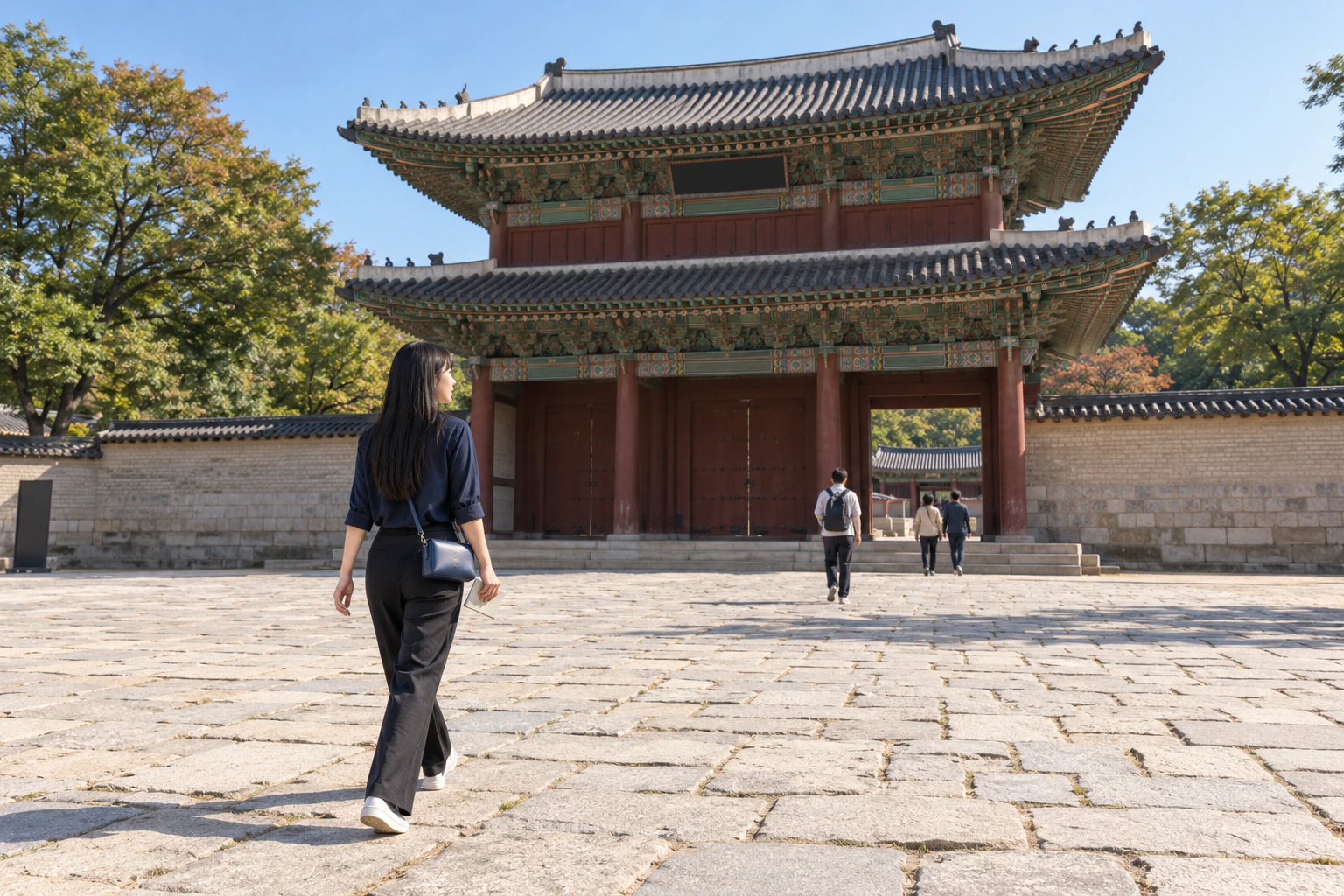
The Royal Palaces and Tombs Center notes that, unlike the other palaces, which face south, Changgyeonggung has its main gate and throne hall facing east. The Korea Heritage Service goes a step further: it calls it the only Joseon palace built facing east. In front of the gate, Maya turns round once. The morning sun is behind her. She buys a ticket: 1,000 won for an adult.
Honghwamun, a main gate three bays wide
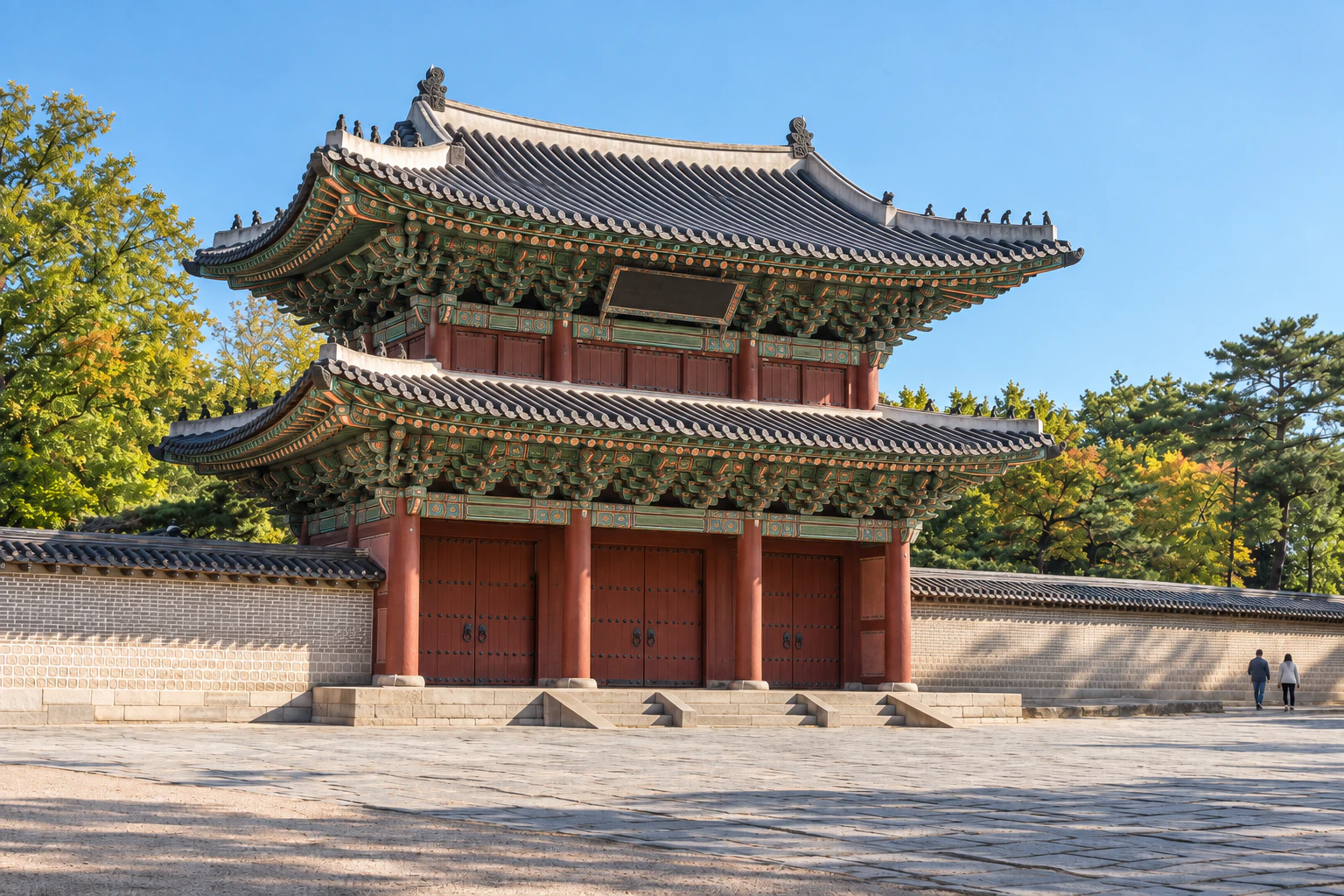
Korea Heritage Service, Treasure “Honghwamun Gate of Changgyeonggung Palace”: the palace’s main gate, built in 1484 (15th year of King Seongjong), burned in the Imjin War and rebuilt in 1616 (8th year of Gwanghaegun), and repaired several times since. It is a two-storey building, three bays wide and two deep, facing east, under a hipped roof that looks like a trapezoid from the front. Each bay of the lower storey has a pair of doors to pass through; the upper storey has a wooden floor and small plank doors in its front and back walls. The Royal Palaces and Tombs Center adds that, while Donhwamun, the main gate of Changdeokgung in the same Eastern Palace, is five bays wide, Honghwamun was built smaller, at three bays, and that King Jeongjo is said to have handed out rice to poor people outside Honghwamun in 1795 to mark the 60th birthday of his mother, Lady Hyegyeong.
According to the Korea Heritage Service, Honghwamun is the main gate of Changgyeonggung, built in 1484, the 15th year of King Seongjong. It burned in the Imjin War, was rebuilt in 1616 and has been repaired several times since. It is a two-storey gate, three bays wide and two deep, and from the front its roof looks like a trapezoid. Find on a map
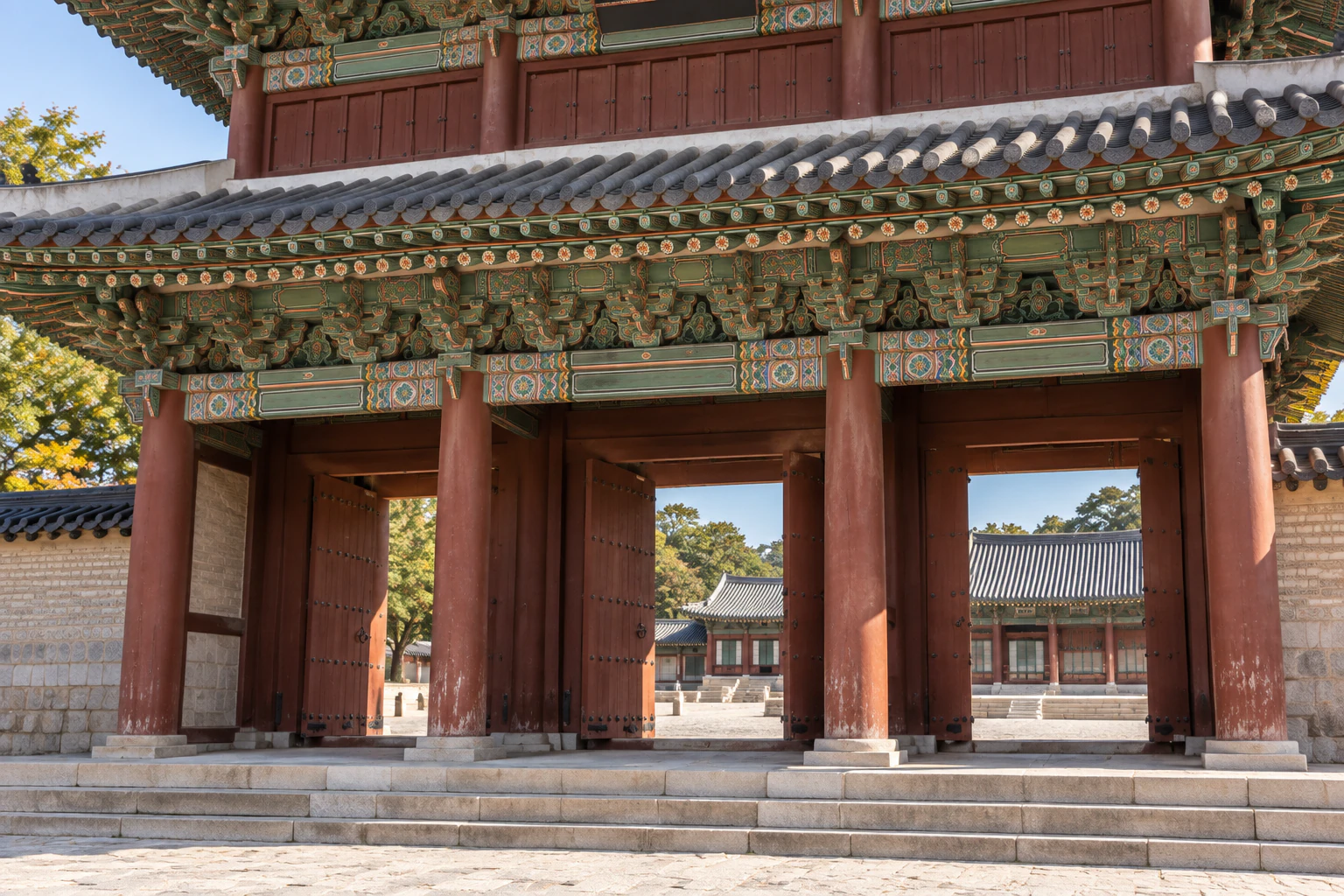
Maya counts the bays. One, two, three. The Royal Palaces and Tombs Center explains that Donhwamun, the main gate of Changdeokgung in the same Eastern Palace, is five bays wide, while Honghwamun was built smaller, at three. Each bay of the lower storey has a pair of doors to walk through; the upper storey has a wooden floor and small plank doors in its front and back walls. Maya looks up at the small doors above. Morning light falls on the front of the gate.
The same page tells a story. In 1795, it says, King Jeongjo handed out rice to poor people outside Honghwamun to mark the 60th birthday of his mother, Lady Hyegyeong. Maya looks back at the street she has just walked in from. The palace gates on screen were always gates you went in through. The gate in this story is one that gave something out.
Okcheongyo, the first bridge inside the gate
Korea Heritage Service, Treasure “Okcheongyo Bridge of Changgyeonggung Palace”: just inside the main gate, Honghwamun, this stone bridge crosses the Okryucheon, which flows from north to south. It joins two semicircular arches. Where the two arches meet, a goblin face is carved, broad at the brow and narrow at the chin, and the deck rises very slightly in the middle like a rainbow. The bridge was made wide enough for the guards who flanked the king’s procession, with railings on both sides and stone animals carved on the posts at each end. It is thought to date from 1483, when the palace was being built. The Royal Palaces and Tombs Center writes that auspicious water from Eungbongsan runs past Jondeokjeong in Changdeokgung and through Chundangji in the north of Changgyeonggung to Okcheongyo and on southwards, that the goblin face was meant to drive away spirits coming in along the water and so protect the palace, and that among the palace bridges that remain, Okcheongyo keeps its original form well.
Through the gate is a stone bridge. The Korea Heritage Service says that once you enter Honghwamun, Okcheongyo crosses the Okryucheon, which flows from north to south. It is made of two semicircular arches joined together, and is thought to date from around 1483, when the palace was being built. The Royal Palaces and Tombs Center describes it as one of the palace bridges that keep their original form well. Find on a map
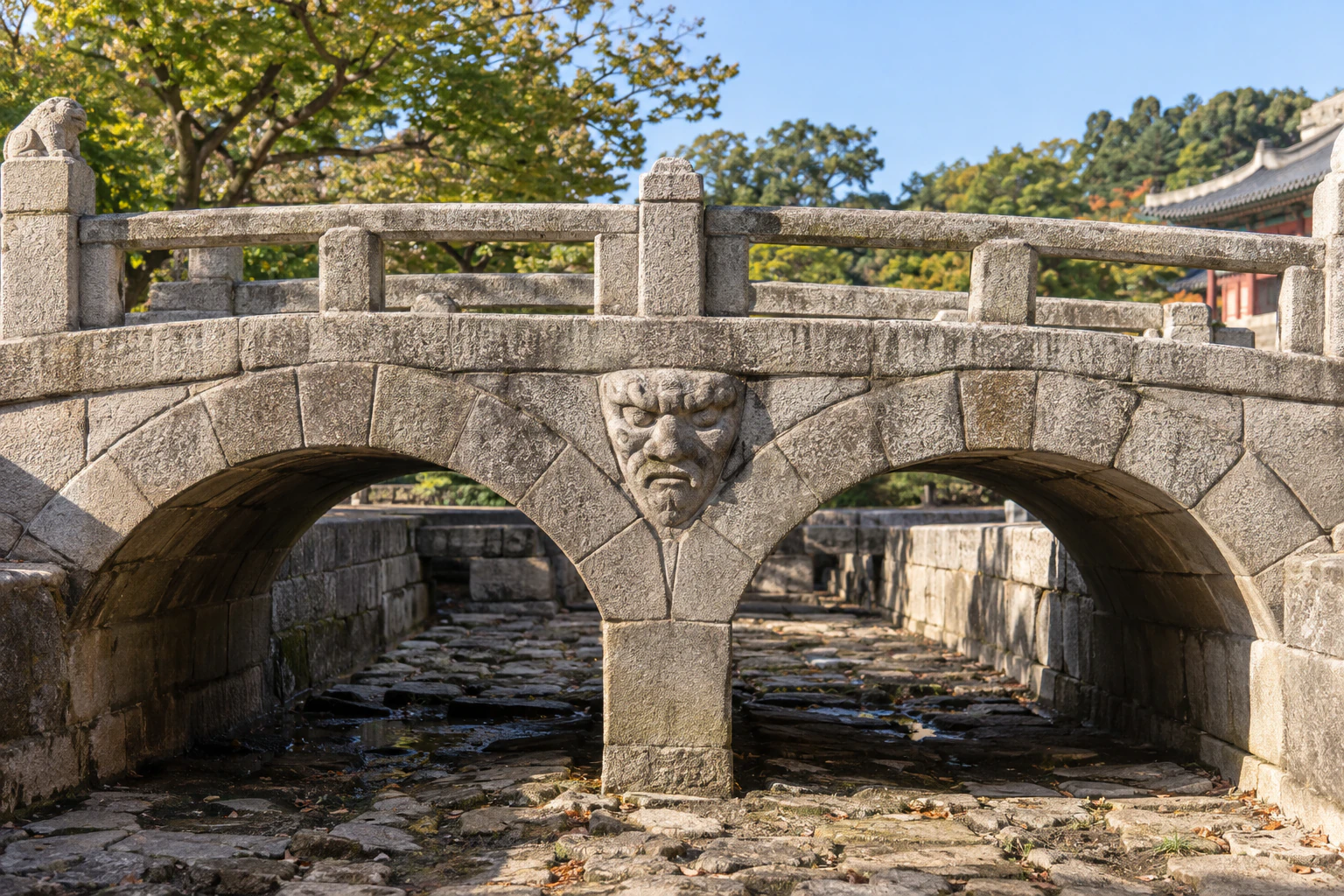
Where the two arches meet, a face is carved: a goblin, broad at the brow and narrow at the chin. The Center explains that it was meant to drive away spirits coming in along the water and so protect the palace. Maya leans over by the railing to find it. On the posts at each end of the bridge sit stone animals, carved round.
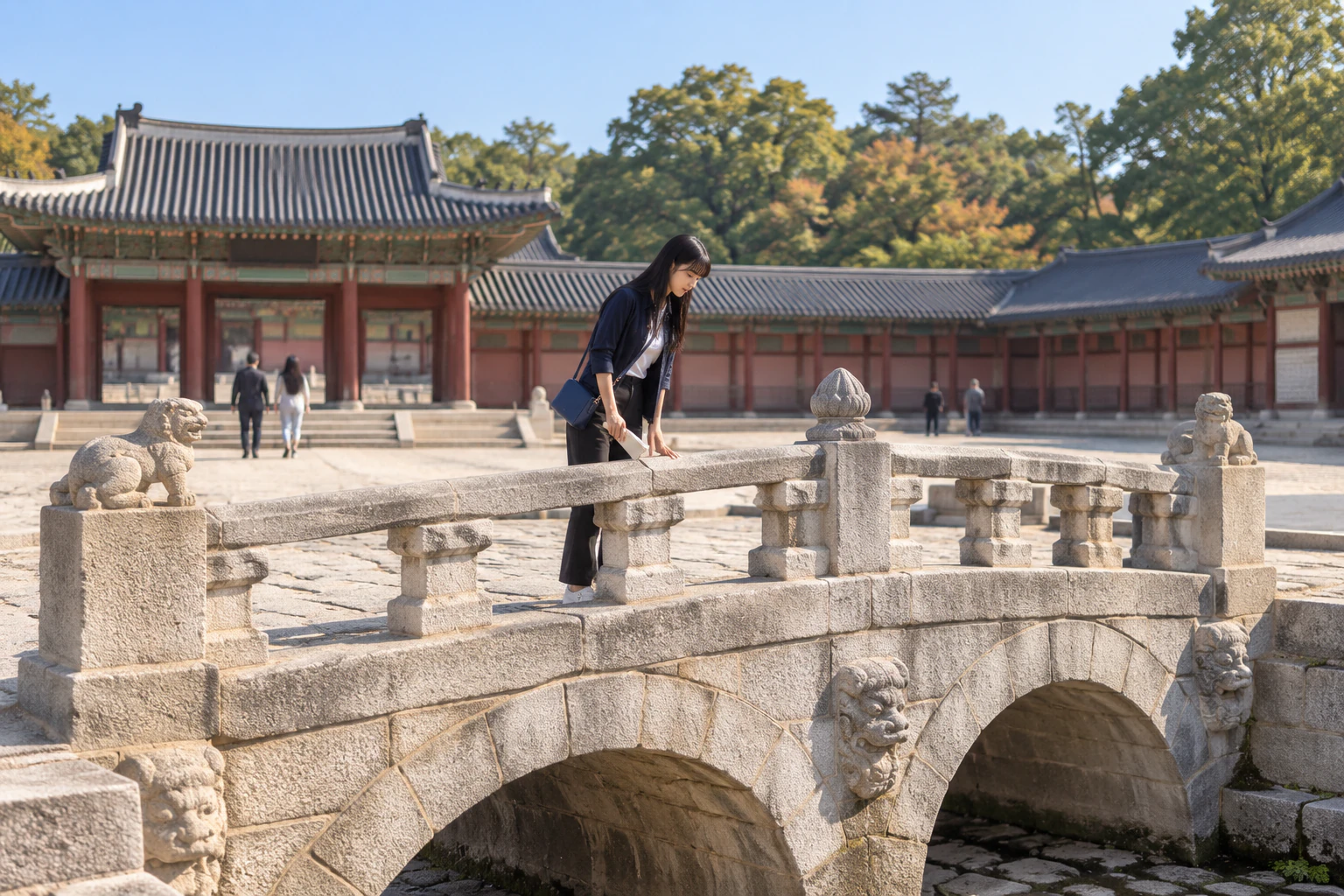
The deck rises very slightly in the middle, like a rainbow. The Korea Heritage Service notes that the bridge was made wide enough for the guards who flanked the king’s procession. The water the Center describes comes from further away: from Eungbongsan, past Jondeokjeong in Changdeokgung and through Chundangji in the north of Changgyeonggung, to this bridge and on south. A 2023 article by a Seoul citizen reporter, though, said that this water was damp rather than flowing. Maya writes down what she sees below in one line, without numbers: “Between the stones, a path for water.”
Under Myeongjeongmun, to a throne hall with a single roof
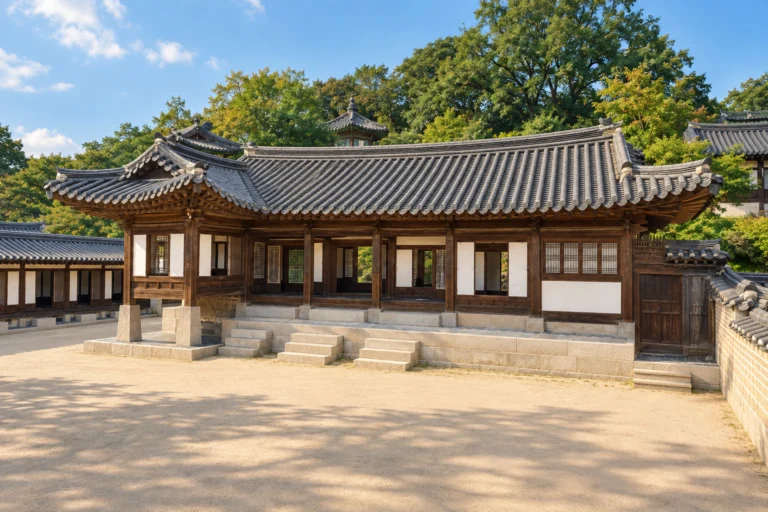
Korea Heritage Service, National Treasure “Myeongjeongjeon Hall of Changgyeonggung Palace”: the palace’s throne hall, where officials offered New Year greetings to the king, great state occasions were held and foreign envoys were received. Built in 1484 and burned in the Imjin War, it was rebuilt in 1616. It is a single-storey building, five bays wide and three deep — small for a throne hall, the description says, next to Geunjeongjeon at Gyeongbokgung and Injeongjeon at Changdeokgung, which were built large on two storeys. It has a hip-and-gable roof, and the bracket work above the columns is described as sturdy and well balanced, showing the style of early Joseon. Inside, the floor is laid with brick and behind the king’s seat stands a screen of the sun, the moon and five peaks; in front of the steps are 24 rank stones. Munjeongjeon, to the south of Myeongjeongjeon, and the surrounding corridors were mostly restored in a three-year project from 1983.
Across the bridge is the second gate, Myeongjeongmun. The 2023 article places Okcheongyo, the palace’s bridge over its inner stream, between Honghwamun and Myeongjeongmun. According to the Korea Heritage Service, Myeongjeongmun is three bays wide and two deep, and inside, most of the ceiling is left open so the roof timbers show. Maya stops under the gate for a moment and looks up at the rafters. Parts of the corridors around it, to the south and north, were pulled down under Japanese rule and restored in 1986. Find on a map
Through the gate is Myeongjeongjeon. The Korea Heritage Service describes it as a single-storey building, five bays wide and three deep — small for a throne hall, next to Geunjeongjeon at Gyeongbokgung and Injeongjeon at Changdeokgung, which were built large on two storeys. Maya writes in her notebook: “Geunjeongjeon, two roofs. Myeongjeongjeon, one.”
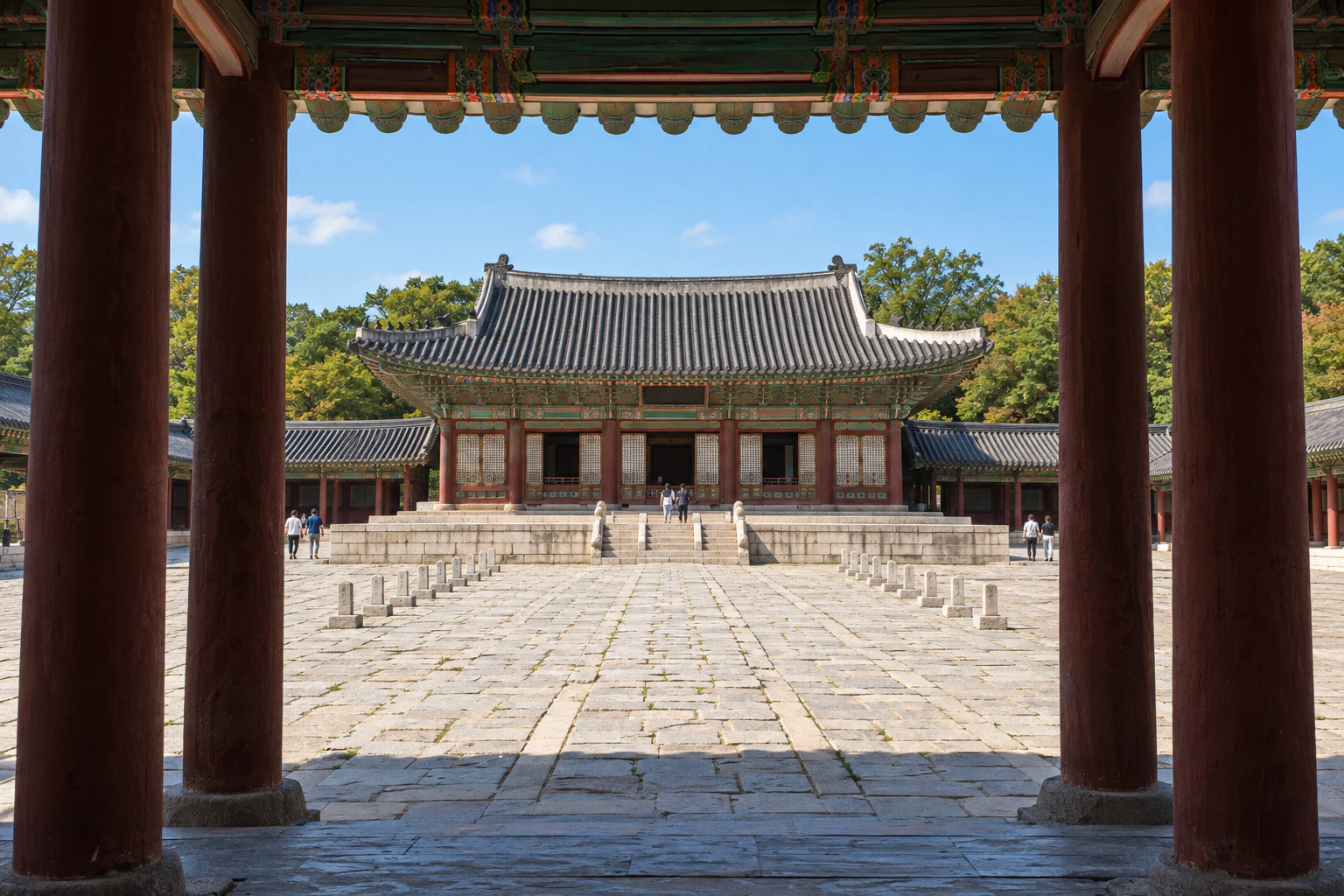
According to the Royal Palaces and Tombs Center, Myeongjeongjeon was where great state occasions took place: coronations, officials’ formal greetings, state examinations and court banquets. It was built in 1484, burned in the Imjin War and rebuilt in 1616, and that building is the oldest throne hall in the palaces today. Maya leaves the morning’s question mark where it is and writes beside it: “A single roof, standing since 1616.”
The Korea Heritage Service writes that the floor inside is laid with brick, and that behind the king’s seat stands a screen painted with the sun, the moon and five peaks. In front of the steps are 24 rank stones. At Geunjeongjeon, Maya stood behind one of the rows of rank stones. Today she stays at the edge of the courtyard and takes her time watching the single roof in the morning light.
Late afternoon, back on the same axis
Royal Palaces and Tombs Center opening hours: at a set evening time, visitors in the daytime areas of Changgyeonggung must move to the night-opening areas. The time is 17:30 in November–January and February, 18:00 in March–May and September–October, and 18:30 in June–August. The night-opening areas are Honghwamun, Myeongjeongjeon, Tongmyeongjeon, Chundangji and the Grand Greenhouse.
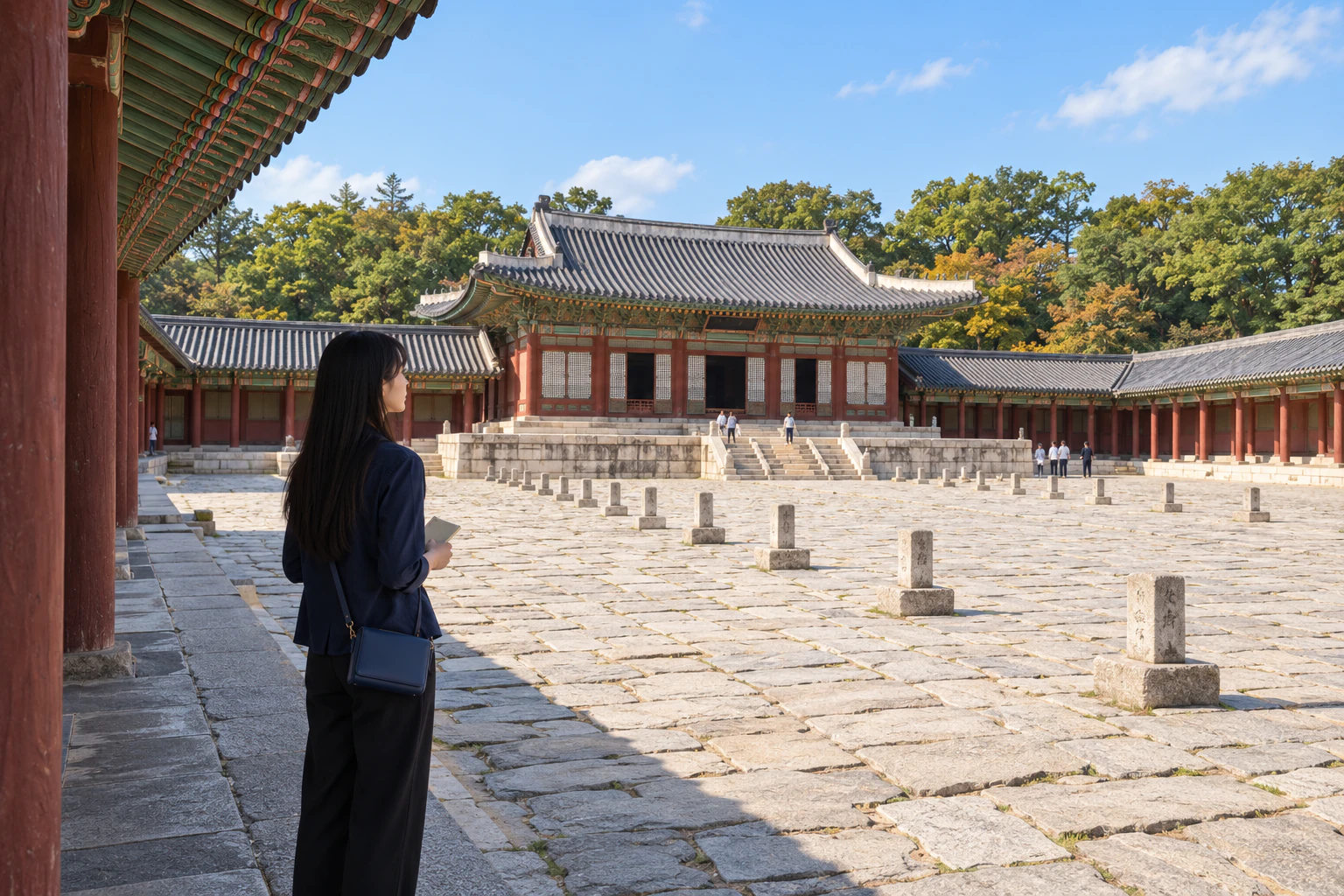
During the day Maya walked north, towards the ponds and the glasshouse. That part of the story is in Lulu’s piece. Around five in the afternoon she comes back down to Myeongjeongjeon. The sun that lit the front in the morning has moved round behind the roof. The building faces east, so late-afternoon light comes from behind the hall. Find on a map
According to the Royal Palaces and Tombs Center’s opening hours, at a set evening time anyone in the daytime areas of Changgyeonggung has to move into the night-opening areas, and in September and October that time is 6 p.m. The night-opening areas named include Honghwamun and Myeongjeongjeon. The start and the end of the axis Maya walked this morning are both on that list. Changgyeonggung is open until 9 p.m., with last entry at 8 p.m.
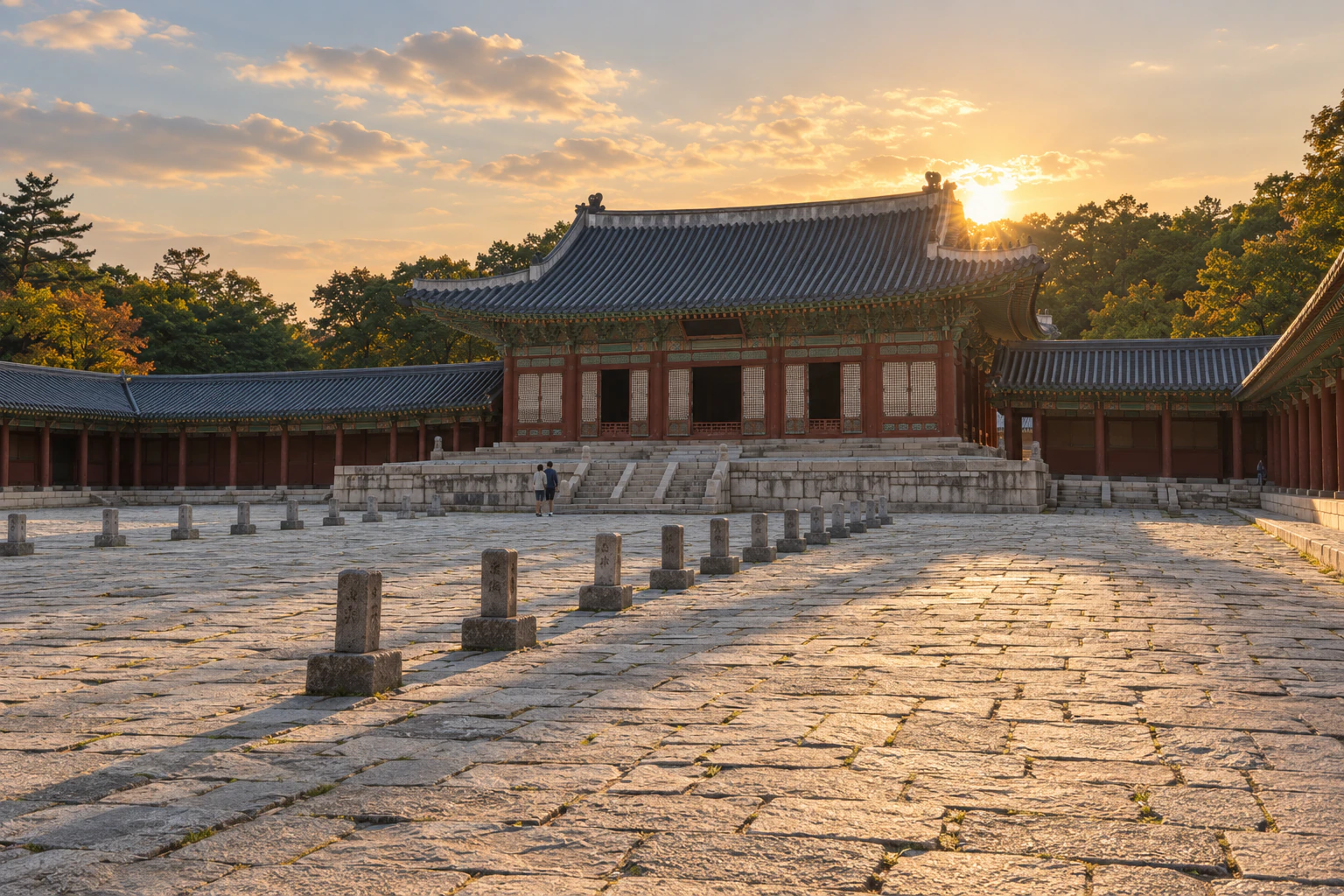
With Myeongjeongmun behind her, Maya walks slowly out towards Honghwamun. This morning she came in facing the gate; now she sees the same gate in light coming from behind her. Her notebook still has the order she came in by: gate, bridge, gate, hall.
Before she leaves through Honghwamun, Maya writes an answer next to the morning’s question mark: “The small throne hall is the oldest. A palace that faces east is bright at the front in the morning, and in the late afternoon the light comes from behind the roof.” The throne halls on screen always had double roofs. The one Maya picked today has a single roof.
Maya has one quiet suggestion. If you go to Changgyeonggung, go in through Honghwamun, look for the goblin face on Okcheongyo, and look up at the ceiling once as you pass under Myeongjeongmun. If you’re curious about the ponds and the glasshouse in the north, Lulu’s piece in this issue has already turned that evening into a timetable.
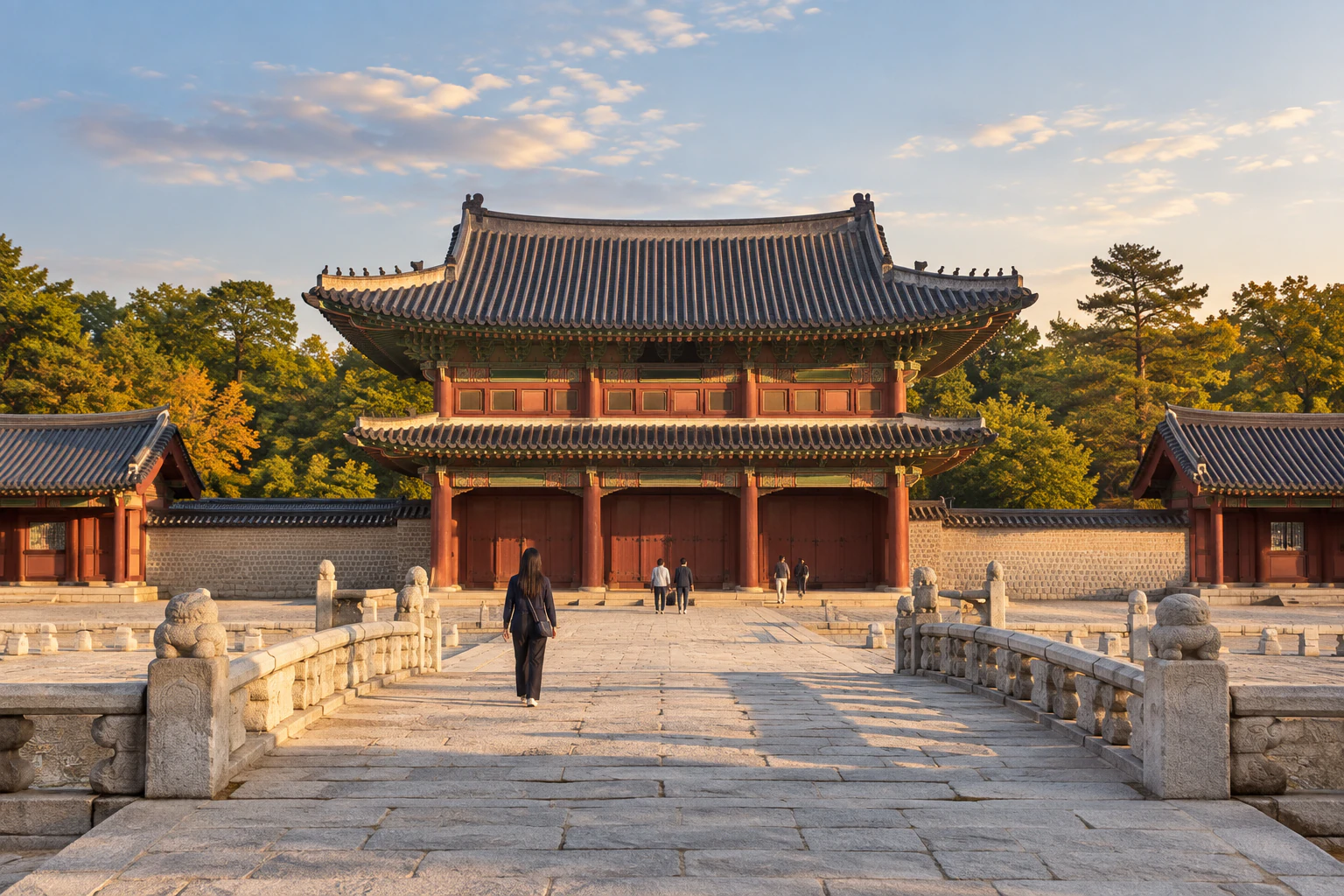
(※ This article includes staged images created with AI.)
Try it on your own day
An editorial suggestion: walk from Exit 4 of Hyehwa Station to Honghwamun at Changgyeonggung, cross Okcheongyo, pass through Myeongjeongmun to stand before Myeongjeongjeon, then come back to the same axis late in the afternoon and compare where the light comes from.
A diagram of the order only · not to scale, orientation or the actual shape of the paths.
- Hyehwa Station Exit 4 to Honghwamun — 830 m, about 11 min (TMAP calculation, ending at the map’s point for Honghwamun). The Royal Palaces and Tombs Center gives a 12-minute walk. The Changgyeonggung car park is temporarily closed until 31 December 2026. Find on a map
- Honghwamun — Changgyeonggung’s east-facing main gate, two storeys and three bays wide, rebuilt in 1616 (Korea Heritage Service). Find on a map
- Okcheongyo — A stone bridge of two semicircular arches. Look for the goblin face between the arches and the stone animals on the end posts. Find on a map
- Myeongjeongmun and Myeongjeongjeon — Look up at the ceiling under Myeongjeongmun, then go on to Myeongjeongjeon, which the Royal Palaces and Tombs Center describes as the oldest throne hall in the palaces today. Find on a map
Getting there
TMAPChecked 2026.10.01
From Exit 4 of Hyehwa Station (Line 4) to Honghwamun, the main gate of Changgyeonggung, the map route is 830 m, about 11 minutes (TMAP pedestrian route calculation; the end point is the map’s point for Honghwamun).
Checked 2026.10.01
Royal Palaces and Tombs Center, directions to Changgyeonggung: a 12-minute walk from Exit 4 of Hyehwa Station (Line 4) — 300 m straight towards Sungkyunkwan University, then 300 m straight towards Changgyeonggung and Jongno. By bus, get off at Seoul National University Hospital (median bus stop, Jongno-bound) or at Changgyeonggung·Seoul National University Hospital. The page says the palace office runs no car park of its own, and that the Changgyeonggung car park is temporarily closed from 5 January 2025 to 31 December 2026.
Hours & fees
Checked 2026.09.24
Royal Palaces and Tombs Center opening hours: Changgyeonggung is open 09:00–21:00 all year, with last entry at 20:00. It closes on Mondays; if a Monday is a public or substitute holiday it opens and closes on the next non-holiday instead.
Royal Palaces and Tombs Center feesChecked 2026.09.24
Changgyeonggung is 1,000 won for adults (Korean nationals aged 25–64, foreigners aged 19–64). It is also covered by the 6,000-won integrated pass for the four palaces and Jongmyo.
Checked 2026.09.24
Royal Palaces and Tombs Center opening hours: at a set evening time, visitors in the daytime areas of Changgyeonggung must move to the night-opening areas. The time is 17:30 in November–January and February, 18:00 in March–May and September–October, and 18:30 in June–August. The night-opening areas are Honghwamun, Myeongjeongjeon, Tongmyeongjeon, Chundangji and the Grand Greenhouse.
Checked 2026.10.01
Royal Palaces and Tombs Center, two Changgyeonggung notices posted on 22 September 2026: because of the event “Changgyeonggung Yayeon”, viewing of Munjeongjeon is restricted from 22 September to 4 October 2026 (by day you can still enter through Munjeongmun but some routes are limited; at night Munjeongjeon cannot be viewed). Separately, the four palaces, Jongmyo and the royal tombs open on Monday 5 October (a substitute holiday) and all close on Tuesday 6 October; the four palaces and Jongmyo are open during the Royal Culture Festival from 7 to 11 October; and entry is free during the Korea Grand Festival from 29 October to 15 November (closing days excluded).
Royal Palaces and Tombs Center noticeChecked 2026.09.24
from 10 to 15 November 2026, general night visits to Changgyeonggung are suspended from 17:30 to 21:00 for the special night programme “Donggwol Dongnak”. During that period the last daytime entry is 16:30 and daytime visits end at 17:30.
Checked 2026.10.01
Royal Palaces and Tombs Center notice “Day and night viewing restrictions and open areas at Changgyeonggung (as of 3 March 2026)”: because of restoration work in the Naesaboksi area of the government offices inside the palace, part of that area is closed 24 hours a day from 22 September 2025 until the work is finished (within the government-office area you can still reach Seoninmun, Gwancheondae, toilet block 3 and the Yulgok-ro entrance). The same notice lists the areas open by day and by night as Yanghwadang, Tongmyeongjeon, Gyeongchunjeon, Haminjeong, Hwangyeongjeon, Munjeongjeon, Myeongjeongjeon, the Grand Greenhouse and Chundangji.
Background7
Checked 2026.10.01
The Royal Palaces and Tombs Center notes that, unlike the other palaces, which face south, Changgyeonggung has its main gate and throne hall facing east; the Korea Heritage Service’s description of the historic site says it is the only Joseon palace built facing east.
Checked 2026.10.01
Korea Heritage Service, Treasure “Honghwamun Gate of Changgyeonggung Palace”: the palace’s main gate, built in 1484 (15th year of King Seongjong), burned in the Imjin War and rebuilt in 1616 (8th year of Gwanghaegun), and repaired several times since. It is a two-storey building, three bays wide and two deep, facing east, under a hipped roof that looks like a trapezoid from the front. Each bay of the lower storey has a pair of doors to pass through; the upper storey has a wooden floor and small plank doors in its front and back walls. The Royal Palaces and Tombs Center adds that, while Donhwamun, the main gate of Changdeokgung in the same Eastern Palace, is five bays wide, Honghwamun was built smaller, at three bays, and that King Jeongjo is said to have handed out rice to poor people outside Honghwamun in 1795 to mark the 60th birthday of his mother, Lady Hyegyeong.
Checked 2026.10.01
Korea Heritage Service, Treasure “Okcheongyo Bridge of Changgyeonggung Palace”: just inside the main gate, Honghwamun, this stone bridge crosses the Okryucheon, which flows from north to south. It joins two semicircular arches. Where the two arches meet, a goblin face is carved, broad at the brow and narrow at the chin, and the deck rises very slightly in the middle like a rainbow. The bridge was made wide enough for the guards who flanked the king’s procession, with railings on both sides and stone animals carved on the posts at each end. It is thought to date from 1483, when the palace was being built. The Royal Palaces and Tombs Center writes that auspicious water from Eungbongsan runs past Jondeokjeong in Changdeokgung and through Chundangji in the north of Changgyeonggung to Okcheongyo and on southwards, that the goblin face was meant to drive away spirits coming in along the water and so protect the palace, and that among the palace bridges that remain, Okcheongyo keeps its original form well.
Checked 2026.10.01
A citizen-reporter article on the Seoul city site “Seoul in My Hand” (May 2023), introducing the streams that separate inside from outside at each palace and the bridges over them, places Okcheongyo at Changgyeonggung between Honghwamun and Myeongjeongmun. The same article says that, of these palace bridges, only Okcheongyo has water in its stream — though it describes it as damp rather than flowing.
Checked 2026.10.01
Korea Heritage Service, Treasure “Myeongjeongmun Gate and Corridors of Changgyeonggung Palace”: built in 1484 with the palace, burned in the Imjin War and rebuilt under Gwanghaegun. Myeongjeongmun is three bays wide and two deep under a hip-and-gable roof. Inside, most of the ceiling is left open so the roof timbers show, with a coffered section in part. Parts of the corridors to the south and north were pulled down under Japanese rule and restored in 1986.
Checked 2026.10.01
Korea Heritage Service, National Treasure “Myeongjeongjeon Hall of Changgyeonggung Palace”: the palace’s throne hall, where officials offered New Year greetings to the king, great state occasions were held and foreign envoys were received. Built in 1484 and burned in the Imjin War, it was rebuilt in 1616. It is a single-storey building, five bays wide and three deep — small for a throne hall, the description says, next to Geunjeongjeon at Gyeongbokgung and Injeongjeon at Changdeokgung, which were built large on two storeys. It has a hip-and-gable roof, and the bracket work above the columns is described as sturdy and well balanced, showing the style of early Joseon. Inside, the floor is laid with brick and behind the king’s seat stands a screen of the sun, the moon and five peaks; in front of the steps are 24 rank stones. Munjeongjeon, to the south of Myeongjeongjeon, and the surrounding corridors were mostly restored in a three-year project from 1983.
Checked 2026.10.01
Royal Palaces and Tombs Center route notes for Changgyeonggung: Myeongjeongjeon, the throne hall, was where major state occasions such as coronations, officials’ formal greetings, state examinations and court banquets took place. It was built in 1484, lost in the Imjin War and rebuilt in 1616, and it is the oldest of the throne halls in the palaces today. Geunjeongjeon at Gyeongbokgung and Injeongjeon at Changdeokgung have two storeys; Myeongjeongjeon was built with one.
- Changgyeonggung is open 09:00–21:00 all year, with last entry at 20:00. It closes on Mondays (if a Monday is a public or substitute holiday, it opens and closes on the next non-holiday instead). Adults pay 1,000 won, and the 6,000-won integrated palace pass also covers it. In September and October, visitors must move to the night-opening areas (around Honghwamun, Myeongjeongjeon, Tongmyeongjeon, Chundangji and the Grand Greenhouse) at 18:00 (Royal Palaces and Tombs Center, checked 1 October 2026). Free Wednesday entry (“Culture Day”) is listed differently on different Royal Palaces and Tombs Center pages: as of 1 October 2026 the fees page says every Wednesday, while the Changgyeonggung Yulgok-ro entrance line on the opening-hours page says the last Wednesday of the month. If you plan to go on a Wednesday, check the fees page before you visit.
- Royal Palaces and Tombs Center notices (22 September): because of the event “Changgyeonggung Yayeon”, viewing of Munjeongjeon is restricted until 4 October (some daytime routes limited, no night viewing). The palaces open on Monday 5 October and close on Tuesday 6 October; they are open during the Royal Culture Festival from 7 to 11 October; and entry is free from 29 October to 15 November (closing days excluded). From 10 to 15 November, general night visits are suspended from 17:30 to 21:00 for a special night programme.
- As of 3 March 2026, part of the Naesaboksi area among the palace’s former government offices is closed around the clock for restoration, from 22 September 2025 until the work is completed.