
SEOUL · CHANGDEOKGUNG
Nakseonjae, the Unpainted House at Changdeokgung
At the end of Changdeokgung’s palace route stands Nakseonjae, an unpainted house built in 1847.

How to get there
The 390 m and 5 minutes in the route box are a map-route calculation from Exit 3 of Anguk Station to Geumhomun at Changdeokgung. The Royal Palaces and Tombs Center gives 5 minutes on foot from Anguk Exit 3. While Donhwamun is under repair, Geumhomun is the entrance; Nakseonjae is the last stop on the palace-buildings route.
In the first, Rina came in by the side gate, Geumhomun, and walked as far as the courtyard of Injeongjeon. Today picks up from there. Instead of turning back at Injeongjeon, you keep following the palace-buildings route to its end, and it brings you to a house: Nakseonjae.
Elena met Korean palaces on screen first, and on screen they were always full of colour — red pillars, and the underside of every eave packed with green and orange patterns. Even after five walks along the wall of Deoksugung in Jeongdong, that was the palace she carried in her head.
Then she read that the last house on Changdeokgung’s route had been left without dancheong. She writes the first line in her notebook: “Take the colour away — what’s left?”
The last gate on the route: Jangnakmun
Royal Palaces and Tombs Center tour route: the Changdeokgung palace-buildings route runs Donhwamun → Geumcheongyo → Injeongjeon → Seonjeongjeon → Huijeongdang → Daejojeon → Nakseonjae, with Nakseonjae last (the Secret Garden is a separate route). The Korea Heritage Service places Nakseonjae on the boundary between Changdeokgung and Changgyeonggung.
Changdeokgung’s main gate, Donhwamun, is under repair, so for now you enter by Geumhomun on the west side. Elena does the same. The Royal Palaces and Tombs Center gives the order for the palace buildings as Donhwamun, Geumcheongyo, Injeongjeon, Seonjeongjeon, Huijeongdang, Daejojeon — and Nakseonjae, last of all. Find on the map
She passes Injeongjeon and heads east. The eaves Rina looked up at over Injeongjeon were thick with colour. Walking the route, Elena decides to watch for where that colour stops.
The Korea Heritage Service places Nakseonjae on the boundary between Changdeokgung and Changgyeonggung, at the palace’s eastern edge. You go in through Jangnakmun, the main gate in the southern haenggak — the long, low wing that wraps around the yard.
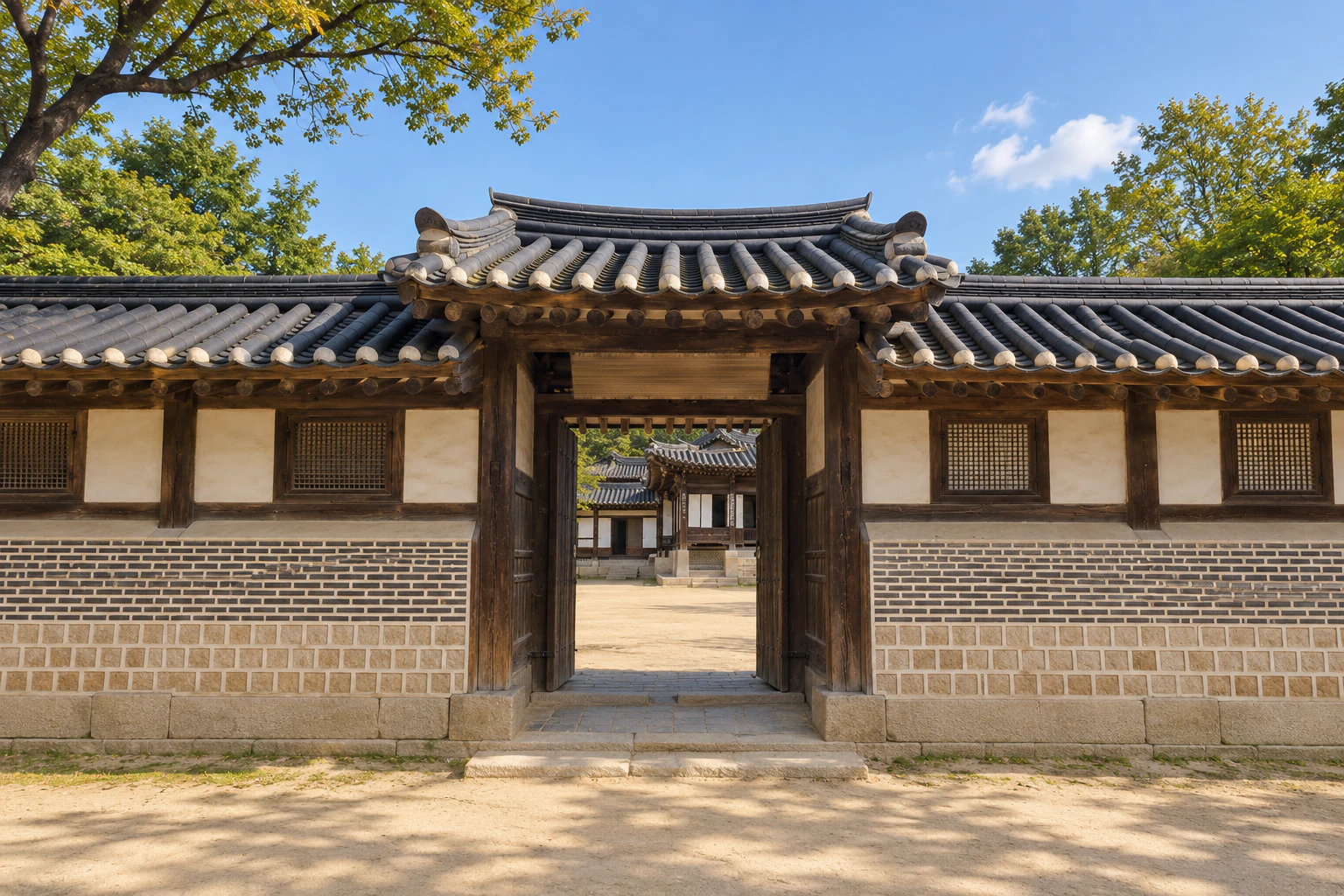
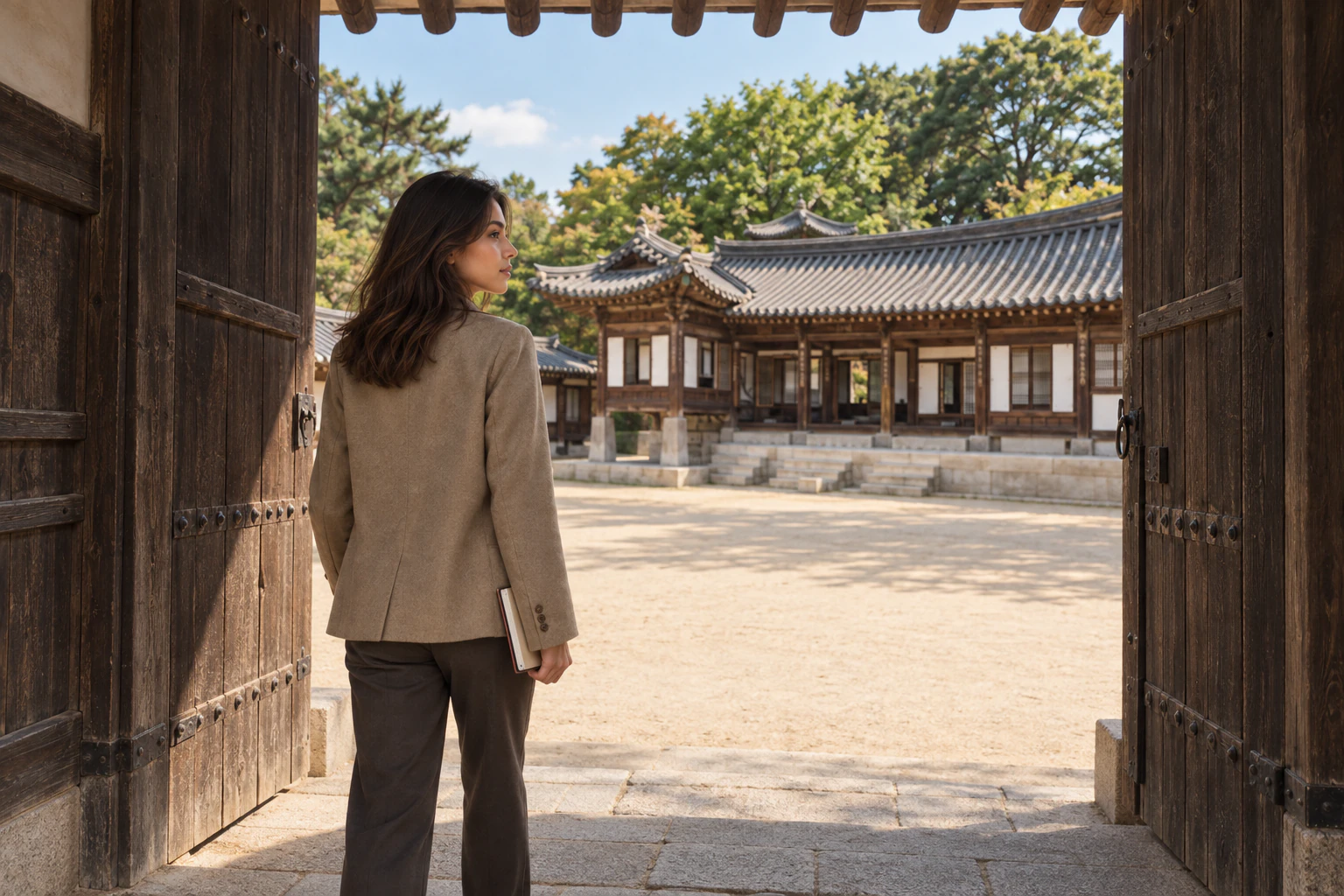
Elena stops once at the gate. Through it lies a wide yard, and across the yard a single house. Under its eaves, the colour is the colour of wood.
A house without dancheong
From the Korea Heritage Service’s description of Nakseonjae (Treasure): built in 1847, the thirteenth year of King Heonjong (the Center’s timeline: on the site of Nakseondang). It was first built as the king’s private quarters; the following year Seokbokheon was built for a royal consort and Sugangjae was rebuilt. Nakseonjae and Yeongyeongdang are the only buildings inside a palace built in the style of a scholar-official’s house. Unlike the palace sleeping halls, it was left without dancheong paint. Through Jangnakmun, the main gate in the southern wing, it stands across a wide yard, six bays wide and two deep, with a raised pavilion room (nu-maru) projecting at the far left. Its doors and windows carry many lattice patterns, and the round “full-moon” doorway between the nu-maru and the heated room behind it is singled out as the finest detail.
Nakseonjae was built in 1847, the thirteenth year of King Heonjong, on the site of an earlier hall called Nakseondang, according to the Center’s timeline. The Korea Heritage Service says it was first built as the king’s private quarters; the next year Seokbokheon went up beside it and Sugangjae was rebuilt. One more line in the description matters here: only two buildings inside a palace were built in the style of a scholar-official’s house, Nakseonjae and Yeongyeongdang. Find on the map
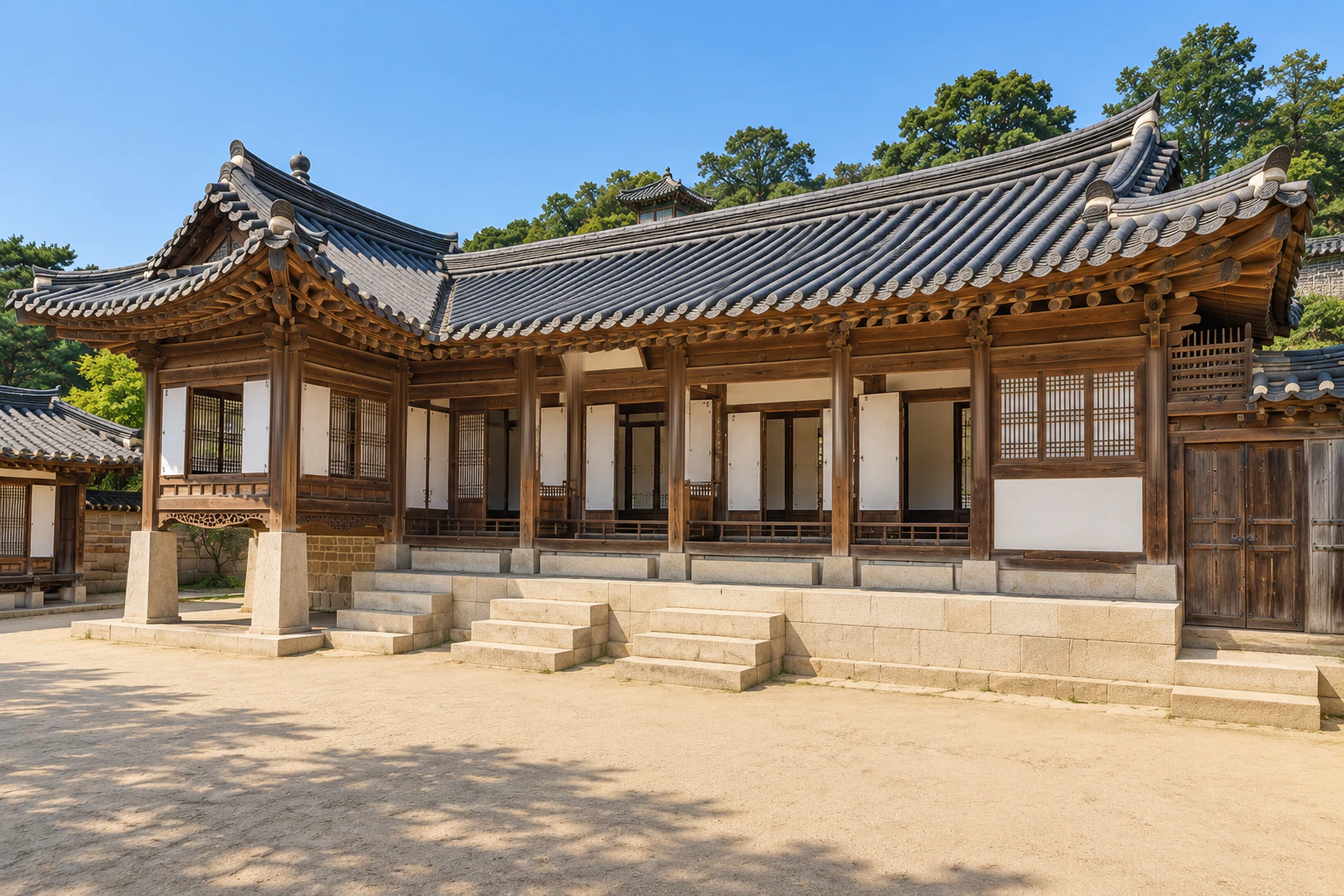
So there is no dancheong. Unlike the royal sleeping halls, this house was left without dancheong paint. It is six bays across and two deep, and at the far left one bay steps forward and sits up on tall, column-like foundation stones — the nu-maru, a raised pavilion room. Elena looks at it for a long time from the yard. Without dancheong, what reaches her first is the grain of the wood, the white walls, and the height the room gains from its stones.
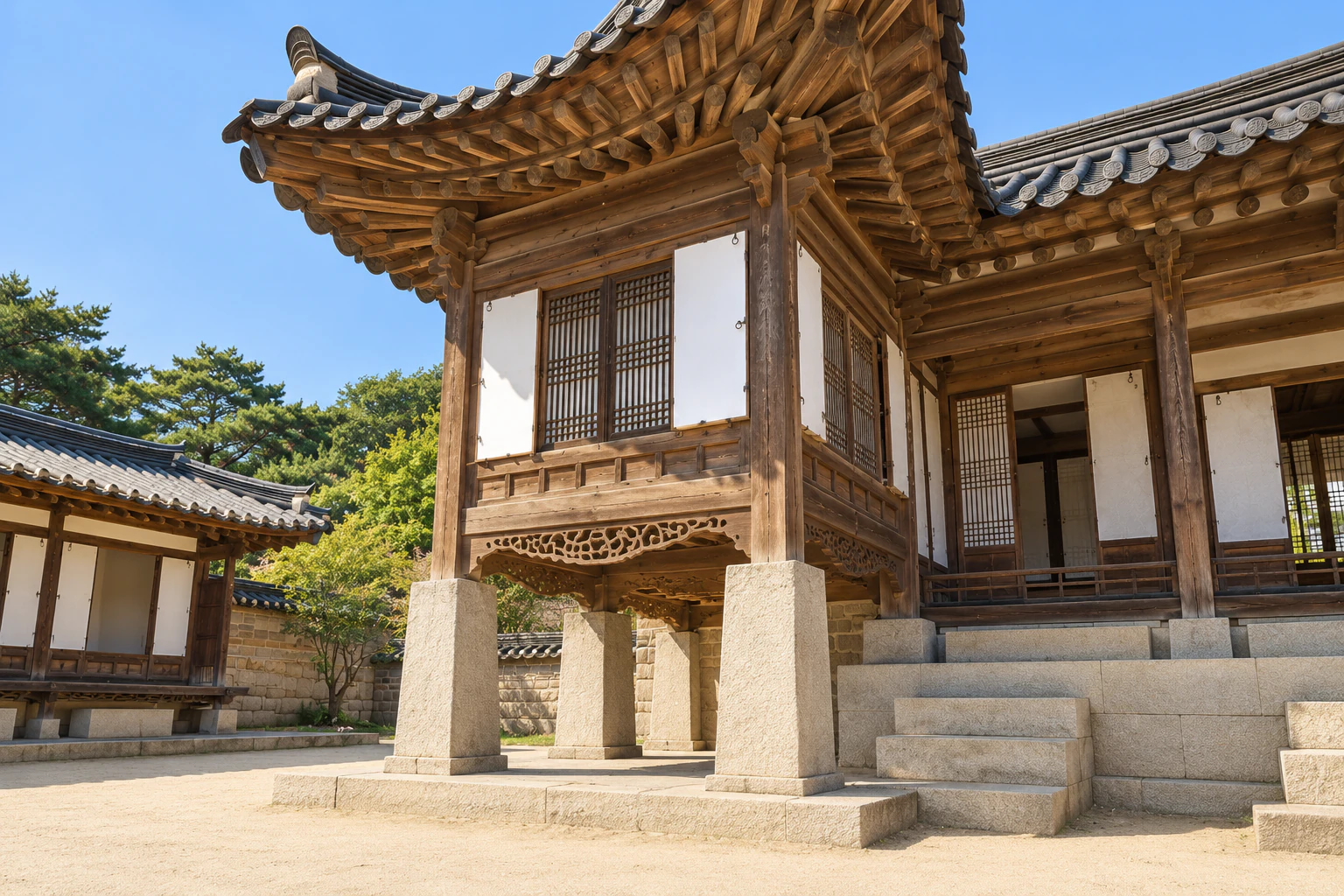
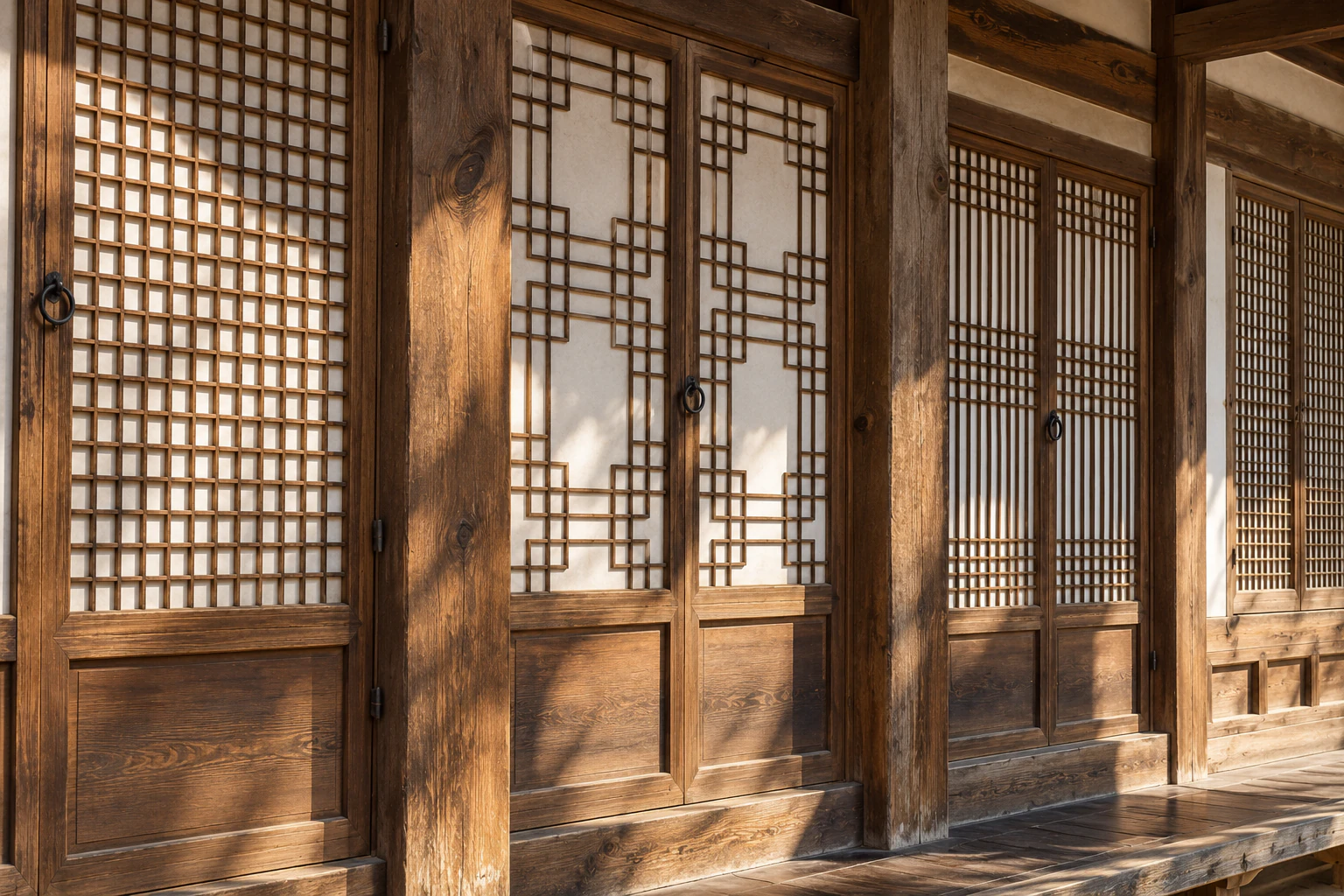
Where the colour went, there is pattern. The Korea Heritage Service notes the many lattice designs on the doors and windows; the latticework does not settle on a single shape. The scholar’s-house style does not mean a plain house: the description adds that elements of the palace sleeping hall were worked in, with decoration hard to find anywhere else. Elena writes: “Pattern instead of colour.”
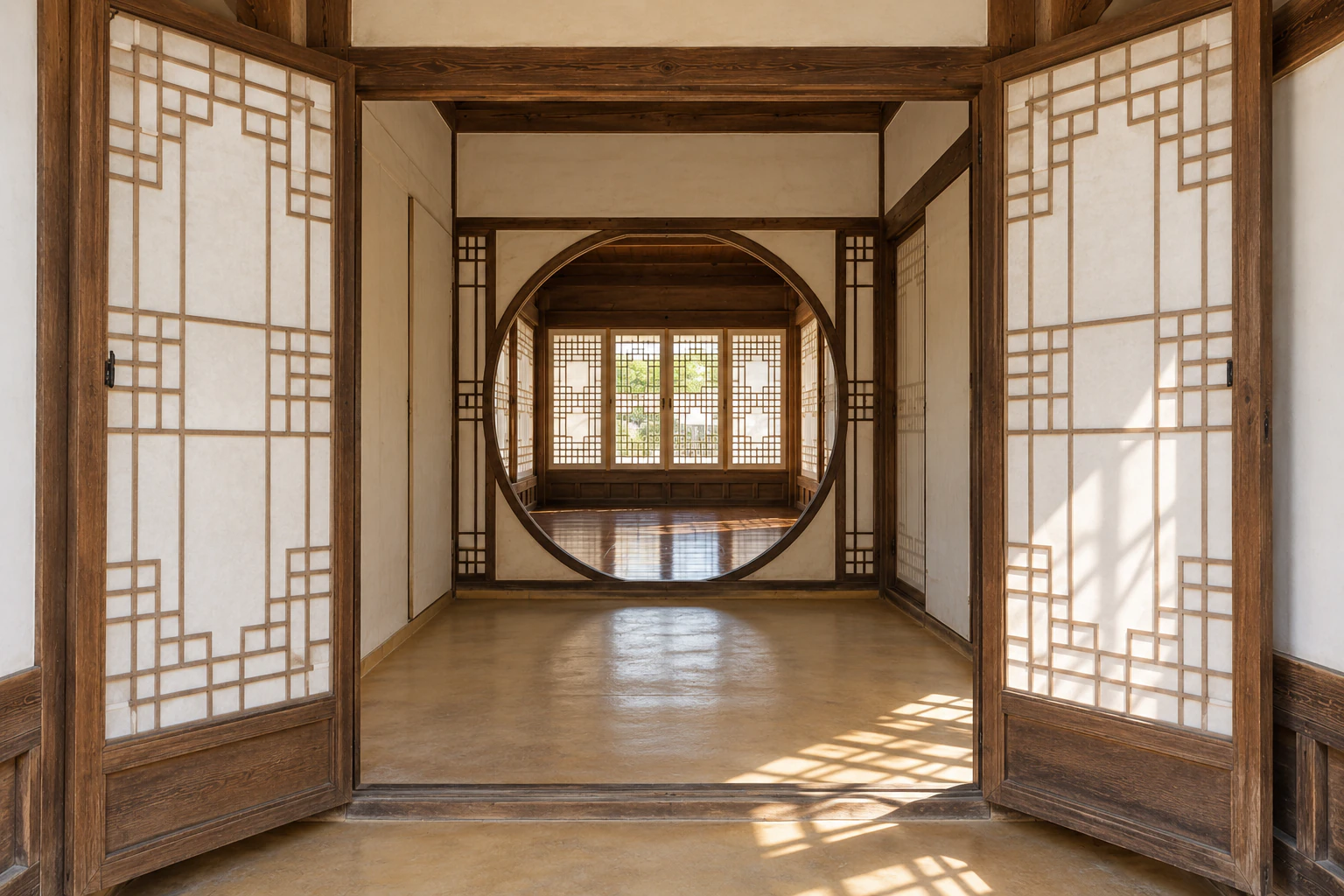
The detail the description calls the finest of all is a round doorway — the full-moon door between the nu-maru and the heated room behind it. It sits inside, so today Elena knows it only from the description. On screen, the camera would have gone into the room and used that circle as a frame. Someone who walks here meets it from outside, in a single line of text.
A house lived in until 1989
From the Korea Heritage Service: right after the Gapsin Coup of 1884, Nakseonjae served as King Gojong’s office; later Crown Prince Yeongchin (Yi Eun) lived here from 1963 to 1970, and Lady Yi Bang-ja lived here from 1966 to 1989. The Royal Palaces and Tombs Center describes the Nakseonjae compound as the place where the last imperial family of the Korean Empire — Empress Sunjeonghyo, Crown Princess Uimin (Lady Yi Bang-ja) and Princess Deokhye — lived after Liberation until they died. Seokbokheon and Sugangjae have been considerably altered.
The house did not stop in 1847. The Korea Heritage Service records that right after the Gapsin Coup of 1884, King Gojong used it as his office. After that, the description jumps to the second half of the twentieth century. Find on the map
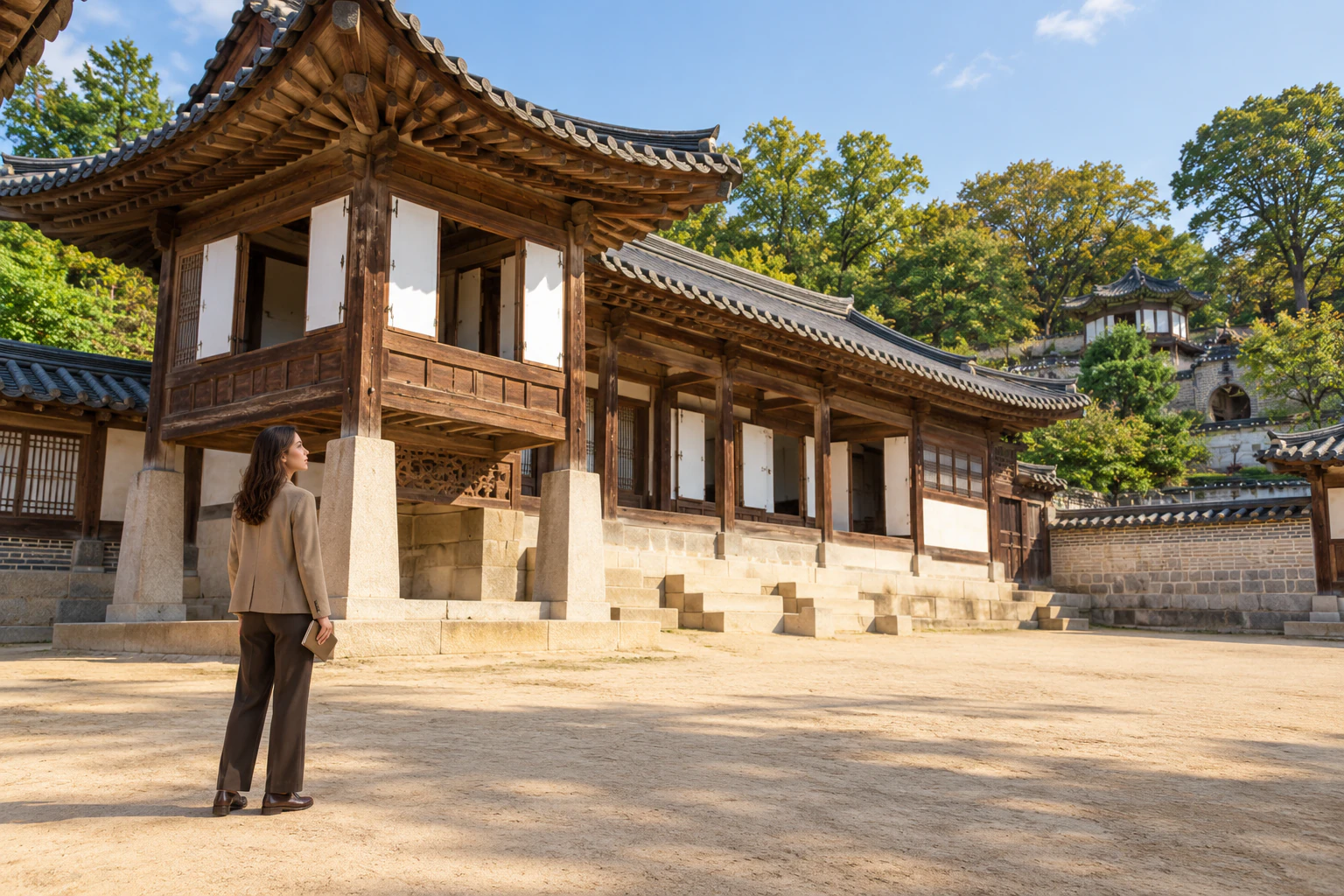
To the right of Nakseonjae run Seokbokheon and Sugangjae: Seokbokheon, built the year after Nakseonjae as quarters for a royal consort, and Sugangjae, rebuilt at the same time. The Korea Heritage Service says Nakseonjae keeps its old form fairly well, while Seokbokheon and Sugangjae have been considerably altered.
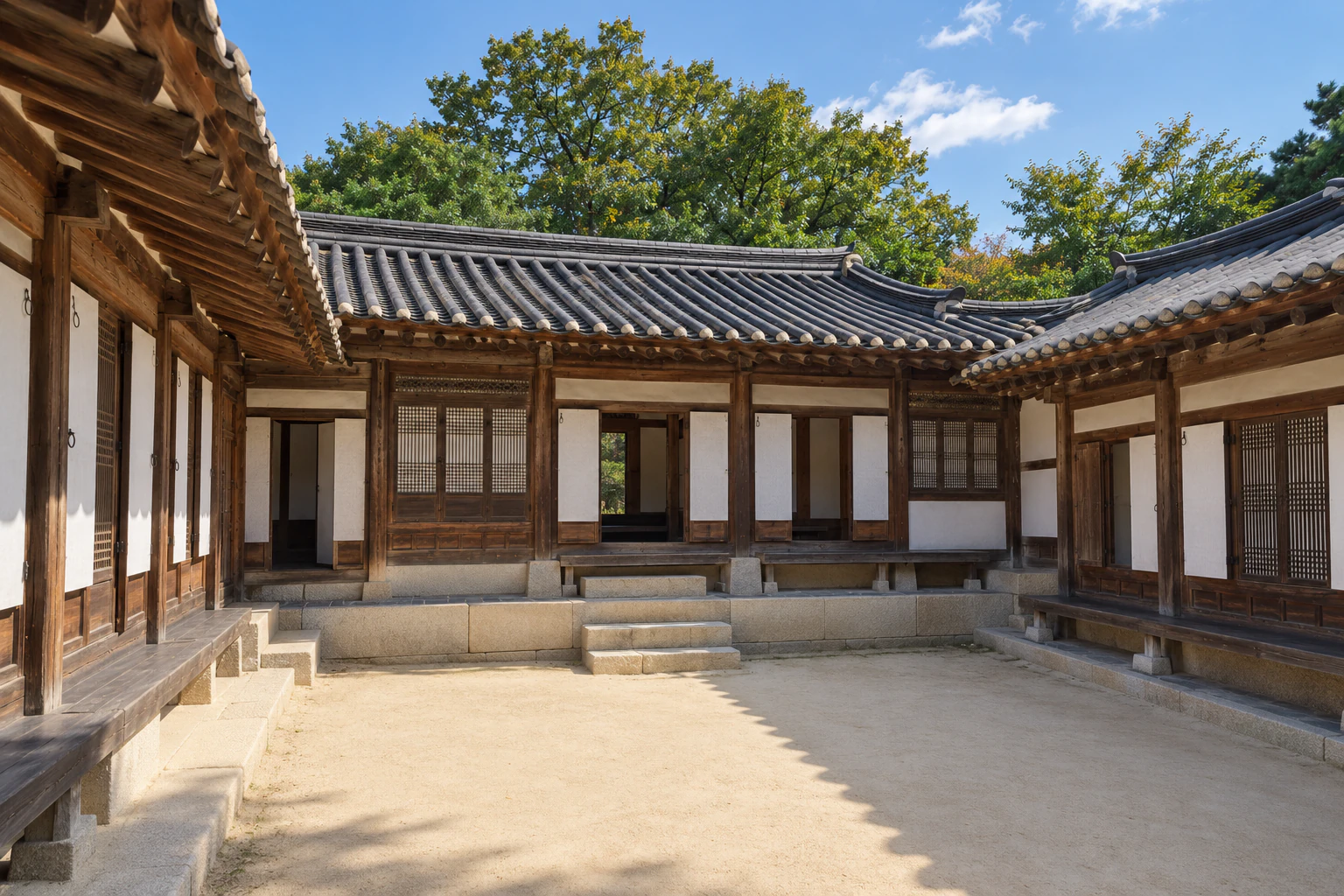
Crown Prince Yeongchin, Yi Eun, lived here from 1963 to 1970, and Lady Yi Bang-ja lived here from 1966 to 1989. The Royal Palaces and Tombs Center describes the Nakseonjae compound as the place where the last imperial family of the Korean Empire — Empress Sunjeonghyo, Lady Yi Bang-ja and Princess Deokhye — lived after Liberation until they died. Elena copies the last year into her notebook: 1989. About ten years before she was born.
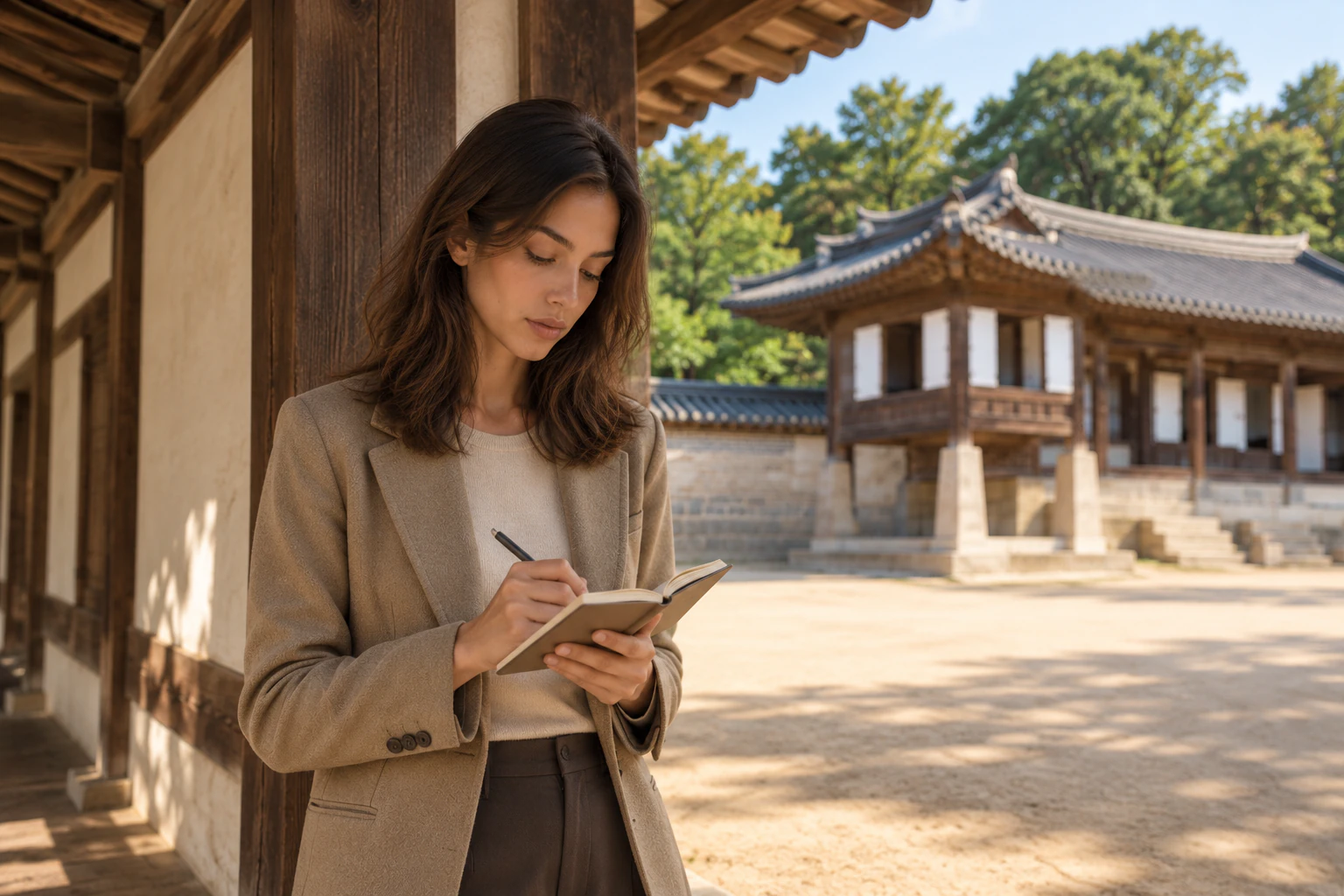
Behind the house, the description says, are terraced flower beds called hwagye, and beyond the patterned wall above them the pavilions Sangnyangjeong, Hanjeongdang and Chwiunjeong. When the Center opened a special guided walk there this spring, it introduced the area as a place “where visitor access has normally been restricted”. Elena does not go round the back. She looks up once past the roofline from the yard, and turns away.
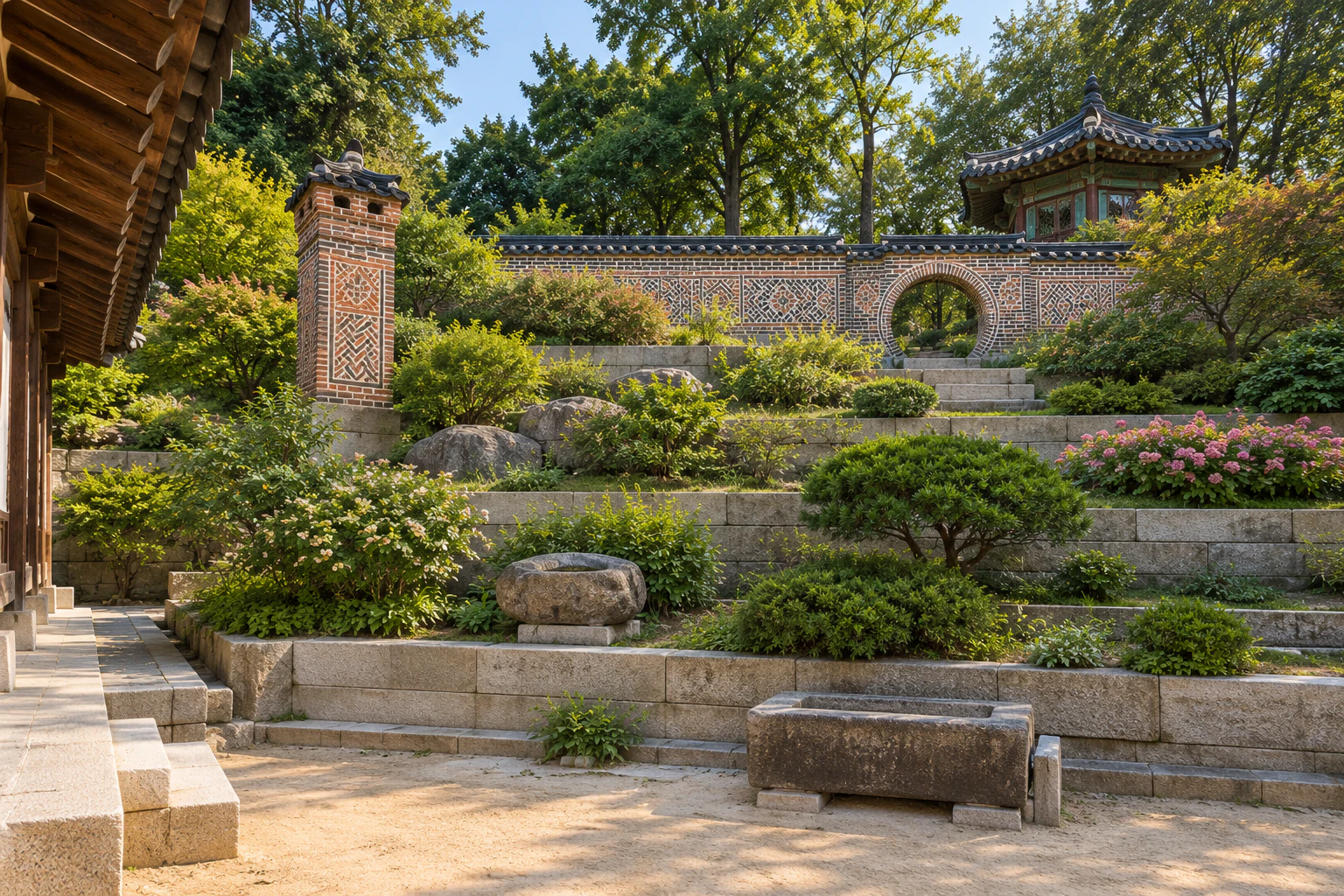
Palaces on screen are remembered in colour. The last house on Changdeokgung’s route was left without dancheong. What it kept instead is the pattern of its lattices, a round door inside, and the time of a household that went on until 1989. Next to the question on her first line, Elena writes her answer: “Pattern — and time.”
Her advice comes in two parts. Don’t turn back at Injeongjeon; walk the route to the end. And if you want to hear more about this house, time your visit for the in-depth Nakseonjae tour on Friday, Saturday or Sunday at 2:30 pm. Changdeokgung is closed on Mondays.
(※ This article includes staged images created with AI.)
Plan your visit
Enter Changdeokgung by Geumhomun from Exit 3 of Anguk Station, then follow the palace-buildings route to the yard of Nakseonjae. The 390 m and 5 minutes are a map-route calculation from Anguk Exit 3 to Geumhomun; the Royal Palaces and Tombs Center gives 5 minutes on foot.
A concept diagram of the order · not to scale, not oriented, not the real shape of the road.
- Geumhomun → Injeongjeon — While Donhwamun is under repair, Geumhomun is the entrance. The walk to the courtyard of Injeongjeon is the subject of the first piece in this series. Find on the map
- Seonjeongjeon · Huijeongdang · Daejojeon — The order of the Royal Palaces and Tombs Center’s palace-buildings route. Find on the map
- Jangnakmun · the yard of Nakseonjae — The end of the route: Nakseonjae without its dancheong, with Seokbokheon and Sugangjae to its right. The terraced garden behind was described in a spring 2026 notice as an area where visitor access had normally been restricted. Find on the map
Getting there
TMAPChecked 2026.09.23
From Exit 3 of Anguk Station (Line 3) to Geumhomun, the temporary entrance to Changdeokgung while Donhwamun is under repair, is 390 m, about 5 minutes, by map route (TMAP pedestrian routing). The Royal Palaces and Tombs Center gives 5 minutes on foot from Anguk Exit 3 and 10 minutes from Exit 7 of Jongno 3-ga Station (Lines 1, 3, 5). Address: 99 Yulgok-ro, Jongno-gu; there is no parking.
Hours & fees
Checked 2026.09.23
Royal Palaces and Tombs Center opening hours: Changdeokgung is closed on Mondays (if a Monday is a public or substitute holiday it opens, and closes on the next non-holiday instead). February–May and September–October 09:00–18:00 (last entry 17:00); June–August 09:00–18:30 (17:30); November–January 09:00–17:30 (16:30).
Royal Palaces and Tombs Center feesChecked 2026.09.24
Changdeokgung palace grounds, adults 3,000 won (Korean nationals aged 25–64, foreigners aged 19–64). The Huwon (Secret Garden) is 5,000 won for adults and seniors and 2,500 won for ages 7–18, and a palace-grounds ticket must be bought as well. The 6,000-won integrated pass for the four palaces and Jongmyo does not include the Huwon. Free entry to the palace grounds covers foreigners aged 18 and under or 65 and over and visitors wearing hanbok; free Huwon entry, however, is limited to children aged 6 and under and to Korean national merit holders and Korean nationals with disabilities.
Checked 2026.09.23
Royal Palaces and Tombs Center guided tours: within Changdeokgung’s in-depth programme “Changdeokgung Up Close”, the Nakseonjae tour runs every Friday, Saturday and Sunday at 14:30, led by volunteer groups. Times, frequency and routes may change.
Background5
Checked 2026.09.23
The Royal Palaces and Tombs Center announced repair work on Donhwamun from 11 November 2024, with Geumhomun as the temporary entrance and the small gate beside it as the exit for the duration of the work. As of 23 September 2026, its visitor guidance still identifies Geumhomun as the entrance to Changdeokgung.
Checked 2026.09.23
Royal Palaces and Tombs Center tour route: the Changdeokgung palace-buildings route runs Donhwamun → Geumcheongyo → Injeongjeon → Seonjeongjeon → Huijeongdang → Daejojeon → Nakseonjae, with Nakseonjae last (the Secret Garden is a separate route). The Korea Heritage Service places Nakseonjae on the boundary between Changdeokgung and Changgyeonggung.
Checked 2026.09.23
From the Korea Heritage Service’s description of Nakseonjae (Treasure): built in 1847, the thirteenth year of King Heonjong (the Center’s timeline: on the site of Nakseondang). It was first built as the king’s private quarters; the following year Seokbokheon was built for a royal consort and Sugangjae was rebuilt. Nakseonjae and Yeongyeongdang are the only buildings inside a palace built in the style of a scholar-official’s house. Unlike the palace sleeping halls, it was left without dancheong paint. Through Jangnakmun, the main gate in the southern wing, it stands across a wide yard, six bays wide and two deep, with a raised pavilion room (nu-maru) projecting at the far left. Its doors and windows carry many lattice patterns, and the round “full-moon” doorway between the nu-maru and the heated room behind it is singled out as the finest detail.
From the Korea Heritage ServiceChecked 2026.09.23
right after the Gapsin Coup of 1884, Nakseonjae served as King Gojong’s office; later Crown Prince Yeongchin (Yi Eun) lived here from 1963 to 1970, and Lady Yi Bang-ja lived here from 1966 to 1989. The Royal Palaces and Tombs Center describes the Nakseonjae compound as the place where the last imperial family of the Korean Empire — Empress Sunjeonghyo, Crown Princess Uimin (Lady Yi Bang-ja) and Princess Deokhye — lived after Liberation until they died. Seokbokheon and Sugangjae have been considerably altered.
From the Korea Heritage ServiceChecked 2026.09.23
behind Nakseonjae are terraced flower beds (hwagye) laid out with plants, stone objects, patterned walls and chimneys, and beyond the patterned wall above them stand the pavilions Sangnyangjeong, Hanjeongdang and Chwiunjeong. In spring 2026 (27 March–2 April), the Royal Palaces and Tombs Center ran a special guided programme, twice a day for 24 people chosen by lottery, through “the Nakseonjae rear garden area, where visitor access has normally been restricted”.
- Changdeokgung is closed on Mondays (if a Monday is a public holiday it opens and closes on the next non-holiday instead). February–May and September–October 09:00–18:00, June–August 09:00–18:30, November–January 09:00–17:30; last entry one hour before closing. Palace buildings 3,000 won for adults; Integrated Palace Ticket 6,000 won (Secret Garden not included). Foreign visitors aged 18 and under or 65 and over, and anyone wearing hanbok, enter free. Nakseonjae is part of the palace-buildings route (Royal Palaces and Tombs Center, checked 23 September 2026).
- Donhwamun has been under repair since 11 November 2024; during the work the entrance is Geumhomun and the exit a small gate beside it. Check the Royal Palaces and Tombs Center’s gate notices before you go. There is no parking at Changdeokgung.
- The in-depth Nakseonjae tour (part of “Changdeokgung Up Close”) runs every Friday, Saturday and Sunday at 14:30, led by volunteer groups. Times may change.
More from this area

Buyongji Pond in Changdeokgung’s Secret Garden
Entry to Changdeokgung’s Huwon is by timed session.

Changgyeonggung from Honghwamun to Myeongjeongjeon: an East-facing Gate and a Single Roof
An added piece in “Changdeokgung, Changgyeonggung and Jongmyo.” The Royal Palaces and Tombs Center notes that, unlike the other palaces, which face south, Changgyeonggung has its main gate and throne hall facing east, and it describes Myeongjeongjeon as the oldest throne hall in the palaces today. Maya, who saw a double roof at Gyeongbokgung, goes in through the east-facing gate in the morning and walks to a throne hall with a single roof. Changgyeonggung is closed on Mondays.