
SEOUL · CHANGDEOKGUNG
Buyongji Pond in Changdeokgung’s Secret Garden
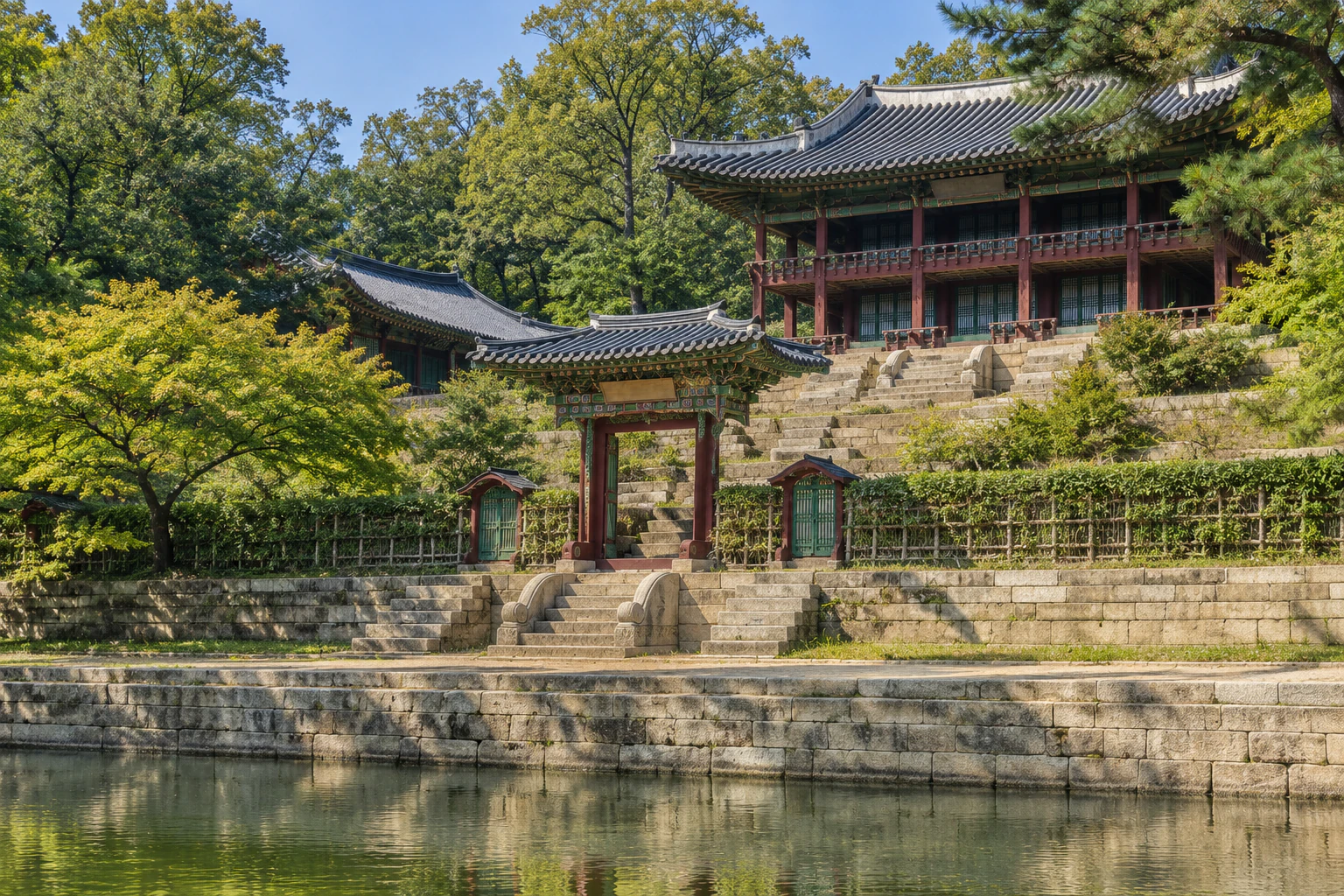
Entry to Changdeokgung’s Huwon is by timed session. At Buyongji, a square pond holds a round island and a pavilion at its edge.

How to get there
The 390 m / 5 minutes is a map-route calculation from Exit 3 of Anguk Station to Geumhomun; the Royal Palaces and Tombs Center says it is a five-minute walk. From Geumhomun to the Huwon entrance the Center allows 15 minutes or more, and you enter the Huwon at your booked session time.
In part one, Rina stood in the courtyard of Injeongjeon; in part two, Elena followed the palace-buildings route to its last stop, Nakseonjae. Today we go north, over the wall, into the garden: Changdeokgung’s Huwon.
Maya has already walked four places in Gyeongbokgung — Geunjeongjeon, Gyeonghoeru, Hyangwonjeong and the forecourt of the folk museum. None of the four asked her to enter at a fixed session time the way the Huwon does. Palace gardens on screen had always felt the same way to her: one still frame, the same pond whenever you looked.
The Huwon is different. Entry is set by session time. Maya writes on the first line of her notebook: “This garden has a clock.” So today she decides in advance what to look at first — the pond you meet just inside the entrance, Buyongji.
A set session time — and 15 minutes or more to the entrance
Royal Palaces and Tombs Center visitor information: the Huwon (Secret Garden) of Changdeokgung is a restricted visit with fixed entry times and capacity. Each language-specific session admits 100 people (50 booked online + 50 sold on site). Korean sessions run on the hour from 10:00 to 16:00 in March–October (to 15:00 in November–February); English at 10:30, 11:30 and 14:30 (plus 15:30 in March–November); Japanese at 13:30 on Wednesdays, Fridays and Sundays; Chinese at 12:30 on Tuesdays, Thursdays and Saturdays. Korean nationals cannot join the foreign-language sessions (up to two may accompany a foreign visitor). A visit takes about 70 minutes.
The Royal Palaces and Tombs Center calls the Huwon a “restricted visit with fixed entry times and capacity.” Each language-specific session admits 100 people (50 online + 50 on site). Online booking opens at 10 a.m. six days before your visit, not counting the day itself; on-site tickets go on sale at 9 a.m. The Center notes that in April–May and October–November both online and on-site tickets sell out very quickly. Find on map
Maya booked at 10 a.m., six days out. She needs two tickets: the Huwon ticket at 5,000 won, and a separate ticket for the palace grounds. Even if you have only come for the garden, you still need the grounds ticket. A visit takes about 70 minutes, and the Ongnyucheon area deep in the garden is closed for conservation work for now.
The way into Changdeokgung is Geumhomun, the side gate Rina used in part one. The Center says the walk from Geumhomun to the Huwon entrance takes 15 minutes or more. Maya goes through Geumhomun well before her session. The notice has a separate line asking visitors to keep to their entry time.

People gather at the Huwon entrance. The guided-tour table lists the garden tours at the same times as the sessions, starting from this entrance. Maya takes a place at the back of the group. From here, she has about 70 minutes.

The square you see from the top of the slope — Buyongji
From the Korea Heritage Service’s description of Buyongjeong (Treasure): the walled passage to the Huwon climbs, then turns left and starts to descend, and at that point the Buyongji pond comes into view below. Buyongji is a square pond 34.5 m east–west and 29.4 m north–south; the square pond and round island reflect the idea that heaven is round and the earth is square. The pond is built of long dressed stones, and at its southern corner a single carp is carved leaping from the water — the king and his officials likened to water and fish.
The Korea Heritage Service describes the approach like this: a passage walled in on both sides climbs gently, then turns left and starts to go downhill, and at that turn the whole Buyongji area comes into view below. Maya slows down right there. The walls end, and there is water beneath her. Find on map

The pond is square — 34.5 metres east to west, 29.4 metres north to south — its edges built straight with long cut stones. Inside it sits one round island with a pine tree on top. The Heritage Service says the square pond and round island reflect an old idea: heaven is round and the earth is square. Maya draws a square in her notebook, and a circle inside it.

The description mentions one more small thing. On a stone at the pond’s southern corner, a single carp is carved leaping out of the water — a picture of the king and his officials as water and fish. Maya traces the pond’s corners with her eyes. It isn’t a carving that jumps out at you; it’s there for people who know to look.

Palace ponds on screen were usually a pavilion framed like a picture. Here, the shape of the pond reaches you first. “The square before the pavilion,” Maya writes. At Gyeonghoeru she had written, “From out here, the square ones first,” and she adds today’s line underneath.
A pavilion with two feet in the water — Buyongjeong
From the Korea Heritage Service’s description of Buyongjeong (Treasure): “buyong” means lotus. Buyongjeong stands on the south side of Buyongji; low hills enclose it on the south, north and west and only the east is open, so the east side, where the name board hangs, is the front. According to the palace records, a pavilion called Taeksujae built in 1707 (33rd year of King Sukjong) was rebuilt under King Jeongjo and renamed Buyongjeong. Its plan is cross-shaped, and two octagonal stone pillars set in the pond carry slender round columns. According to an old geography, King Jeongjo enjoyed the flowers and fished here, and held banquets for men who had passed the state examination.
On the south side of the pond stands a pavilion, Buyongjeong. “Buyong” means lotus. According to the Heritage Service, low hills close it in on the south, north and west, and only the east lies open — so the east side, where the name board hangs, is the front. Maya walks a little way around the pond to find it. Find on map
Seen from above, the plan is shaped like a cross. From the water’s edge, one arm of the pavilion reaches out over the pond: two octagonal stone pillars stand in the water, and slender round columns rise from them. To Maya it looks like the pavilion is standing with two feet in the pond. She adds two short lines to her drawing.

The place has its dates, too. According to the palace records, a building called Taeksujae went up here in 1707, the 33rd year of King Sukjong, and under King Jeongjo it was rebuilt and renamed Buyongjeong. Accounts say Jeongjo came here to look at the flowers and to fish, and held banquets for men who had just passed the state examination. Maya looks at the colour of the water and pictures a king with a fishing rod — then stops there.
The group ahead drifts along the edge of the pond. Maya turns toward the pavilion for one more look. In a garden with a clock, it works better to decide what you will see than to try to stay long in one spot.

A gate and a hall on the hill — Eosumun and Juhamnu
From the Korea Heritage Service’s description of Juhamnu (Treasure): Juhamnu stands on the hill north of Buyongji; it is a two-storey building put up in 1776, the year King Jeongjo came to the throne, to keep the king’s writings and calligraphy. It was a centre of the cultural revival of Jeongjo’s reign, where scholars such as Jeong Yak-yong, Bak Je-ga, Yu Deuk-gong and Yi Deok-mu worked, and it held Jeongjo’s writings, calligraphy, portraits and seals. The ground floor was fitted out for storing royal books, and the upper-floor reading room was laid out to take in the fine views on every side.
North of the pond, beyond the island, the hillside rises in three terraces of flower beds. On the first terrace there is a gate: Eosumun. The Heritage Service explains that the name likens the king to water and his officials to fish. The king went through Eosumun in the middle; his officials used the small gates on either side. Find on map
Maya thinks back to the carp in the corner of the pond. Water and fish in the stones of the pond, water and fish in the gate on the hill — the same image twice in one place. Next to her square, she draws a small fish.
Above the gate stands a two-storey hall, Juhamnu. It was built in 1776, the year King Jeongjo came to the throne, to keep the king’s own writings and calligraphy. The Heritage Service calls it a centre of the cultural revival of Jeongjo’s reign, where scholars such as Jeong Yak-yong, Bak Je-ga, Yu Deuk-gong and Yi Deok-mu worked. The upper floor was a reading room laid out to take in the views on every side.

Maya stays by the pond and looks up at Juhamnu without climbing the hill. The garden was first laid out in 1406 under King Taejong, and buildings such as Juhamnu were added from the reign of Injo to that of Sunjo. Several hundred years are layered around one square pond.

The group moves on. The route carries on toward Aeryeonji and Yeongyeongdang, but this story stops here. On screen, a garden was a still frame. In a garden with a clock, what Maya chose to see first was a square pond, a round island, and one image — water and fish — told twice. Under the first line in her notebook she writes: “Because there’s a clock, you choose first.”
Maya has three tips. Online booking opens at 10 a.m. six days before your visit — in April–May and October–November, don’t miss that moment. Buy a palace-grounds ticket as well as the Huwon ticket. And allow 15 minutes or more from Geumhomun to the garden entrance, so go in early. Changdeokgung is closed on Mondays.

(※ This article includes staged images created with AI.)
Plan your visit
Enter Changdeokgung by Geumhomun from Exit 3 of Anguk Station, then walk to Buyongji with your booked Huwon session. The 390 m / 5 minutes is a map-route calculation from Exit 3 of Anguk Station to Geumhomun; the Royal Palaces and Tombs Center says it is a five-minute walk. From Geumhomun to the Huwon entrance, the Center allows 15 minutes or more.
A concept diagram showing the order only · not to scale, direction or actual path shape.
- Geumhomun — The entrance while Donhwamun is under repair. You need a palace-grounds ticket as well as the Huwon ticket. Find on map
- Huwon entrance — Meet here at your session time. The Center says it is a walk of 15 minutes or more from Geumhomun. Find on map
- Buyongji · Buyongjeong · Eosumun and Juhamnu — The first stop on the Huwon route. The route continues to Aeryeonji, Gwallamji and Yeongyeongdang; the Ongnyucheon area is currently closed for conservation work. Find on map
Getting there
TMAPChecked 2026.09.23
From Exit 3 of Anguk Station (Line 3) to Geumhomun, the temporary entrance to Changdeokgung while Donhwamun is under repair, is 390 m, about 5 minutes, by map route (TMAP pedestrian routing). The Royal Palaces and Tombs Center gives 5 minutes on foot from Anguk Exit 3 and 10 minutes from Exit 7 of Jongno 3-ga Station (Lines 1, 3, 5). Address: 99 Yulgok-ro, Jongno-gu; there is no parking.
Hours & fees
Checked 2026.09.23
Royal Palaces and Tombs Center opening hours: Changdeokgung is closed on Mondays (if a Monday is a public or substitute holiday it opens, and closes on the next non-holiday instead). February–May and September–October 09:00–18:00 (last entry 17:00); June–August 09:00–18:30 (17:30); November–January 09:00–17:30 (16:30).
Royal Palaces and Tombs Center feesChecked 2026.09.24
Changdeokgung palace grounds, adults 3,000 won (Korean nationals aged 25–64, foreigners aged 19–64). The Huwon (Secret Garden) is 5,000 won for adults and seniors and 2,500 won for ages 7–18, and a palace-grounds ticket must be bought as well. The 6,000-won integrated pass for the four palaces and Jongmyo does not include the Huwon. Free entry to the palace grounds covers foreigners aged 18 and under or 65 and over and visitors wearing hanbok; free Huwon entry, however, is limited to children aged 6 and under and to Korean national merit holders and Korean nationals with disabilities.
Checked 2026.09.24
Royal Palaces and Tombs Center visitor information: the Huwon (Secret Garden) of Changdeokgung is a restricted visit with fixed entry times and capacity. Each language-specific session admits 100 people (50 booked online + 50 sold on site). Korean sessions run on the hour from 10:00 to 16:00 in March–October (to 15:00 in November–February); English at 10:30, 11:30 and 14:30 (plus 15:30 in March–November); Japanese at 13:30 on Wednesdays, Fridays and Sundays; Chinese at 12:30 on Tuesdays, Thursdays and Saturdays. Korean nationals cannot join the foreign-language sessions (up to two may accompany a foreign visitor). A visit takes about 70 minutes.
Checked 2026.09.24
Royal Palaces and Tombs Center fee information: Huwon tickets are booked online first come first served from 10:00 six days before the visit (not counting the visit day) until the day before, or bought on site first come first served from 09:00 on the day. The Center notes that in April–May and October–November both online and on-site Huwon tickets sell out very quickly.
Background8
Checked 2026.09.23
The Royal Palaces and Tombs Center announced repair work on Donhwamun from 11 November 2024, with Geumhomun as the temporary entrance and the small gate beside it as the exit for the duration of the work. As of 23 September 2026, its visitor guidance still identifies Geumhomun as the entrance to Changdeokgung.
Checked 2026.09.24
Royal Palaces and Tombs Center guided tours: the Ongnyucheon area of the Huwon is closed for heritage conservation work until further notice (checked 24 September 2026).
Checked 2026.09.24
Royal Palaces and Tombs Center guided tours: Huwon tours start at the same times as the visiting sessions, and the meeting point is the Huwon entrance. The Center notes that the walk from the palace entrance (Geumhomun) to the Huwon entrance takes 15 minutes or more.
Checked 2026.09.24
From the Korea Heritage Service’s description of Buyongjeong (Treasure): the walled passage to the Huwon climbs, then turns left and starts to descend, and at that point the Buyongji pond comes into view below. Buyongji is a square pond 34.5 m east–west and 29.4 m north–south; the square pond and round island reflect the idea that heaven is round and the earth is square. The pond is built of long dressed stones, and at its southern corner a single carp is carved leaping from the water — the king and his officials likened to water and fish.
Checked 2026.09.24
From the Korea Heritage Service’s description of Buyongjeong (Treasure): “buyong” means lotus. Buyongjeong stands on the south side of Buyongji; low hills enclose it on the south, north and west and only the east is open, so the east side, where the name board hangs, is the front. According to the palace records, a pavilion called Taeksujae built in 1707 (33rd year of King Sukjong) was rebuilt under King Jeongjo and renamed Buyongjeong. Its plan is cross-shaped, and two octagonal stone pillars set in the pond carry slender round columns. According to an old geography, King Jeongjo enjoyed the flowers and fished here, and held banquets for men who had passed the state examination.
Checked 2026.09.24
From the Korea Heritage Service’s description of Juhamnu (Treasure): the area around Juhamnu is laid out as three terraced flower beds, and on the first terrace stands Eosumun, the main gate leading up to Juhamnu. Its name likens the king to water and his officials to fish, expressing harmony between them. The king used Eosumun, and his officials the small side gates beside it.
Checked 2026.09.24
From the Korea Heritage Service’s description of Juhamnu (Treasure): Juhamnu stands on the hill north of Buyongji; it is a two-storey building put up in 1776, the year King Jeongjo came to the throne, to keep the king’s writings and calligraphy. It was a centre of the cultural revival of Jeongjo’s reign, where scholars such as Jeong Yak-yong, Bak Je-ga, Yu Deuk-gong and Yi Deok-mu worked, and it held Jeongjo’s writings, calligraphy, portraits and seals. The ground floor was fitted out for storing royal books, and the upper-floor reading room was laid out to take in the fine views on every side.
Checked 2026.09.24
Royal Palaces and Tombs Center, about Changdeokgung: the Huwon was first laid out north of the palace in 1406 (6th year of King Taejong), enlarged in 1463 (9th year of King Sejo) and destroyed during the Japanese invasions of 1592; from the reign of Injo to that of Sunjo, Ongnyucheon, Gyujanggak, Juhamnu, Aeryeonji, Uiduhap, Yeongyeongdang and others were added.
- The Huwon is a restricted visit with fixed entry times and capacity. Korean sessions run on the hour from 10:00 to 16:00 in March–October (to 15:00 in November–February); English at 10:30, 11:30 and 14:30 (plus 15:30 in March–November); Japanese at 13:30 on Wednesdays, Fridays and Sundays; Chinese at 12:30 on Tuesdays, Thursdays and Saturdays. Each language-specific session admits 100 people (50 online + 50 on site) (Royal Palaces and Tombs Center, checked 24 September 2026).
- Online booking opens at 10:00 six days before the visit, not counting the visit day, and runs until the day before, first come first served; on-site tickets go on sale at 09:00 on the day. The Center notes that in April–May and October–November both sell out very quickly. Korean nationals cannot join the foreign-language sessions (up to two may accompany a foreign visitor).
- The Huwon ticket is 5,000 won for adults and seniors and 2,500 won for ages 7–18, and you must also buy a Changdeokgung palace-grounds ticket (3,000 won for adults). Free Huwon entry is limited to children aged 6 and under and to Korean national merit holders and Korean nationals with disabilities — not the same as the free categories for the palace grounds (foreigners aged 18 and under or 65 and over, visitors in hanbok). The integrated palace pass does not include Changdeokgung’s Secret Garden (Huwon). The Secret Garden is also excluded from free admission on Culture Day, held every Wednesday. Changdeokgung is closed every Monday (if Monday is a public holiday it opens and closes on the next non-holiday).
More from this area

Changgyeonggung from Honghwamun to Myeongjeongjeon: an East-facing Gate and a Single Roof
An added piece in “Changdeokgung, Changgyeonggung and Jongmyo.” The Royal Palaces and Tombs Center notes that, unlike the other palaces, which face south, Changgyeonggung has its main gate and throne hall facing east, and it describes Myeongjeongjeon as the oldest throne hall in the palaces today. Maya, who saw a double roof at Gyeongbokgung, goes in through the east-facing gate in the morning and walks to a throne hall with a single roof. Changgyeonggung is closed on Mondays.

From Changdeokgung’s Side Gate to Injeongjeon
With Donhwamun under repair, enter Changdeokgung through Geumhomun and follow the bent path to Injeongjeon.