
SEOUL · ANGUK
An exhibition about home at the hour people head home: Ethan spends a free Wednesday evening with Do Ho Suh at MMCA Seoul
From Anguk Station Exit 1 past Dongsipjagak to MMCA Seoul, a route through Galleries 3, 4 and 5 on B1, plus free late openings on Wednesdays and Saturdays, admission and closing days
Two days after the four friends had dinner in Bangi Matgol, Ethan finishes his Wednesday meetings and heads for Anguk Station. He wants to see an exhibition about home and migration at the hour when everyone else is going home.
How to get there
On Wednesday morning, Ethan opens his notebook at the hotel desk. Since dinner with the others in Bangi Matgol two days ago, a few lines in it carry names instead of numbers for the first time. It is a habit he borrowed after seeing Rina’s boxes. On the last page, the line Rina wrote for him, “Jongno 3-ga — Seosulla-gil — morning”, still sits beside the small question mark Ethan drew. His next trip has not been decided, so the question mark cannot be rubbed out yet.

Ethan is a 44-year-old engineer who designs machinery in Seattle, and wherever he goes, the first thing he does is draw a plan. Market, lake or island, he only feels settled once he has drawn a line from the station exit and written the distance and the minutes beside it. For the last week of this business trip, though, he has chosen a museum. It is the Do Ho Suh exhibition at MMCA Seoul, running from 27 August 2026 to 9 February 2027. Reading the museum’s introduction, he learns it is a large solo show bringing together the installation artist’s work on space, memory and identity, built around migration and dwelling, the individual and the community, from his earliest pieces to projects still in progress.
What catches Ethan’s eye is the set of three words attached to the listing: “installation art, home, identity”. For an engineer, an exhibition with the word home at its centre is not something to skim past. Ethan once lived in Itaewon for six years, and these days he travels between Seattle and Seoul for work, making a hotel room his home for a few days at a time. He is curious himself about what a man who has only ever drawn spaces in lines and numbers will bring back from the rooms of an artist who sees home as something you carry with you.
This is the story of that Wednesday evening, and a guide for anyone going to see the Do Ho Suh exhibition. Following Ethan’s notebook in order, it covers the walk from Anguk Station (Line 3) Exit 1 past Dongsipjagak to the museum, the free entry from 6 p.m. to 9 p.m. on Wednesdays and Saturdays, the way down from the ground-floor lobby to Galleries 3, 4 and 5 on B1, and what to look for in the galleries. It also sets out what to know before you go, from admission and closing days to the temporary closure on 1 December.
The Cue
The Do Ho Suh exhibition runs at MMCA Seoul (30 Samcheong-ro, Jongno-gu, Seoul) from 27 August 2026 to 9 February 2027, in Galleries 3, 4 and 5 on B1. Admission is ₩8,000. The museum opens 10:00–18:00 on Mondays, Tuesdays, Thursdays, Fridays and Sundays, and 10:00–21:00 on Wednesdays and Saturdays, with free entry during the late opening from 18:00 to 21:00 on those two days. Entry is also free on Culture Day, the last Wednesday of every month. The museum closes on 1 January, Seollal and Chuseok, and has a temporary closure on Tuesday 1 December 2026. From Anguk Station (Line 3) Exit 1, go right for 500 m, turn right at Dongsipjagak and walk another 500 m, and the museum is on your right.
- Where: MMCA Seoul, 30 Samcheong-ro, Jongno-gu, Seoul (Sogyeok-dong). Enquiries: 02-3701-9500.
- Exhibition: Do Ho Suh, 27 August 2026 – 9 February 2027, Galleries 3, 4 and 5 on B1.
- Admission: ₩8,000. Free during the Wednesday and Saturday late opening, 18:00–21:00, and on the last Wednesday of every month.
- Opening hours: Mon, Tue, Thu, Fri, Sun 10:00–18:00 · Wed, Sat 10:00–21:00.
- Closed: 1 January, Seollal and Chuseok. Temporary closure on Tuesday 1 December 2026.
- Free and discounted entry (MMCA Seoul visitor information): Free for visitors aged 24 and under or 65 and over, undergraduate students, people with disabilities and one accompanying carer, and Culture Nuri Card holders. 20% off for multi-child family card holders and 50% off for Artist Pass holders (with ID or proof of eligibility).
- Subway: Anguk Station (Line 3) Exit 1 (right for 500 m → right at Dongsipjagak for 500 m) · Gyeongbokgung Station (Line 3) Exit 4 · Gwanghwamun Station (Line 5) Exit 2.
- As you walk in: The cloakroom and toilets are right by the entrance, and the ticket desk and lifts are in the lobby.
Free from 6 p.m. on Wednesdays and Saturdays: why Ethan chose the Wednesday late opening
On a business trip, a weekday daytime museum visit was never in Ethan’s plans. His meetings usually end around early evening, and MMCA Seoul opens at 10 a.m. and closes at 6 p.m. on Mondays, Tuesdays, Thursdays, Fridays and Sundays. On Wednesdays and Saturdays, though, it stays open until 9 p.m., and the late opening from 6 p.m. to 9 p.m. is free. Spotting this line in the visitor information, Ethan writes “Wed 18 → 21, free” at the top of his notebook. A plan only comes together for him once the time and the price sit on the same line.
Open in Kakao Map — Anguk Station

Saturday evening comes with the same terms, but Ethan picks Wednesday. The last Saturday of the trip looks set to be tight, with packing and loose ends to tie up. More than anything, he wants to see this exhibition at going-home time. He likes the idea of walking through galleries that ask what home is, just as people are finishing work and heading home. Knowing it is not much of an engineer’s reason, he still adds one more line to his notebook: “Going-home hour — an exhibition about home”.
If you are still deciding when to go, start with the day of the week, as Ethan did. If you can get away during the day, pay the ₩8,000 and take your time from 10 a.m., and if evenings are all you have, aim for after 6 p.m. on a Wednesday or Saturday. Entry is also free on Culture Day, the last Wednesday of every month. Bear in mind that Tuesday 1 December 2026 is a temporary closure, so if you are planning a visit in the first week of December, avoid that date.
From Anguk Station Exit 1 past Dongsipjagak to the museum: two stretches of 500 m
When his meeting ends a little after 5 p.m. on Wednesday, Ethan takes Line 3. MMCA gives three subway routes, and Ethan chooses Anguk Station Exit 1, the one with the simplest map. Come out of Exit 1 and go straight ahead on the right for about 500 m until you see Dongsipjagak, then turn right and go straight for another 500 m, and the museum is on your right. In Ethan’s notebook, this becomes a single bent line, two “500”s, and a dot where the line turns.
By the time he leaves the exit, the sky has already turned to evening. Ethan puts his phone in his pocket and walks with only one thing in mind: turn when Dongsipjagak comes into view at the end of the first 500 m. On a first visit, that turning point is all you need to remember. When you see Dongsipjagak, turn right, walk straight on for another 500 m, and the museum appears on your right.
Ethan also sketches the other two routes in a corner of his notebook. From Gyeongbokgung Station (Line 3) Exit 4, go right and straight on for about 300 m to the Gwanghwamun junction, cross at the pedestrian crossing on the Gwanghwamun side, then head towards Anguk Station for about 300 m until Dongsipjagak appears. From Gwanghwamun Station (Line 5) Exit 2, go straight for 500 m, cross at the pedestrian crossing, then head towards Anguk Station for about 300 m to the same Dongsipjagak. On both routes, you turn left at Dongsipjagak and walk about 500 m, and the museum is on the right across the pedestrian crossing, so Ethan labels the drawing where three lines meet at one point “Dongsipjagak — the turning point”.
The ground the museum stands on has its own story. MMCA Seoul opened in November 2013 in Sogyeok-dong, Jongno-gu, on the former site of the Defense Security Command, as a complex with galleries, project galleries, a cinema and a multipurpose hall. Reading this, Ethan jots “Sogyeok-dong — 2013. 11” in the margin of his notebook. A piece of land once used for one purpose becoming a building with an entirely different use is a familiar story to Ethan, who has spent years overhauling machines and putting them back to work on a different process.
At the end of the second 500 m, the museum appears on his right and Ethan checks his watch. There are a few minutes left before six. While he waits for the free entry to begin, he marks a small cross at the end of the bent line and writes a name beside it instead of a number: “MMCA Seoul”. It is the method he borrowed from Rina on Monday evening.
From the ground-floor lobby to B1: a plan of B1 drawn from the MMCA Seoul floor guide
As you walk in, the cloakroom and toilets are right there. Ethan takes off his coat and drapes it over his arm, keeping his bag tucked close to his shoulder. He learnt on the day he spent walking through the frigate Seoul that it pays to keep your hands free if you plan to walk the galleries for a long time. The lobby has the ticket desk, lifts and an emergency staircase, and on the ground floor of the lobby you will also find the MMCA Shop and the Art Book Shop. With just his notebook in hand, Ethan pauses for a moment in the middle of the lobby.
The most entertaining part of the floor guide Ethan read beforehand was the names of the courtyards, or madang. On the ground floor there are Museum Madang and Open Madang, on B1 Exhibition Madang, and on 3F Gyeongbokgung Madang. Four courtyards in one building strike Ethan as remarkable. It must mean the building was divided by leaving space empty between rooms, like the courtyard of a hanok. In his notebook, the four names go down one line per floor.
The Do Ho Suh exhibition is on B1. On B1, Gallery 2 is on the right, and from Gallery 2, Galleries 3, 4 and 5 follow anticlockwise. To the left of Gallery 5 is the MMCA Multi-Project Hall, with Gallery 6 opposite. Ethan copies this word for word into four boxes, starting at 2 and running anticlockwise through 3, 4 and 5. On a first visit, go down to B1, take Gallery 2 on your right as your reference point, and head anticlockwise from there to reach the exhibition’s three galleries one after another.
B1 also has two information desks, one in front of the MMCA Multi-Project Hall and one in front of Gallery 6. The toilets are beside MMCA Film and Video and beside the Media Lab, so if you are planning a long visit, it helps to note where they are before you go into the galleries. Ethan marks them too, with two small circles beside his four boxes. Including the places where people rest is a habit he has kept since he first started drawing factory equipment.
Do Ho Suh begins outside the galleries: Seed Bank and early works shown for the first time
Before his visit, Ethan read the texts for all twelve audio guide stops on the exhibition page of the museum website. Today, he decides to walk in the order of the stop numbers. The first stop explains that rather than dividing the works by theme, the exhibition is arranged so that early and recent work, drawing and installation, home and body, space and time reflect and extend one another in a single flow. In other words, this is not an exhibition you can split into boxes by section name. Ethan stops drawing boxes for a moment and adds an arrow between each one.
The first stop has one more sentence Ethan holds on to for a long time. For the artist, it says, home was not a building standing still in one place, but a space of the senses that moves with the body, crosses the world carrying memories, and connects one person’s experience with another’s. Every plan Ethan has ever drawn has been of something fixed to the ground. So beside this sentence he writes “Home = something that moves?”, question mark and all.

The exhibition begins outside the galleries. That space is called Seed Bank. And this exhibition shows, for the first time, early works and drawings by the artist that have never been on display before. Ethan likes the idea of a place where seeds are collected. In design, too, if you keep the very first hand-drawn sketches instead of throwing them away, you can later trace a finished machine back to where it came from.
Not rushing to the gallery doors is part of the knack to this exhibition. It is tempting to walk past Seed Bank straight into Gallery 3, but once you know this space is the exhibition’s opening chapter, your pace slows a little. Ethan adds another box in front of the first one in his notebook and writes “0 — Seed Bank”. It is the first time on this trip that he has drawn a box numbered zero.
Gallery 3: some 200 drawings and the Small Gate of a Seongbuk-dong hanok
Gallery 3 shows about 200 drawings, including works on display for the first time. Seeing that number, Ethan sets his pace in advance. Rather than lingering over each piece, he will take in the flow of the whole room on a first lap, then go back to whatever caught his attention. It is the “First lap: just look” rule from the day he first met Lulu at Mangwon Market, carried straight into the museum.
The first work in this room is the main gate of the Seongbuk-dong hanok where the artist grew up, the Small Gate. Ethan is pleased that the exhibition’s first room begins with a gate. On Monday evening in Bangi Matgol, the single word Rina wrote beside her drawing of the lit arch was also “Gate”. At the front of box 3 in his notebook, Ethan writes that one word before any number, and wonders whether Rina will recognise it when he shows her.
The audio guide also explains what kind of house it was. It was built in the traditional way, from the timbers of old hanok that had been torn down, and modelled on Yeongyeongdang in Changdeokgung Palace. Hearing that the house was made from wood salvaged from other houses, with a building inside a palace as its model, Ethan nods for a long while. The sequence is exactly the same as building a new machine by reusing parts and following a proven design. Beside box 3, in an engineer’s words, he writes “Reused timber + a model design”.
Rubbing/Loving in Gallery 4: how a whole house was lifted with hanji and pencil
In Gallery 4 you meet the series Rubbing/Loving. Its title comes from the similar sound of two English words, rubbing and loving. Ethan quietly says the two words aloud. They really do sound almost the same, and that alone gives him a reason to stay in this room for a long time.
The method goes like this. Traditional hanji paper was pressed against the surfaces of the Seongbuk-dong hanok where the artist grew up, then the whole building was rubbed with graphite pencil, lifting an impression of the entire house. The hanji stayed on the house for almost a year. At the words “a year”, Ethan’s pencil stops. Ethan measures a house with a tape measure and numbers, but this artist carried its size straight onto paper by rubbing it surface by surface with his hands.
The same series includes a work on the staff house of Gwangju Theater. Here, participants are blindfolded and feel and rub the surfaces of the space together, sharing through their fingertips the time that has built up there. Ethan tries to picture measuring a space with his eyes closed. If he had to remember a room with only his fingertips, without a single number or line, he has no idea what would end up in his notebook.
The series continues in New York. The apartment at 348 West 22nd Street in Chelsea was the artist’s home and studio for longer than anywhere else after he settled in the United States, and he spent months rubbing it by hand with coloured pencil. Thinking back to the home he lived in for six years in Itaewon, Ethan realises with a wry smile that he cannot remember the height of a single door handle or the width of a single window frame. In box 4 of his notebook, he leaves the note “Remembered by rubbing, not measuring”.
Perfect Home in London and The Bridge Project, ongoing since 1999
The next stop is Perfect Home. The soft, translucent outline of a house is the home the artist has actually lived in since moving to London in 2016. The position of each specimen in the work was decided through a highly precise digital process, and the objects become clues to which city’s home they came from. Ethan counts on his fingers which cities would turn up if he made the same clues from his own belongings, and his fingers stop at Seattle and Seoul.
What keeps Ethan at this stop is the phrase “a highly precise digital process”. Unlike the previous room, where a house was lifted by hand, here every position was set by calculation. That the two approaches, hand and calculation, sit side by side in one exhibition is Ethan’s biggest discovery. In the next box of his notebook, opposite “Rubbed” in the box before, he writes “Calculated”.
The Bridge Project is a long-term project Do Ho Suh has kept going from 1999 to the present. It is an imaginary bridge linking Seoul and New York, born from the idea of erasing physical distance. And the project does not aim to be completed. Ethan stands in front of that last sentence for some time. A design with no set end is the strangest idea of all for an engineer who has always worked to deadlines and delivery dates.
Yet, oddly, it sounds comforting. Ethan’s business trips between Seattle and Seoul are, in truth, a bridge with no fixed end too. He turns to the last page of his notebook and looks once at the line Rina wrote and the question mark beside it. He does not rub it out. His next trip is still undecided, and Ethan decides to leave that question mark as part of a bridge that does not aim to be completed.
Who am we in a 15 m-high space, and Floor, held up by some 180,000 figures
The next stop is titled Who am we. Made from people in graduation albums, shrunk to the smallest size at which they can still be recognised, the work wraps the exhibition’s tallest space, 15 m high, like wallpaper. Ethan reads the title twice. A title that joins a question about “me” to a word for “us” looks, to an engineer’s eye, like a part machined on purpose so it does not quite fit.
Floor is grouped under the same stop. Walk across the glass work and look closely beneath it, and you will find about 180,000 small PVC figures holding up the glass panel with both arms stretched above their heads. Ethan writes two numbers side by side, one above the other, in his notebook: “15 m” and “about 180,000”. One is a height, the other a number of people.
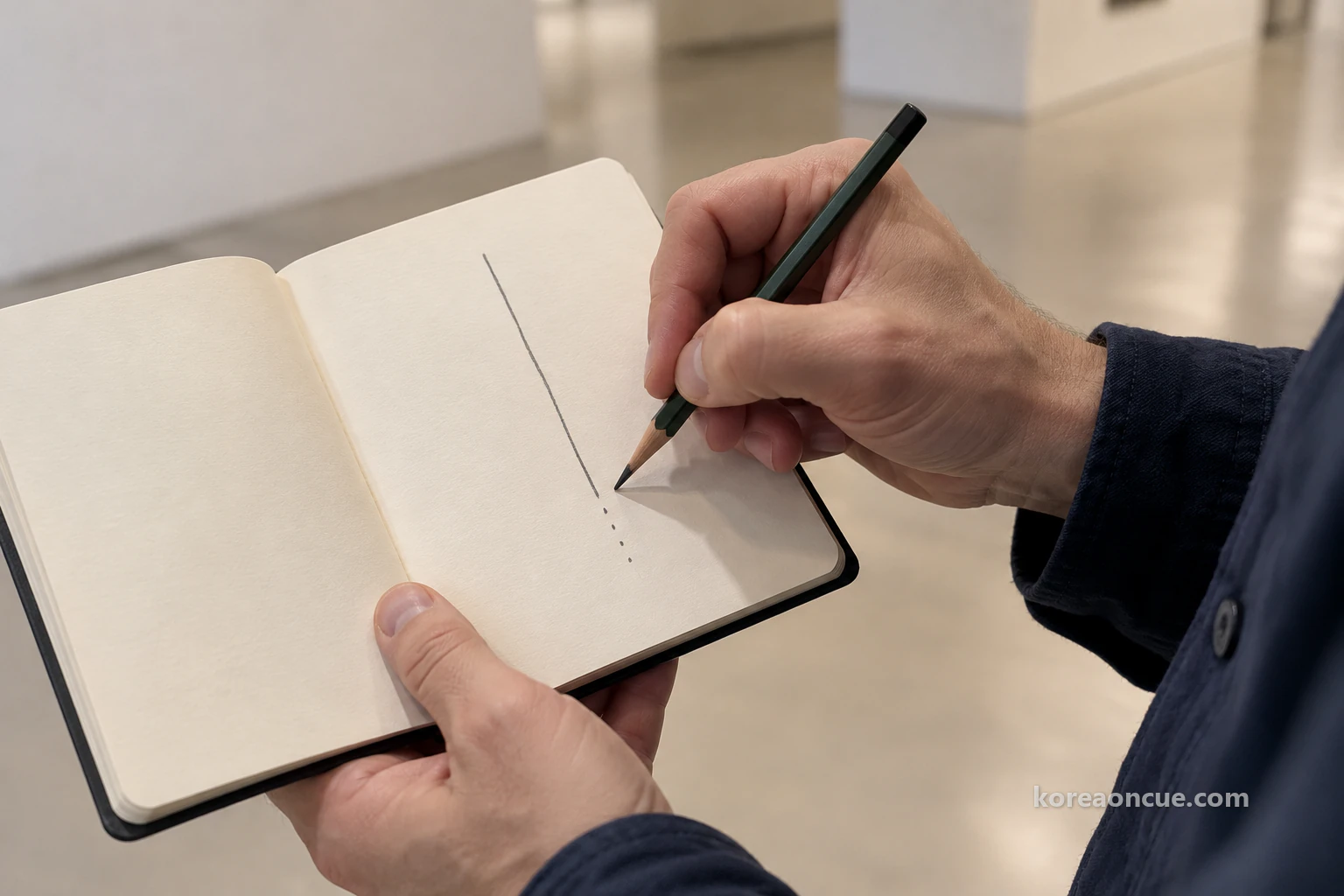
For someone who designs structures, 180,000 reads first as a load figure. The idea of all those little arms sharing the weight of a single glass panel reaches Ethan before any calculation could. Something too heavy for one person to bear becomes bearable when many share it, and Ethan thinks the picture connects to the “we” in the title grouped alongside it. In this room, leave yourself time to walk slowly and look up and down in turn, rather than staring at a notebook.
From Nest/s to Memory of Love: the remaining stops, where home and body meet
Nest/s is a work you see as you walk through a passage. As you go, the museum beyond the work shows through, because it is made from the translucent polyester widely used today for traditional hanbok, especially summer hanbok. The title holds a device too. The plural of nest is nests, but the artist drew a slash before the s to separate the two. Ethan thinks the way one slash points to one and many at once resembles the dimension lines on a drawing.
The stops that follow are all about home and dwelling as well. A panoramic film based on Robin Hood Gardens, a public housing estate in London, explores the idea of a street in the sky. There is also Upside-down Monument, in which a statue that should stand proudly on a tall plinth hangs upside down inside a transparent one. The idea of seeing the corridors of shared housing as streets stops Ethan in his tracks, and for a moment he thinks of the corridor of the hotel where he is staying.
The final stop is Memory of Love, shown for the first time in this exhibition. The artist sewed pockets taken from his family’s clothes back into the inside of his own coat, and filled them with objects holding family memories. The first stop’s sentence about carrying home on the body comes back at the end as a single coat. Ethan thinks of his own coat waiting in the cloakroom, and the notebook he always keeps in its inside pocket.
Back to the lobby before 9 p.m.: Ethan’s messages and the question mark on the last page
By the time Ethan has walked all twelve stops and come up to the ground-floor lobby, it is a little after eight. The late opening runs until nine, so if you want to take your time right through to the last stop, you will feel more relaxed going in at six and using all three hours. Before collecting his coat, Ethan opens his notebook in a corner of the lobby. From box 0, Seed Bank, to the coat at the end, every box holds both a number and a name. It is the first time a plan of his has had as many names as numbers.
Ethan photographs the page and sends it to Rina. “I tried giving every box a name. It’s the method I learnt on Monday.” The reply comes quickly. Rina has spotted the “0” on one box and says she has never seen a box zero before. Ethan answers briefly that it is because the exhibition starts outside the galleries. Rina’s messages are always short, but exactly as precise as they are short.
He leaves a line in the group chat with Lulu and Maya too. When Lulu asks whether he has eaten, Ethan says not yet, adding that he wrote down so many numbers at the museum today that he is starving. Maya replies to Ethan, who has sent a plan instead of a photo, that she likes the composition, with its boxes running anticlockwise. As usual, the three of them wrap up the chat quickly and lightly.
Putting back on the coat he has been carrying over his arm, Ethan pauses as he slips the notebook into the inside pocket. The last work he saw has come back to him. An engineer’s coat, it turns out, already had something like a home in its inside pocket. In the notebook he has carried between hotel rooms all through this trip, Mangwon Market, Seokchon Lake, Nodeul Island, Bangi Matgol and today’s B1 are drawn one after another.
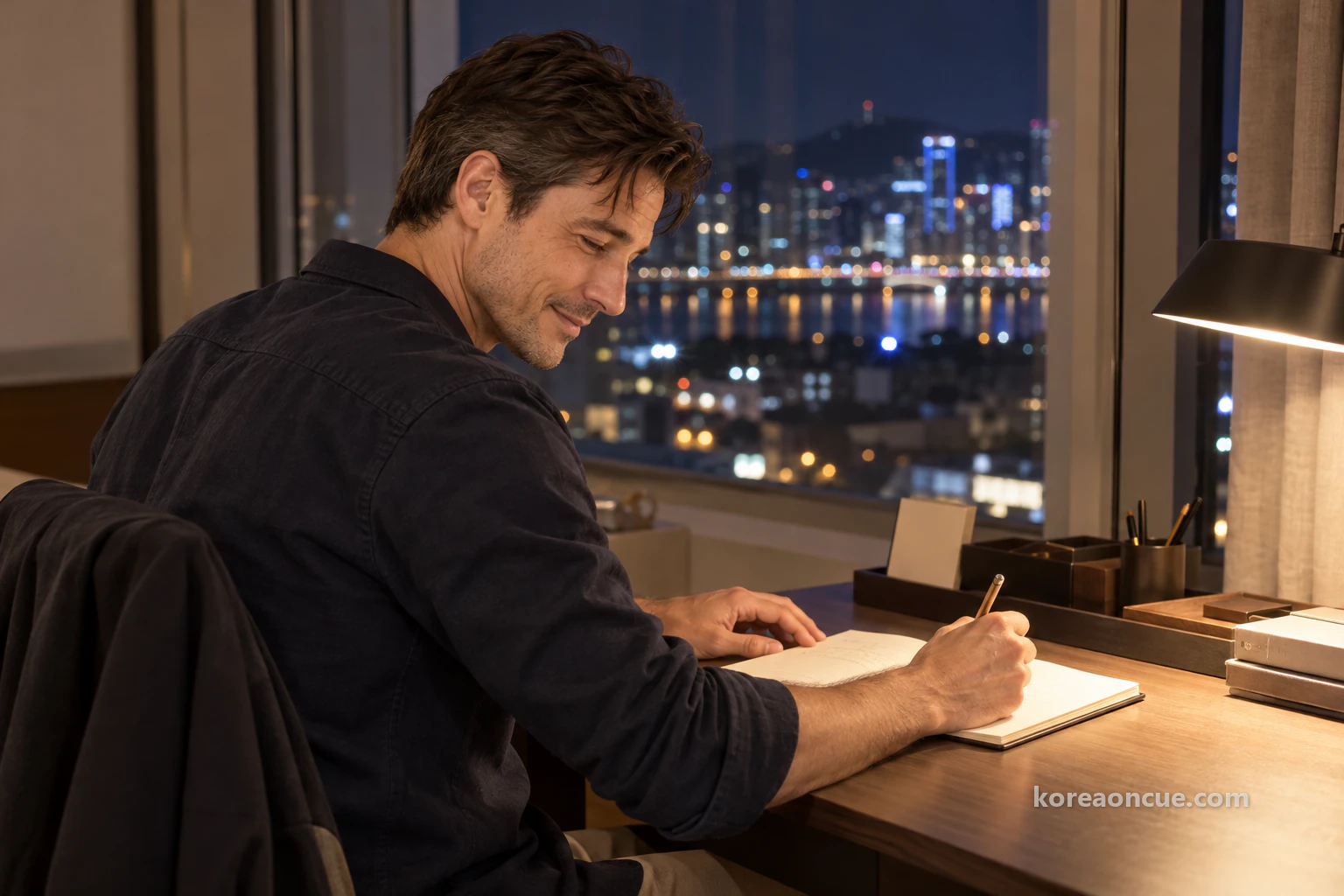
Back at the hotel, Ethan opens the last page of his notebook once more. The question mark beside “Jongno 3-ga — Seosulla-gil — morning” is still there. He does not rub it out, and instead adds one very small line beneath it: “Bridge — no end”. He has no idea when his next trip will be, but today he learnt that a bridge with no set end is still a bridge that keeps going. And so the Wednesday of his last week in Seoul is left behind as a page with slightly more names than numbers.
Common Mistakes
Turning up on a weekday after 6 p.m.
The museum closes at 18:00 on Mondays, Tuesdays, Thursdays, Fridays and Sundays. For an evening visit, choose a Wednesday or Saturday, when it stays open until 21:00.
Only thinking about daytime and missing the free late opening
Entry is free during the Wednesday and Saturday late opening, 18:00–21:00, and on the last Wednesday of every month.
Going on 1 December
Tuesday 1 December 2026 is a temporary closure.
Looking for the galleries on the ground floor
Do Ho Suh is in Galleries 3, 4 and 5 on B1. Go down, take Gallery 2 on your right as your reference point, and head anticlockwise to reach Galleries 3, 4 and 5.
Heading straight for the gallery doors
The exhibition begins outside the galleries, at Seed Bank.
Arriving after 8 p.m. on a late-opening night
The museum closes at 9 p.m., so to take your time right to the end, go in at 6 p.m.
FAQ
Which station and exit should I use?
From Anguk Station (Line 3) Exit 1, go straight ahead on the right for about 500 m until you see Dongsipjagak, then turn right and go straight for another 500 m, and the museum is on your right. You can also go from Gyeongbokgung Station (Line 3) Exit 4 or Gwanghwamun Station (Line 5) Exit 2.
How much is admission?
Admission to Do Ho Suh is ₩8,000. It is free during the Wednesday and Saturday late opening, 18:00–21:00, and on Culture Day, the last Wednesday of every month.
How long is the exhibition on?
From 27 August 2026 to 9 February 2027, in Galleries 3, 4 and 5 on B1.
When is the museum closed?
On 1 January, Seollal and Chuseok, with a temporary closure on Tuesday 1 December 2026.
Who gets in free?
The MMCA Seoul visitor information lists free entry for visitors aged 24 and under or 65 and over, undergraduate students, people with disabilities and one accompanying carer, and Culture Nuri Card holders.
Where can I leave my bag?
The cloakroom and toilets are right by the entrance as you walk in.
Who do I contact with questions?
MMCA Seoul on 02-3701-9500.
Recap — 30 seconds before you go
- Anguk Station (Line 3) Exit 1 → right for 500 m → right at Dongsipjagak for 500 m → MMCA Seoul (30 Samcheong-ro)
- Do Ho Suh, 27 August 2026 – 9 February 2027, Galleries 3, 4 and 5 on B1, admission ₩8,000
- Free during the Wednesday and Saturday late opening, 18:00–21:00, and on the last Wednesday of every month
- Temporary closure on Tuesday 1 December 2026
- The exhibition starts outside the galleries at Seed Bank. On B1, go anticlockwise from Gallery 2 to Galleries 3, 4 and 5
Sources
- MMCA — Exhibition: Do Ho SuhDates 27 August 2026 to 9 February 2027 · Galleries 3, 4 and 5 on B1 · admission ₩8,000 · exhibition introduction (migration and dwelling, the individual and the community, space, memory and identity)checked 2026-10-27
- MMCA — Visit: SeoulOpening hours (Mon, Tue, Thu, Fri, Sun 10:00–18:00; Wed and Sat 10:00–21:00) · free entry during Wed and Sat late opening 18:00–21:00 · free on the last Wednesday of every month · closed 1 January, Seollal and Chuseok, plus a temporary closure on Tuesday 1 December · free and discounted admission · address and enquiries · floor guide (lobby, named courtyards, B1 gallery layout, information desks, toilets, cloakroom) · directions (Anguk Exit 1, Gyeongbokgung Exit 4, Gwanghwamun Exit 2)checked 2026-10-27
- MMCA — Do Ho Suh audio guideHow the exhibition is arranged and its idea of home · early works shown for the first time · Seed Bank · the Seongbuk-dong hanok and the Small Gate, some 200 drawings in Gallery 3 · Rubbing/Loving (Seoul, the Gwangju Theater staff house, New York) · Perfect Home · The Bridge Project · Who am we and Floor · Nest/s · the Robin Hood Gardens film · Upside-down Monument · Memory of Lovechecked 2026-10-27
- MMCA — HistoryMMCA Seoul opened in November 2013 in Sogyeok-dong, Jongno-gu, on the former Defense Security Command site, with galleries, project galleries, a cinema and a multipurpose hallchecked 2026-10-27
A Seoul story told with our AI characters. Place details are checked against public sources; the photos are AI-made illustrative images. How we use AI
More from this area
Rina walks Unhyeongung on a November evening, from Sujiksa by the gate to Irodang in the inner quarters
Rina has got off at Anguk Station more times than she can count, yet she has always walked past the old house outside Exit 4.

Things to Do in Insadong
From Ssamziegil’s rising walkways to the courtyard at Kyung-In Museum of Fine Art, Maya has come to look for one souvenir.