
SEOUL · ANGUK
Elena splits the Seoul Museum of Craft Art into day and night: six embroidery chapters and 《각각의 각》
A free craft museum right outside Anguk Station Exit 1 — how to plan your day around Building 1’s late opening until 9 p.m. on Tuesdays, Wednesdays, Fridays, Saturdays and Sundays (until 30 November)
On some days the Seoul Museum of Craft Art stays open until 9 p.m., but only Building 1 keeps its lights on after dark. Elena, who reads places as scenes, knows this and splits her day in two: first the embroidery exhibition, which closes at 18:00, then the newly opened 《각각의 각》 at night.
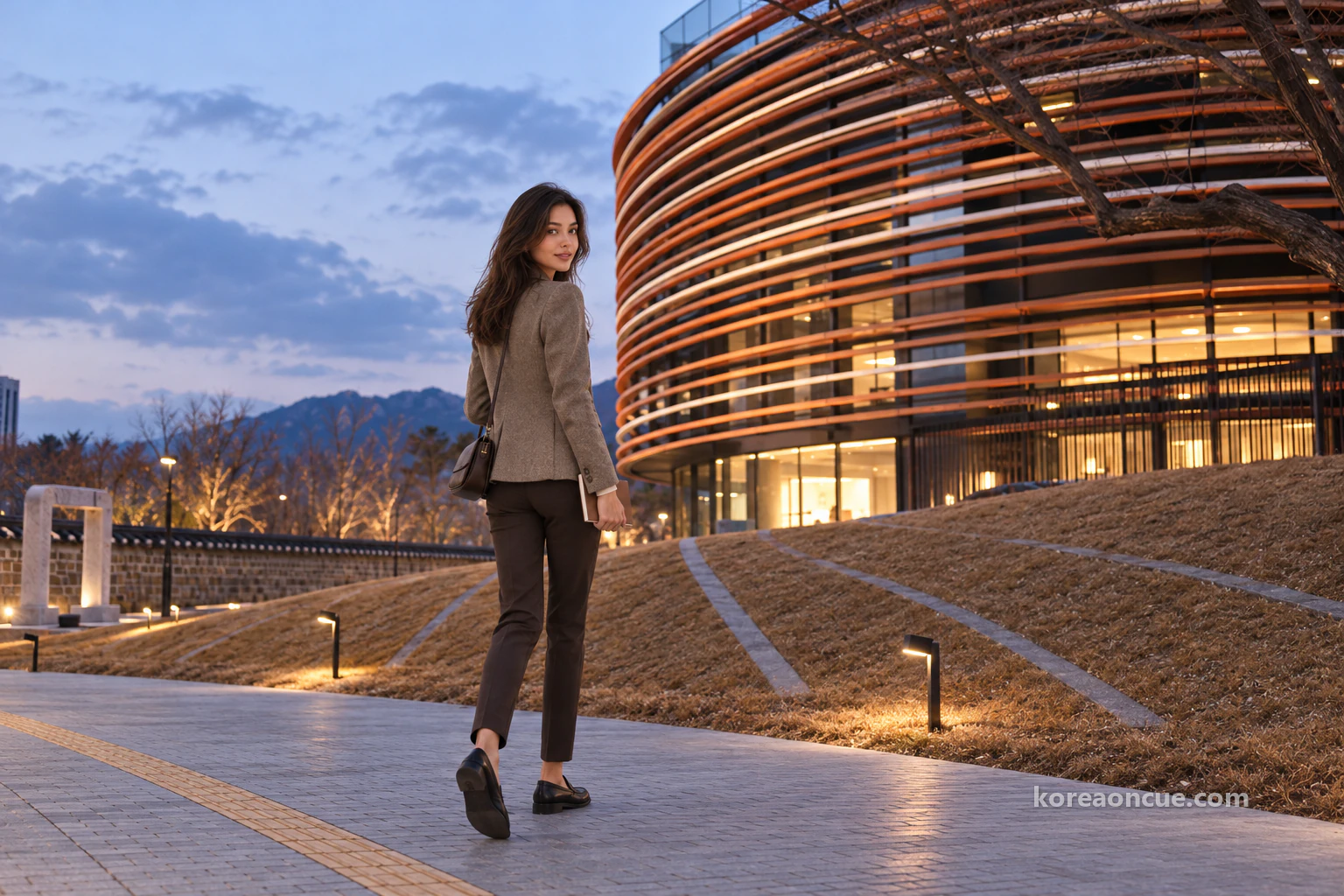
How to get there
Elena likes to carry scenes from stories into real places and read them again there. At twenty-seven, from Spain, she numbers every scene in her notebook and has a habit of sketching cross-sections of buildings she likes. On screen, a scene usually passes in a single light, either day or night, yet Elena has always wondered how the same spot becomes a different stage as the hours change. So this time she has decided to read one place twice, once by day and once by night.
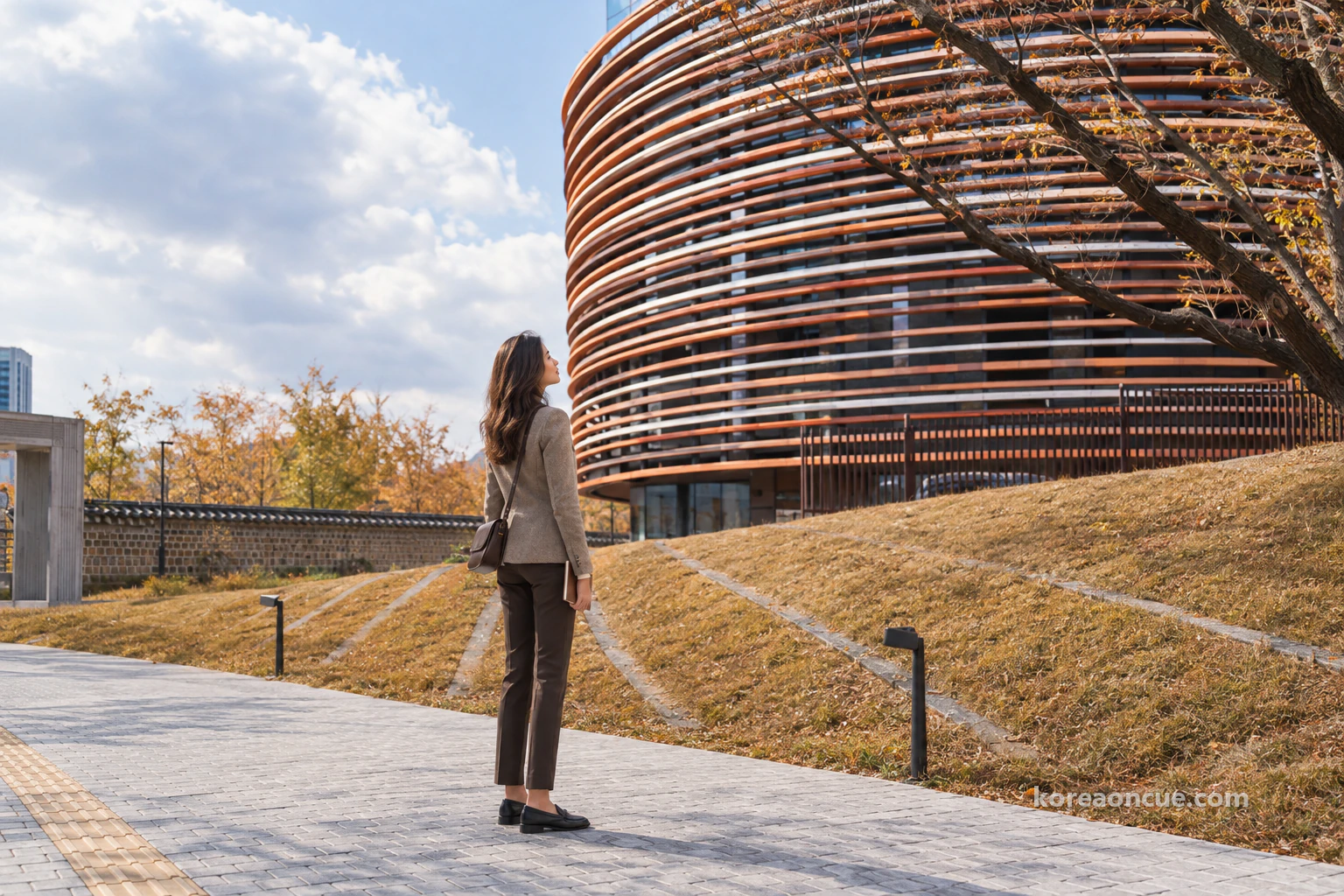
The place she has chosen is the Seoul Museum of Craft Art in Anguk-dong, Jongno-gu. Opened in July 2021, it is Korea’s first public craft museum, created by the Seoul Metropolitan Government from five buildings of the former Pungmoon Girls’ High School. Admission is free, and from 15 September to 30 November the museum extends its evening opening, staying open until 9 p.m. on Tuesdays, Wednesdays, Fridays, Saturdays and Sundays. On 27 October, the contemporary craft exhibition 《각각의 각》 has just opened on the ground floor of Building 1, and Elena wants to know what kind of scene it makes after dark.
Today’s story follows Elena through the first Friday in November. She enters the museum’s outer courtyard from Anguk Station (Line 3) Exit 1 and, while it is still light, sees the permanent embroidery exhibition 《자수, 염원을 그리다》 in Building 3, the show window on Building 3’s ground floor and the permanent exhibition on the second floor of Building 2. After 18:00, when the other buildings close, she takes a short break in the Information Building, then returns to Building 1, which stays open into the evening, for 《각각의 각》 on the ground floor and the permanent exhibition 《장인, 세상을 이롭게 하다》 on the second. Which building closes when, and what needs to be seen in daylight, is set out here in the order of Elena’s notebook.
The Cue
The Seoul Museum of Craft Art is a free craft museum at 4 Yulgok-ro 3-gil, Jongno-gu, Seoul, right outside Anguk Station (Line 3) Exit 1. The galleries normally open 10:00–18:00 and close on Mondays, opening if a Monday is a public holiday. From 15 September to 30 November 2026, the evening opening runs until 21:00 on Tuesdays, Wednesdays, Fridays, Saturdays and Sundays, but only Building 1 stays open late, while Buildings 2 and 3 and the Education Building close at 18:00. On Thursdays, Building 1 also closes at 18:00. 《각각의 각》 runs on the ground floor of Building 1 until 15 November, and last admission is 30 minutes before closing.
- Where: Seoul Museum of Craft Art, 4 Yulgok-ro 3-gil, Jongno-gu, Seoul (Anguk-dong). Main phone 02-6450-7000.
- Subway: Anguk Station (Line 3) Exit 1, then a one-minute walk (60 m).
- Admission: Free (rented exhibitions may charge), self-guided visits.
- Hours: Galleries 10:00–18:00. Evening opening (until 30 November) until 21:00 on Tue, Wed, Fri, Sat and Sun — Building 1 only. Thursdays until 18:00. Closed Mondays (open on public holidays). Last admission 30 minutes before closing.
- See in daylight: 《자수, 염원을 그리다》 on the second floor of Building 3 and the permanent exhibition on the second floor of Building 2 close at 18:00.
- Open into the evening: 《각각의 각》 on the ground floor of Building 1 (27 October–15 November), the permanent exhibition 《장인, 세상을 이롭게 하다》 on the second floor, and 《에퀴녹스: 추분_춘분》 on the third.
- Parking: There is no car park for general visitors. Come by subway or bus.
- Tours: Regular guided tours take individual registration on site and last about 50 minutes per session. The “Docent in Your Hand” QR audio guide in the galleries is available in Korean, English, Japanese and Chinese.
Changing an all-evening plan: only Building 1 stays open after 18:00
Elena’s first plan was simple. When she read that the museum opens until 9 p.m., she meant to arrive around sunset and spend the whole evening working slowly through every exhibition. She had even written it in her notebook: “Friday, arrive 18:00, everything.” But the night before, rereading the evening opening notice at her guesthouse, Elena stopped with her pen in mid-air, because it said that only Building 1 opens until 9 p.m., and that Buildings 2 and 3 and the Education Building (the children’s museum) do not operate during the extended evening hours.
Open in Kakao Map — Anguk Station

The galleries here normally open from 10:00 to 18:00. Even during the evening opening period, Buildings 2 and 3 and the Education Building close at 18:00, and only Building 1 keeps its lights on until 21:00. The exhibition Elena most wanted to see, the embroidery show 《자수, 염원을 그리다》, is on the second floor of Building 3, so if she had come in the evening as planned she would have found nothing but a closed door. Elena struck a line through “everything”, folded a page of her notebook in half lengthways, and wrote “Day” on the left and “Night” on the right.
Under Day she listed the places that close at 18:00, and under Night, Building 1, which stays open until 21:00. Day took the embroidery exhibition on the second floor of Building 3, the show window on Building 3’s ground floor and the permanent exhibition on the second floor of Building 2. Night took 《각각의 각》 on the ground floor of Building 1, 《장인, 세상을 이롭게 하다》 on the second floor and 《에퀴녹스: 추분_춘분》 on the third. Set side by side, the two columns split the day neatly into Act One and Act Two, and Elena moved her arrival forward to around 2 p.m. Divided like this, there is no need to rush the daytime exhibitions, and at night it is just a matter of moving between floors in a single building.
She checked the days again too: the evening opening is on Tuesdays, Wednesdays, Fridays, Saturdays and Sundays, and on Thursdays even Building 1 closes at 18:00. Mondays are closing days for the whole museum, though it opens when a Monday falls on a public holiday. Elena also found a spot in advance for a break between the two acts — the café on the ground floor of the Information Building. She could pick up a coffee before 18:00 and spend the interval in the outer courtyard, she thought, and drew a small cup beside the fold in her notebook.
From Anguk Station Exit 1 to the outer courtyard: five old school buildings on the Andong Byeolgung site
On the afternoon of the first Friday in November, Elena gets off at Anguk Station on Line 3 and comes up through Exit 1. The museum is so close to the exit that she barely needs to look at a map. With no car park for general visitors, the subway is the easier choice, and by bus there is the “Anguk Station · Seoul Museum of Craft Art” stop, served by buses 171, 272, 710 and 7025. A few steps from the exit, Elena walks into the outer courtyard in front of the museum.
The museum is not one large building but several buildings gathered around courtyards. Facing the museum, from left to right, stand the Administration Building, Building 2, Building 1, the Information Building and Building 3, and the open space in front of Building 1, the Information Building and Building 3 is the outer courtyard of the craft yard. Building 2 has its own inner courtyard in front of it, where the Education Building (the children’s museum) stands. Elena pauses at the names, “outer courtyard” and “inner courtyard”. For a museum, they sound just like the yards of a house.
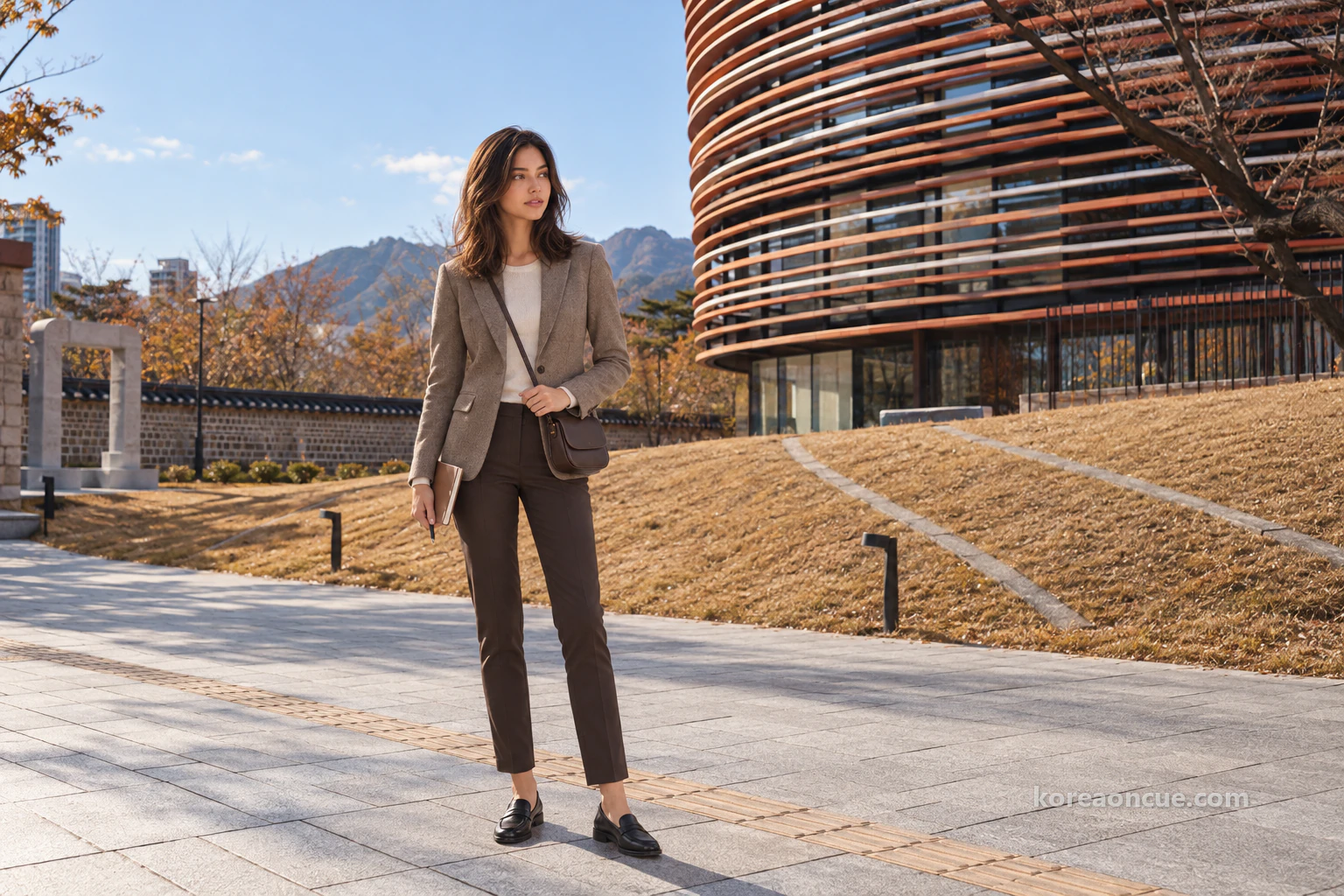
There is a reason for that feeling. The museum stands on the site of Andong Byeolgung, a royal detached palace of the Joseon period. The site was once the residence of Prince Yeongeung, a son of King Sejong, and later held the detached palace built for the wedding of King Sunjo, so for a long time it served as a royal residence and a place for royal weddings. After that, on the same ground, the Pungmoon Girls’ High School buildings, where students studied for more than 70 years, became today’s museum. At the top of a page Elena writes “royal house → school → museum”, and laughs to herself that the stage has stayed the same while the cast has changed three times.
The site has one more layer. This is also the heart of the Jongno area where the gyeonggongjang (京工匠), the Joseon artisans who made handcrafted goods and supplied them to the government, once worked. Bukchon, Insadong and Gyeongbokgung are all close by as well. Once Elena knows the history of the stage, the exhibitions she is about to see start to read differently. The neighbourhood where artisans worked, the classrooms where students studied and the craft objects now placed inside them all join up into one line.
While she is in the courtyard, she also jots the house rules in the corner of her notebook. Every part of the museum is non-smoking, food and drink cannot be brought in, and eating indoors is not allowed. Exhibits are not to be touched, and phones should be switched to vibrate in the galleries. Photography with flash or a tripod and commercial photography are banned, so if you want to take pictures, it is easiest to plan on flash off and a camera held lightly in your hand.
See it first in daylight: the six chapters of 《자수, 염원을 그리다》 on the second floor of Building 3
For the opening scene of Act One, Elena picks Building 3 at the right-hand end of the outer courtyard. Building 3 is the textile building, also known as the Sajeonga Textile Museum. The permanent exhibition on its second floor, 《자수, 염원을 그리다》, is a textile craft exhibition that opened on 20 December 2025, showing embroidery, folding screens, clothing and embroidery tools that came to the museum as donations and loans. Reading the introduction, which describes looking through embroidery at the hearts of people who lived every moment of life with care, stitch by stitch, Elena feels she has chosen the right first scene.
The exhibition is divided into six chapters. Chapter 1 covers the history of Korean embroidery, and Chapters 2 to 6 each carry a wish in their titles: “金枝玉葉 — grow up healthy and unblemished”, “富貴多男 — have many children and be happy”, “牧民之官 — look after the people with all your heart”, “壽福康寧 — live long, stay well and be at peace”, and “極樂往生 — be blessed in the life to come”. As she copies the titles into her notebook, Elena realises they are not descriptions at all. They are lines of dialogue, spoken by someone to someone else.
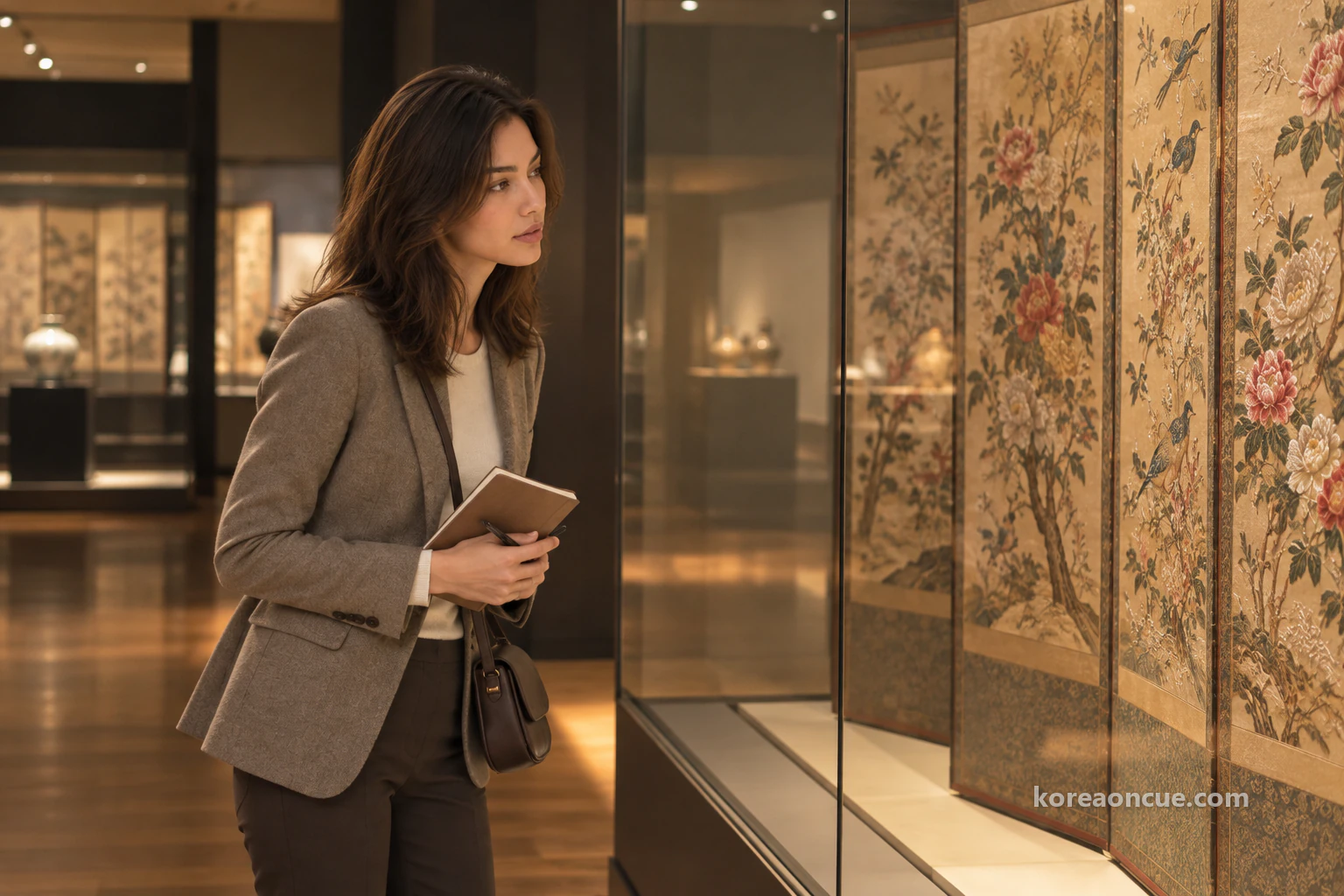
So Elena decides to read the six chapters as a single story. It begins with the wish for a baby to grow up healthy, moves through marriage and children, office and the people, and parents living long, and ends with blessings in the next life. Each chapter holds one scene from a single life, from birth to departure. Elena rules six lines in her notebook and, instead of the chapter titles, writes only short lines of dialogue down the page, such as “grow up strong” and “be happy”.
Chapter 1, on the history of Korean embroidery, also explains why so much embroidery survives from the Joseon period and the early modern era. One of the reasons is that sewing and embroidery were stressed at the time as basic accomplishments for women. Elena stands in front of that sentence for a while. The thought that every one of the countless stitches in the cases was someone’s time quietly adds weight from the very first scene. Walking through all six chapters takes longer than you might expect, so it is worth allowing plenty of time for the embroidery exhibition early in the afternoon.
The Hundred Children screen, the bridal hwarot and the wedding robes of the final chapter
In Chapter 2, what stops Elena is a Hundred Children screen. Placed in the living spaces of newlyweds and women, this kind of screen was not simply a picture of everyday customs but also a prayer for the long, healthy and blessed lives of the children who would one day lead society. After reading this, Elena looks at the screen again. A picture of children at play was, in fact, a prayer a household faced every morning.
Chapter 3 brings the hwarot, the robe a bride wore over her skirt and jacket on her wedding day. The hwarot is densely patterned with motifs such as peonies, pomegranates and bats. The peony, king of flowers, the pomegranate packed with seeds and the bat, which stands for good fortune, all voice the same wish within one garment. Elena starts reading each motif like a prop in an actor’s costume, then realises that in this robe the props are the dialogue, and writes “the clothes do the talking” in her notebook.
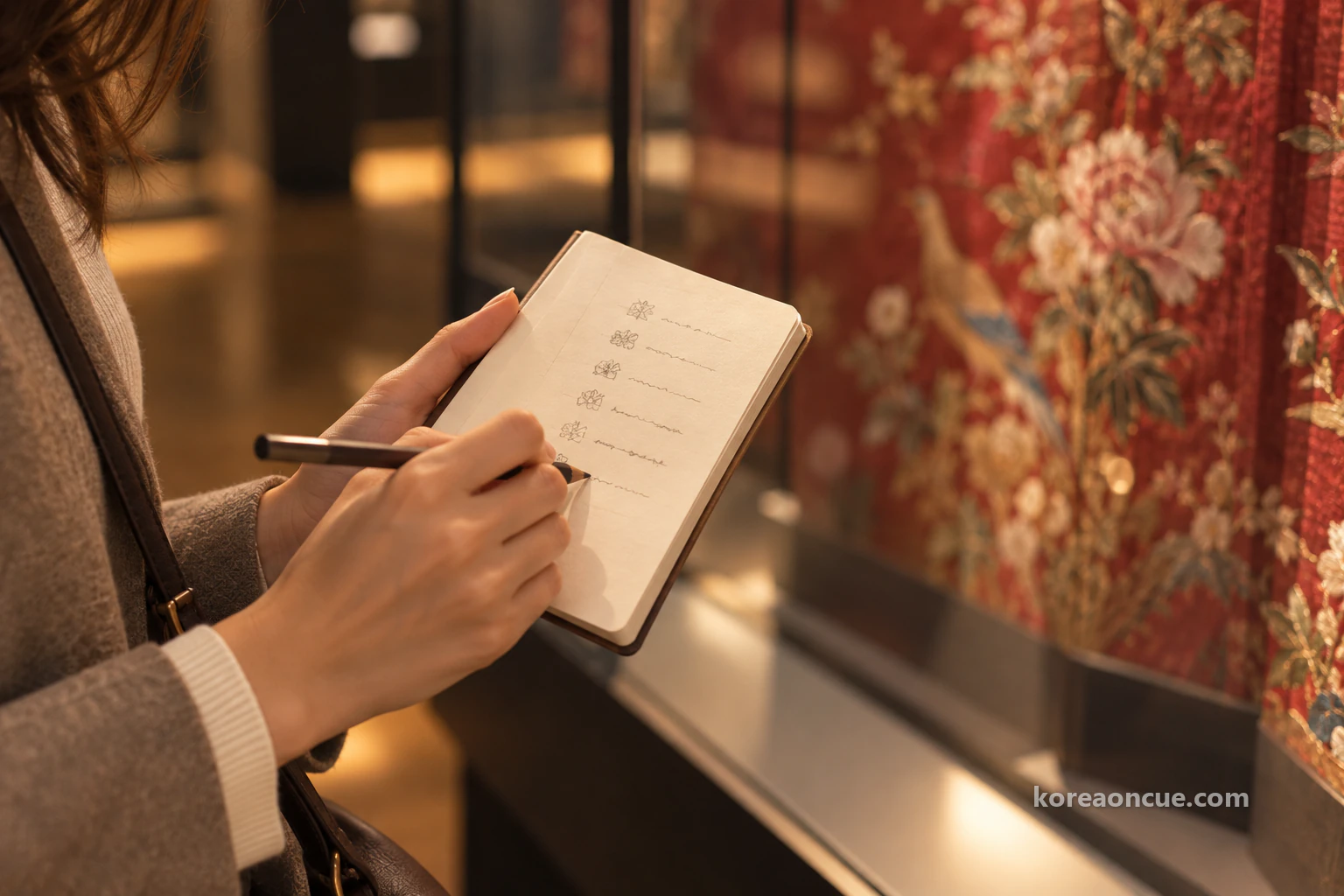
The embroidered commemorative screen in Chapter 4 has a slightly different texture. It is a memorial that local people made together to remember the good work of an honest and kind district magistrate. Rather than one person taking up a needle for another, it was a greeting from a whole district to one man. If the two earlier chapters were family dialogue, Elena thinks, this one is the voice of a crowd, and on the fourth of her six lines she draws a small circle to stand for many people.
Elena stands for a long time in the last chapter, Chapter 6. Here is the story that clothes worn at life’s high point, such as wedding robes, were sometimes later used as burial garments. The exhibition explains this as the old view of life and death, linking beginning and end with a single length of cloth. Placing the baby clothes of the first chapter beside the wedding robes of the last in her mind, Elena sees that the exhibition was built as one person’s story from the start. Beneath her six lines she also notes, one after another, the featured works: Kim Seon-hui’s wedding robe, an embroidered Guunmongdo folding screen and Kim Gwang-gyun’s embroidered gulle cap.
Before 18:00: the 《실루엣》 show window in Building 3 and the permanent exhibition in Building 2
Coming down from the second floor, Elena stops again at the show-window gallery on the ground floor of Building 3. Running from 21 October to 6 December, Craft Together @ Show Window #6: Silhouette shows work by two artists, Baek Jae-won and Oh Se-rin, who combine different materials such as metal, clay, concrete and plastic in a single piece. Baek Jae-won buries metal remnants in concrete and breaks the surface to reveal what is inside, while Oh Se-rin builds up clay forms with layers of objects that have lost their use and traces of nature. The old story at the start of the exhibition text, about someone tracing the outline of a departing lover’s shadow on a wall, strikes Elena as exactly like the opening scene of a film.
In front of the window, Elena makes a small discovery. The names of both artists are also on the list of participants in 《각각의 각》, which she will see tonight. 《실루엣》, too, is an exhibition made in collaboration with young craft artists from the Seoul Foundation for Arts and Culture’s Sindang Creative Arcade. Elena draws an arrow into the Night column of her notebook. She will meet the same two artists again tonight on a different stage, so a character introduced in Act One now returns in Act Two.
The next scene is Building 2, across the outer courtyard to the left. The permanent exhibition on its second floor, “From Nature to Craft — Artisans Make the Tradition of Craft”, shows how ore was reborn as metalwork, clay as earthenware and then ceramics, and wood and abalone shell as mother-of-pearl lacquerware. On the second floor, three rooms follow one another from the right: metal that withstood the flames, history and art made from earth and fire, and the brilliant colours of mother-of-pearl lacquerware. This building also closes at 18:00, so pairing it with the embroidery exhibition, as Elena does, keeps the route tidy.
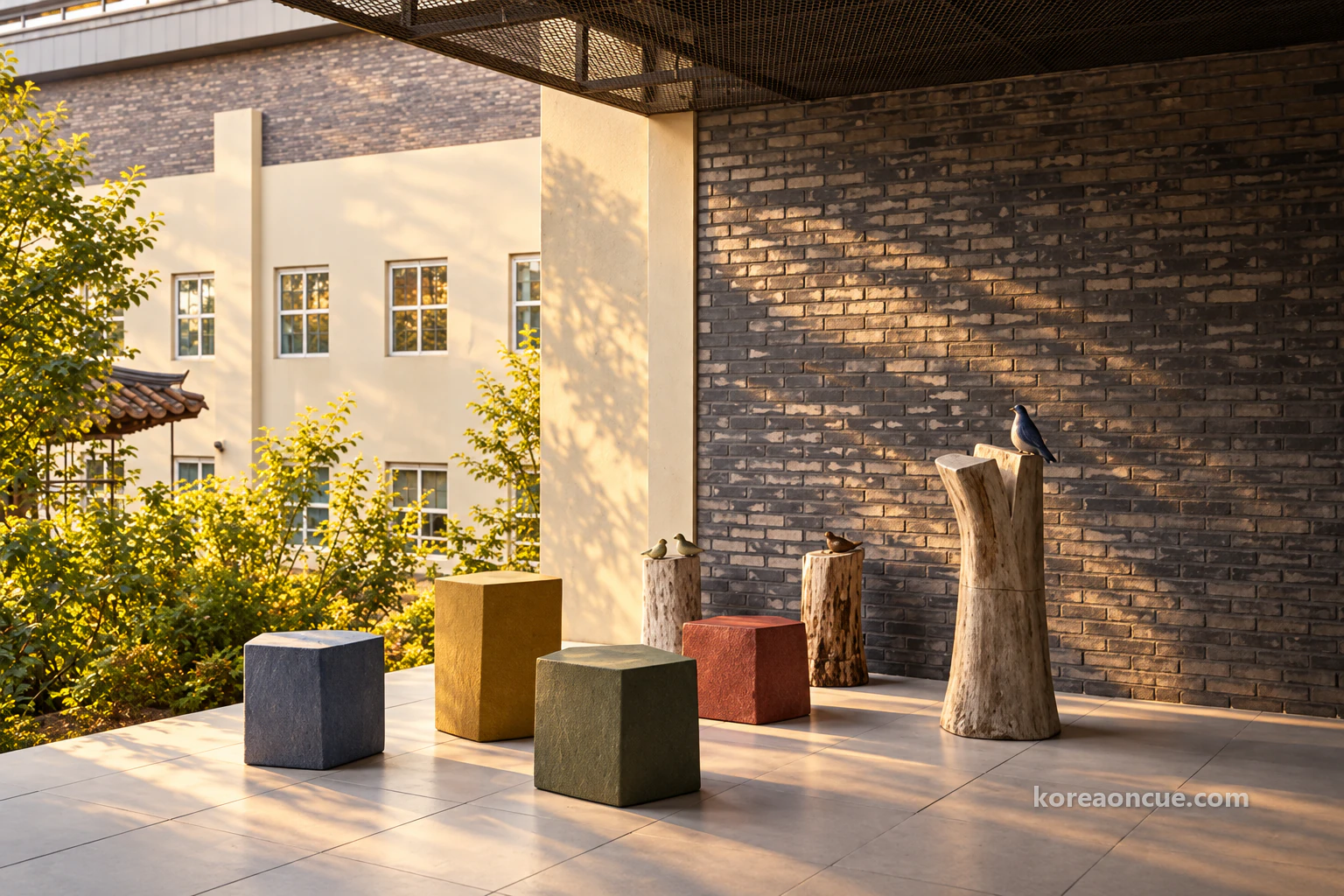
On the ground floor of Building 2 there is a covered outdoor rest area. Colourful seats shaped like hexagonal columns stand in front of a dark brick wall. Elena rests her legs here for a moment and ticks off the Day column one item at a time. By the time the embroidery exhibition, the show window and the Building 2 permanent exhibition are all crossed out, the clock is heading towards 18:00 and Act One is nearly over.
At 18:00, between the buildings that close and the one that stays open: a stop at the café in the Information Building
At 18:00, Buildings 2 and 3 and the Education Building close. Seen from the outer courtyard, the buildings on one side finish their day while only Building 1, in the middle, carries on into the evening. To Elena, the moment feels like an interval in a play. It is the short gap just before a scene change, when the lights go down on part of the stage and stay up in only one place.
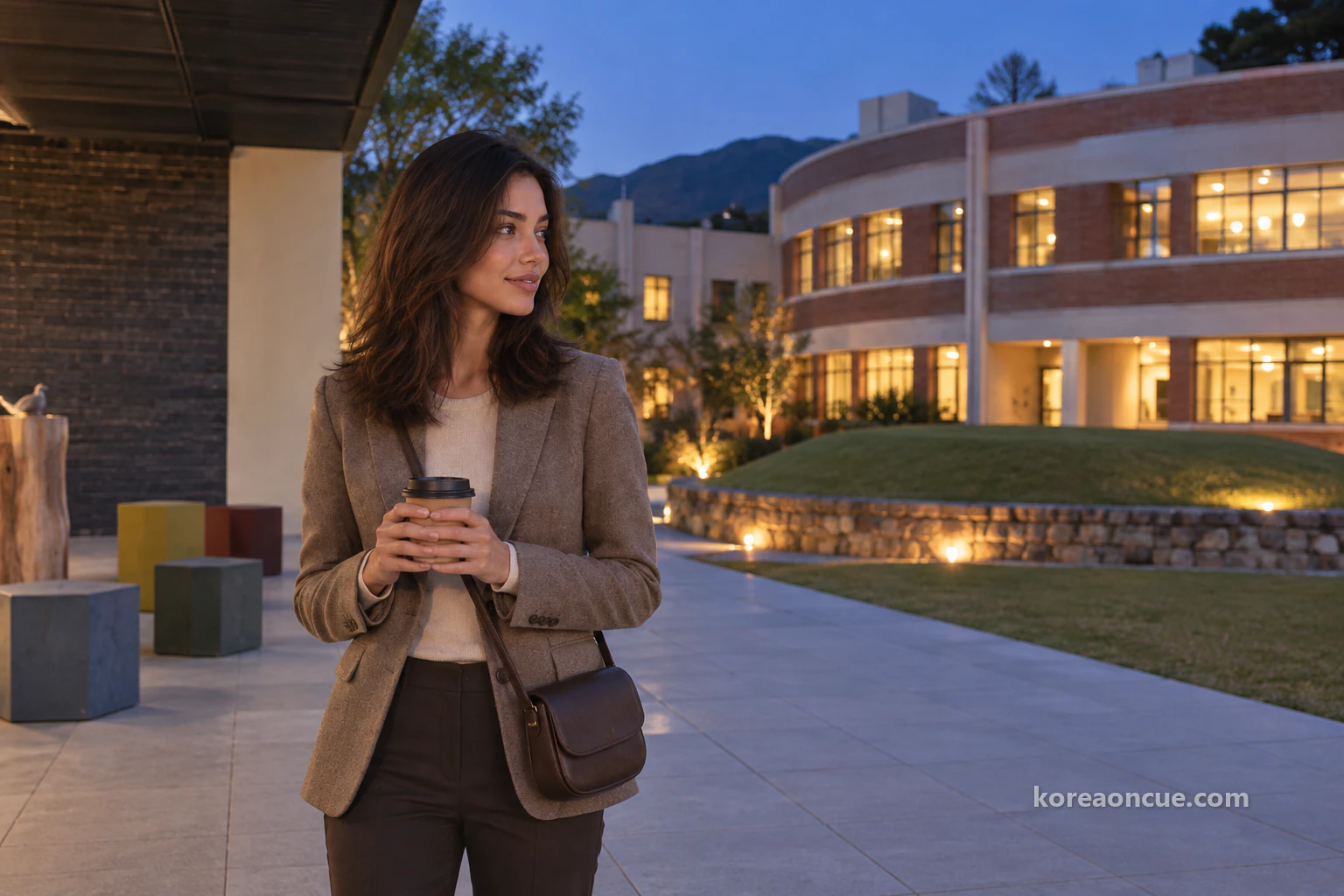
Elena decides to spend the interval at the Information Building. The museum’s place to rest is the café on the ground floor of the Information Building, serving light snacks, coffee and seasonal drinks. Before it closes, Elena picks up a hot coffee and settles at the edge of the outer courtyard to sort through her notes from Act One.
Over her coffee, Elena rereads the notes in the Day column: the six lines of dialogue, the shadow story, and the arrow beside the two artists’ names. The daytime scenes were all about old wishes and human hands, while 《각각의 각》, tonight’s exhibition, is new work by artists active today. Elena likes the idea that, inside one museum, the day is edited with a jump in time. She waits for the outer courtyard to grow fully dark, then walks towards the door of Building 1.
To prevent accidents, access to the museum’s outdoor craft yard is restricted from 22:00 until 8:00 the next morning. Building 1 closes at 21:00, so when you finish your visit, simply cross the courtyard and head straight for the exit. During the interval Elena checks one more thing. Last admission is 30 minutes before closing, so to see everything in the Night column it is better not to go in too late.
Building 1 ground floor at night: reading 《각각의 각》’s 54 works by 35 artists through five qualities
The first scene of Act Two is 《각각의 각》 on the ground floor of Building 1. The exhibition is the 2026 Sindang Creative Arcade exhibition, organised in collaboration between the Seoul Foundation for Arts and Culture and the Seoul Museum of Craft Art. The ground floor of Building 1 was closed from 13 to 25 October after one exhibition ended and the next was prepared, then reopened on 27 October, the day this exhibition began. Running until 15 November, it is both a contemporary craft exhibition and a civic craft communication project.
Elena’s eyes widen at the scale of it. Thirty-five artists from the 17th residency at Sindang Creative Arcade are showing 54 new works. The materials range widely too, falling into ten categories: wood and lacquer, painting and calligraphy, synthetic resin, glass and jewellery, stone, paper, textiles, metal, ceramics, and everything else. The exhibition looks at all these works through five qualities — generation, transformation, accumulation, structure and connection — and aims to be a place where visitors discover, each from their own angle, the many sides of very different works.

As soon as she hears the phrase “five qualities”, Elena opens her notebook. In keeping with her habit of numbering scenes, she divides a page into five boxes and labels them “1 Generation”, “2 Transformation”, “3 Accumulation”, “4 Structure” and “5 Connection”. Then she gives each word a question of her own. In the Generation box she writes “What came into being first?”, in Transformation “What turned into what?”, and in Accumulation “What built up?”.
Walking with the questions in hand changes the way she lingers in front of each work. The same piece shows a different side depending on which box’s question she brings to it, and sometimes Elena writes one work into two or three boxes at once. Just as the title suggests, different angles are gathered in one space. If it is your first visit, you might do what Elena does: pick just one of the five words, walk the room once through its eyes, then go round again with another.
Elena’s pen stays longest in the Accumulation and Connection boxes. She remembers that the two artists in the show window that afternoon worked with adding and building up, burying and breaking. Like a character from Act One returning in Act Two in a different costume, her day notes and night notes join up inside the notebook. Between the two boxes, Elena draws one more arrow leading back to the Day column.
《장인, 세상을 이롭게 하다》 on the second floor of Building 1: walking the four rooms in order
Having finished the ground floor, Elena climbs the stairs to the second floor. Building 1’s second floor has three permanent exhibitions, and the one Elena chooses is 《장인, 세상을 이롭게 하다》, a craft-history exhibition that has run since the museum opened on 16 July 2021. The exhibition opens with the number of Joseon artisans. The Gyeongguk Daejeon, the dynasty’s code of law, assigned 2,841 gyeonggongjang in 129 fields to central government offices and 3,656 oegongjang in 27 fields to provincial offices.
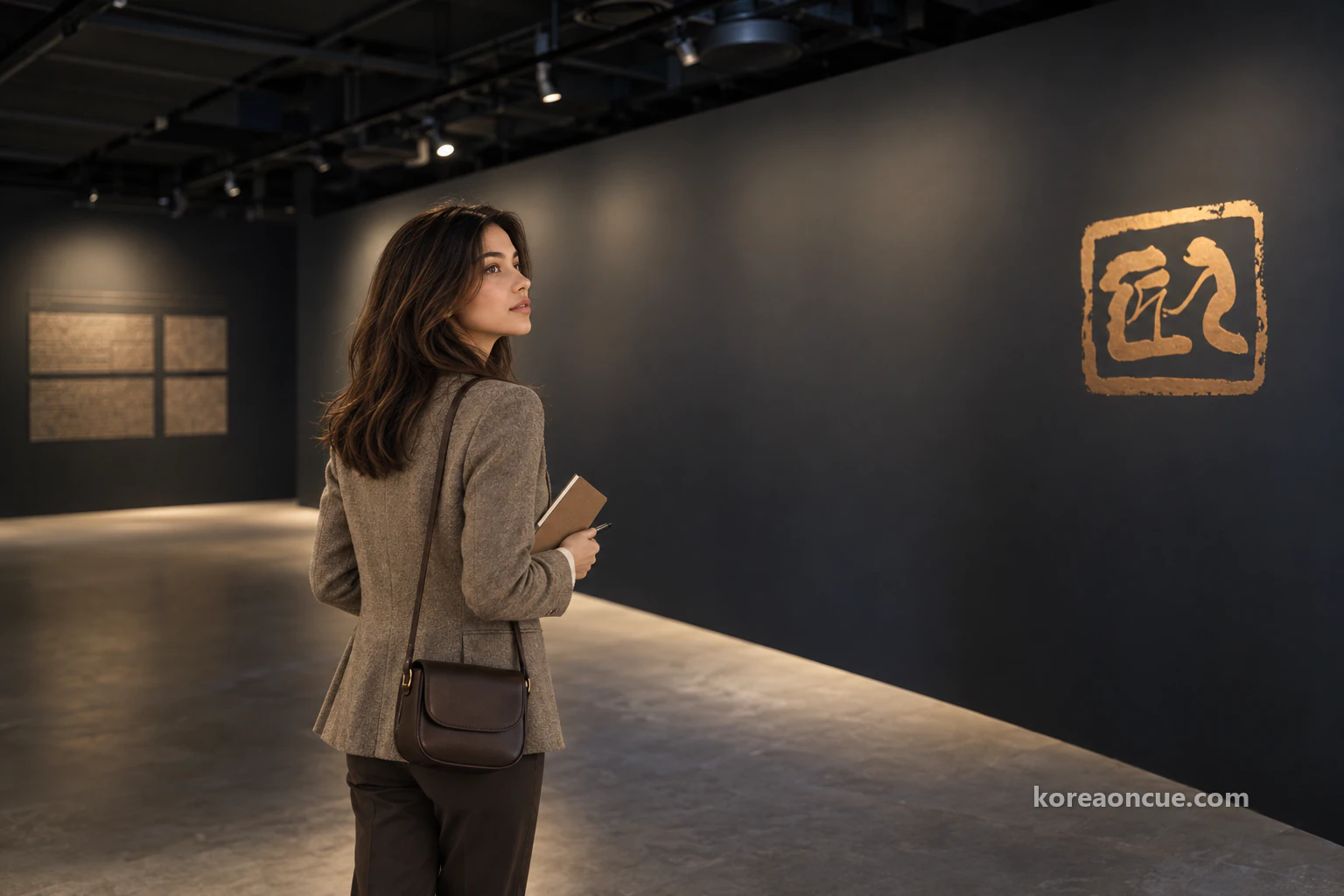
Writing the number 2,841 in her notebook, Elena thinks back to the history of the stage she learned in the outer courtyard that afternoon. The ground this museum stands on was the heart of Jongno, where the gyeonggongjang who supplied craft goods to the government once worked. For Elena, reading those artisans’ stories inside this very building feels like reading the original of a scene at the place where it was filmed. The second-floor galleries are walked in order, starting with the first room on the left as you enter and continuing to the fourth, and you leave on the fourth room’s side.
The first room is about the special royal names carved by artisans. Royal investiture books for kings and queens were made of jade and called okchaek, and those for crown princes and royal concubines were made of bamboo and called jukchaek, and more than 100 artisans worked together on a single book. The second room covers gyeonyang (見樣), the models for royal craft. Gyeonyang showed the prescribed sizes and styles for objects used in state rites or by the royal household as drawings or samples, and they appeared as illustrations in state records such as the uigwe. Elena writes gyeonyang down as “storyboards for objects”, because like a storyboard drawn before a scene is shot, they were drawings that fixed a shape before anything was made.
The third room is about the style of the women’s quarters and the scholar-officials. Reading that imitations of court style among ordinary people were called gungyang (宮樣), Elena pictures a fashion spreading from the palace into the streets. The fourth room, on craft moving into everyday life, introduces the sajang (私匠), artisans who worked outside government offices from the mid-17th century onwards. The state system for managing artisans loosened through the wars of the 16th and 17th centuries and was dismantled by the end of the 19th century.
When she comes out of the four rooms, Elena’s notebook holds a single line of story. State artisans make royal objects, their styles spread among ordinary people, and finally independent artisans make the things of daily life. Under that line she also writes the names of the featured works: a hwagak box, a white porcelain jar with underglaze blue cloud and dragon design, a book chest, and a chaekgado screen painted by Yi Taek-gyun. The other permanent exhibitions on the same floor and 《에퀴녹스: 추분_춘분》 on the third floor are also open into the evening, but Elena closes the scene here for today.
Back to the outer courtyard before 21:00, and folding up a day of two halves at Anguk Station
She saves 《에퀴녹스: 추분_춘분》 on the third floor for next time. Running until 7 March 2027, the exhibition is about the balance of different things coming together at the turn of the autumnal equinox, when day and night become equal in length. For Elena, who has just split her day into day and night, the title fits almost too well to be a coincidence, so at the very bottom of the Night column she writes only “Next scene — third floor”. On Fridays there is also an Equinox tour at 18:00 and a craft-history tour at 18:30, so if you would like to join one, head a little early to the meeting point in the ground-floor lobby of Building 1.

When Elena steps out of Building 1, night has already fallen over the outer courtyard. At the edge of the courtyard she turns round once and looks again at the buildings she first looked up at that afternoon. The buildings that were open in the day are resting quietly now, and Elena has watched, from start to finish, the same courtyard become two different stages. Anguk Station Exit 1 is only a moment away, so she takes her time.
On the subway back to her guesthouse, Elena opens the folded notebook again. The Day column on the left holds six lines of dialogue and the shadow story, and the Night column on the right holds five boxes of questions and four rooms. Had she come only in the evening, as first planned, the left column would be empty. On the fold between the two columns, Elena writes a small “18:00”, because that is the time the act changes at this museum.
Common Mistakes
Coming in the evening to see every exhibition
during the evening opening, only Building 1 stays open until 21:00. Buildings 2 and 3 and the Education Building close at 18:00, so see the embroidery exhibition and Building 2’s permanent exhibition first, in daylight.
Visiting on a Thursday evening
even during the evening opening period, Building 1 closes at 18:00 on Thursdays. For a night visit, go on a Tuesday, Wednesday, Friday, Saturday or Sunday.
Going on a Monday
the museum closes every Monday (it opens on public holidays).
Driving
there is no car park for general visitors. The museum is right outside Anguk Station (Line 3) Exit 1.
Taking snacks into the galleries
food and drink cannot be brought in, and eating indoors is not allowed. For a break, use the café on the ground floor of the Information Building.
Arriving just before closing
last admission is 30 minutes before closing.
FAQ
Which station and exit should I use?
Anguk Station (Line 3) Exit 1, then a one-minute walk (60 m). The address is 4 Yulgok-ro 3-gil, Jongno-gu, Seoul.
Is there an admission charge?
No, it is free. Only rented exhibitions may charge.
What can I see in the evening?
Until 30 November 2026, Building 1 opens until 21:00 on Tuesdays, Wednesdays, Fridays, Saturdays and Sundays. Building 1 holds 《각각의 각》 on the ground floor, permanent exhibitions on the second floor and 《에퀴녹스: 추분_춘분》 on the third. Buildings 2 and 3 and the Education Building close at 18:00.
When and where is 《각각의 각》?
From 27 October to 15 November 2026, on the ground floor of Building 1. It presents 54 new works by 35 artists from the 17th residency at Sindang Creative Arcade through five qualities: generation, transformation, accumulation, structure and connection.
Are there guides in other languages?
The “Docent in Your Hand” QR audio guide in the galleries is available in Korean, English, Japanese and Chinese. Craft Eye devices in Korean and English can be borrowed free at the information desks in Buildings 1 and 3 by leaving an ID.
Can I take photos?
Photography with flash or a tripod and commercial photography are not allowed. Please switch your phone to vibrate in the galleries.
Recap — 30 seconds before you go
- Anguk Station (Line 3) Exit 1 → Seoul Museum of Craft Art right outside (4 Yulgok-ro 3-gil), free
- Day (until 18:00): Building 3, 2F embroidery exhibition → Building 3, ground-floor show window → Building 2, 2F permanent exhibition
- Night (until 21:00, Tue, Wed, Fri, Sat, Sun): Building 1 only — ground floor 《각각의 각》 (until 15 Nov) → 2F 《장인, 세상을 이롭게 하다》
- Thursdays everything closes at 18:00, closed Mondays, last admission 30 minutes before closing
- No car park, no food or drink inside
Sources
- Seoul Museum of Craft Art — Visitor informationFree admission with possible charges for rented exhibitions · regular hours 10:00–18:00 · Monday closure and public holiday exception · evening timetable and last admission · courtyard access restricted 22:00–08:00 · visiting and photography rules · Anguk Station Exit 1, buses, address and no general visitor parkingchecked 2026-10-26
- Seoul Museum of Craft Art — Extended evening opening notice15 September–30 November 2026: Building 1 open until 21:00 on Tuesdays, Wednesdays, Fridays, Saturdays and Sundays · Thursdays until 18:00 · Buildings 2 and 3 and the Education Building do not operate during the extended evening hourschecked 2026-10-26
- Seoul Museum of Craft Art — About the museumOpened in July 2021 · Korea’s first public craft museum, created by remodelling five former Pungmoon Girls’ High School buildings · site of Prince Yeongeung’s residence and royal wedding ceremonies · government artisans in Jongno and nearby Bukchon, Insadong and Gyeongbokgungchecked 2026-10-26
- Seoul Museum of Craft Art — 《자수, 염원을 그리다》, embroidery exhibitionBuilding 3, second floor · opened 20 December 2025 · six chapters covering embroidery history and five wishes · Hundred Children screen, bridal robe motifs, commemorative screen for a local official, and wedding robes reused as burial garments · names of featured workschecked 2026-10-26
- Seoul Museum of Craft Art — Craft Together @ Show Window #6: Silhouette21 October–6 December 2026, Building 3 ground-floor show-window gallery · Baek Jae-won and Oh Se-rin · combining different materials · the old story of tracing a shadow · collaboration with Sindang Creative Arcadechecked 2026-10-26
- Seoul Museum of Craft Art — 《각각의 각》, contemporary craft exhibition27 October–15 November 2026, Building 1 ground floor · collaboration with Seoul Foundation for Arts and Culture · 54 new works by 35 artists from Sindang Creative Arcade’s 17th residency · generation, transformation, accumulation, structure and connection · ten material categories and participation by Baek Jae-won and Oh Se-rinchecked 2026-10-26
- Seoul Museum of Craft Art — 《장인, 세상을 이롭게 하다》, artisans exhibitionOpened 16 July 2021, Building 1 second floor · 2,841 central-government artisans in 129 fields and 3,656 provincial artisans in 27 fields · four-room route · royal investiture books, prescribed models, court styles, independent artisans and changes in the government artisan system · featured works · three exhibition themes and route on Building 2’s second floorchecked 2026-10-26
- Seoul Museum of Craft Art — Exhibition toursIndividual on-site registration and tours of about 50 minutes · Friday Equinox tour at 18:00 and craft-history tour at 18:30, meeting in Building 1’s ground-floor lobby · QR audio guides in four languages · free Korean/English Craft Eye device loans with identificationchecked 2026-10-26
A Seoul story told with our AI characters. Place details are checked against public sources; the photos are AI-made illustrative images. How we use AI
More from this area
An exhibition about home at the hour people head home: Ethan spends a free Wednesday evening with Do Ho Suh at MMCA Seoul
Two days after the four friends had dinner in Bangi Matgol, Ethan finishes his Wednesday meetings and heads for Anguk Station.
Rina walks Unhyeongung on a November evening, from Sujiksa by the gate to Irodang in the inner quarters
Rina has got off at Anguk Station more times than she can count, yet she has always walked past the old house outside Exit 4.