
SEOUL · ROOM OF QUIET CONTEMPLATION
The Room of Quiet Contemplation: Walking All the Way Round Two Pensive Bodhisattvas
Rina Heads Straight from Ichon Station to the 2nd Floor of the National Museum of Korea, Takes the Dark Entrance Passage Slowly, and Sorts Two Statues — One 6th-Century, One 7th-Century — into Left and Right on a Saturday Evening
Part two of “Yongsan.” The Room of Quiet Contemplation, on the 2nd floor of the National Museum of Korea’s Permanent Exhibition Hall, opened on 12 November 2021: a 439 m² gallery that shows two national-treasure pensive bodhisattva statues side by side. Before then, the pair had been shown together in a room of their own only three times. On her first visit Rina reached this room almost last, after every other floor. This time she comes for this one room.

How to get there
Calculated with a map app’s walking route (TMAP), to the museum’s point on the map — not to the Room of Quiet Contemplation itself. The museum’s website directs visitors from Ichon Exit 2 along the museum walkway to the west gate.
This is part two of “Yongsan.” In part one Lulu worked out the order in which to show a friend the National Museum of Korea — the building, its open yard, the Mirror Pond. This time the story goes inside and stays a long while in one room on the 2nd floor.
Rina is someone who comes to the same place twice. The first time she takes in the whole, the second time she looks for what she missed. On her first visit here she walked the galleries in order, from the 1st floor to the 3rd, and reached the Room of Quiet Contemplation almost at the end. By the time she stood in front of the two statues, her legs had given up before her eyes had.
Six o’clock on a Saturday evening. On Wednesdays and Saturdays the museum stays open until nine. On the first line of her notebook Rina writes: “One room today. Not just the front — all the way round.”
Straight up to the 2nd floor from Ichon
From Exit 2 of Ichon Station (Line 4) to the National Museum of Korea (the map’s representative point), the map route is 547 m, about 8 minutes (TMAP pedestrian route calculation). This is not the distance to the Room of Quiet Contemplation itself.
The way in is the same as in part one. The museum’s website sends visitors from Ichon Station (Line 4 and the Gyeongui–Jungang Line), towards Exit 2, along the museum walkway to the west gate. By a map app’s walking route it is 547 m from Exit 2 to the museum, about eight minutes. That figure ends at the museum’s point on the map, though. The walk through the building and up to a room on the 2nd floor comes on top. Find on a map
Last time Rina began with the 1st-floor galleries nearest the entrance and worked her way through. This time she heads upstairs as soon as she is inside. The museum’s floor guide puts the Room of Quiet Contemplation on the 2nd floor, alongside the Calligraphy and Painting and Donated Collection galleries, and describes it as a space showing two national-treasure pensive bodhisattva statues side by side.
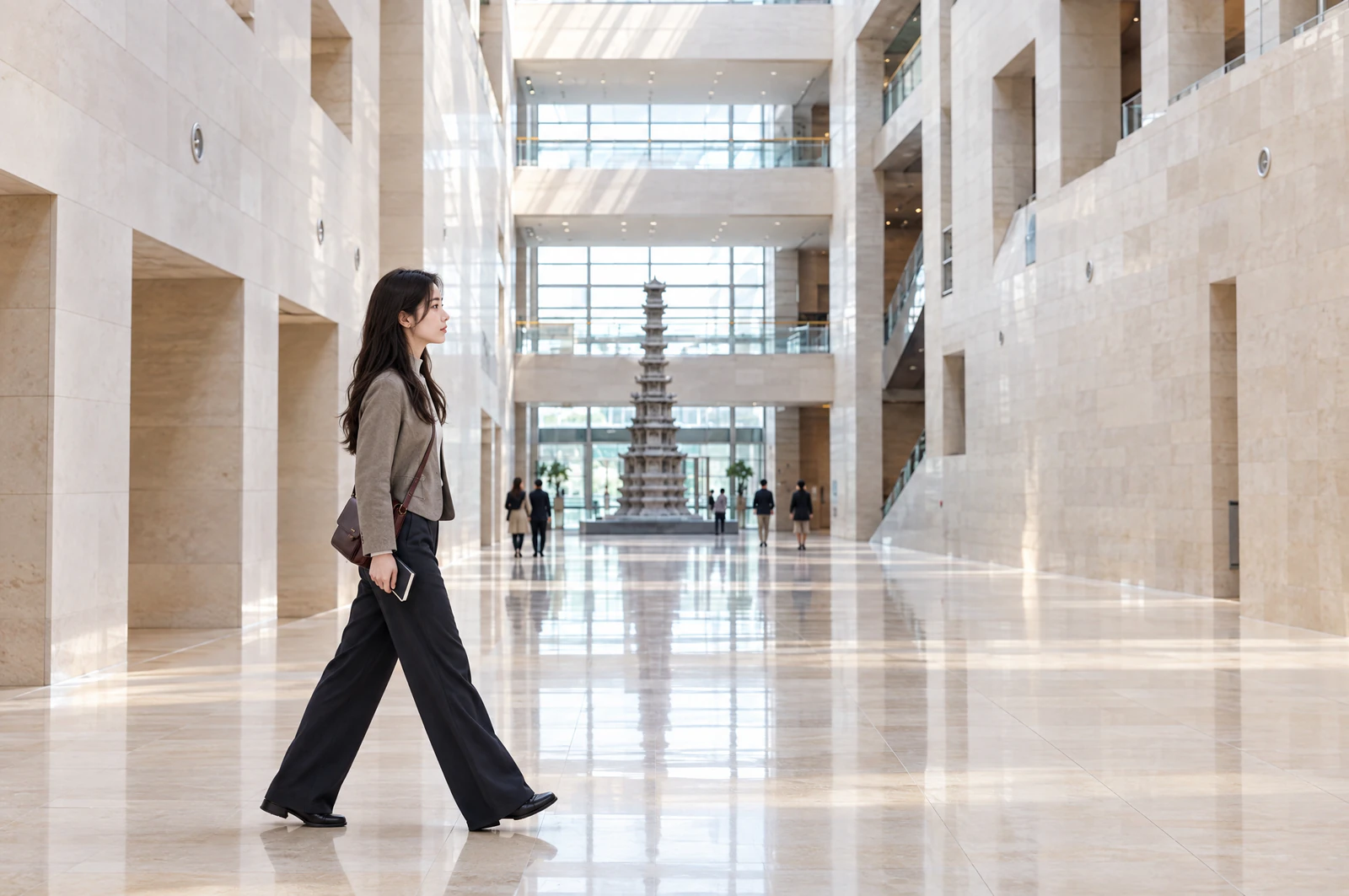
The same page lists the rooms that are currently closed. On the 3rd floor, Buddhist Sculpture and Metal Arts. On the 2nd, Buddhist Painting, Wood and Lacquer Crafts and two Calligraphy and Painting rooms, all until 28 January 2027. On the list as checked on 29 September, the Room of Quiet Contemplation does not appear. Rina notes in a corner of the page: “Next time too — check the closure notices first.”
A long passage for the eyes to adjust
National Museum of Korea press release (2021): the gallery was completed in collaboration with the architect Choi Wook (principal of ONE O ONE architects) — the first time the museum had worked with an architect on a gallery. In a space the size of a small theatre he designed an entrance passage through darkness, a gallery floor and walls that tilt very slightly, and a ceiling with a faint sparkle. The long entrance passage, fitted with media artworks, is a transitional space for the eyes to adjust to the dark interior. After facing the statues, visitors are led along the oval display platform to take in their whole form. Labels were kept to a minimum, and commentary on the works and the space is provided through QR codes on the gallery walls.
According to the museum’s 2021 press release, the room opened on 12 November that year. It was built from scratch as a 439 m² gallery on the 2nd floor, set apart from the existing visitor route. The museum worked on it with the architect Choi Wook, principal of ONE O ONE architects — the first time, the release notes, that it had brought in an architect to design a gallery. Find on a map

The release calls it a space the size of a small theatre. What the architect imagined was an entrance passage through darkness, a gallery floor and walls that tilt very slightly, and a ceiling with a faint sparkle. The long passage, fitted with media artworks, is described as a transitional space where the eyes slowly get used to the dark.
The first time, Rina hurried through it. She already knew what was at the end. Now she slows down, keeps to the wall and lets eyes that came in from a bright hallway catch up with the dark. She has read that the floor tilts. Whether her feet can tell is another matter.

The release also says that written labels were kept to a minimum, with commentary on the works and the space offered through QR codes on the walls — that was the arrangement in 2021. Rina leaves her phone in her bag.
Left, 6th century. Right, 7th century
National Museum of Korea, Room of Quiet Contemplation guide: the gilt-bronze pensive bodhisattva on the left of the gallery dates from the late 6th century (Three Kingdoms period), 81.5 cm high and weighing 37.6 kg. It is marked by a sharp nose, clearly defined eyes, rich ornaments and refined drapery, with a shoulder scarf flaring out to either side. The two statues look alike but differ in expression, dress, size, weight and date.
At the far end of the room the two statues sit side by side. The museum’s page for the room describes them seated with the right leg resting on the left knee and the fingers of the right hand lightly touching the cheek, lost in thought. The room guide adds that they look alike but differ in expression, dress, size, weight and date. On Rina’s first visit her notebook held one line: “Two pensive bodhisattvas.” Today she rules the page into two columns. Find on a map
Left column. According to the guide, the statue on the left was made in the late 6th century, in the Three Kingdoms period. It stands 81.5 cm high and weighs 37.6 kg. It has a sharp nose, clearly defined eyes, rich ornaments and finely worked drapery, and a scarf over the shoulders flares out to either side.

Right column. A little later, from the early 7th century, 90.8 cm high and 112.2 kg. The upper body is bare, the crown is made of three half-circles and a double round necklace sits at the neck. Rina lays the two sets of figures side by side and reads them again. Less than 10 cm apart in height, and nearly three times apart in weight.
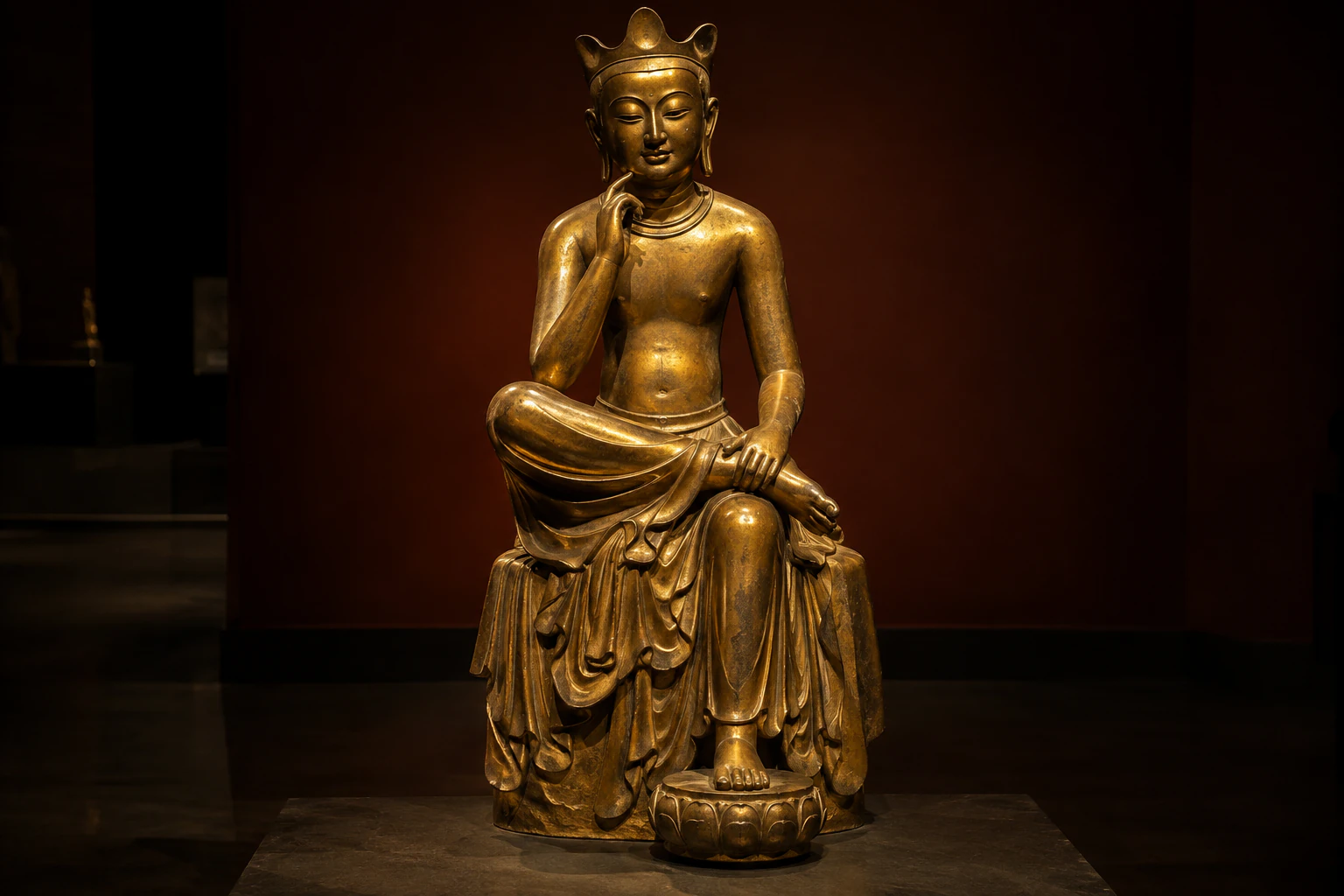
The National Heritage Service gives slightly different heights: 80 cm for the statue with the ornate crown, 93.5 cm for the one whose crown has three rounded, mountain-like faces. Matching the crown descriptions in the museum guide against the National Heritage Service records, the statue on the left appears to correspond to 1962-1 and the one on the right to 1962-2. That correspondence is an editorial cross-reference between the two sources. The figures in this piece follow the museum’s guide. According to the Heritage Service’s register, both were designated National Treasures on the same day, 20 December 1962.
Round the oval platform to the back
National Heritage Service: the Gilt-bronze Maitreya Bodhisattva in Meditation (1962-2) is a National Treasure, designated on 20 December 1962. At 93.5 cm high it is, together with the museum’s other gilt-bronze pensive bodhisattva, the largest in Korea. Its crown has three rounded, mountain-like faces, so it is also called the ‘Three-Mountain’ Pensive Bodhisattva. The upper body is bare, with a double necklace at the neck. A long tenon at the back of the head shows that a halo was once fitted there.
The 2021 press release says the room was laid out so that visitors walk in slowly, meet the statues face to face, and then follow the oval display platform to take in the whole of each figure. On her first visit Rina only saw them from the front. What she has written down to look for today is the back. Find on a map
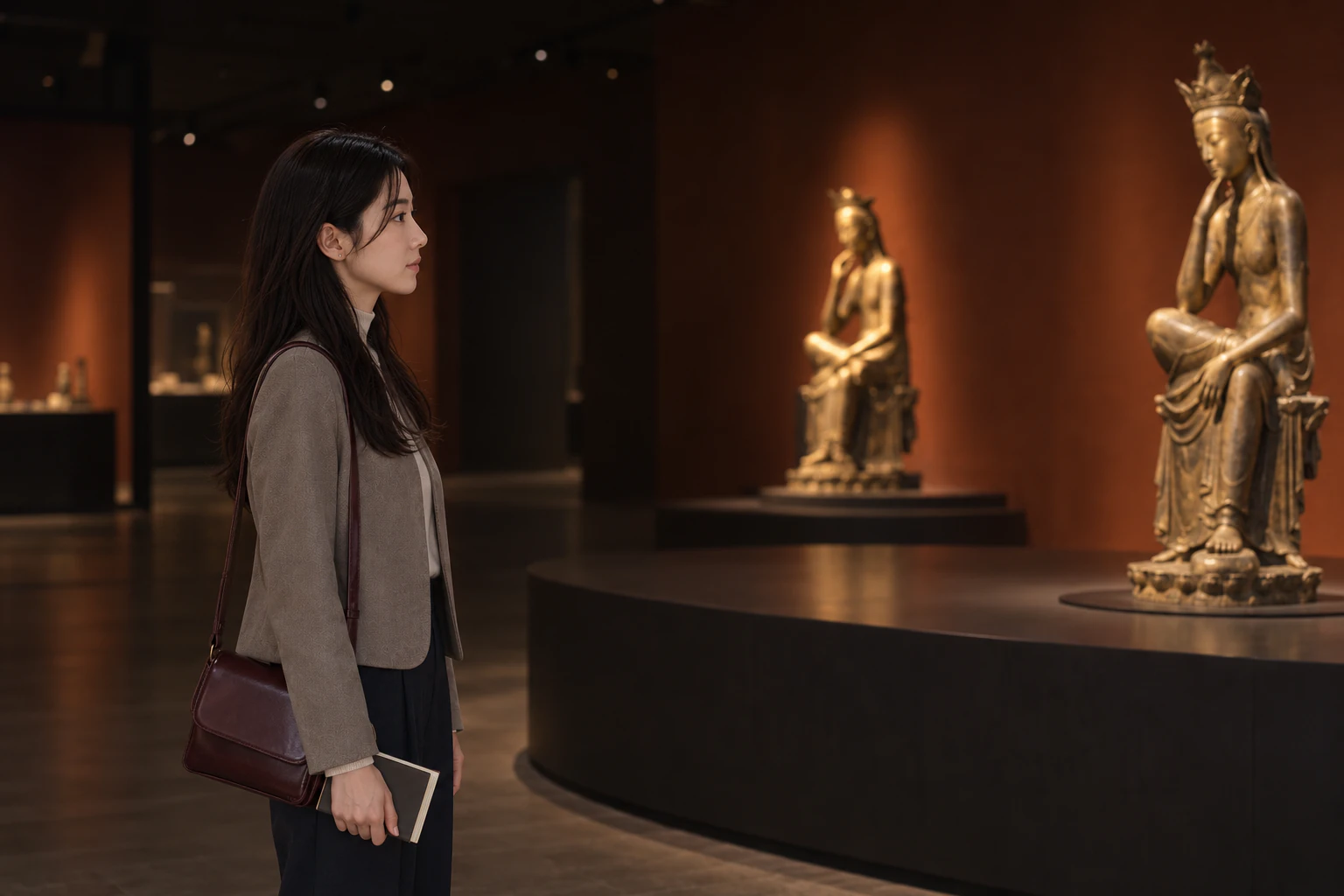
According to the National Heritage Service, the statue registered as 1962-2 (the one on the right, by the cross-reference above) is also known as the “Three-Mountain” pensive bodhisattva, after its crown. At the back of its head is a long tenon, which shows that a halo was once fitted there. Of 1962-1 (the one on the left, by the same cross-reference) it says only a trace remains at the back of the head and the halo is lost. Both descriptions point to the same place: behind the head.
Rina keeps a step back from the platform and circles it slowly.
The guide credits the two figures with the most advanced casting of the Three Kingdoms period: gilt-bronze statues close to a metre in size, cast about 0.2–1.0 cm thick. Rina looks again at the 112.2 kg in her right-hand column. How does such a thin gilt-bronze body come to weigh that much? She draws a question mark instead of an answer.
1912: two statues, two ways in
National Museum of Korea, Room of Quiet Contemplation guide: when and where the two statues were made, and where and how they were found, is still not clearly known. The statue on the right was bought in 1912 by the Yi Royal Household Museum from a Japanese antiques dealer for 2,600 won. The one on the left was acquired the same year by the Government-General of Korea, which paid a collector 4,000 won in compensation, and entered the Government-General Museum in 1916. The National Museum took over the Government-General Museum in 1945, and the collection of the Yi Royal Household Museum (Deoksugung Museum of Art) was merged into the National Museum in 1969. The statue on the right is thought to have been made in Silla.
The guide says it is still not clearly known when and where the statues were made, or where and how they were found. How they reached the museum is on record, though. The statue on the right was bought in 1912 by the Yi Royal Household Museum from a Japanese antiques dealer, for 2,600 won. The one on the left was acquired the same year by the Government-General of Korea, which paid a collector 4,000 won in compensation, and in 1916 it entered the Government-General Museum. The guide gives the 1912 sums as 2,600 won and 4,000 won. This piece preserves the source’s unit and does not convert the amounts into present-day value. Find on a map
It is hard to write in a dark room. Rina steps out for a moment, stands by a window in the hallway and copies down the two sums: 2,600 won and 4,000 won. The same year, two different doors.

The two collections later became one. The National Museum took over the Government-General Museum in 1945, and the holdings of the Yi Royal Household Museum, by then the Deoksugung Museum of Art, were merged into the National Museum in 1969. The National Heritage Service tells the story of 1962-1 (the left-hand statue, by our cross-reference) differently, saying a Japanese acquired it in 1912 and donated it to the Government-General. The guide believes the right-hand statue was made in Silla.
According to the 2021 press release, the two had been shown together in a room of their own only three times before — in 1986, 2004 and 2015. With this room, the museum wrote, they could be seen together at any time. The room’s page also carries a request: to keep the space quiet, please refrain from group commentary.
Towards eight, Rina goes back into the room once more, then walks the passage in reverse. Three new things from a second visit: a hallway for letting the eyes adjust, two statues whose weights differ far more than their heights, and a story at the back of the head that the front never tells.
In the next part Maya heads out into Yongsan Family Park beside the museum. Before closing her notebook, Rina adds one more line: “Next time in daylight. Same room, different hour.”
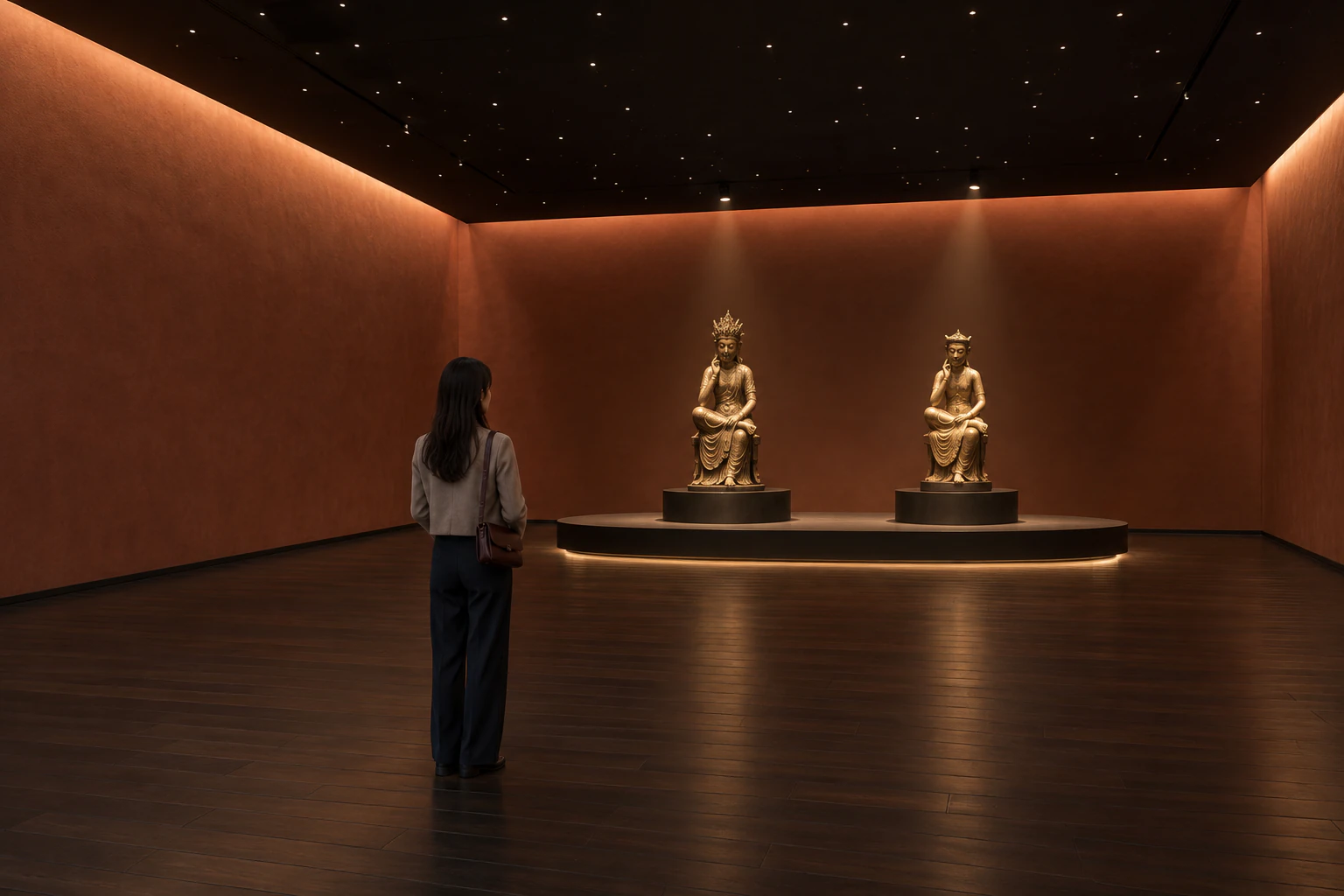
(※ This article includes staged images created with AI.)
Try it on your own evening
An editorial suggestion: come from Ichon Exit 2 along the museum walkway, check the closure notices, go straight up to the Room of Quiet Contemplation on the 2nd floor, take the entrance passage slowly, look at the two statues as left and right, then follow the oval platform all the way round.
A diagram of the order only · not to scale, orientation or the actual shape of the streets.
- From Ichon Exit 2 to the museum — Follow the walkway to the west gate. 547 m, about 8 min from Ichon Exit 2 to the museum (TMAP calculation, to the museum’s map point). Find on a map
- Up to the Room of Quiet Contemplation, 2nd floor — On the 2nd floor, according to the floor guide. The permanent galleries are free. Check closure notices before you go. Find on a map
- Take the passage slowly — A long entrance passage designed to let your eyes adjust to the dark, according to the 2021 press release. Find on a map
- Left, right, and all the way round — Left: late 6th century. Right: early 7th century. As an editorial suggestion, keep back from the platform and walk round it slowly. Find on a map
Getting there
TMAPChecked 2026.09.29
From Exit 2 of Ichon Station (Line 4) to the National Museum of Korea (the map’s representative point), the map route is 547 m, about 8 minutes (TMAP pedestrian route calculation). This is not the distance to the Room of Quiet Contemplation itself.
Checked 2026.09.29
National Museum of Korea website, Directions: from Ichon Station (Line 4 and the Gyeongui–Jungang Line), towards Exit 2, along the museum walkway (Nadeulgil) to the museum’s west gate.
Hours & fees
Checked 2026.09.29
National Museum of Korea press release (2021): the Room of Quiet Contemplation opened on the 2nd floor of the Permanent Exhibition Hall from 12 November, a new 439 m² gallery set apart from the existing visitor route and given its new name.
Checked 2026.09.29
National Museum of Korea visitor information: Mon, Tue, Thu, Fri and Sun 09:30–17:30 (last entry 17:00), and Wed and Sat 09:30–21:00 (last entry 20:30). Last entry is 30 minutes before closing. The permanent galleries close on the first Monday of March, June, September and December — in 2026, on 1 June, 7 September and 7 December.
Good to know
Checked 2026.09.29
National Museum of Korea visitor guidelines: photography with flash, tripods, selfie sticks, gimbals and the like, and photography for commercial purposes, is prohibited. Backpacks and school bags go in the lockers on the 1st floor.
Background11
Checked 2026.09.29
National Museum of Korea, permanent galleries by floor: the Room of Quiet Contemplation is on the 2nd floor (with the Calligraphy and Painting and Donated Collection galleries) and displays two national-treasure pensive bodhisattva statues side by side. The permanent galleries are free for everyone. The closure notice on the same page (Buddhist Sculpture, Metal Arts and ‘Space_Sai’ on the 3rd floor and Buddhist Painting and Wood and Lacquer Crafts on the 2nd floor, 6 July 2026 – 28 January 2027, plus Calligraphy and Painting rooms 202-3 and 202-4, 10 August 2026 – 28 January 2027) does not include the Room of Quiet Contemplation.
Checked 2026.09.29
National Museum of Korea press release (2021): the two statues had very rarely been shown together in a room of their own — three times in all, in 1986, 2004 and 2015. From now on, visitors could see both at any time.
Checked 2026.09.29
National Museum of Korea press release (2021): the gallery was completed in collaboration with the architect Choi Wook (principal of ONE O ONE architects) — the first time the museum had worked with an architect on a gallery. In a space the size of a small theatre he designed an entrance passage through darkness, a gallery floor and walls that tilt very slightly, and a ceiling with a faint sparkle. The long entrance passage, fitted with media artworks, is a transitional space for the eyes to adjust to the dark interior. After facing the statues, visitors are led along the oval display platform to take in their whole form. Labels were kept to a minimum, and commentary on the works and the space is provided through QR codes on the gallery walls.
Checked 2026.09.29
National Museum of Korea press release (2021): to keep the visit quiet and comfortable, the number of people entering at once may be limited when it is crowded.
Checked 2026.09.29
National Museum of Korea, Room of Quiet Contemplation page: a gallery showing, side by side, two national-treasure pensive bodhisattva statues made in the Three Kingdoms period, in the late 6th and early 7th centuries. Past a dark, quiet corridor, visitors meet the statues seated with the right leg over the left knee and the fingers of the right hand lightly touching the cheek, deep in thought. Visitors are asked to refrain from group commentary so that the room stays quiet.
Checked 2026.09.29
National Museum of Korea, Room of Quiet Contemplation guide: the gilt-bronze pensive bodhisattva on the left of the gallery dates from the late 6th century (Three Kingdoms period), 81.5 cm high and weighing 37.6 kg. It is marked by a sharp nose, clearly defined eyes, rich ornaments and refined drapery, with a shoulder scarf flaring out to either side. The two statues look alike but differ in expression, dress, size, weight and date.
Checked 2026.09.29
National Museum of Korea, Room of Quiet Contemplation guide: the gilt-bronze pensive bodhisattva on the right dates from the early 7th century (Three Kingdoms period), 90.8 cm high and weighing 112.2 kg. Its style is simple and restrained — a bare upper body, a crown formed of three half-circles and a double round necklace — while the drapery below the knee flows down in waves.
Checked 2026.09.29
National Museum of Korea, Room of Quiet Contemplation guide: the two statues embody the most advanced casting technology of the Three Kingdoms period. The guide gives their thickness as about 0.2–1.0 cm and their size as close to 1 m.
Checked 2026.09.29
National Museum of Korea, Room of Quiet Contemplation guide: when and where the two statues were made, and where and how they were found, is still not clearly known. The statue on the right was bought in 1912 by the Yi Royal Household Museum from a Japanese antiques dealer for 2,600 won. The one on the left was acquired the same year by the Government-General of Korea, which paid a collector 4,000 won in compensation, and entered the Government-General Museum in 1916. The National Museum took over the Government-General Museum in 1945, and the collection of the Yi Royal Household Museum (Deoksugung Museum of Art) was merged into the National Museum in 1969. The statue on the right is thought to have been made in Silla.
National Heritage ServiceChecked 2026.09.29
the Gilt-bronze Maitreya Bodhisattva in Meditation (1962-1) is a National Treasure, designated on 20 December 1962. It is 80 cm high. Acquired by a Japanese in 1912 and donated to the Government-General of Korea, it was moved to the Government-General Museum in 1916. It wears an ornate crown. Only a trace remains at the back of the head, and the halo is lost.
National Heritage ServiceChecked 2026.09.29
the Gilt-bronze Maitreya Bodhisattva in Meditation (1962-2) is a National Treasure, designated on 20 December 1962. At 93.5 cm high it is, together with the museum’s other gilt-bronze pensive bodhisattva, the largest in Korea. Its crown has three rounded, mountain-like faces, so it is also called the ‘Three-Mountain’ Pensive Bodhisattva. The upper body is bare, with a double necklace at the neck. A long tenon at the back of the head shows that a halo was once fitted there.
- Opening hours: Mon, Tue, Thu, Fri and Sun 09:30–17:30, Wed and Sat 09:30–21:00, last entry 30 minutes before closing. The permanent galleries close on the first Monday of March, June, September and December — the remaining date in 2026 is 7 December (National Museum of Korea website, checked 29 September 2026).
- Photography with flash, tripods, selfie sticks or gimbals, and photography for commercial use, is prohibited throughout the museum. Backpacks and school bags go in the lockers on the 1st floor.
- The room’s page asks visitors to refrain from group commentary to keep it quiet. The 2021 press release stated that the number of visitors admitted at one time could be limited during busy periods.
- The museum’s guide (81.5 cm and 90.8 cm) and the National Heritage Service (80 cm and 93.5 cm) give different heights for the two statues. This piece follows the museum’s guide. The statues in the images are reconstructed from public descriptions and do not match the originals in every detail.
More from this area

Yongsan Family Park: A Picnic, Chosen Again Without the Lunch
The third part of “Yongsan.” Yongsan Family Park opened on 5 November 1992 on land once taken up by a golf course. On Maya’s list of scenes was a picnic: a mat spread on a wide lawn and a packed lunch opened on it. But the general visitor notes on Seoul’s parks website say that, to protect wildlife, bringing in food is prohibited. So this time Maya takes the lunch out of the scene and chooses it again.
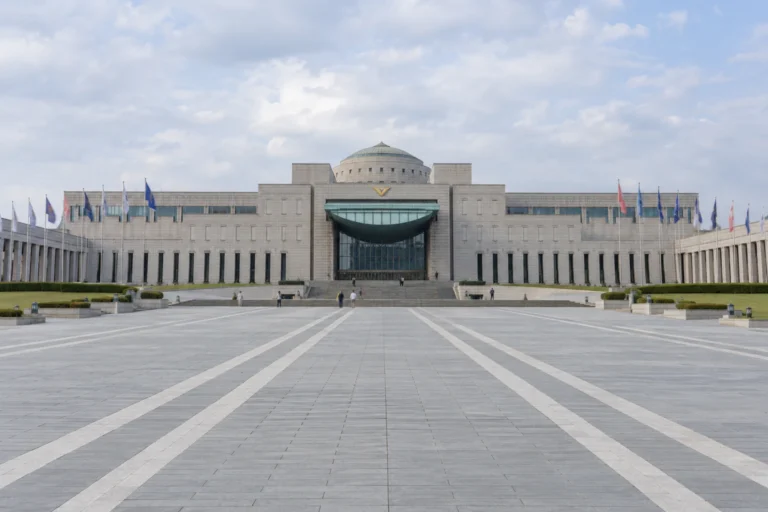
The War Memorial of Korea: One Straight Line from the Plaza to the Door
Part four of “Yongsan.” The War Memorial of Korea opened on 10 June 1994, and its exhibition halls are free to enter. Noah, who reads distances and routes with his eyes, follows the axis that runs from a broad plaza to the entrance at the very centre of the building. Because this is a place of remembrance, it is also a story about slowing down.