SEOUL · JEONGDONG
How late can you enter Seodaemun Prison History Hall and still see it to the end? The one box Noah left without a time
17:00 closing and 16:30 last tickets in winter · closed on Mondays · Exits 5 and 4 at Dongnimmun Station · the official route in order · the two places you can’t photograph
Noah’s notebook said “Monday 16:00”. It was a closing day, and the closing time was wrong too. Entering instead at 2 p.m. on a Friday, Noah decides to leave one box on his ninth map empty.
How to get there
On the night of Thursday 26 November, Noah opens his notebook to a fresh page at the desk in his accommodation. Noah is twenty, from Canada, and he draws a map of every place he walks for the first time, then adds the times as well. He calls these sheets his “time maps”, and this trip has now produced eight of them. Today he crossed Seoul marking numbers, so he has already decided that the next map will be of a single place where he stays a long while. The name at the top of the new page is Seodaemun Prison History Hall.

The first line on that page is one he wrote a few days ago: “Monday 16:00 entry → 18:00”. The plan was to get off at Dongnimmun Station on Line 3, see the history hall and then call in at the nearby National Memorial of the Korean Provisional Government. Noah has a habit of rereading the official information the night before he goes somewhere new, and that habit shows him the whole line is wrong. Both places are closed on Mondays, and 18:00 was the closing time only until October.
Seodaemun Prison is a modern prison built by imperial Japan. It opened in October 1908 and served as a prison for 80 years, until it was closed in November 1987. Under Japanese colonial rule it held anti-Japanese independence activists, and after liberation it held pro-democracy activists. It opened as the present history hall on 5 November 1998. This piece follows the order Noah walks the next day, going through how late to enter, which days it is closed, which exit to use and what order to see things in.
The Cue — At a glance
In winter (November–February), be inside Seodaemun Prison History Hall by 3 p.m. if you want to see it to the end. Tickets are sold until 30 minutes before closing, but go in around then and no time is left for the far end of the route. The hall is closed on Mondays, so pick another day, then come out towards Exit 5 at Dongnimmun Station and follow the official route, starting at the Exhibition Hall.
- Station and exit: Line 3, Dongnimmun Station, towards Exit 5. Independence Park and Independence Gate (Dongnimmun) are on the Exit 4 side.
- Bus and car: The Dongnimmun Station–Hansung Science High School stop (독립문역 한성과학고, median bus lane). Parking is limited and takes cards only, so public transport is easier.
- Hours: Winter (November–February) 09:30–17:00. The ticket cut-off and summer hours are in the first section.
- Closed: Every Monday. The other closing days are in the table in the Monday section.
- Tickets: Individual visitors simply buy on site, with no booking.
- Bring: Earphones for the free guide app. You can’t eat inside, so finish your meal before you go in.
How late to enter Seodaemun Prison History Hall and still see it to the end: by 3 p.m. in winter
To see it to the end in winter, it is best to be inside by 3 p.m. That isn’t a rule on any notice. It is the closing time minus the long end of the average visit, with 30 more minutes held back. In 2026 the winter schedule runs from 1 November to 28 February 2027: the doors open at 09:30 and close at 17:00, and tickets are sold until 16:30. From March to October the hall closes at 18:00 and last entry is 17:30, so if you trust the times in a review written in summer, you will be an hour out.
Open in Kakao Map — Dongnimmun Station
Noah’s planned 16:00 entry came from the same gap. When he corrects 18:00 to 17:00 in his notebook, the time left shrinks from two hours to one. The average visit takes one hour to an hour and a half, so he writes ticket times down the page and works out the time left until closing in the next column. The table below is simple subtraction, 17:00 minus the time you buy your ticket, so the time you actually have to look round will be a little shorter. Start with the right-hand column.
| Ticket bought at (winter) | Time until closing | Against the average of 1 hour to 1 hour 30 minutes |
|---|---|---|
| 14:00 | 3 hours | 1 hour 30 minutes more than the long end of the average |
| 15:00 | 2 hours | 30 minutes more than the long end of the average |
| 15:30 | 1 hour 30 minutes | Exactly the long end of the average, with no margin |
| 16:00 | 1 hour | Only the short end of the average, so it is tight |
| 16:30 | 30 minutes | 30 minutes short of the short end of the average |
The bottom three rows are risky because of the shape of the route. On the official general route the Execution Building comes seventh and the Women’s Prison Building tenth. The longer you stay in the Exhibition Hall and prison buildings at the start, the less time is left for the outdoor area towards the end. This is also a place that asks for quiet and asks visitors not to run, so it isn’t time you can make up by hurrying. Noah rules two lines through “Monday 16:00” and writes “Friday 14:00” beneath it.
If you go in the morning, none of this arithmetic is needed. The difficulty comes on an afternoon when you link two places. On a day like that, put the history hall first and leave the other place for later. The hall closes at 17:00, but Independence Park, which contains it, is open 24 hours. Going first to the place that closes is something Noah learnt from writing times on his maps, and he uses it here too.
Seodaemun Prison History Hall closes on Mondays, and so does the Provisional Government memorial
Seodaemun Prison History Hall closes every Monday and is open from Tuesday to Sunday. If a Monday is a public holiday, it closes the next day. In November 2026, the Mondays fall on the 2nd, 9th, 16th, 23rd and 30th. The Monday Noah first wrote down was one of them, so this is where that line in his notebook first went wrong.
The plan most likely to come unstuck is one stop for two places. The National Memorial of the Korean Provisional Government is also within walking distance of Dongnimmun Station, and it too closes on Mondays. So on a Monday you can get off at Dongnimmun Station and enter neither. To pair them, pick a day from Tuesday to Sunday. In the table below, look first at the closing days and the last entry row.
| Seodaemun Prison History Hall | Provisional Government memorial | |
|---|---|---|
| November hours | 09:30–17:00 | 10:00–18:00 |
| Last entry | 16:30 | 17:00 |
| Closed | Mondays (the next day if a public holiday), 1 January, Lunar New Year’s Day and Chuseok Day | Mondays, 1 January, Lunar New Year’s Day and Chuseok Day |
| Admission | Adults 3,000 won | Free |
| From Dongnimmun Station | Towards Exit 5 | Straight on from Exit 5, left at the Independence Park junction, then 100 m (a five-minute walk) |
The table settles the order too. The hall closes earlier, so if you see both in one day, the hall goes first. The memorial also has guided tours: English every Thursday and Chinese every Friday, both at 1:30 p.m. and booked at least two weeks ahead. Noah pencils the memorial’s name faintly under the Friday box. He doesn’t want to decide now what state he will be in after seeing the history hall.
Which exit at Dongnimmun Station: Exit 5 for the history hall, Exit 4 for Independence Park
To go straight to the hall, come out towards Exit 5 at Dongnimmun Station on Line 3. Exit 5 comes up on the hall side, and Exit 4 on the Independence Park side. From Exit 4 you first see the March First Independence Declaration Monument, the statue of Seo Jae-pil, Dongnimgwan Hall and Independence Gate. At this station, one exit changes your first view. From other lines, change to Line 3 at Jongno 3-ga from Lines 1 and 5, at Euljiro 3-ga from Line 2 and at Chungmuro from Line 4.
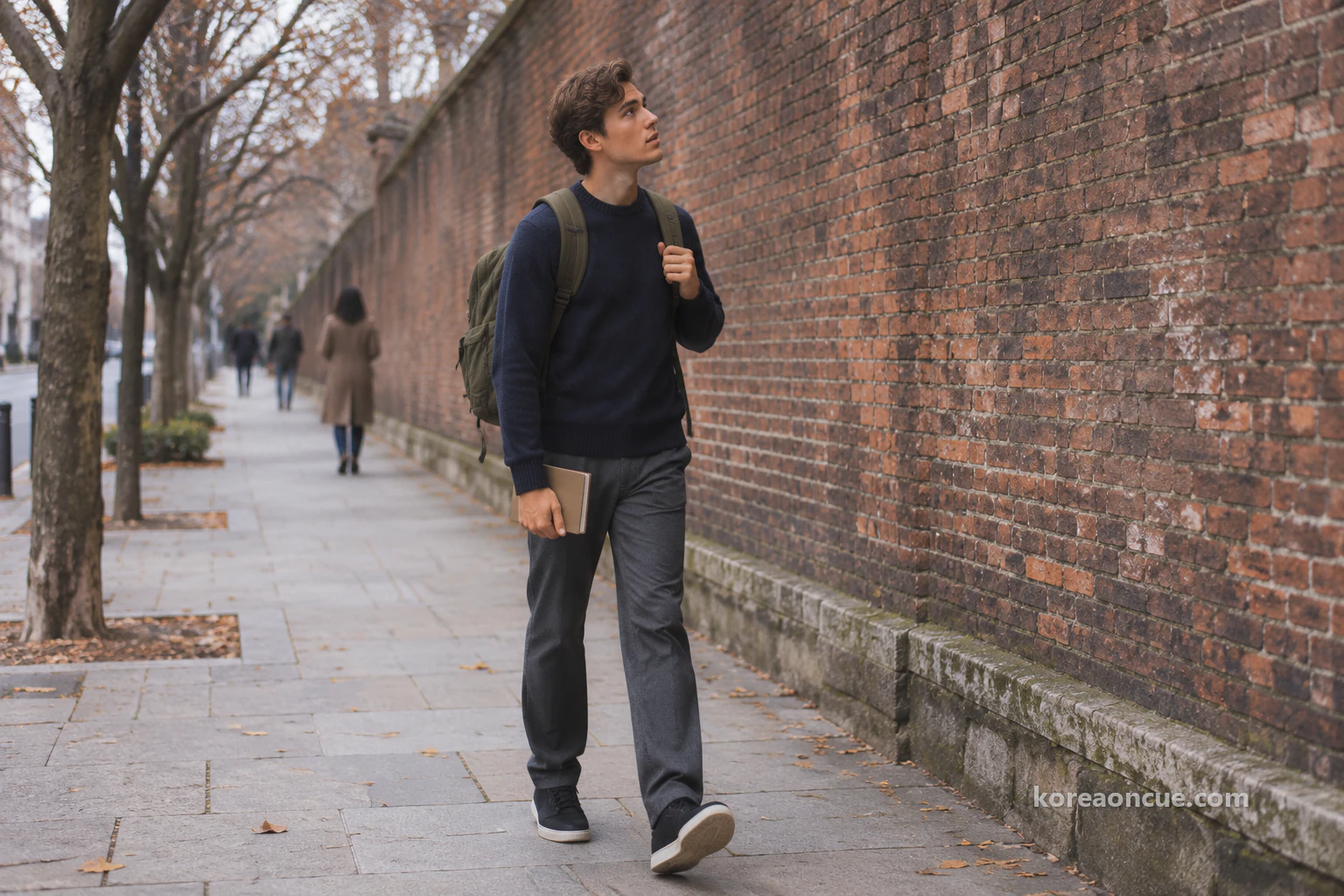
At 1:40 p.m. on Friday, Noah comes out towards Exit 5. Part of him wants to see the park first, but he keeps to the rule of going first to the place that closes. At street level the wind is cold, and he pulls his sweater sleeves down over the backs of his hands. Soon a red brick wall comes into view. It once ran 1,161 m in all, and today only 80 m at the front and 200 m at the back are preserved. Without breaking step, Noah writes “13:40” on the top line of his notebook.
There is one more route Noah gave up the night before. Seoul’s guided walking tour meets outside Exit 4 of Dongnimmun Station, looks at Independence Gate and then enters the hall. It takes about two hours, and you pay the hall’s admission yourself. It has to be booked at least three days before the tour date, so by the time Noah read about it the night before, that route was already closed to him. Bookings for the following month open on the 15th of the current month, and all bookings are cancelled if there is a weather warning, so book early if you want to come this way (enquiries 02-6925-0777). On a solo visit, coming out at Exit 5 and starting with the hall makes the timing easier too.
Admission and English tours: buy tickets on site, book Tuesday, Thursday or Friday tours 14 days ahead
Wondering whether he has to book first, Noah opens the ticket page before anything else, but someone going alone has no need to. Individuals simply buy a ticket on site, and booking applies only to groups of 20 or more. Adults (19–64) pay 3,000 won, teenagers (13–18) 1,500 won and children (7–12) 1,000 won, and people aged 6 and under or 65 and over enter free. People with disabilities and national merit recipients also enter free, and a person with a severe disability can bring one companion free, but free and discounted tickets can only be issued on site. You can pay by cash or credit card.
Foreign-language tours run on set days and can’t be arranged on the day. Docent tours are free and are given in Korean, English, Chinese and Japanese. They take about 1 hour 30 minutes, and places open first come, first served from 00:00, 14 days before the date you want. Any foreign visitor can apply for a foreign-language tour, whatever their nationality. Each tour takes 20 people or fewer.
The night before, Noah read only as far as the times, closing days, tickets and directions, and he opens the tour table only on Friday morning. He finds the 15:00 English tour on Friday and thinks it fits his entry time. He assumes he can sign up on site, but the line directly below says same-day booking and on-site sign-up aren’t possible. Noah crosses out the tour box and downloads the guide app. In the table below, note first that the English column is empty on Saturday and Sunday.
| Day | English | Japanese | Chinese |
|---|---|---|---|
| Tue | 15:00 | None | None |
| Wed | None | 11:00 | None |
| Thu | 11:00, 15:00 | 10:00 | None |
| Fri | 15:00 | None | 11:00 |
| Sat | None | 11:00 | None |
| Sun | None | 11:00 | None |
If you are only free at weekends, there is no English tour for you, and the only Chinese tour is at 11:00 on Friday. A weekday morning tour leaves plenty of time after it ends, and if you choose a 15:00 tour, you need to have entered before then. If you have booked, arrive at least 10 minutes before the start. Arrive late and you can’t join, and a no-show blocks you from booking for six months, so cancel by the day before your visit.
Without a booking, there are still ways to hear the explanations. The free guide app “서대문형무소역사관 무료 해설 안내” is available in Korean, English, Chinese, Japanese and German, and you bring your own earphones. Leaflets in the same five languages are available in the Exhibition Hall. On Sundays, regular tours that need no booking start in front of the Exhibition Hall entrance at 13:00, 13:30 and 14:00. At 2 p.m., Noah buys one adult ticket and writes “14:00” in his notebook, with the three hours left until closing.
What order to see it in: the official general route and the two places you can’t photograph
On a first visit, follow the official general route, starting at the Exhibition Hall. The prison buildings were built on a panopticon plan to make inmates easy to watch, fanning out from the Central Prison Building, so if you go in with no order in mind it is easy to miss the far side. After Seoul Detention Center moved to Uiwang in 1987, the Administration and Security Office, Prison Buildings 9–12, the Labor Building, the Hansen’s disease ward, the Execution Building and some others were kept, and the rest were demolished. The table below is the order of the general route. Take note first of the two places marked “Prohibited” in the right-hand column.
| Order | Place | What you see | Photos |
|---|---|---|---|
| 1 | Exhibition Hall (Administration and Security Office) | Prison history, National Resistance Rooms, Underground Interrogation Room | Prohibited in the basement |
| 2 | Central Prison Building | Prison organisation, surveillance tools, the inmates’ daily routine | — |
| 3 | Prison Buildings 12 and 11 | Where people were actually held, inside a cell, the tap code | — |
| 4 | Labor Building | The factory where forced labour took place | — |
| 5·6 | Hansen’s disease ward · memorial stone | A building that held inmates with Hansen’s disease apart | — |
| 7 | Execution Building | Where executions were carried out | Prohibited |
| 8 | Gyeokbyeokjang (Exercise Yard) | The inmates’ exercise yard | — |
| 9 | Rest and exhibition space | An exhibition and seats inside the warehouse | — |
| 10 | Women’s Prison Building | Where women were held, Cell 8 | — |
| 11 | Kitchen | Excavated remains display, museum shop | — |
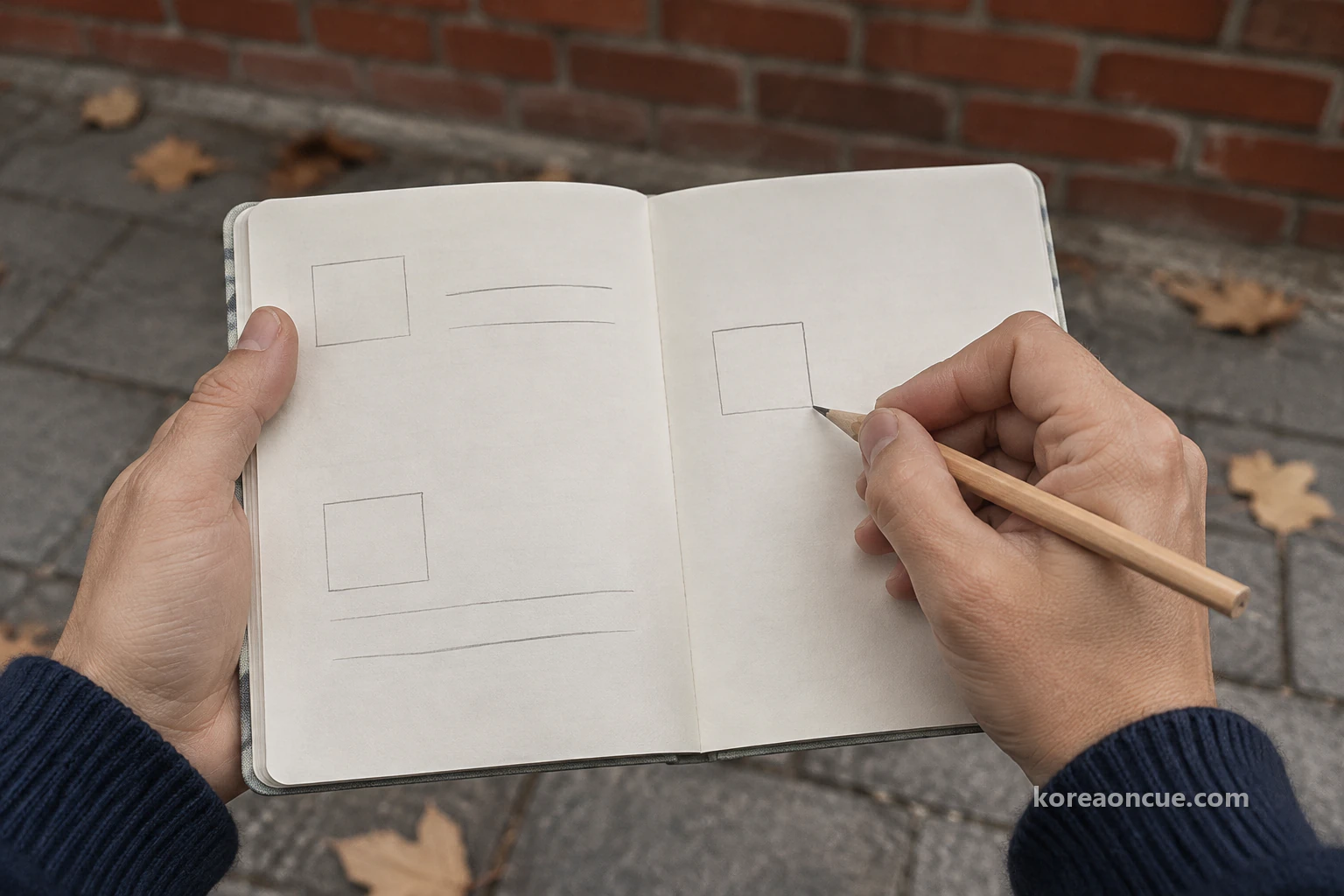
The route has its own exit at the end. The main gate you come in by is in the south wall, and the exit at the end of the route is beside the kitchen in the south-east wall, so you don’t leave where you came in. There are three official routes, general, group and family. The family route starts at the Women’s Prison Building, crosses to the Exhibition Hall and then passes the Execution Building and the Gyeokbyeokjang to end at the kitchen. Noah sets the site map beside his notebook, marks a dot each for the main gate and the exit, and draws boxes from the Exhibition Hall through to the Women’s Prison Building. He leaves a blank in each box for a time, and up to this point this map is the same as the eight before it.
The Exhibition Hall and Underground Interrogation Room: the first place you can’t photograph
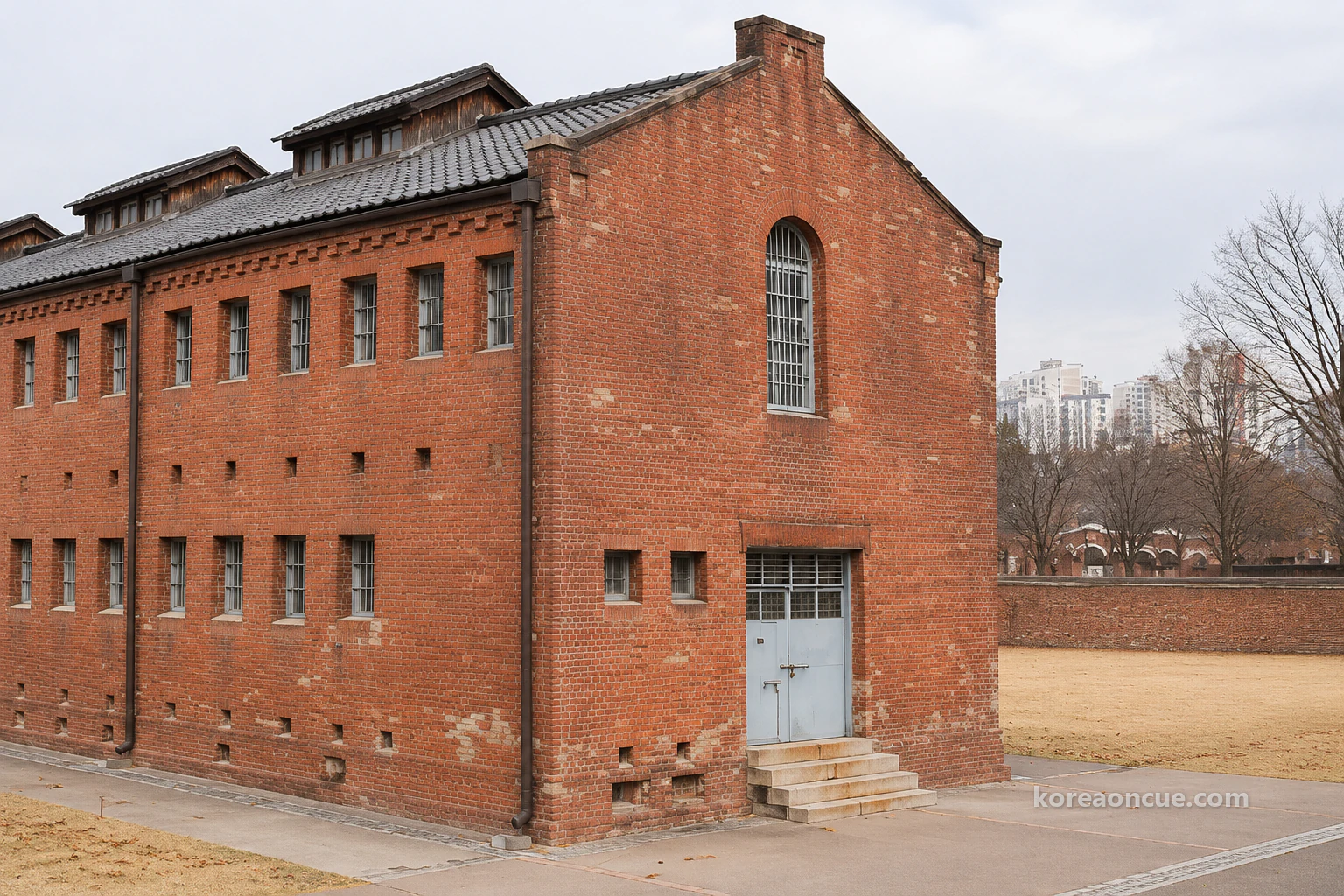
The Exhibition Hall (the Administration and Security Office) is the building that oversaw the prison’s work. It was built in 1923 with two floors above ground and one below, with offices on the 1st floor and interrogation rooms in the basement. White tiles were put on the outer walls in 1959, then removed in 2010 to restore the original look. The grey cement marks left on the walls are traces of those tiles. Noah, who always looks first for places where a sign and the real thing differ, slows down in front of these marks.
Inside are the Prison History Room, National Resistance Rooms I–III and the Underground Interrogation Room. The Prison History Room covers the prison’s establishment and expansion through to the restoration after Seoul Detention Center moved out in 1987. National Resistance Room II displays about 4,800 prison record cards of people held as “political offenders”. In the building’s basement, the general exhibition “Women Independence Activists’ Life in Prison” (여성 독립운동가의 옥중생활) runs until 1 January 2030. Even on a busy day, this building is not one to skip.
The Underground Interrogation Room is where inmates were searched and made to wait, and where prosecutors of the Japanese colonial regime interrogated them. Today it presents the torture used in interrogation and the recorded voices of surviving patriots. Photography isn’t allowed here, so put your phone in your bag before you go down and you won’t have to think twice about it. Noah stops the app, puts his phone in his backpack and closes his notebook too. While he is downstairs, he doesn’t write a single line.
The Central Prison Building and Prison Buildings 12 and 11: the inmates’ daily routine and inside a cell
After leaving the Exhibition Hall, Noah doesn’t switch the app back on for some time. He usually talks quietly to himself as he walks, but today the words hardly come. At the next box, the Central Prison Building, you can see the prison’s organisation, its surveillance tools and the inmates’ daily routine. Noah stands longest in front of the daily routine. The times on his maps have always been times he chose, and here it is the opposite.
Prison Buildings 12 and 11 are where independence activists and pro-democracy activists were actually held. You can see how the buildings were laid out and how the guards worked, and you can step inside a cell. There is also a display on the tap code that independence activists used to speak to each other through the walls. Noah writes “14:35” in his notebook, steps into a cell and turns towards the wall. His wrist begins to lift, out of habit, to check his watch, and he lowers it. After a while he comes out without a word.
The Labor Building was a factory where inmates’ labour was used to make goods. Inmates suffered forced labour and abuses of their human rights here, and from the late 1930s it also made military supplies for the Second World War. The prison buildings with no number on the general route are worth knowing too. Prison Building 9 was a separate block that mainly held “political offenders” under special watch, and bullet marks from the Korean War remain on its outer walls. On the 1st floor of Prison Building 10, the special exhibition “The Red Brick House, Seodaemun Prison” (붉은 벽돌집, 서대문형무소) runs until 31 December 2028.
You can’t photograph the Execution Building: the one box without a time
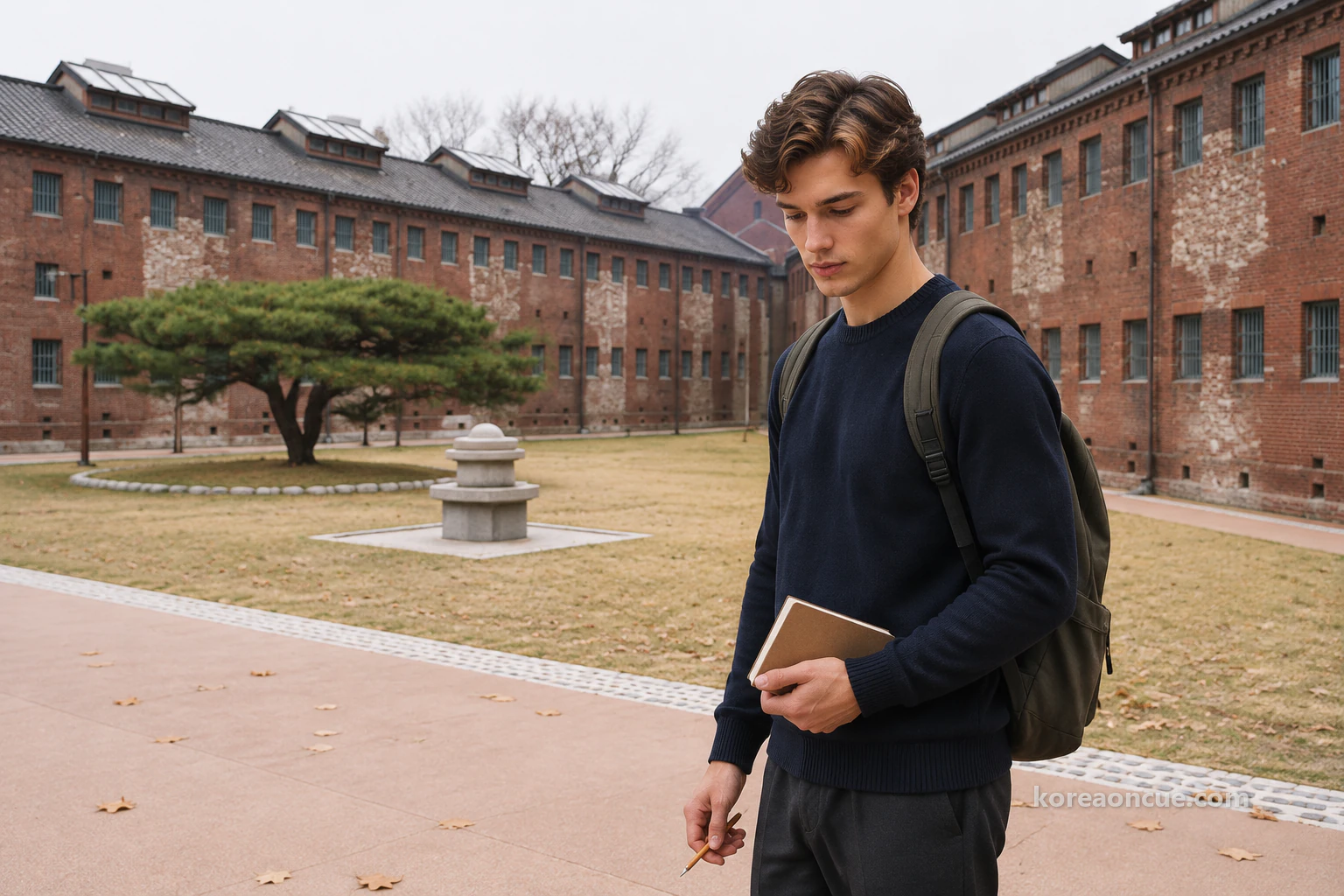
The Execution Building, seventh on the route, is a place you can’t photograph. It is where executions were carried out, and a 5 m wall surrounds it, shutting it off from view even inside the prison. The way there is outdoors. Noah walks past the Labor Building and along under the north wall, passing the Hansen’s disease ward, a low building where inmates with the disease were held apart. From the memorial stone onwards, his steps become noticeably slower.
Noah stands for a long time in front of the wall of the Execution Building. The wind is cold, but he forgets to pull down his sleeves, and his phone stays in his backpack. He doesn’t know how many minutes pass, because he doesn’t look at his watch. Standing there is all he does.
After moving away, Noah opens his notebook again. The tip of his pencil touches the blank beside the Execution Building box and lifts off. On his eight maps no box has ever gone without a length of stay, but he decides to leave this one as a bare square. How many minutes he stayed is no use to the next person who comes, and he doesn’t want to measure this place in minutes. It is the first box in which someone who writes down time has chosen not to.
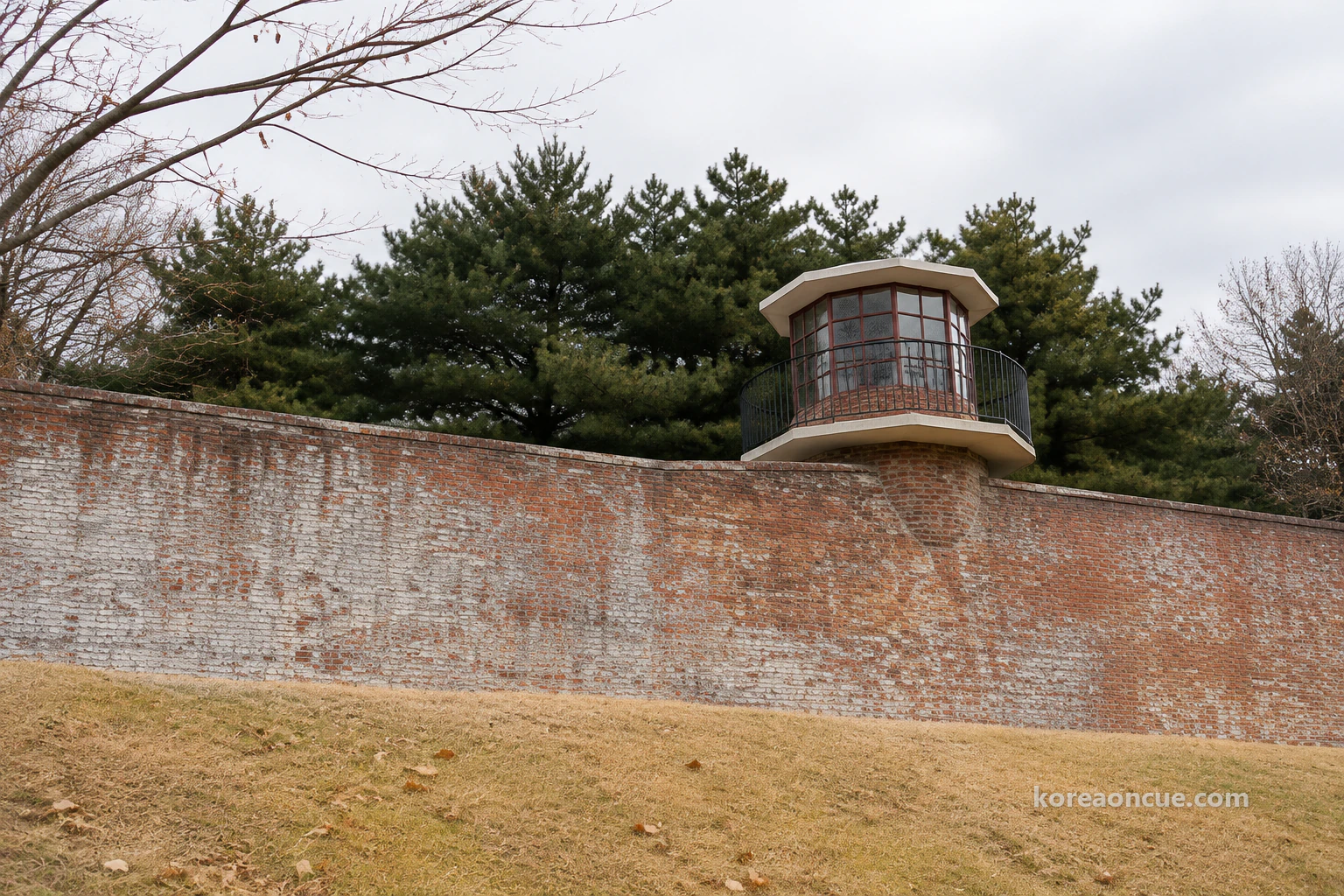
Under the same north wall is the Corpse Removal Exit. It is a passage cut through to the outside to carry bodies to a public cemetery after executions. It had collapsed, and 40 m of it was excavated and restored in 1992 when Independence Park was created. Look up at the watchtower behind the wall as well. There were six watchtowers, each 10 m high, and today they remain in only two places, at the main gate and by the back wall.
The Gyeokbyeokjang and the Women’s Prison Building: how not to hurry the far end of the route
Because it lies towards the end of the route, this is the stretch that runs out of time first if you enter late. The Gyeokbyeokjang was the yard where inmates took in the sun and did some light exercise. Walls were put up to keep people apart so they couldn’t talk or escape while exercising. At the centre of its fan shape stands a tall guard post. It was restored here in 2011, about 20 m from its original position.
The Women’s Prison Building held women awaiting trial, that is, women locked up before their cases were over. It was built around 1916, demolished in 1979 and restored in 2011. Today it displays relics of women’s anti-Japanese activism. Cell 8 is where a protest inside the prison marked the first anniversary of the March 1st Movement on 1 March 1920. Being near the end of the route doesn’t make it a place to see quickly, so set aside enough time for it when you choose your entry time.
With the Execution Building box left empty, it becomes hard to write times in the boxes after it. For the Gyeokbyeokjang and the Women’s Prison Building Noah writes only the names, and the times on his map break off after “14:35”. Instead he switches the app back on and listens to the explanation for each box to the end. Having come in at 2 p.m., he has no need to look at a clock in the later boxes either. Had he come in after 16:00, this is the very stretch he would have cut first.
The place to take a break is the rest area in the warehouse. It has seats, but you can’t eat there. Here and in the glass gallery, the exhibition “Liberation, Glory and the Medals Left Behind” (광복, 영광 그리고 남겨진 훈장) runs until 31 December 2027. The last stop, the kitchen, is the building where the inmates’ meals were cooked, and it is now used as an excavated remains display and the museum shop. You can buy catalogues and activity sheets at the shop, and the exit is next to it.
Photos, food, children and wheelchairs: what to know before you go in
With the next visitor in mind, Noah has set aside some boxes in the margin of his map. Photos can be taken in the Exhibition Hall, prison buildings and outdoor areas with the flash off, and tripods and commercial shoots are prohibited. Video needs approval in advance, shoots with a model aren’t allowed without permission, and revealing photos are prohibited and must be deleted on the spot. Keep your phone on vibrate. The entire site is smoke-free and alcohol-free, and visitors are asked to walk quietly and not run.
Finish eating before you go in. Noah too had his lunch before coming to Dongnimmun Station, because the hall is a national historic site where you can’t eat or bring food in, and the rest area is no exception. Pets other than guide dogs aren’t allowed in. You can’t enter in shoes with wheels, and you can’t ride bicycles, kick scooters, inline skates or skateboards. The far end of the route is outdoors, so on a cold day bring an extra layer, and avoid footwear such as slippers that disturbs a quiet visit.
If you go with children, walk the family route and watch how your child is doing before anything else. The basement of the Exhibition Hall has displays on torture, and the Execution Building is on the route. Seoul’s guided walking tour recommends joining from the upper years of primary school, as walking and concentrating can be hard for younger pupils and kindergarten children. In the children’s box in the margin, Noah wrote “At the basement and the Execution Building, the child’s face comes first.”
Pushchairs and wheelchairs can be borrowed by leaving ID. If you need the wheelchair lift, ask the staff at the Exhibition Hall information desk. The sign-language guide system is also borrowed at that desk by showing ID. It can be viewed through the QR codes beside the exhibition panels too, and the area has public Wi-Fi, so it uses no data. If you are with a family member who has difficulty moving around, stopping at the Exhibition Hall information desk before you start the route will save steps.
After the hall: walking out to Independence Park and Independence Gate, open 24 hours
When you leave the hall, walk in Independence Park. Seodaemun Prison History Hall is a facility inside this park, and the park is open 24 hours. The whole park is non-smoking, and pushchairs and wheelchairs can also be borrowed at the visitor centre. The Memorial Tower for Patriotic Martyrs, Dongnimgwan Hall, the March First Independence Declaration Monument and the statue of Seo Jae-pil are all here. You can walk here after the hall has closed, so on a day short of time, leave the park until last.
When Noah comes out of the exit, the afternoon is well advanced. His watch shows it is well past 4. The memorial he pencilled in faintly hasn’t reached last entry yet. Noah leaves its name as it is, without rubbing it out. One more place today, he feels, would push aside what he has just seen, and the memorial will be there to come back to, from Tuesday to Sunday.
Walking towards the park, Noah stops in front of Independence Gate. It is 14.28 m high and 11.48 m wide, and was modelled on the Arc de Triomphe in France. It became Historic Site No. 32 on 21 January 1963. The gate originally stood 70 m south-east of here, in the middle of the Dongnimmun intersection, and it was moved and restored here on 31 December 1979. Only now does his habit of looking for small gaps between a sign and reality return, and Noah writes “70 m” at the end of his map.
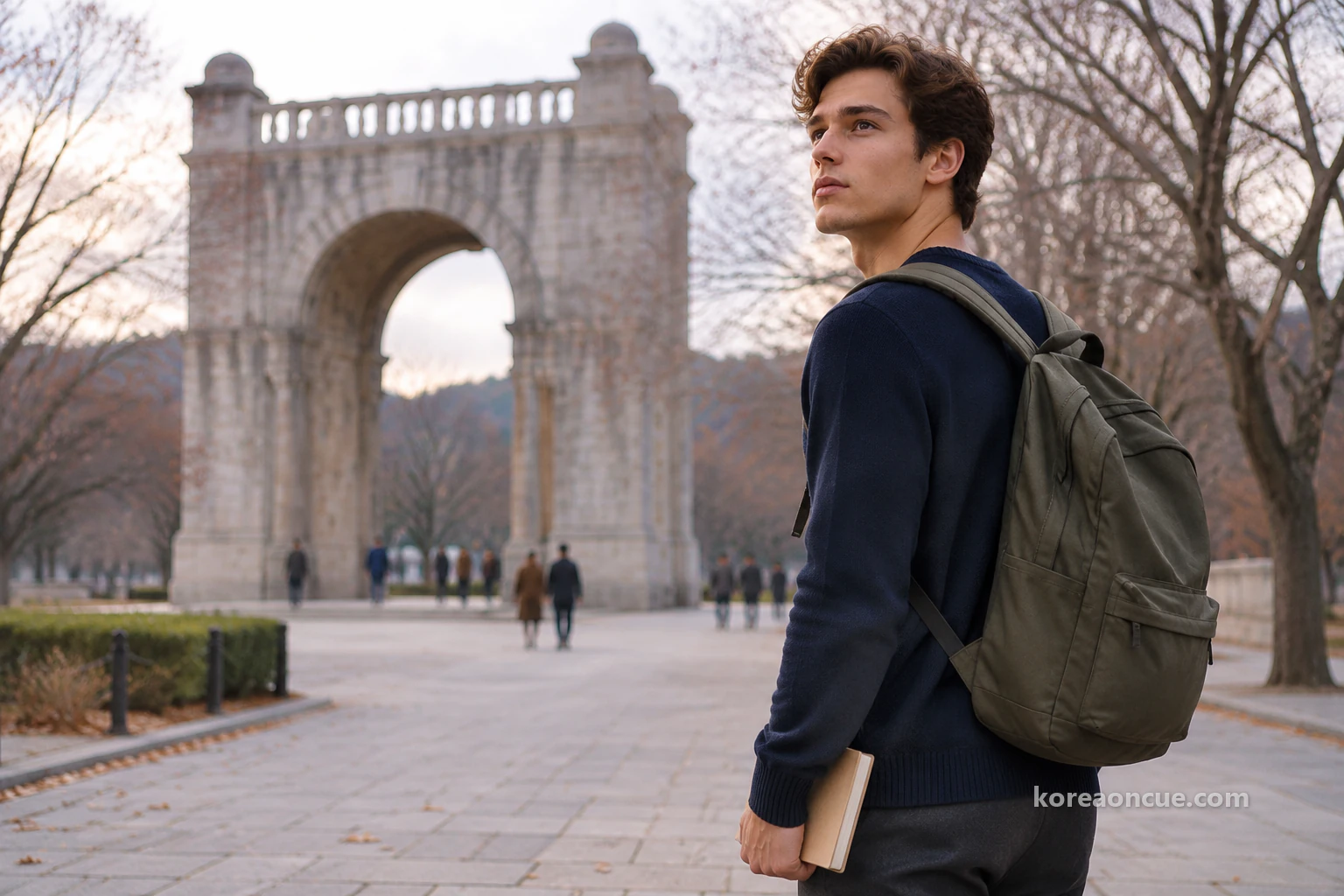
On Line 3 back to his accommodation, Noah looks through his ninth map from the start. The boxes at the front have times, and those at the back have only names. In the middle, one square is empty. Noah always photographs his maps and sends them to Hina, but this time he closes the notebook without taking a picture. Hina’s map, tucked in at the very back, brushes his hand for a moment as he shuts it.
On the day you go to Seodaemun Prison History Hall, settle your entry time first. Once that is fixed, so is the time for the far end of the route and for walking in the park afterwards. If you want a tour, check the table by day and book 14 days ahead, and if you can’t, bring earphones and get the app. And whatever else you do, go in with enough time left not to hurry the end of the route.
Common Mistakes
Planning with summer hours
Noah’s first note was exactly this. The single line “Monday 16:00 entry → 18:00” held both a closing day and last season’s closing time.
Thinking a ticket is all you need
You can still buy a ticket after 16:00. But the Execution Building and the Women’s Prison Building are towards the end of the route, so going in then means walking the last boxes with your eyes on the clock.
Trying to sign up for an English tour on site
This is the plan Noah made on Friday morning and dropped on reading the next line down. If you haven’t booked, pack earphones first.
Taking out a packed lunch because there are seats
The rest area in the warehouse is for sitting down. You can’t eat here either.
Assuming you leave by the main gate
The route ends not at the gate you came in by but at the exit beside the kitchen. If you split up from your group and plan to meet, arrange it on the exit side.
FAQ
Are there any discounts?
Seodaemun-gu residents and primary, middle and high schools in the district get 50% off, and holders of a Natural History Museum ticket get 20% off. Discounts are only available on site.
What if more than 20 of us go together?
20 or more counts as a group, which must book in advance to enter. Group rates are 2,400 won for adults, 1,200 won for teenagers and 800 won for children.
Can Koreans apply for an English tour?
Foreign-language tours are for foreign visitors only. If a Korean applies, their booking is restricted.
Can a large family book a docent tour in one go?
One user ID can book up to 10 people. These tours are for individuals and families, so groups can’t book them.
Can I get a paper guide in advance?
You can download the guide leaflet from the archive on the website.
Can I take young children to the Provisional Government memorial?
Children aged 6 and under must enter with a guardian.
What number can I call?
The main number is 02-360-8590, and the ticket office is 02-360-8571.
Recap — 30 seconds before you go
- In winter, go in by 3 p.m. to leave time for the far end of the route
- Pick a day other than Monday, and come out towards Exit 5 at Dongnimmun Station
- Book a tour 14 days ahead or use the app, and keep your phone away at the Execution Building and in the Exhibition Hall basement
Sources
- Seodaemun Prison History Hall — Visitor informationSummer and winter hours · closing days · individual and group admission, including 3,000 won for adults · free and discount categorieschecked 2026-11-05
- Seodaemun Prison History Hall — Notice on shorter winter hours1 November 2026 to 28 February 2027 · 09:30–17:00 · last tickets 16:30checked 2026-11-05
- Seodaemun Prison History Hall — DirectionsLine 3, Dongnimmun Station, towards Exit 5 · transfer stations from Lines 1, 2, 4 and 5 · bus stop and parking noteschecked 2026-11-05
- Seodaemun Prison History Hall — FAQAverage visit 1 hour to 1 hour 30 minutes · where photos are and aren’t allowed · no eating on site · pushchair and wheelchair loans · guide app and leafletschecked 2026-11-05
- Seodaemun Prison History Hall — Docent bookingFirst come, first served from 00:00 14 days ahead · languages by day · no same-day or on-site booking · 6-month booking ban for no-shows · up to 10 people per IDchecked 2026-11-05
- Seodaemun Prison History Hall — Site guideOfficial general, group and family routes · order of the general route · where the main gate and exit arechecked 2026-11-05
- National Memorial of the Korean Provisional Government — Visiting and tours10:00–18:00, last entry 17:00 · closed Mondays, 1 January, Seollal and Chuseok days · free admissionchecked 2026-11-05
- Seoul Parks — Independence ParkOpen 24 hours · main facilities · non-smoking throughout · pushchair and wheelchair loans · size of Independence Gate and how it was moved and restoredchecked 2026-11-05
- Seoul Guided Walking Tours — The Names Encountered at SeodaemunMeets outdoors at Exit 4 of Dongnimmun Station · about 2 hours · hall admission paid individually · book at least 3 days ahead · enquiries 02-6925-0777checked 2026-11-05
A Seoul story told with our AI characters. Place details are checked against public sources; the photos are AI-made illustrative images. How we use AI