SEOUL · JEONGDONG
What time is the royal guard-changing ceremony, and where do you watch it? The tenth map, where Noah corrected 11:00
Gyeongbokgung at 10:00 and 14:00, Deoksugung at 11:00 and 14:00 · Gyeongbokgung only on Mondays, Deoksugung only on Tuesdays · at Gyeongbokgung, no ticket, right in front of Gwanghwamun · where to see winter cancellations by session
Noah’s map said “10:00 Gyeongbokgung, 11:00 Deoksugung” in ballpoint. On a cold, windy Wednesday, the drum sounded at Gwanghwamun and 11:00 never came at Daehanmun. The tenth map learns that some notices have to be read that same morning.

How to get there
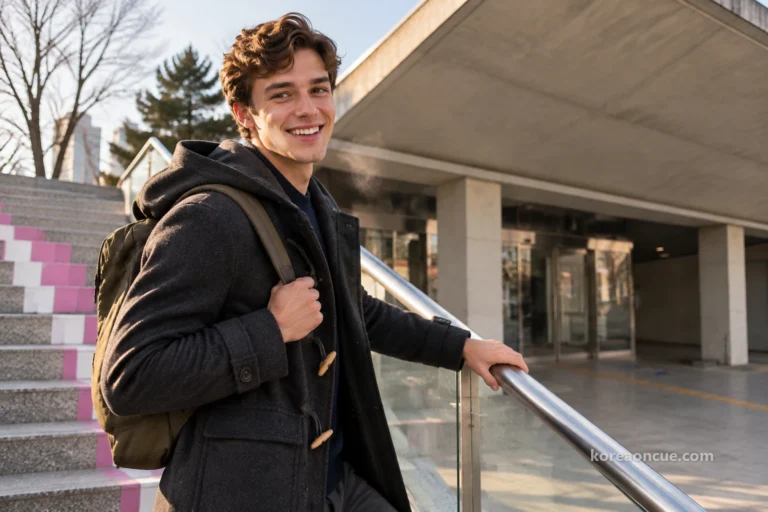
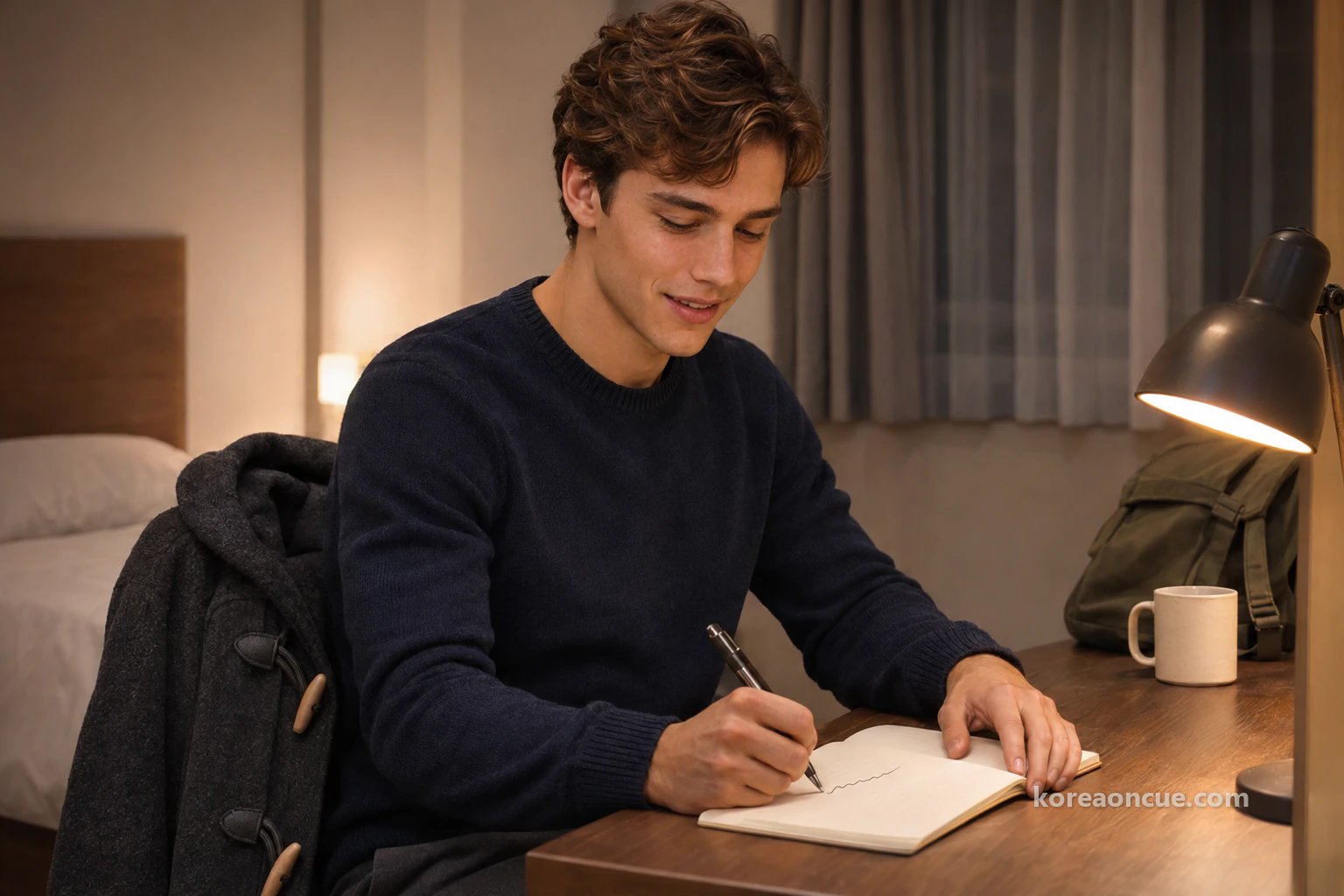
On the night of Tuesday 1 December, Noah opened a fresh page of his notebook at the desk in his accommodation. Noah is twenty, from Canada, and he draws a map of every place he walks for the first time, then adds the times as well. He calls these sheets his “time maps”, and this trip had now produced nine of them. It had turned cold enough that day to get out his thick coat, and the first line on the tenth page was not a street but a time: “10:00 Gyeongbokgung → 11:00 Deoksugung”.
What Noah wanted to see was the royal guard-changing ceremony, a re-enactment of the gatekeepers and guards of the Joseon era handing over duty at the main gate of a palace. You can watch the drums sound and the flags go up in front of a palace gate at two places: Gwanghwamun at Gyeongbokgung and Daehanmun at Deoksugung. Two ceremonies with almost the same name, starting an hour apart at two palaces: for someone who writes down times, no box could be easier. Once the start times were on the page, all that was left was to walk.
Noah has a habit of rereading the official information the night before he goes somewhere new. That night too he read the times and closing days, and even opened the cancellation notices on the Deoksugung ceremony’s website. There was nothing for the next day. So instead of the pencil he normally uses for times, he wrote them in ballpoint. This piece follows how that ballpoint line got corrected over one day, and goes through what time to go, where to stand, which days are off and what happens with winter cancellations.
The Cue — At a glance
If you want to see both, pick a day from Wednesday to Sunday and see Gyeongbokgung at 10:00 first. That way, if 11:00 drops out at Deoksugung, you still have 14:00. At Gyeongbokgung you just walk up to the front of Gwanghwamun with no ticket, and in winter it pays to open Deoksugung’s cancellation notices once more before you leave. Write your times in pencil.
- Times and days off: Gyeongbokgung 10:00, 14:00 (off on Tuesdays). Deoksugung 11:00, 14:00 (off on Mondays). Each takes about 20 minutes and both are free.
- Gyeongbokgung: The square and Woldae terrace area in front of Gwanghwamun. Gyeongbokgung Station on Line 3, Exit 5, 217 m; Gwanghwamun Station on Line 5, Exit 2, 440 m.
- Deoksugung: In front of Daehanmun. City Hall Station on Line 1, Exit 2; City Hall Station on Line 2, Exit 12 (towards Deoksugung). There is no car park.
- Checking cancellations: For Deoksugung, the 취소안내 (cancellation notices) board on royalguard.kr, or phone 02-6462-7402 (10:00–17:00, closed Mondays).
- What to bring: You stand outdoors, so gloves in winter, plus earphones for the Deoksugung audio guide.
What time is the guard-changing ceremony, and when is it off? Gyeongbokgung only on Mondays, Deoksugung only on Tuesdays
The two palaces take their days off on different days of the week. Deoksugung is off every Monday, and at Gyeongbokgung there is no ceremony on Tuesdays, when the whole palace is closed. That splits the week into three rows, and this was the table Noah drew in his notebook first. Start with the bottom row, the one that lets you link both in a single day.
Open in Kakao Map — Gyeongbokgung Station
| Day | Gwanghwamun, Gyeongbokgung | Daehanmun, Deoksugung |
|---|---|---|
| Mon | 10:00, 14:00 | Off |
| Tue | Off | 11:00, 14:00 |
| Wed–Sun | 10:00, 14:00 | 11:00, 14:00 |
When Noah held the table against the calendar, Monday 30 November that week was Gyeongbokgung only and Tuesday 1 December was Deoksugung only. The first day that linked both was the next day, Wednesday 2 December, so he drew a circle around that box. The place this table trips people up is where the palace name and the day don’t match. Go to Daehanmun on a Monday or Gwanghwamun on a Tuesday and there is no ceremony, so if those two days are all your trip has, simply choose the palace that is open that day.
Drawing the table, Noah noticed one more thing: 14:00 is the same time at both palaces. So you can’t see both using the afternoon sessions alone, and one of them has to go in the morning. The names are so alike that they sound like a single event, but they are two different ceremonies. Deoksugung’s is the Seoul Royal Guard Changing Ceremony, organised by the city of Seoul and begun in 1996, and Gyeongbokgung’s has been running since 2002.
Where to watch at Gyeongbokgung: in front of Gwanghwamun, no ticket
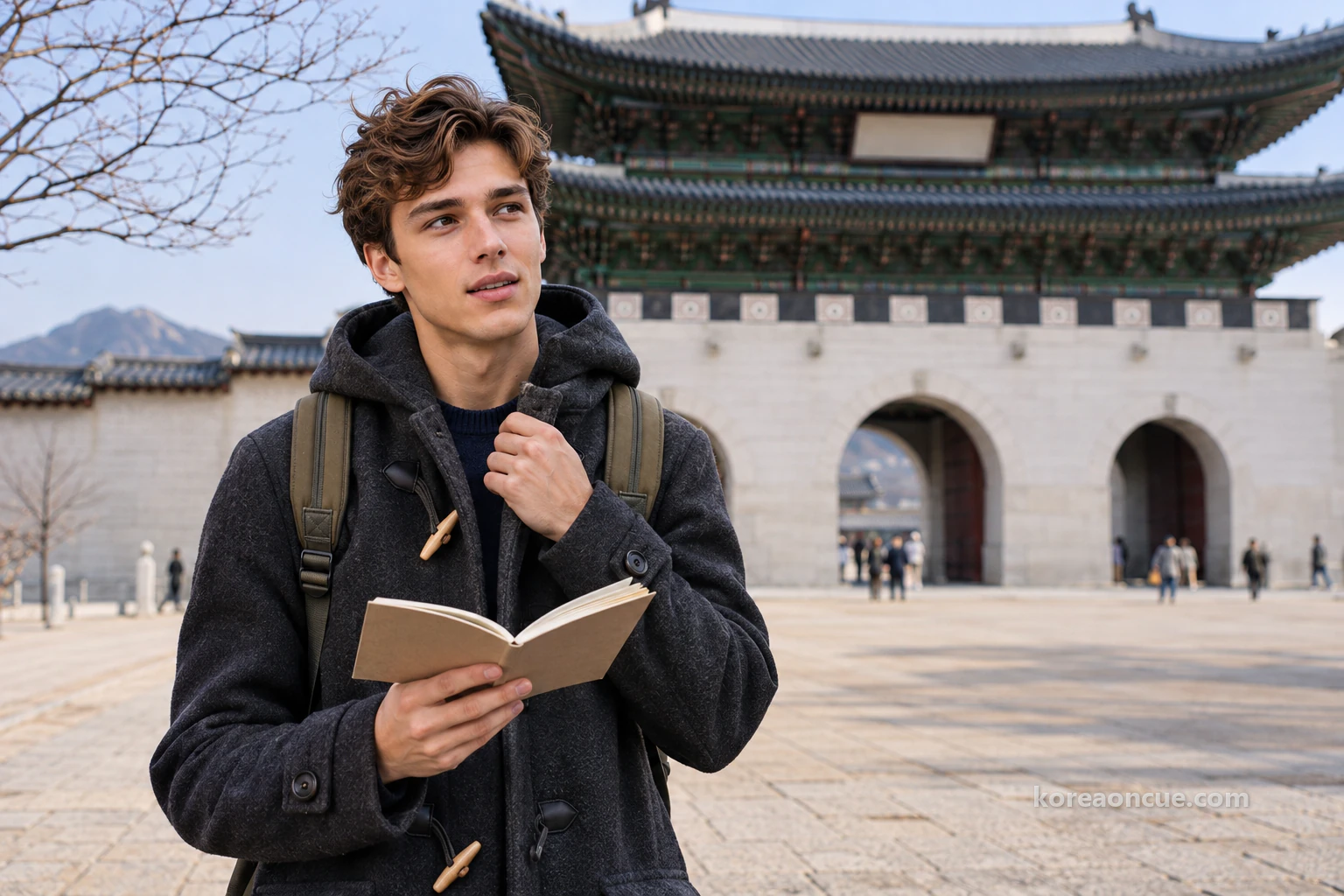
You watch the Gyeongbokgung ceremony in front of Gwanghwamun without buying an admission ticket. It takes place in the square and around the Woldae, the broad raised terrace in front of the gate. Watching is free. It has nothing to do with the ticket for going inside the palace, so there is no need to spend time at the ticket office. That was why Noah skipped drawing a ticket-office box on his map.
The subway is the easy way there: 217 m from Exit 5 of Gyeongbokgung Station on Line 3, or 440 m from Exit 2 of Gwanghwamun Station on Line 5. The address is 12 Hyoja-ro, Jongno-gu, in front of Gwanghwamun. On the morning of 2 December, Noah came out of Gyeongbokgung Station and reached the square at around 9:30. The wind was cold, and he pulled his coat collar up under his chin.
Anyone who arrives early gets an extra item on the programme. The guards hold a public training session for 15 minutes at 09:35 and 13:35 in front of Hyeopsaengmun. Noah wrote “09:35” in his notebook, watched the training and went back to the square. As 10:00 drew near people slowly gathered towards the front, and Noah found a spot one row behind the very front.
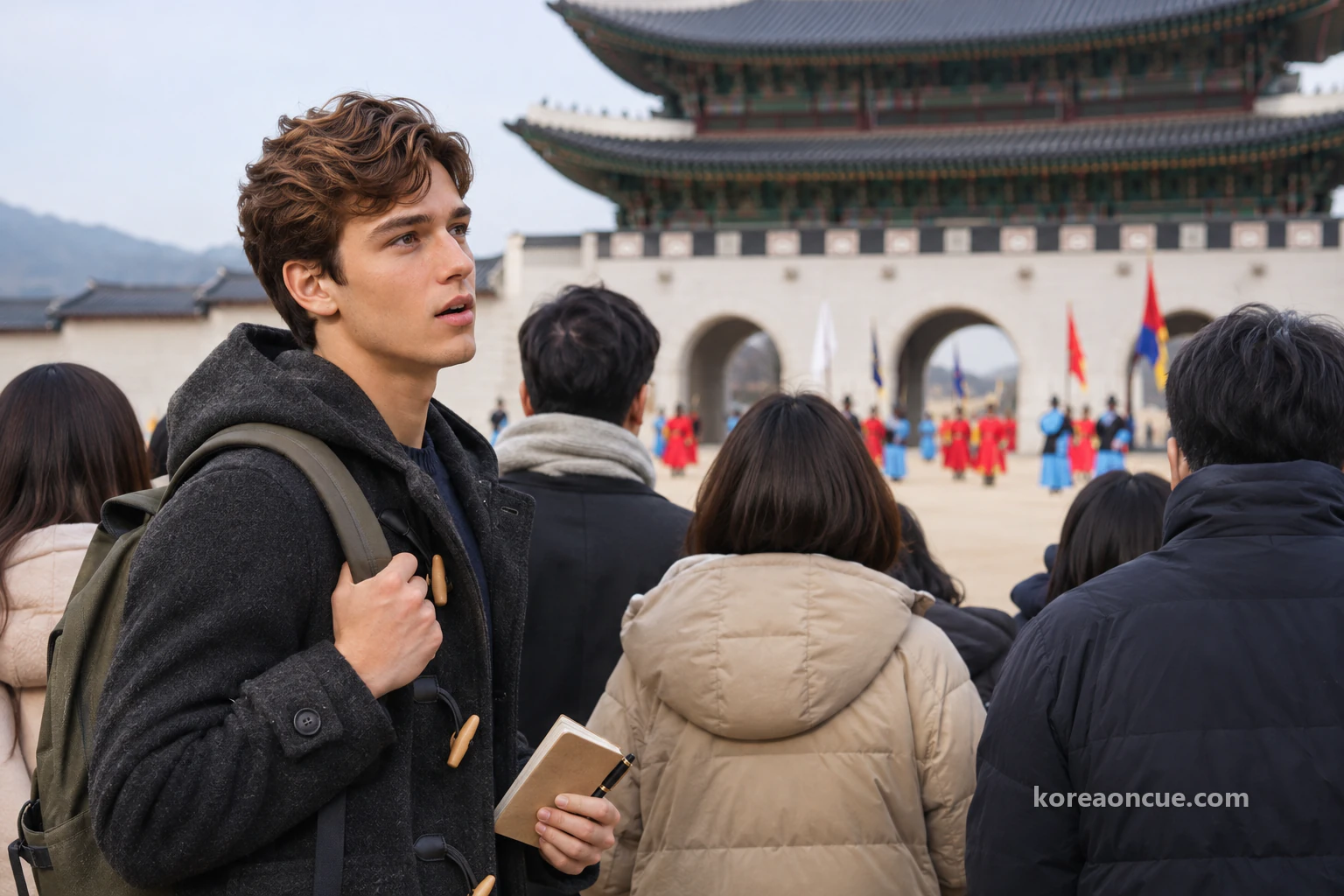
If you have children with you or use a wheelchair, head for the front row first. This spring there was a viewing area in the very front row for wheelchair users and children, who have a lower line of sight. On his own, Noah moved two steps to the side so as not to stand behind anyone tall. A spot that took in the line of flags and the drum at a glance was better for his map than one facing the gate head-on. Watching the flags lean to one side in the wind, he took out his ballpoint.
What you see in 20 minutes at Gyeongbokgung: choeom, ieom, sameom
The Gyeongbokgung ceremony lasts 20 minutes, and a great drum gives three signals. Once the guards on duty have taken up their positions at Gwanghwamun, choeom sounds, and the incoming guards set off and arrive at the gate. At ieom the gatekeepers exchange military salutes and confirm each other’s identity. At sameom the outgoing side withdraws. Knowing just these three drum signals, you can tell where you are in the 20 minutes.
Noah made a small dot in his notebook each time the drum sounded. First-timers usually notice the red clothes and flags first, but to someone who writes down times, the drum came first. At the first beat a child in front flinched, and Noah, a little startled himself, nearly dropped his ballpoint. Even from a spot where the front was hard to see, he could follow where things had got to by the sound of the drum.
What this ceremony sets out to show is the soldiers of the early Joseon era. It was reconstructed from the record of the gatekeeper system being introduced in the first year of King Yejong’s reign (1469) in the Annals of the Joseon Dynasty. So if the order differs a little from Deoksugung’s, neither is wrong: they are different re-enactments. Noah noted the names of the three drum signals and left an empty box beside them, planning to fill in the same box at Deoksugung that afternoon.
The front of Gwanghwamun doesn’t empty when the change is over. The Gwanghwamun guard ceremony follows at 11:00 and 13:00, for 10 minutes each, and after the changing and guard ceremonies there is hourly duty at Gwanghwamun. So if you miss 10:00, you can still see the scene at the gate at the 11:00 guard ceremony. The change itself happens only at 10:00 and 14:00, so if you want the drums too, come for one of those two. Noah wrote “10:20” and moved on to the next box.
Seeing both palaces in a day: Gyeongbokgung at 10:00 first
On a day when you see both, watching Gyeongbokgung at 10:00 first gives you the most room. The change takes 20 minutes, so it ends at 10:20, which on the timetable leaves 40 minutes before Deoksugung’s 11:00. Noah’s ballpoint line had trusted those 40 minutes too. But the real advantage of this order is not the 40 minutes: it is in the far-right column of the next table. From Wednesday to Sunday you can choose between three orders.
| Order | First | Next | If a session is cancelled |
|---|---|---|---|
| Straight through the morning | Gyeongbokgung 10:00 | Deoksugung 11:00 | Deoksugung 14:00 is left |
| Morning and afternoon | Gyeongbokgung 10:00 | Deoksugung 14:00 | No Deoksugung session is left |
| Deoksugung first | Deoksugung 11:00 | Gyeongbokgung 14:00 | 14:00 clashes, so you give one up |
Only the first row leaves you one more chance later on, because even if 11:00 is cancelled you can still go for 14:00 the same day. The second row is easier on the legs, but it leaves a gap of 3 hours 40 minutes, and if 14:00 is cancelled that is the end of Deoksugung for the day. The third row suits people who want to see Gyeongbokgung in the afternoon and carry on into the palace. Last entry to the palace is 16:00 in winter, though, so there isn’t much time after the ceremony.
That morning Noah hadn’t yet drawn this table. With the last box of the first row still blank, he left the square and set off towards Daehanmun. Walking away from the people waiting for the 11:00 guard ceremony at Gwanghwamun felt like a bit of a waste. Still, keeping to the times on his map always came first for Noah. All the more so with times written in ballpoint.
Where to watch at Deoksugung: from City Hall Station to the front of Daehanmun
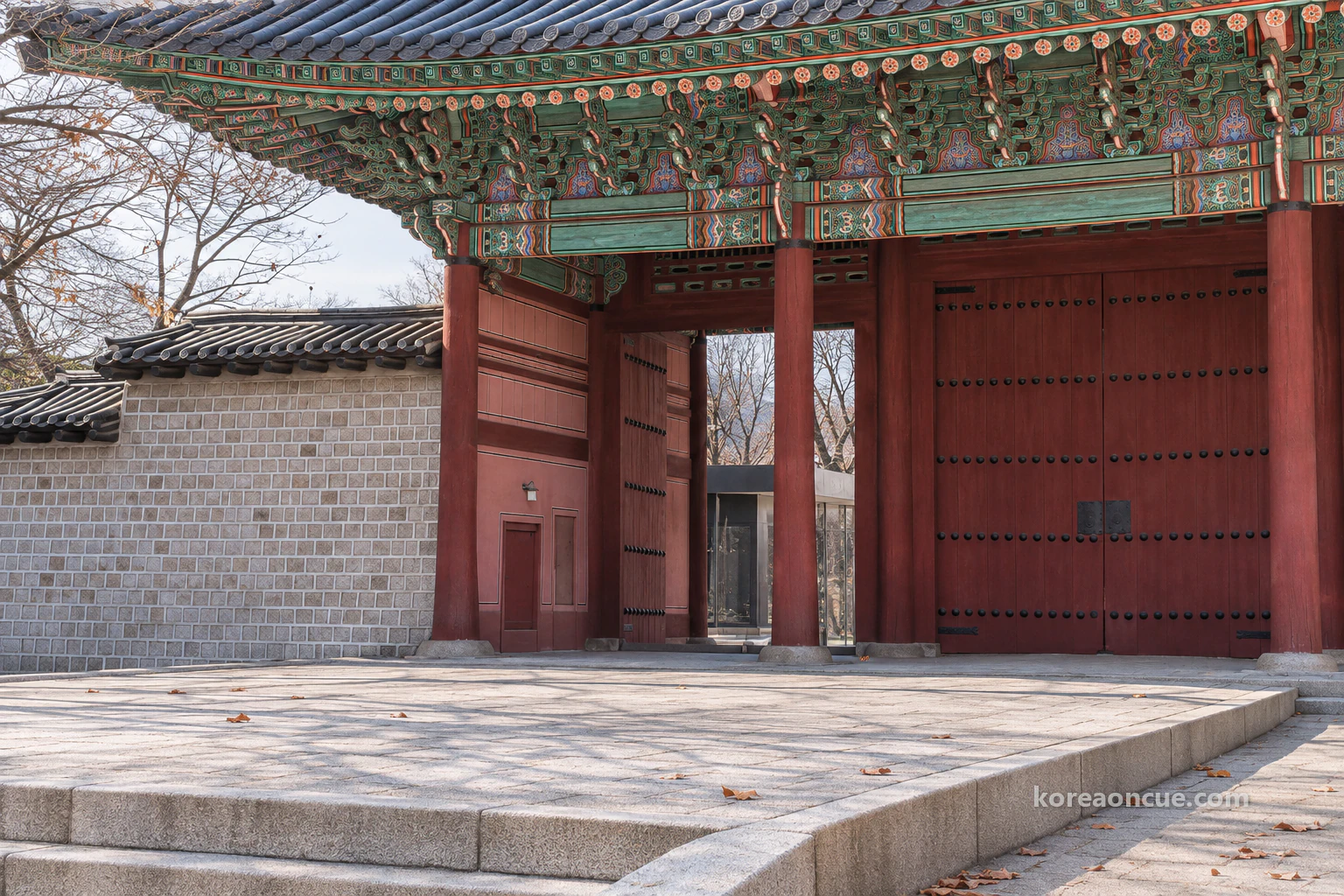
The Deoksugung ceremony takes place in front of Daehanmun, and the easy way there is from City Hall Station. On Line 1 come out of Exit 2, and on Line 2 come out of Exit 12 and head towards Deoksugung. By bus, get off at City Hall. There is no parking, so it is better to leave the car behind. It is held outdoors in front of Daehanmun and it is free.
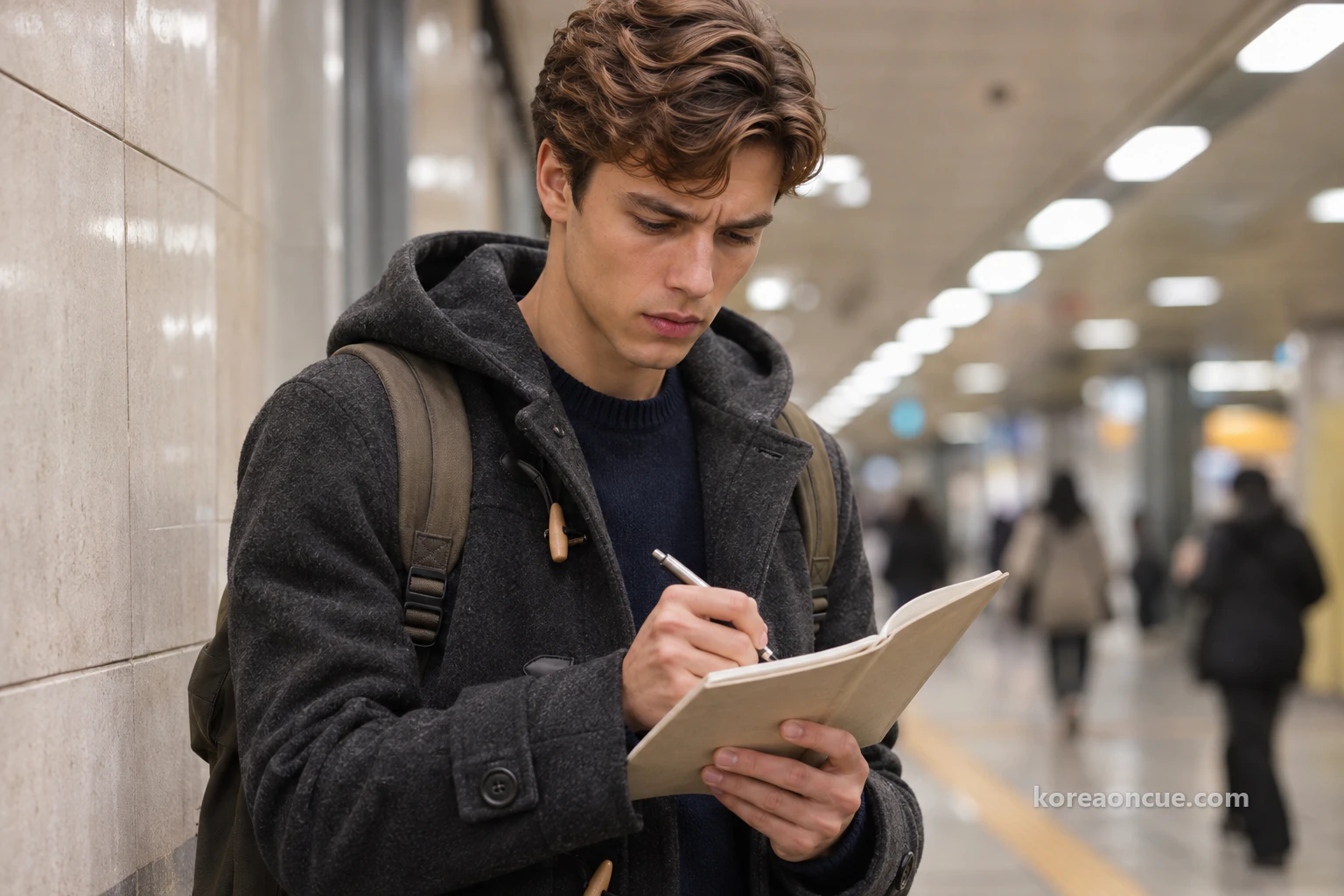
Noah reached the front of Daehanmun at “10:50”. In front of the gate, with its red pillars under the eaves, was a low stone platform, and he stood where he had a good view of it. Just in case, he opened the cancellation notices on his phone, and there was a new post at the top: “금일 11시 행사가 취소되었음을 안내드립니다.” Noah looked at the first syllable, 금, the same one that starts 금요일, Friday. So that was about Friday, he thought, and today was Wednesday, so it had nothing to do with him, and he gave a nod.
Noah put his phone away and stood up straight with his notebook in hand, the posture of someone who has come with the time written on a map. It must have looked fairly reliable, because before long four people had gathered behind him, all looking the same way. One of them asked, “It’s at 11:00 here, right?” Noah showed them the “11:00” in his notebook and nodded. It reached 11:00, then one minute past, then four minutes past.
At 11:05 Noah took out his phone again and saw today’s date at the very start of the post. Put through a translator, “금일” turned out to mean not Friday but today. It was a notice that today’s 11:00 session had been cancelled because of the cold. Noah turned round and said to the four people in a low voice, “I’m sorry. Apparently geumil means today.”
Where to check Deoksugung cancellations: the royalguard.kr board and the phone
Deoksugung cancellations appear by session on the 취소안내 (cancellation notices) board on royalguard.kr. Many days lose just one session, so there are three things to look at. Is the date at the front today, is the category label “덕수궁 교대의식” (the Deoksugung ceremony), and which session is it? Posts labelled “숭례문 파수의식” (the Sungnyemun guard ceremony) are mixed in on the same board, so you have to read the label as well. Some titles don’t give the session either, so unlike Noah, don’t stop at the first syllable: open the post and read the time in the text.
When you check matters too. Last winter, Deoksugung’s cancellation posts all went up dated the very day of the cancellation. That was why there was no post for the next day when Noah opened the board the night before, and that blank was only true up to that night. Even if you looked the night before, open it again just before you leave, and once more on your way to Daehanmun. And “금일” in a notice means today, so don’t read it as a day of the week.
You can also ask by phone. The Seoul Royal Guard Changing Ceremony number is 02-6462-7402, answered from 10:00 to 17:00 and closed on Mondays. Before 10:00 only the board is available, so on an early start, look at the board first. If you are leaving Gyeongbokgung after the 10:00 ceremony, that is a good moment to call. If Noah had dialled that number on his way out of the square, he wouldn’t have ended up standing there with four other people.
Only news of the Seoul city ceremonies goes up on this board, with nothing about Gyeongbokgung. Schedule notices for Gyeongbokgung go up separately, in Korean and English, in the Korea Heritage Service’s notices. They are two ceremonies with different organisers, so one being on does not mean the other is. Beside each palace name in his notebook, Noah wrote where to look in a box of its own. On a day linking both palaces, it is easiest to open both in the morning.
Does it run in winter? Deoksugung had cancellations on 27 days last winter
Deoksugung cancels often in winter. The ceremony runs except during the coldest and hottest spells, on rainy days and on days when emergency air-quality reduction measures are in force. Going down into City Hall Station to warm up, Noah stood by a wall and scrolled the board all the way back to its first post. That first post was from 5 December 2025, and he copied the days with a cancellation notice, line by line, into his notebook up to 28 February 2026. They came to 27 days.
These 27 days are a count of cancellation posts on the board, by date. A day counts even if only one session was cancelled, and Sungnyemun guard ceremony posts are left out. In the table below, start with the cold in the top row. There is far more cold than rain. It is easy to let your guard down just because a winter day is clear.
| Reason | Days with a cancellation notice | When they clustered |
|---|---|---|
| Cold wave | 17 days | 9 days between 20 and 30 January |
| Fine dust | 4 days | 12–14 and 22 February |
| Icy-path safety | 3 days | 5 December, 13 January, 3 February |
| Rain | 3 days | 16, 20 and 23 December |
Once the cold came, it went on for days. On 20, 21, 22 and 23 January, posts for both 11:00 and 14:00 went up four days running, and 26 December, 2 January and 7 February were off for the whole day. So in winter, opening the board that day is quicker than guessing from a weather app. By month that makes 6 days in December, 13 in January and 8 in February, so last winter January had the most cancellations. In Noah’s notebook too, the January box alone grew noticeably crowded.
Here Noah split the boxes once more. Being someone who writes down times, he counted by session rather than by reason. Which session dropped out more often was the figure he could use straight away in the next day’s plan. The table below divides the same 27 days by month and session. Posts that said only 금일 행사, today’s event, with no time in the text, are counted as both sessions cancelled.
| Month | 11:00 post only | 14:00 post only | Both sessions cancelled |
|---|---|---|---|
| December 2025 (from the 5th) | 3 days | 1 day | 2 days |
| January 2026 | 6 days | 0 days | 7 days |
| February 2026 | 2 days | 2 days | 4 days |
| Total | 11 days | 3 days | 13 days |
Going by the posts, 14:00 dropped out less often than 11:00 last winter. 11:00 was lost on 24 days and 14:00 on 16. There were 11 days with an 11:00 cancellation post only, so a cancelled 11:00 is no reason to strike Deoksugung off straight away. Then again, both sessions dropped out on 13 days, so on a winter trip it is safer not to rely on a single day for Deoksugung. If your schedule has room, keep a second day free, avoiding only Monday.
What happens in the rain? Deoksugung cancels by session, Gyeongbokgung’s guards work in rain gear
In the rain, Deoksugung cancels by session. When Noah scrolled the board back up towards this autumn, 13 October had lost only 11:00, 18 October only 14:00, and 1 November both sessions to rain. It follows the same pattern as winter, so don’t write off the day because it is raining in the morning: first check which session it is. Some days are lost to rallies rather than weather. On 1 March 2026, 14:00 was cancelled because of a rally.
Noah split the bad-weather box in his notebook in two, one half for each palace. At Gyeongbokgung, rain stops the Gwanghwamun guard ceremony, and the gatekeepers and guards just stand duty at Gwanghwamun in ujang, traditional rain gear. At those times you can have your photo taken with the gatekeeper. The changing ceremony too may be cancelled or altered depending on weather such as rain or extreme heat. Guards in rain gear are a sight you won’t get on a clear day, so it is worth taking an umbrella up to the gate.
Gyeongbokgung has stopped for the weather before too. On 5 August 2026 all events were suspended under a severe heatwave alert, restarting on 10 August when the alert was lifted. So on days of really bad weather, read the notices for both palaces before you set off. In the rain box Noah wrote briefly: “Deoksugung = cancelled by session, Gyeongbokgung = rain-gear duty”. That one line alone he wrote in pencil.
What to see at Deoksugung’s 14:00 ceremony: follow it with the audio guide
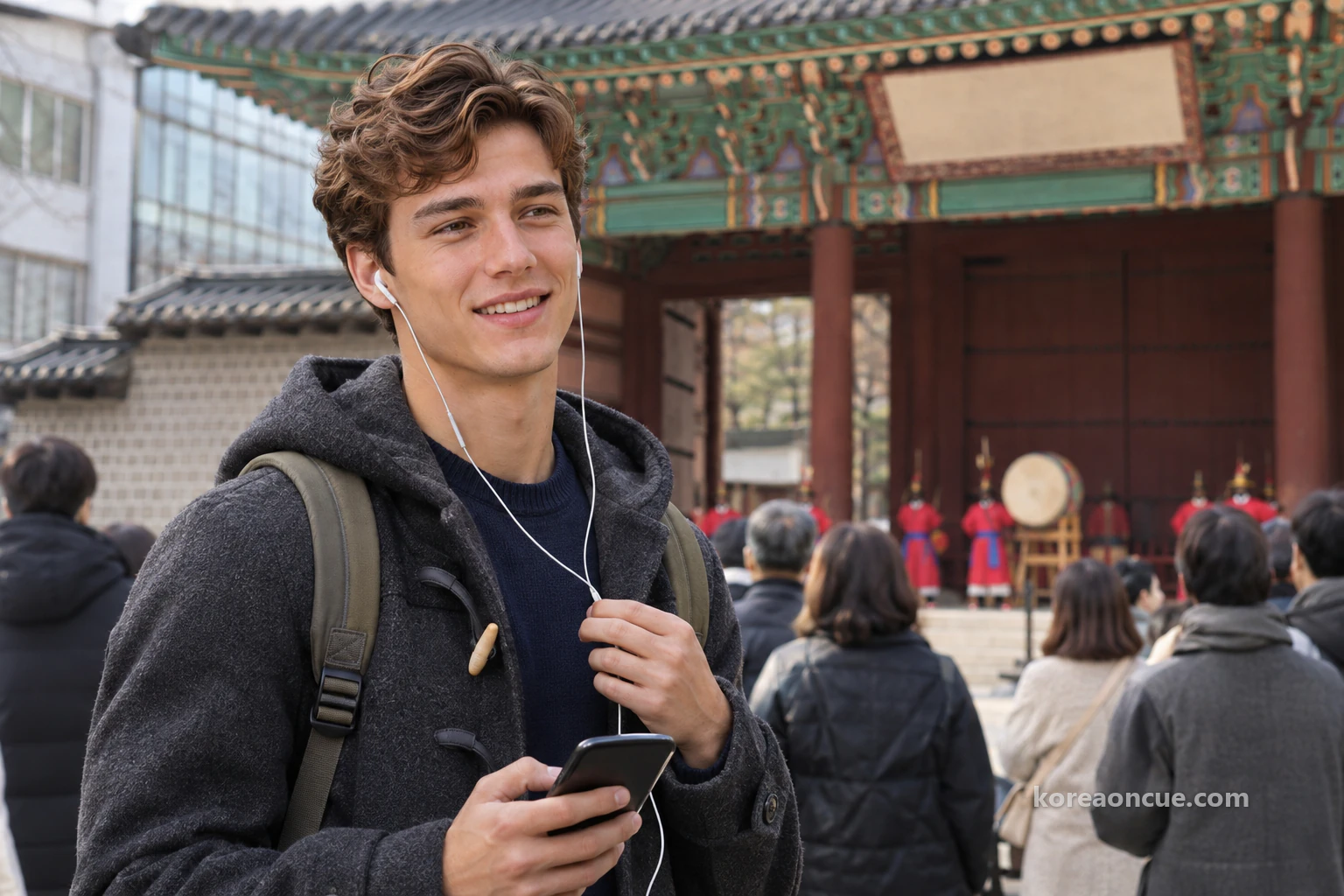
At Deoksugung you can watch with an audio guide in four languages: Korean, English, Chinese and Japanese. At the venue, open the ceremony procedure section of royalguard.kr and press the headset icon to the right of each step. So if you bring earphones, you can follow the procedure without knowing the language. At 1:40 p.m. Noah drew two lines through “11:00” in ballpoint, wrote “14:00” beside it and came back to the front of Daehanmun.
This time he didn’t stop at the first syllable. Noah read the date, the label and the session in turn, saw that there was no 14:00 cancellation post, and only then put in his earphones. Soon the drum sounded three times. This is the opening signal, called gaesiktago. Next came the password procedure: the password approved by the king was passed to the gatekeeper, and the identity of the incoming soldiers was tested by asking for it and answering.
Then came the chamal ceremony. The newly arrived guards report to the gatekeeper, and the gatekeeper inspects the ranks. At choeom the drum sounds six times and the yaksiham, the box holding the keys to the palace gates, is handed over. At jungeom the tally halves are matched and the wijangpae tablet is passed on, and at sameom the drum sounds twice and the two groups swap duty. Ending with yepil, the whole thing takes about 20 minutes: 1 minute of gaesiktago, 1 of the password, 17 of the change and 1 of yepil.
Only then did Noah fill in the box he had left empty that morning. Gyeongbokgung had been choeom, ieom, sameom, and here it was choeom, jungeom, sameom. In two ceremonies with almost the same name, the middle drum signal had a different name. For someone who looks first for the places where signs and reality disagree, a box like this was the day’s haul. Smiling quietly to himself, Noah drew a circle round “ieom / jungeom”.
The ceremony’s origins turn out to be interesting as well. Seoul wanted a cultural attraction like the Changing of the Guard at Buckingham Palace, and launched it in 1996 after consulting experts. In the Joseon era the gatekeepers were military officials of the junior sixth rank who guarded the palace gates, opened and closed them and patrolled in and around the palace. But the term “royal guard-changing ceremony” does not appear in Joseon sources such as the Gyeongguk Daejeon: the name was given on the basis of material on the official posts and on gate-opening and closing rites. It is more accurate to see it not as an old rite carried over unchanged but as a ceremony rebuilt through historical research.
Patrols and the gatekeeper experience: what else there is besides the change
The ceremony’s day goes on after the 14:00 session ends, so Noah didn’t close his notebook. Besides the change, Deoksugung has the watch ceremony in front of Daehanmun from 10:00 to 15:30. The patrol ceremony, in which the guards go out on patrol after the change, takes place at around 15:00, heading for Namdaemun Market on Tuesdays and Thursdays and the Uijeongbu site on Wednesdays, Fridays, Saturdays and Sundays. If you can stay a little longer after the 14:00 session, look for the one that fits the day. It was a Wednesday, and Noah left the Uijeongbu site as his next box.
Gyeongbokgung has a patrol ceremony too, but only in set seasons. It runs from March to May and from September to November, on Saturdays, Sundays and public holidays, from 15:00 to 16:00. On Saturdays it stays inside Gyeongbokgung, and on Sundays it walks from the Gwanghwamun Woldae to Insadong’s cultural street. If demonstrations or rallies make the roads difficult, it can change to a patrol inside the palace on Sundays and public holidays too. Having come in December, Noah struck this box off his map and copied it into the margin for anyone coming in spring.
If you’d like to try it yourself, Deoksugung has the “나도 수문장이다” (“I’m a gatekeeper too”) experience. One person becomes the gatekeeper at each 11:00 and 14:00 session, and places go on a first-come, first-served basis. Applications open at midnight on the 20th of the previous month, it is for primary school age and up, and you can’t apply twice in the same month. You go to the waiting room an hour before your session to dress and be briefed. The ceremony is off on Mondays, and on Saturdays there is no experience because of rallies around Daehanmun. Noah worked out that applications for December had already opened on 20 November, and wrote only “20th of the month before, 00:00” in the margin.
If you’re going inside the palace after the ceremony, compare the closing times. Gyeongbokgung is open 09:00–17:00 from November to February, with last entry at 16:00. Deoksugung is open 09:00–21:00 all year, with last entry at 20:00. In winter it is easier to put Gyeongbokgung, which closes early, first and leave Deoksugung, open into the evening, for later. The order for the change and the order for going inside run the same way, and here Noah felt rather pleased.
A winter day at the ceremony: the tenth map, corrected
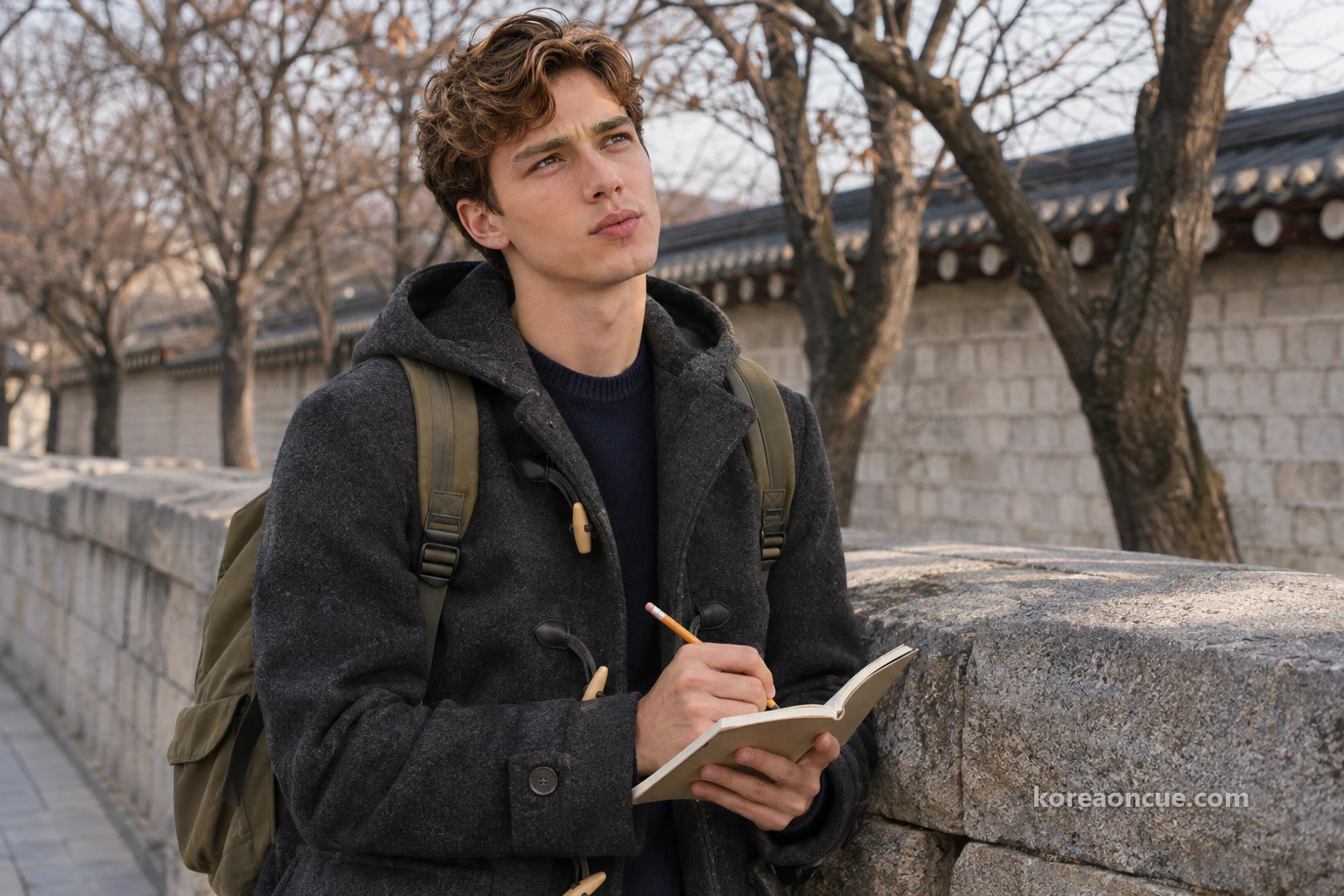
Noah wrote “14:20” and, going down into City Hall Station, looked over his map again from the beginning. In nine maps he had sometimes got a time wrong, but a time he had written down had never vanished on the day. Under the ballpoint writing he added a new line in pencil: “10:00 Gyeongbokgung → 11:00 Deoksugung → if not, 14:00”. At the very top he added “Not the night before: that morning”, deciding to keep his habit of reading the official information the night before, but to read this one box again before leaving.

He hadn’t sent the last map, but this time he took a photo of the corrected page and sent it to Hina. “For the first time, I corrected a time I’d written in ballpoint. Geumil wasn’t Friday.” At the very back of the notebook, the time map Hina gave him in Ttukseom on Halloween night is still tucked in. Closing his map, Noah found himself hoping that the four people who had stood behind him at Daehanmun had come back at 14:00 too.
Common Mistakes
Going to Daehanmun on a Monday or Gwanghwamun on a Tuesday
if you don’t read the palace name and the day together, you find out standing at the gate.
Putting both palaces at 14:00
Noah didn’t spot it either until he drew the table. One of them has to move to the morning.
Only checking for cancellations the night before
the board Noah opened that night had no post for the next day, and his ballpoint had to be corrected on the day.
Reading “금일” as a day of the week
this is how Noah spent 15 minutes in front of Daehanmun with four other people.
Giving up the day when 11:00 is cancelled
last winter there were 11 days with an 11:00 cancellation post only. Read as far as 14:00 before you decide.
FAQ
Does it go ahead in snow?
Last winter no Deoksugung cancellation post gave snow as the reason, and 3 days were lost to icy-path safety.
What if I’ve booked the experience and it’s cancelled?
If the event is cancelled because of a rally or the weather, you’ll be contacted individually and your booking is cancelled automatically. If you still want to take part, you have to book again on the website.
Can pre-school children do the gatekeeper experience?
Because of costume sizes and the briefing, pre-school children can’t take part.
Is there an experience where you just try on traditional clothes?
Deoksugung’s traditional costume experience isn’t running at the moment.
Recap — 30 seconds before you go
- Mondays are Gyeongbokgung, Tuesdays are Deoksugung, and for both go between Wednesday and Sunday
- See Gyeongbokgung at 10:00 first, then Deoksugung at 11:00, and if that drops out, 14:00
- In winter, open the cancellation notices before you leave and read the date, the label and the session
Sources
- Seoul Royal Guard Changing Ceremony — Procedure and schedule (Korean)Daehanmun at Deoksugung, 11:00 and 14:00, off on Mondays · the steps from the opening drum to the closing salute · audio guide in four languages and the headset icon · enquiries 02-6462-7402checked 2026-11-06
- Seoul Royal Guard Changing Ceremony — About the ceremony (Korean)Its start in 1996 · gate watch 10:00–15:30 · patrol destinations by day · the aim of a cultural product like the Changing of the Guard at Buckingham Palace, and the basis of the ceremony’s namechecked 2026-11-06
- Seoul Royal Guard Changing Ceremony — Getting here (Korean)City Hall Station on Line 1, Exit 2, and on Line 2, Exit 12 (towards Deoksugung) · bus to the City Hall stop · no car parkchecked 2026-11-06
- Seoul Royal Guard Changing Ceremony — 취소안내, cancellation notices (Korean)Cancellation posts by session, with their tags · reasons and sessions for the 27 days with posts from 5 December 2025 to 28 February 2026 (counted post by post) · this autumn’s rain cancellations and the rally cancellation of 1 March 2026checked 2026-11-06
- Seoul Royal Guard Changing Ceremony — Side events (Korean)나도 수문장이다: one person per session, first come, first served, applications from midnight on the 20th of the month before, primary school age and up, no second application in the same month · no experience on Saturdays · traditional costume experience not running nowchecked 2026-11-06
- Korea Heritage Service — 2026 guard-changing ceremony, August schedule (Korean)Ceremony 10:00 and 14:00 (20 minutes) · Gwanghwamun guard ceremony 11:00 and 13:00 (10 minutes) · public training 09:35 and 13:35 (15 minutes, in front of Hyeopsaengmun) · gate duty on rainy dayschecked 2026-11-06
- Korea Heritage Service — Guard-changing ceremony programme (Korean)The choeom, ieom and sameom steps · the ceremony running since 2002 and the record of the gatekeeper system from the first year of King Yejong (1469) · seasons and route of the patrolchecked 2026-11-06
- Seoul Tourism Organization — Gyeongbokgung guard-changing ceremony (Korean)12 Hyoja-ro, Jongno-gu, in front of Gwanghwamun · Gyeongbokgung Station on Line 3, Exit 5, 217 m, and Gwanghwamun Station on Line 5, Exit 2, 440 m · off on Tuesdayschecked 2026-11-06
- Seoul Metropolitan Government, Seoul Mediahub — Citizen reporter’s article on the Gyeongbokgung ceremony (Korean)Location: the square and Woldae terrace area in front of Gwanghwamun · free, no Gyeongbokgung ticket needed to watch · front-row viewing area (an article from April 2026)checked 2026-11-06
A Seoul story told with our AI characters. Place details are checked against public sources; the photos are AI-made illustrative images. How we use AI