
SEOUL · SONGHYEON
Numbers 1 to 15: Hina walks the Seoul Sculpture Festival at Open Songhyeon Green Plaza like a setlist
Anguk Station Exit 1, next to the Seoul Museum of Craft Art, free entry — the outdoor sculpture exhibition runs until Monday 30 November 2026, and how to walk the 15 Seoul Sculpture Award selections in the order of the numbered map
It is the last Saturday before the exhibition closes, and Hina has the whole day free until her evening show. The fifteen sculptures on the lawn each have a number. Hina makes those numbers her setlist for the day.
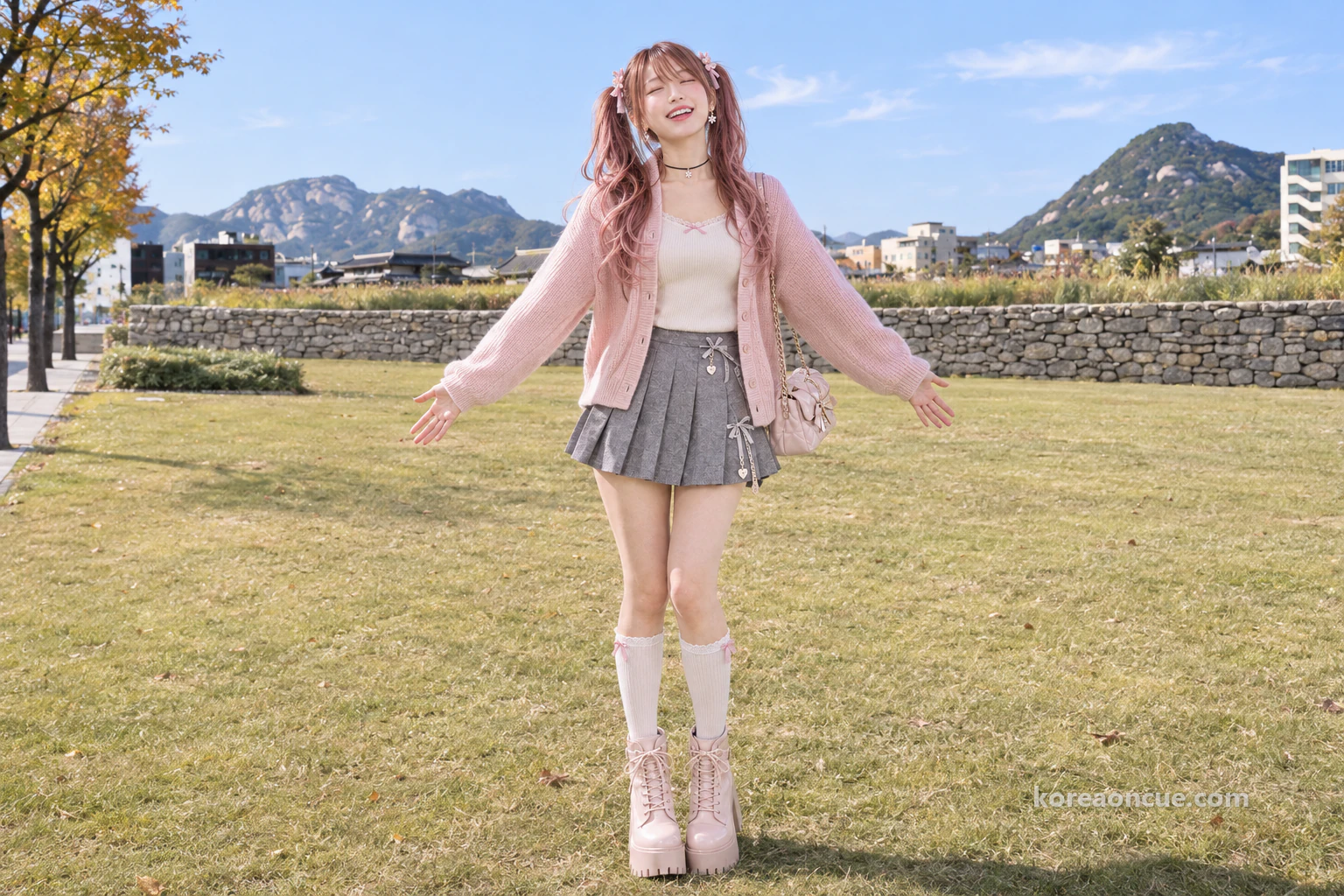
How to get there
On the morning of Saturday 28 November, Hina stands on the subway to Anguk Station, looking at one screen on her phone for a long time. She is twenty-one and promotes shows for a marketing company in Tokyo, and she often comes to Seoul for shows and merchandise. Ten days have passed since the 18th, when she counted back from closing times at Seoul Metropolitan Library and went home. This time the show is tonight. So from morning until the evening, the whole day is free.

What Hina is looking at is a map with fifteen circles on a lawn. Each circle has a number from 1 to 15, with an artist’s name beside it. It is the layout of the outdoor sculpture exhibition of the Seoul Sculpture Festival (서울조각페스티벌), held at Open Songhyeon Green Plaza between Gyeongbokgung Palace and Insa-dong. Hina cannot walk past a numbered list. Just as she follows a setlist song by song, a list with numbers makes her want to walk it in order.
Checking the dates, Hina grips her phone a little tighter. The outdoor sculpture exhibition runs until Monday 30 November. Today is the last Saturday before it closes. Entry is free. “I always start with the showtime,” she likes to say, and true to form, she writes the time of tonight’s show at the very bottom of her notepad first, then fills the day’s slots from the top down.
This piece follows Hina’s Saturday. It starts with the way from Anguk Station Exit 1 on Line 3 to Open Songhyeon Green Plaza. It also covers how long the exhibition runs and the history of the land the plaza stands on. Then it walks the 15 Seoul Sculpture Award selections in the order of the numbers on the map, and goes round once more for the invitational exhibition of 11 senior sculptors. It is meant to help you decide what to see first on a wide lawn, and where to take a break.
The Cue — At a glance
The outdoor sculpture exhibition of the Seoul Sculpture Festival runs until Monday 30 November 2026 at Open Songhyeon Green Plaza in Jongno-gu. Entry is free. Come out of Anguk Station (Line 3) Exit 1 and head for the plaza next to the Seoul Museum of Craft Art. The 15 selections for the 2026 Seoul Sculpture Award are numbered 1 to 15 on the official map, so you can find each work by its number. The invitational exhibition of 11 senior sculptors, 「흐름과 기억, 존재의 서사」 (Flow and Memory, a Narrative of Being), is on the same lawn. The festival programme, such as the opening ceremony and busking, ended on 4 September—what is on now is the sculpture exhibition on the lawn.
- Station and exit: Anguk Station (Line 3) Exit 1 → Open Songhyeon Green Plaza (around 48-9 Songhyeon-dong, Jongno-gu), right next to the Seoul Museum of Craft Art.
- Exhibition: the outdoor sculpture exhibition of the 3rd Seoul Sculpture Festival, 「예술의 도시, 산들바람 타고」 (City of Art, Riding the Breeze), Sat 29 August – Mon 30 November 2026.
- Admission: free.
- Already over: the festival programme, such as the opening ceremony, busking and the open-air cinema, ran from 29 August to 4 September.
- Map: the numbered map on the 2026 Seoul Sculpture Award selections page of the Sculpture City Seoul website — 1–4 along the lower path, 5–7 on the yellow path in the middle, 8–15 on the upper lawn. Save it to your phone before you go.
- Worth seeing: ① the 15 selections for the 2026 Seoul Sculpture Award (numbers 1–15) ② the invitational exhibition of 11 senior sculptors, 「흐름과 기억, 존재의 서사」.
- Toilet: marked at the bottom-left corner of the official map.
- When: in bright daylight — the lawn, the sky, the mountains and hanok behind the works all come into view.
How long it runs and what it costs: until Monday 30 November 2026, free
The outdoor sculpture exhibition of the Seoul Sculpture Festival runs from Saturday 29 August to Monday 30 November 2026. Entry is free. This year is the third edition, the 3rd Seoul Sculpture Festival, hosted and organised by the Seoul Metropolitan Government. The venue is Open Songhyeon Green Plaza, around 48-9 Songhyeon-dong, Jongno-gu. If you are going in November, put the closing date in your calendar first.
Open in Kakao Map — Anguk Station
The festival programme is already over. Events such as the opening ceremony, busking and the open-air cinema ran only from 29 August to 4 September. What remains now is the outdoor sculpture exhibition on the lawn. Hina runs her finger down the names of the past events on the information page, then scrolls back up to the line with the exhibition dates. What she has come to see today was never a stage. It was always the lawn.
This year’s exhibition is called 「예술의 도시, 산들바람 타고」 (City of Art, Riding the Breeze). The idea is that a sense of art, flowing softly like a breeze, seeps into Seoul and spreads through every part of the city. The exhibition has two strands. One is the exhibition of the 2026 Seoul Sculpture Award selections, and the other is a specially planned themed exhibition. By showing the two together, the city says it is creating an “open-air museum without a roof”.
Hina writes the two strands in her notepad as two boxes. The top box is the 15 numbered award selections, and the bottom box is the invitational exhibition of 11 senior sculptors. In show terms, it is the main setlist and the encore. Once she names them that way, the order settles itself. She will go round the numbered side first, all of it, and see the side without numbers slowly at the end.
Which exit to use: Anguk Station Exit 1 on Line 3, next to the Seoul Museum of Craft Art
For Open Songhyeon Green Plaza, come out of Exit 1 at Anguk Station on Line 3 and head for the plaza. It is right next to the Seoul Museum of Craft Art on Yulgok-ro 3-gil. It is a wide green space between Gyeongbokgung Palace and Insa-dong, so it is easy to add on a day of walking the nearby palaces or lanes. Before she passes the ticket gates, Hina writes “Anguk 1” in big letters on the first line of her notepad.
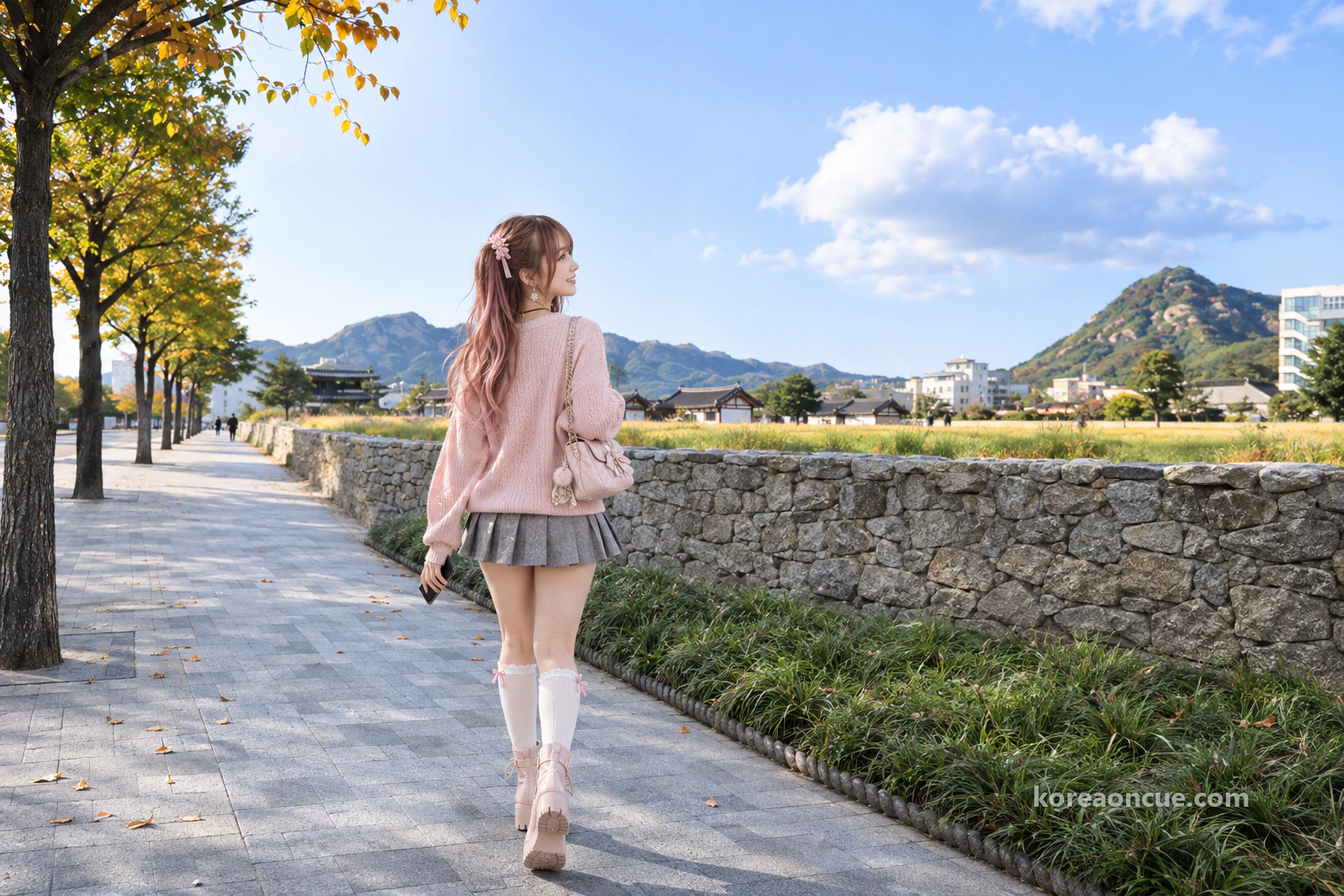
Hina has a reason for writing the exit number first. More than once, she has picked the wrong exit at a station near a venue and ended up running around just before a show. If you type only the plaza’s name into a map app, it sometimes points to somewhere in the middle of a big piece of land. So on a first visit, it helps to note “Anguk Station Exit 1” separately. Settle on one exit first, and after that all you need to find is the Seoul Museum of Craft Art.
What Open Songhyeon Green Plaza is: the old Songhyeon-dong site, opened in 2022
Open Songhyeon Green Plaza is a piece of land that stayed closed behind walls for a long time and opened to the public in 2022. The Seoul Metropolitan Government turned the 37,117 m² Songhyeon-dong site into “Open Songhyeon Green Plaza, with rest and culture”. It opened to the public on a temporary basis from 5.30 pm on 7 October 2022. Near the plaza entrance, Hina first reads the history of the land on her phone. Her habit of looking into a stage before a show kicks in here too.
This land has changed hands many times. In the Joseon period, it was a hill of pine forest that protected Gyeongbokgung Palace. Under Japanese colonial rule, housing for the Chosen Industrial Bank was built here. After Liberation, it was used as housing for the US military and for the US Embassy. Land that sat behind walls for so long only became a plaza anyone could walk into in the autumn of 2022.
When the plaza opened in 2022, the city lowered the 4 m stone wall around it to 1.2 m. A 10,000 m² lawn was laid out in the centre. In other words, land once closed behind walls was opened so that people could see in from outside. Hina writes the two numbers, 4 m and 1.2 m, side by side in the corner of her notepad. It is a habit from her show promotion work—checking the height of the stage.
The plaza’s future is in the city’s plans too. The Seoul Metropolitan Government plans to build Songhyeon Culture Park here, with completion targeted for 2029. On the east side of the site, the Lee Kun-hee Donation Museum (working name) will go up, planned as one space with the park. The museum is also due to have an observation deck looking down over Songhyeon Culture Park. Reading the plan, Hina decides to take in the lawn just as it is today, and keep it in her memory.
Using the numbered map: 1–4 along the lower edge, 5–7 on the yellow path, 8–15 at the top
One official map shows where the 15 award selections are. It is on the 2026 Seoul Sculpture Award selections page of the Sculpture City Seoul website. Save the image to your phone before you go, and finding the works on the wide lawn becomes much easier. Hina saved the screen at her accommodation too. Not having to load a map again while standing on the plaza saves a lot of hassle.

On the map, the numbers fall into three main groups. Numbers 1 to 4 sit along the path at the bottom of the map. Numbers 5 to 7 are on either side of the yellow path that crosses the middle. Numbers 8 to 15 are gathered on the lawn above it. A toilet is marked at the bottom-left corner of the map, so it is worth checking where it is before you start walking.
Following the numbers with her finger, Hina tilts her head. From 1 to 4, the route passes along the lower path from one end to the other. Number 5 is at the left end of the yellow path, but 6 and 7 are back near the right end. From 9 to 12, the line runs again from right to left, and 13 goes back up to the top right. Join the numbers with a line, and you get a zigzag that crosses the plaza several times.
Hina writes 1 to 15 down the page in her notepad and draws the zigzag beside them. Seeing the nearest works first would save steps, but Hina chooses the order of the numbers. “A setlist has to be heard in order,” she says to herself, and laughs before she can stop it. If you would rather save your legs, grouping the nearby works together is a good way too. Whichever way you choose to walk, keeping the map to hand means you will not miss a single work.
Numbers 1 to 4: four works along the lower path
Numbers 1 to 4 are four works in a row along the path at the bottom of the map. Number 1 is 「즐거운 날」 (A Joyful Day) by Ho Haeran, and number 2 is 「호흡하는 잎맥」 (Breathing Leaf Veins) by Kang Sinyeong. Number 3 is 「열린 손」 (Open Hand) by Cha Hyeonju, and number 4 is 「실바람처럼, 윤슬처럼」 (Like a Light Breeze, Like Glittering Ripples) by Lee Sanggil. They sit right by the path, so they are the first group you meet as soon as you enter the plaza. Hina draws a small star beside number 1 in her notepad and walks to the first work.
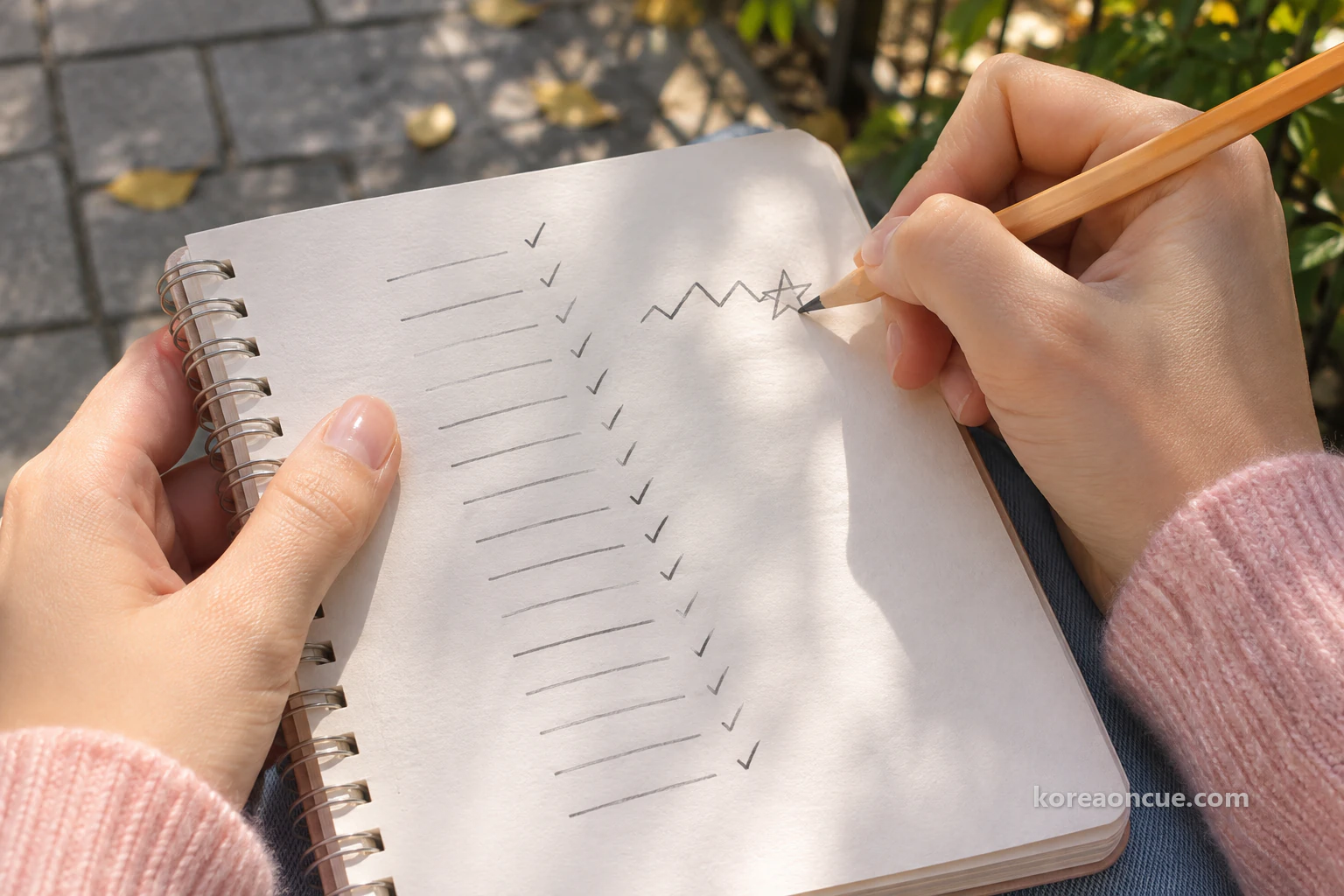
In front of each work, Hina first reads the title silently. Working in show promotion, she is always weighing how much a single name can stop people in their tracks. 「즐거운 날」, she thinks, is the perfect title for an opening song. It suits a Saturday like today, too. Hina walks slowly once around the work, then ticks the line for number 1.
Walking between numbers 2 and 3, Hina keeps looking back. The background behind each work changes with every step. In this exhibition, the lawn and the sky are the backdrop instead of white walls and lighting. Turn your head, and the hanok houses around Inwangsan and Bugaksan come into view, along with the city’s buildings. Depending on where you stand, the same work has a mountain behind it or a building.
At number 4, 「실바람처럼, 윤슬처럼」, Hina stops and narrows her eyes. What catches her first is that the title has wind in it, baram in Korean. The exhibition is called 「산들바람 타고」, “riding the breeze”, so she wonders whether other titles have wind in them too. In the corner of her notepad, Hina writes “wind 1”. And just like that, the day has one more small game.
Numbers 5 to 7: either side of the yellow path in the middle
Numbers 5 to 7 are on either side of the yellow path that crosses the middle of the plaza. Number 5 is 「단청 테트라포드」 (Dancheong Tetrapod) by Lee Hojun, at the left end of the yellow path. Number 6 is Data Drawing-Human by Shin Chihyeon, and number 7 is 「바람」 (Wind) by Bang Junho. Numbers 6 and 7 sit close to the right end of the yellow path. Getting from 4 to 5 is quick, but to get from 5 to 6, you have to walk the whole length of the yellow path.
Hina reads the title of number 5 and laughs out loud. “Dancheong and a tetrapod? That sounds like a collab merch name.” Putting the colours of Korean palace eaves and a seaside breakwater block into one title strikes her as wonderfully funny. It is a very Hina reaction, from someone who always picks up the product that joins two different worlds at a merch stand. Hina draws a heart beside the title.
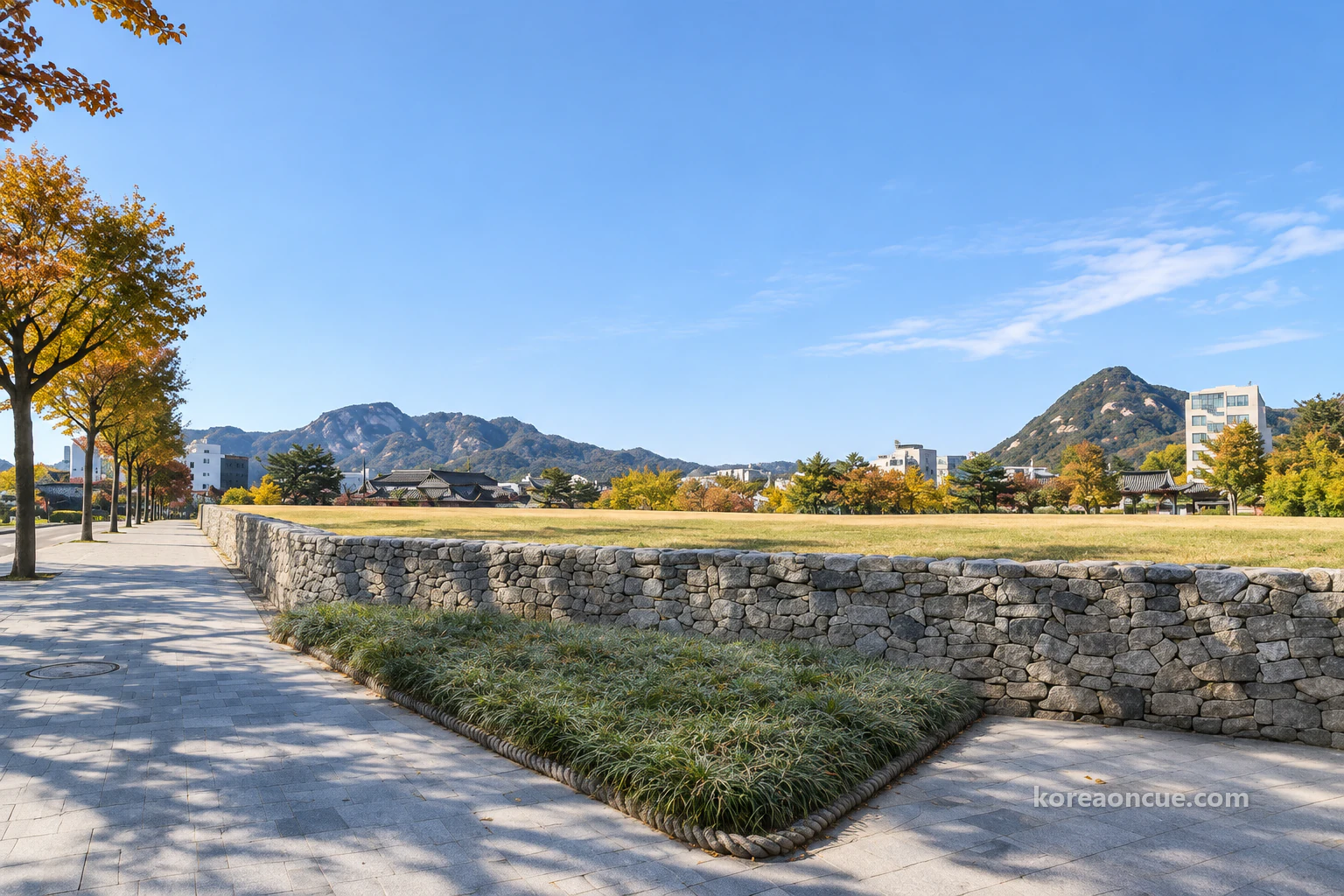
Walking the yellow path from 5 to 6, Hina looks again at the zigzag in her notepad. Just as on the map, this stretch crosses from one end of the path to the other. On a wide plaza, keeping to the order of the numbers makes the walk this long. In return, the whole plaza comes into view from the yellow path. Hina slows down and scans the next group, scattered over the lawn above, with her eyes first.
The title of number 7 is just one word, 「바람」, wind. Hina crosses out “wind 1” in the corner of her notepad and writes “wind 2”. The shorter a title, she thinks, the more room the viewer has to fill. On show posters, too, a one-word line is sometimes the one that stays longest. Hina walks once more around number 7, then moves on to number 8, just above.
Numbers 8 to 15: eight works on the upper lawn, four with “wind” in the title
Numbers 8 to 15 are eight works gathered on the lawn above the yellow path. Number 8 is 「보이지 않는 바람」 (Invisible Wind) by Kim Jiana. Number 9 is 「바람의 그림자를 안고 피다」 (Blooming with the Wind’s Shadow in Its Arms) by Debi Han, and number 10 is 「연결인식의 감각」 (A Sense of Connected Awareness) by Oh Yugyeong. Number 11 is 「침묵의 주파수」 (The Frequency of Silence) by Kim Eunsuk, and number 12 is 「설레임」 (Flutter) by Kim Jaeho. On the map, numbers 9 to 12 stand in a row from right to left.
Passing numbers 8 and 9, the count in the corner of Hina’s notepad soon reaches “wind 4”. Of the 15 award selections, four have wind in the title: numbers 4, 7, 8 and 9. The breeze in the exhibition’s name has blown into the titles of the works as well. Hina raises her eyebrows in surprise and joins the four wind numbers with circles. Save the list of titles before you go, and you can have fun finding hidden links like this too.

Hina stands in front of number 12, 「설레임」, for a long time. Asked to choose one word for the feeling on the morning of a show, she would probably choose this one, the flutter of looking forward to something. Hina walks slowly once around the work. Then she stops in one spot and quietly takes a breath. It feels as if she has taken out, a little early, the feeling she will have before she sits down in the audience tonight.
To get from 12 to 13, you have to cross back to the upper right. Number 13 is 「피톤치드」 (Phytoncide) by Kim Jinu, and number 14 is 「머무는 사이」 (While We Stay) by Nam Jeonggeun. The last, number 15, is 「매그놀리아 연리지」 (Magnolia, Two Trees Grown as One) by Lim Gwanghyeok. Numbers 13 to 15 are grouped at the upper right of the map, so after number 12, head back to the right and you meet them in turn. Hina ticks the line for number 15 and holds her notepad tight against her chest.
With the main setlist over, Hina opens her notepad again at the edge of the lawn. Every one of the fifteen lines has a tick. The zigzag was longer than she expected, but because she skipped no numbers, she missed no works at all. Hina checks the toilet mark at the bottom left of the map once more and pops over there for a moment. It is time to catch her breath before the encore.
What the Seoul Sculpture Award is: created by the city in 2024, with a new Citizens’ Award this year
The 15 numbered works are all selections for the 2026 Seoul Sculpture Award. The Seoul Sculpture Award was created by the Seoul Metropolitan Government in 2024. The 15 selected artists are Kang Sinyeong, Kim Eunsuk, Kim Jaeho, Kim Jiana, Kim Jinu, Nam Jeonggeun, Debi Han, Bang Junho, Shin Chihyeon, Oh Yugyeong, Lee Sanggil, Lee Hojun, Lim Gwanghyeok, Cha Hyeonju and Ho Haeran. The official list of names is in Korean alphabetical order, which differs from the numbers on the map. So when you are looking for a work, the map numbers are quicker than the list of names.
This year, something new has been added to the Seoul Sculpture Award. From this year, the city buys the grand prize work, to give artists more support. A Citizens’ Award, chosen by visitors’ votes, has also been introduced for the first time this year. Reading this, Hina’s eyes light up. Just as fans each pick their favourite song of the night after a show, this is an award where visitors choose a work themselves.

At the very bottom of her notepad, Hina makes a separate box called “My Citizens’ Award”. She narrows it down to three: number 5, 「단청 테트라포드」, which felt like collab merch, number 7, the one-word 「바람」, and number 12, 「설레임」, which felt like the morning of a show. After a long think with the end of her pencil against her lips, Hina finally circles number 12. It is the title that has stayed with her longest today.
The invitational exhibition of 11 senior sculptors: 「흐름과 기억, 존재의 서사」
The second strand, the one without numbers, is the invitational exhibition of 11 senior sculptors. It is called 「흐름과 기억, 존재의 서사」 (Flow and Memory, a Narrative of Being). It was curated by Lee Huchang, art director of Sculpture City Seoul, who leads the project to turn the whole of Seoul into a museum without a roof. For Hina, this exhibition is the encore of today’s setlist.
This invitational brings together, outdoors, works by senior sculptors who have led the history and spirit of Korean contemporary sculpture. Its curatorial idea is that we need to go back to the fundamentals. The 11 artists are Ko Jeongsu, Kim Yeongwon, Bae Hyeonggyeong, Shin Eunsuk, Shim Jeongsu, Ahn Byeongcheol, Won Injong, Lee Yongdeok, Lee Jeongja, Jeong Bowon and Jeong Hyeon. If the award selections are works newly chosen this year, the invitational is the place for artists who have worked for a long time. The fun of this exhibition is seeing two generations together on one lawn.
The invitational has no numbered map, so Hina copies the list of artists and titles into her notepad. Titles follow one another: 「오! 내 새끼들!」 (Oh! My Little Ones!) by Ko Jeongsu, 「하늘나비」 (Sky Butterfly) by Lee Yongdeok, 「하늘구름」 (Sky Cloud) by Won Injong. The list also has 「나는…」 (I Am…) by Bae Hyeonggyeong, 「그림자의 그림자 08-5」 (Shadow of a Shadow 08-5) by Kim Yeongwon, 「시간여행자-무시무종」 (Time Traveller – Without Beginning or End) by Shin Eunsuk, 「무제」 (Untitled) by Jeong Hyeon, 「생명-기원 II」 (Life – Origin II) by Ahn Byeongcheol and 「소망」 (Wish) by Lee Jeongja. This time, instead of numbers, Hina ticks the names as she goes round the lawn once more.

Reading down the list, Hina’s finger stops dead on one line. It is 「소리의 움직임 시리즈 S1 (BTS 음악을 듣고)」 (Movement of Sound Series S1 (Listening to BTS’s Music)) by Jeong Bowon. For Hina, who comes to Seoul for K-pop shows, meeting a group’s name inside a sculpture title is a lovely surprise gift. “I never expected to see that name here,” she says, wrapping both hands around her phone. A sculpture made after listening to music — it feels as if tonight’s show and today’s walk join up in one line.
Last of all, Hina slows down at 「가을 바람」 (Autumn Wind) by Shim Jeongsu. This time the count in the corner of her notepad becomes “wind 5”. The four winds of the award selections now have one autumn wind from the invitational added. Meeting this title on a late-autumn Saturday feels to Hina like perfect timing. Beside 「가을 바람」, she writes today’s date in small figures.
When and how to see it: in bright daylight, with the mountains and hanok behind the works
This exhibition is best seen in bright daylight, when you can take in the works and their backdrop together. The backdrop is not a white wall but the lawn, the sky and the view towards Inwangsan and Bugaksan. The works range from 2 m to as much as 5 m in height. With a large work, you cannot see the top well if you stand right up against it, so step back a few paces and walk once around it. You will soon see where a mountain sits behind it and where a building does.
If you are taking photos, try two backdrops or so for each work. Take one with the mountains and hanok roofs behind, and another with the city’s buildings behind. Hina photographs the plaza in two framings, one taking in the mountains and hanok roofs, the other the city’s buildings. Putting the two side by side, as she does when choosing a draft for a show poster, makes the choice easy. Just make sure other visitors are not kept waiting long, and step aside once you have your shot.
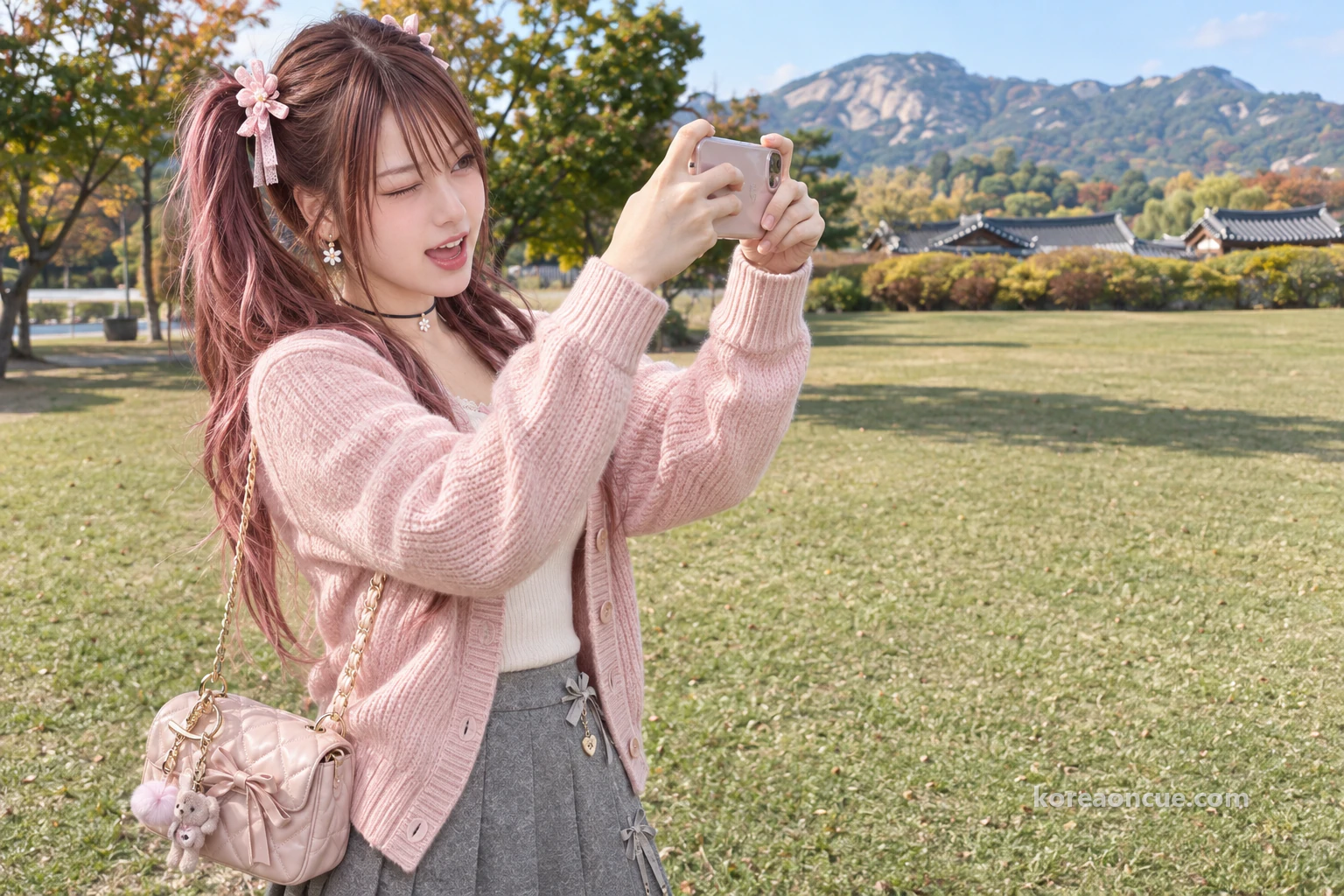
There are a few things worth having ready before you walk. Save the map image and the lists of titles for the award selections and the invitational to your phone in advance. On a wide lawn, you end up opening your screen often as you move between works. The toilet is marked at the bottom-left corner of the map. If you plan to see both strands, arrive in the morning or early afternoon and take your time.
Back to Anguk Station Exit 1: a zigzag setlist sent to Noah
As the afternoon light begins to slant, Hina closes her notepad and walks towards Anguk Station. Walking along the stone wall, she looks back once. Beyond the works on the lawn, the ridgeline, the hanok roofs and the city’s buildings sit in a slightly different light from the morning. The outdoor sculpture exhibition runs until Monday, two days from now. Thinking that she has played the whole setlist on the last Saturday before it closes, Hina smiles to herself.

Hina takes a photo of one page of her notepad and sends it to Noah. It is the page with the numbers 1 to 15 written down the side and the zigzag that crosses the plaza again and again. Her message is a single line: “Today the numbers were my setlist. I went in order, and this is what the line looks like.” Over time, Noah has sent her several maps with times written on them. Today it is Hina’s turn to send a map with numbers on it.

Noah’s reply arrives before she reaches the station entrance. “None of the maps I’ve drawn has had this many turns.” Looking down at her screen, Hina bursts out laughing. It is true that keeping to the numbers gave her a lot of turns. Hina checks the show time at the bottom of her notepad once more, and goes down the steps of Anguk Station Exit 1 with a light step.
Common Mistakes
Thinking you can still see it in December
the outdoor sculpture exhibition runs until Monday 30 November 2026.
Going for the festival shows or events
the festival programme, such as the opening ceremony, busking and the open-air cinema, ran from 29 August to 4 September. What is on now is the sculpture exhibition on the lawn.
Walking onto the wide lawn without the map
the 15 award selections are easy to find by the numbers on the official map. Save the image from the award selections page of the Sculpture City Seoul website before you go.
Assuming consecutive numbers sit close together
walk in number order and you cross the plaza several times. To save steps, group them as 1–4, 5–7 and 8–15.
Only looking at large works up close
step back a few paces and walk around them, and you see the mountains and hanok behind them too.
FAQ
Which station and exit should I use?
Come out of Anguk Station (Line 3) Exit 1 and head for the plaza. Open Songhyeon Green Plaza is right next to the Seoul Museum of Craft Art.
How long does it run?
The outdoor sculpture exhibition runs from Saturday 29 August to Monday 30 November 2026.
Do I have to pay?
No. Entry is free.
What works are there?
The 15 selections for the 2026 Seoul Sculpture Award (numbers 1–15), together with 「흐름과 기억, 존재의 서사」 (Flow and Memory, a Narrative of Being), the invitational exhibition of 11 senior sculptors.
How do I find where the works are?
There is a numbered map on the 2026 Seoul Sculpture Award selections page of the Sculpture City Seoul website. Numbers 1–4 are along the lower path, 5–7 on the yellow path in the middle, and 8–15 on the upper lawn.
Is there a toilet?
A toilet is marked at the bottom-left corner of the official map.
Recap — 30 seconds before you go
- Anguk Station (Line 3) Exit 1 → Open Songhyeon Green Plaza (around 48-9 Songhyeon-dong, Jongno-gu, next to the Seoul Museum of Craft Art).
- Outdoor sculpture exhibition Sat 29 August–Mon 30 November 2026 · free entry.
- The festival programme (opening ceremony, busking and more) ended on 4 September.
- What to see: the 15 Seoul Sculpture Award selections (numbered map) · the invitational of 11 senior sculptors, 「흐름과 기억, 존재의 서사」.
- Save the map and the lists of titles in advance · the toilet is at the bottom left of the map.
Sources
- Sculpture City Seoul — about the Seoul Sculpture FestivalThe 3rd Seoul Sculpture Festival · hosted and organised by the Seoul Metropolitan Government · exhibition 29 Aug – 30 Nov 2026 · venue Open Songhyeon Green Plazachecked 2026-11-03
- Sculpture City Seoul — Art Director’s invitational show “Flow and Memory, a Narrative of Being”An invitational show of 11 senior sculptors · curated by Lee Huchang, art director of Sculpture City Seoulchecked 2026-11-03
- Sculpture City Seoul — 2026 Seoul Sculpture Award selected works, “City of Art, Riding the Breeze”15 selected artists · numbers 1–15 and artists’ names on the official map · a toilet marked on the mapchecked 2026-11-03
- Seoul Media Hub — “A museum on the lawn! The free outdoor sculpture show in the city, the Seoul Sculpture Festival” (1 Sep 2026)Outdoor sculpture exhibition 29 Aug – 30 Nov 2026 · free admission · about 300 m on foot from Anguk Station (Line 3) Exit 1 · citizens’ prize voting by QR codechecked 2026-11-03
- Seoul Media Hub — “Sculpture in a plaza outside the museum, the Seoul Sculpture Festival” (4 Sep 2026)Grass and sky, with hanok and city buildings around Inwangsan and Bugaksan as the backdrop to the works · a citizens’ prize newly introduced this yearchecked 2026-11-03
- Seoul Media Hub — “The Songhyeon-dong site opens after 100 years as a green plaza” (6 Oct 2022)Temporary opening of the 37,117 sq m Songhyeon-dong site · a Japanese-colonial-era Siksan Bank residence, then US military housing and US embassy housing after liberationchecked 2026-11-03
- Seoul Metropolitan Government press release — outline of Songhyeon Cultural Park completed (1 Mar 2026)Construction to start in 2026, completion targeted for 2029 · an integrated spatial plan with the planned Lee Kun-hee Donation Hallchecked 2026-11-03
A Seoul story told with our AI characters. Place details are checked against public sources; the photos are AI-made illustrative images. How we use AI
More from this area
Kyung-In Museum: galleries till 6, tea till 9 p.m.
Elena, who writes her scene directions in square brackets, has picked as her stage this time a museum where the curtain changes every Wednesday.
Museum Kimchikan: finding the Insadong Maru entrance
Rina had been writing down every kimchi she was served as “the red one” and nothing more, so she went to Museum Kimchikan to fill in the names.