
SEOUL · DONGDAEMUN
Ethan saw out the full “about 10 minutes” while Lulu watched the ramen: a Friday evening of cook-it-yourself tteokbokki in Sindang-dong
About 3 minutes on foot from Exit 8 of Sindang Station on Line 6 · the closed Mondays differ from shop to shop · one shop’s signature set starts at two people · about 10 minutes on high heat, turn it down once the ramen is fairly well cooked, and finish with the egg
Ethan’s plan to go alone ran straight into three small words: two or more. On a Friday evening in Sindang-dong, with Lulu summoned as the required second person, the one watching the clock and the one watching the pan argue over when to turn down the heat.
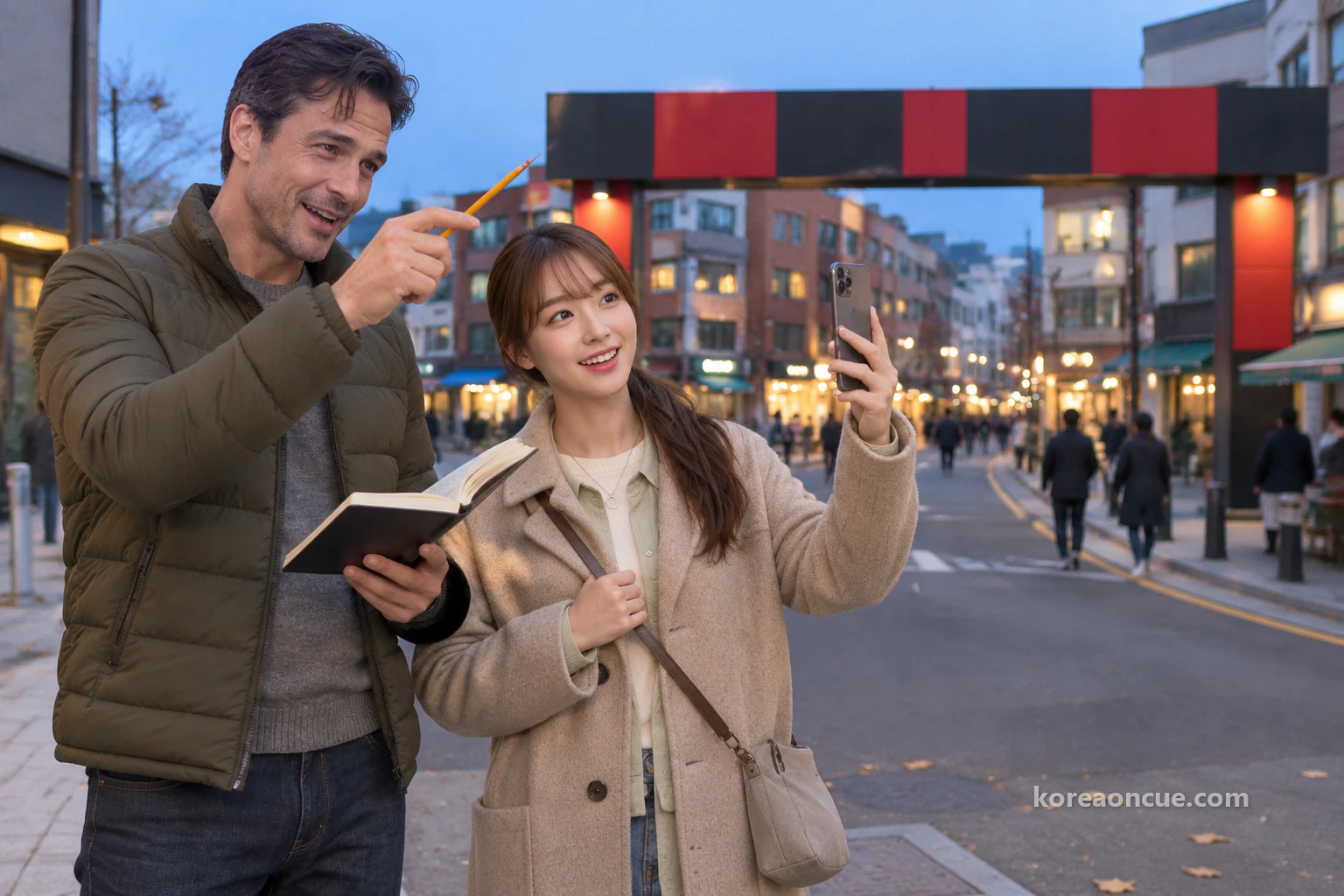
How to get there
On Thursday night, back at his hotel after measuring up Dongmyo Flea Market, Ethan wrote one line on a fresh page of his notebook: “Sindang-dong tteokbokki — Monday lunch — 1 person.” Ethan is a 44-year-old engineer who designs machines in Seattle, and he is the sort of person who converts everything into a different unit. He had lived in Seoul for six years, yet for some reason he had kept putting off the home of cook-it-yourself tteokbokki. His flight home left on Monday evening, so this looked like an ideal last lunch.

Five minutes into reading up on it, the plan was stuck in two places. The first problem was “1 person”. The signature dish at the shop that started this street comes as a set for two, three or four, and it can only be ordered by two or more. The second was “Monday”: the closed Mondays differ from shop to shop, so he would first have to work out which Monday of the month it was. Two of the three boxes on his line were wrong, so Ethan put down his pencil and scratched his beard.
He picked up his phone and sent Lulu a message. “There is a dish that can only be ordered by two. I am seeking a second person.” The answer came in under a minute. “Friday at seven, I’ll film, and we’re skipping Mondays because counting them is a pain.” Lulu is twenty, was born and raised in Seoul, and introduces neighbourhoods and markets in short videos. The two first met at Mangwon Market and walked Garak Market together, which makes them “market buddies”, and they are still polite with each other in Korean.
Today’s story is that Friday evening at Sindang-dong Tteokbokki Town, a street of tteokbokki shops close to Sindang Station in Jung-gu, Seoul. Following the two of them, we’ll work out whether you can eat alone, whether it is open on Mondays, which exit to use and what to do once the pan arrives. Ethan watches the clock, and Lulu watches her screen. You’ll soon see why, in front of the same pan, they ended up saying completely different things.
The Cue — At a glance
Yes, some shops are open on Mondays. But the closed Mondays differ from shop to shop, so the answer depends on where you go. If you are on your own, you can’t order the signature set at the shop that started the street, so bringing one friend is the surest plan. When the pan arrives, don’t just watch the clock: watch the ramen as well.
- Station and exit: About 3 minutes on foot from Exit 8 of Sindang Station on Line 6 to 5 Dasan-ro 35-gil. If you come on Line 2, head for Exit 8 inside the station. Cheonggu Station Exit 1 is close too.
- Address for your map: 5 Dasan-ro 35-gil · further in, the area around 50 Toegye-ro 76-gil.
- Opening hours: There are no hours for the Town as a whole. Each shop’s hours and closed Mondays are together in the Monday table below.
- By car: The shop we call “the set place” below offers valet parking.
- Wheelchairs: Before you pick a date, look at the accessibility table first.
Can you eat tteokbokki alone in Sindang-dong? The set place starts at two
If you go alone, you can’t order the signature set at the shop that started this street. The cook-it-yourself tteokbokki comes as a set for two, three or four, and it can only be ordered by two or more. Rather than shop names, this piece calls each place by what you go there for. This one is “the set place”. Tteokbokki shops gathered around it until they became a street, so if it is your first target, coming as a pair is the surest way.
Open in Kakao Map — Sindang Station
If you are travelling alone, you have two options. One is to find someone where you are staying or at a meet-up to go with you. The other is to ask “한 명도 되나요?” (“Is one person OK?”) first, at the door of the two other shops coming up. That one short sentence gets you an answer before you sit down, so say it as you open the door. Ethan took the first option, because even a business traveller well used to eating alone needed one friend in front of a two-person set.
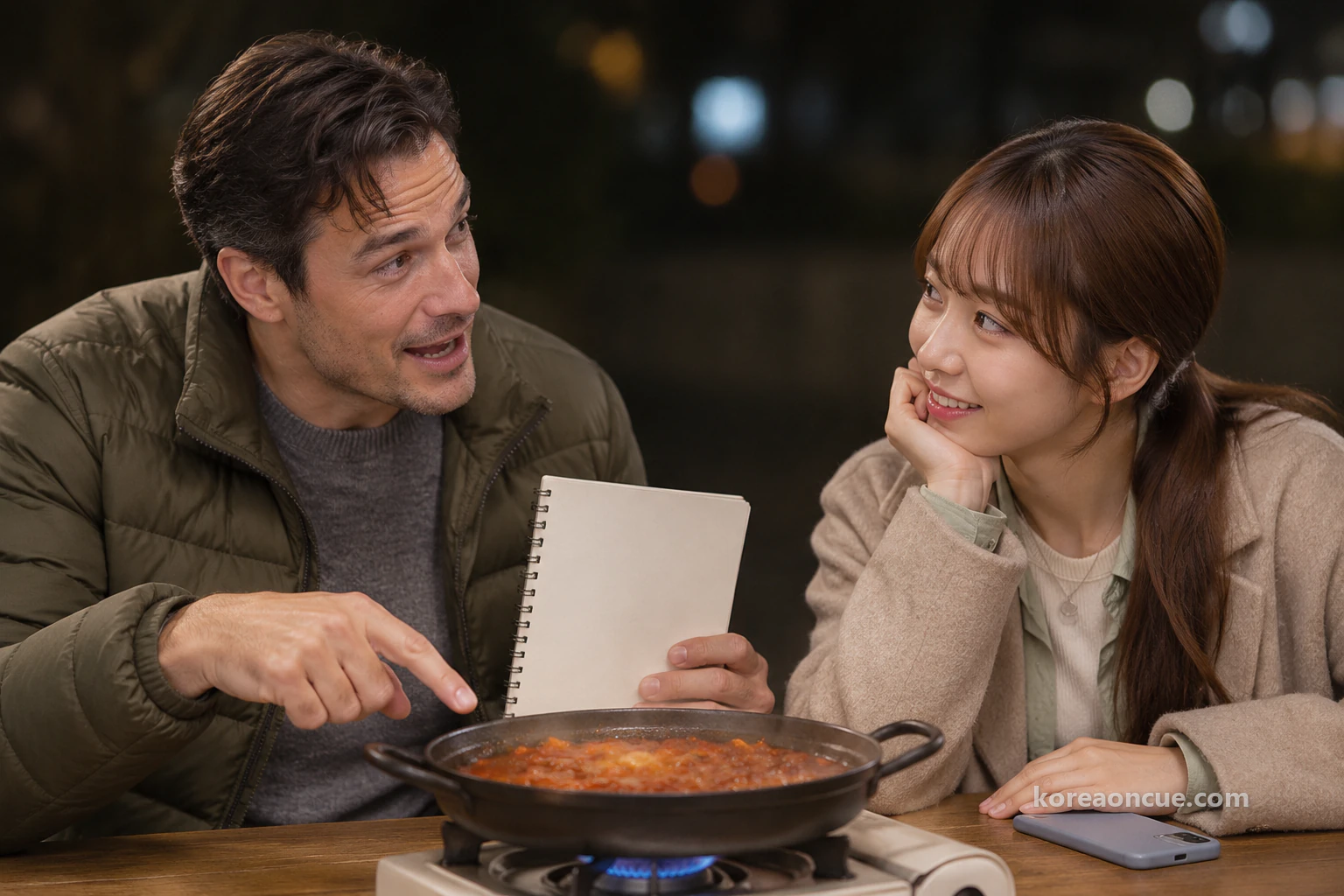
Ethan actually rather liked this rule. Everything in the world has a minimum order quantity, and here the unit happened to be a person. He struck through “1 person” in his notebook and corrected it to “Minimum unit = 2”. Later that night he sent Lulu one more joke. “I am 193 cm, so by height I should count as about 1.2 servings.” Lulu’s reply was quick again. “Height isn’t on the menu.”
There is one more advantage to coming as a pair. Cook-it-yourself tteokbokki isn’t something the kitchen boils and brings out — you boil it yourself at the table. While one person minds the heat, the other can sort out the bowls or take photos. Ethan and Lulu divided up the jobs by message before they even met, and his notebook gained the line “Heat: Ethan. Screen: Lulu.” Why that tidy division of labour wobbled is something we’ll come to in front of the pan.

Is Sindang-dong Tteokbokki Town open on Mondays? The closed Mondays differ from shop to shop
Yes, some shops are open on Mondays. But the Town doesn’t open and close at one set time, so there is no one-line answer to “How late is it open?” This piece follows three shops. Besides the set place, there is “the stage place”, with live performances at night, and “the jjajang place”, which serves jjajang tteokbokki. If you are coming on a Monday, start with the far-right column of the table below.
| Which shop | Hours | Closed Mondays |
|---|---|---|
| The set place | 09:00–22:50 | 2nd and 4th Mondays |
| The stage place | 24 hours | 1st and 3rd Mondays |
| The jjajang place | 24 hours, every day | Open on Mondays too |
Read down the right-hand column and something fun appears. From the first Monday to the fourth, the closed days of the set place and the stage place never overlap. On those four Mondays, whenever one of the two is shut, the other is open. On Thursday night Ethan drew four Monday boxes in his notebook and shaded the two shops in turn, and seeing the boxes fall out of step like a chessboard put him in a good mood for no real reason.
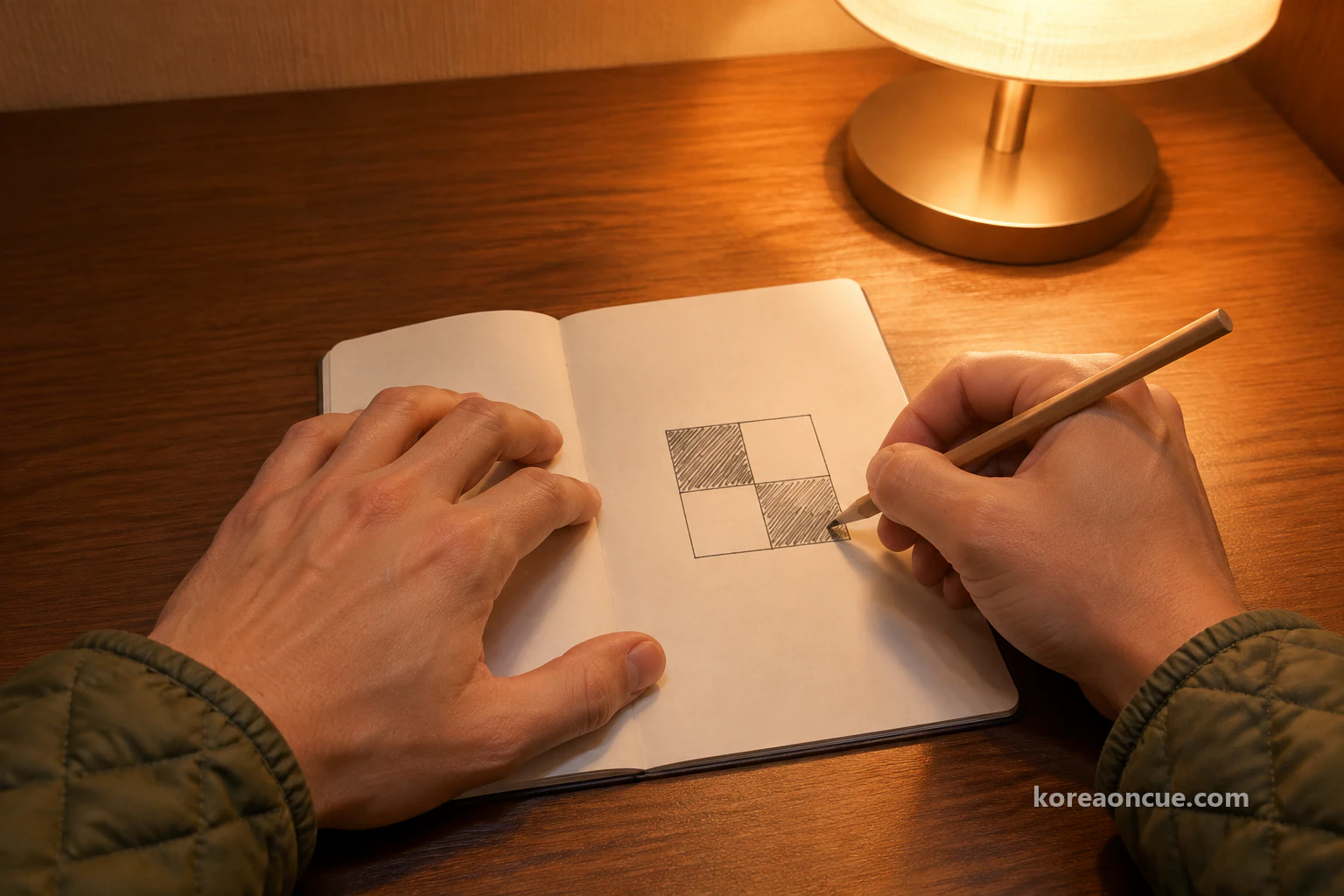
If you are going on a Monday, you have just one job. Count which Monday of the month it is on the calendar, then hold that up against the right-hand column of the table. If counting sounds like a chore, go to the jjajang place, and leaving out Mondays altogether, as Lulu did, is a fine option too. When Ethan sent her a photo of his chessboard, her reply was a single line. “Lovely boxes, but I’m still saying Friday.”
All the closed days in the table are Mondays, so moving to another day of the week makes the counting disappear altogether. If your itinerary has room, the simplest thing is to fit this street in between Tuesday and Sunday. Ethan had one more reason to move to Friday. A Monday lunch would come right before an evening flight, so he’d be eating with his luggage on his mind. As the line in his notebook changed to “Friday 19:00 — 2 people”, the two wrong boxes were fixed in one go, thanks to one friend.
Which exit do I use? About 3 minutes on foot from Exit 8 of Sindang Station on Line 6
Sindang-dong Tteokbokki Town is about 3 minutes on foot from Exit 8 of Sindang Station on Line 6. That is exactly the walk to 5 Dasan-ro 35-gil, the set place’s address. If you come on Line 2, there is no need to change trains: just head for Exit 8 inside the station. Cheonggu Station Exit 1 is close too, so if that line suits your hotel better, getting off at Cheonggu is fine. Once you reach street level, put the address into your map app and start walking.
Ethan stopped dead at this “about 3 minutes”. It was the figure his map app had shown him, and he is someone who can’t leave a number alone when it has the word “about” attached. On Friday evening, the moment they met by the ticket gates, he opened his notebook and held it out to Lulu. On the page was a formula: “About 3 min = 180 s ± 30 s.” Lulu took one look and burst out laughing. “Ethan, nobody measures the margin of error on the way to tteokbokki.”
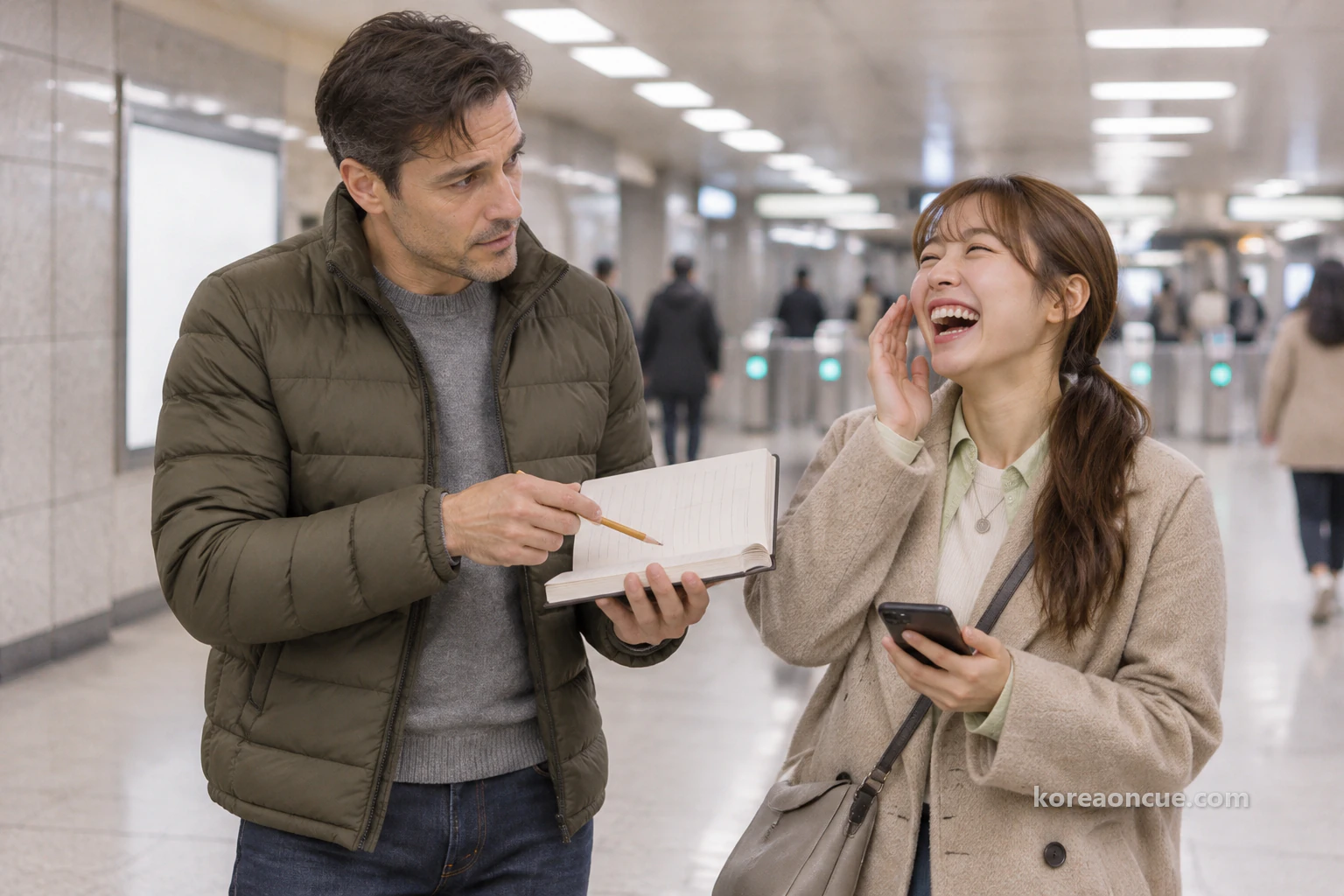
Even so, Ethan didn’t rub the formula out. In his view, a walk looks shorter as long as there is at least one value in it you can measure. The street is close to the station, so the walk isn’t much of a burden even on an evening with a cold wind. Still, copy the address before you come through the ticket gates. Stand at street level holding your phone for too long at the end of November, and your hands will be the first to feel it.
Where is the entrance to the Town? One arch and two addresses
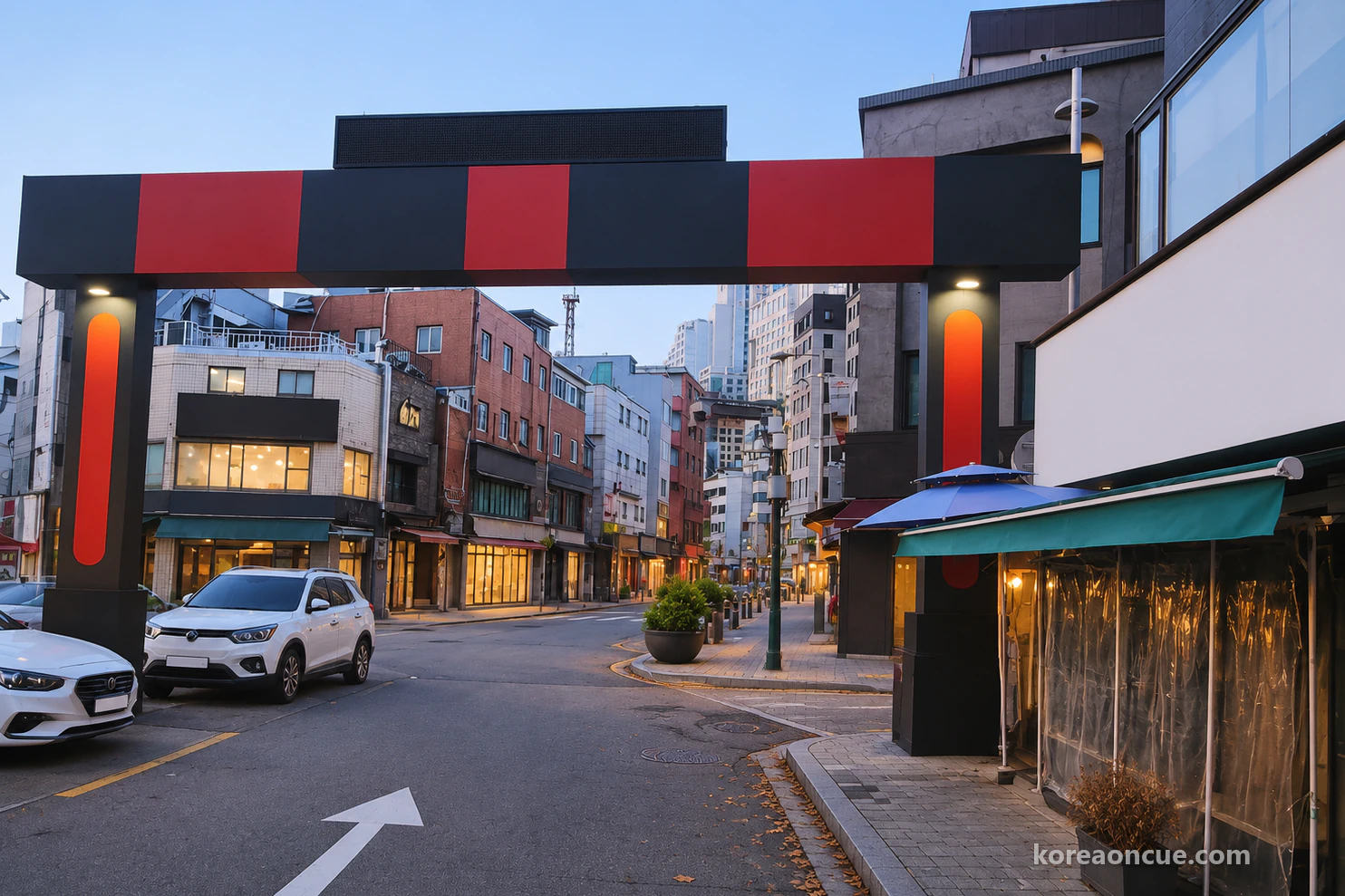
The Town’s entrance marker is a large arch across the road. It carries the Korean 신당동 떡볶이 먹거리 상점가 together with the English “SIN DANG FOOD STREET”. Red panels alternate on a black background and a pillar stands on each side, so it is easy to spot from a distance. In front of the arch, on the right, you’ll see a big white sign. When this arch is standing in front of you, you’ve come to the right place.
The street’s addresses split two ways. The set place is at 5 Dasan-ro 35-gil, while the stage place and the jjajang place are both listed at 50 Toegye-ro 76-gil. The address for the street as a whole is “the area around 50 Toegye-ro 76-gil”. An address with “the area around” in it doesn’t stop at a single dot on the map. That’s why first-timers who rely on the Town’s name alone can easily end up wandering about in search of the arch.
What Ethan had written in his notebook was also 50 Toegye-ro 76-gil. He had read the words “the area around” as something like a margin of error and moved on. A few steps from the exit, Lulu glanced at her screen and stopped walking. “The first shot is the arch. Let’s use an address without ‘the area around’ in it.” They changed the destination on the map to 5 Dasan-ro 35-gil, and with a clean number on the screen, Ethan’s face relaxed a little.
It helps to choose your address by what you’re after. If you are heading for the set place, or coming for the first time, put in 5 Dasan-ro 35-gil. If you are going straight to the stage place or the jjajang place, put in 50 Toegye-ro 76-gil. Those two shops are listed at the same address, so take a look around when you reach it. When the arch rose in front of him, Ethan drew a small circle beside his formula, marked the arch as the origin, and drew the two addresses as two arrows.
Which shop should you go into? Choose by what you want to eat
Deciding which shop to go into is easy if you start from what you want to eat. The three shops sell quite different things, so on the same street the evening takes a different shape. Find what you’re in the mood for in the left column of the table and read across. If there are two or more of you and it is your first time, start with the top row, and if you are three or four, choose a three- or four-person set to match.
| If you… | Go to | Why |
|---|---|---|
| Want to try the start of cook-it-yourself tteokbokki | The set place | Sauce of gochujang mixed with chunjang, sets for 2, 3 or 4 |
| Fancy jjajang or seafood tteokbokki | The jjajang place | There are spicy chicken feet too |
| Are curious about fried rice and live performances | The stage place | A big shop with fried rice and a stage |
Under the arch, Ethan wrote the three shops in his notebook, put one word beside each (sauce, menu, stage) and tried to work out which one was the variable. If sauce was the choice it meant the set place, and since you can add all sorts of extras as it boils, he reckoned the same sauce would differ from pan to pan. Choose the stage and dinner would be pushed later — choose the menu and his reason for calling a friend over a two-person set would grow weaker. While he took the variables up to three, the cold wind crept little by little into his padded sleeves, and Lulu, waiting beside him with her phone, began to stamp her feet.
Lulu’s answer was far quicker. “The first time, you go to the place that started it, or nothing after that makes sense.” Lulu believes a video only means anything if you watch it in order from the start. And since Ethan had called her out because of a two-person set, going elsewhere now would remove the reason she had come, which was fair enough. Ethan lowered his pencil and nodded. With their backs to the cold wind, they walked into the street.

Can I go late at night? After 22:50, head for the two 24-hour shops
If it is getting on for 11 p.m., skip the set place and go to the two 24-hour shops. “Sindang-dong is open all night” is a story about those two, not the whole street. The set place’s day ends at the 22:50 you saw in the table, and for the stage place you only need to avoid its closed Mondays. If you are coming after a late show or a long shift, sort this difference out first. To someone who watches the clock, an evening on this street ends in a different place at each shop.
Ethan liked the figure 22:50. It is 23:00 with ten minutes taken off, he said, so you can see to the minute where the shop’s day ends. Live performances at the stage place happen every day at 7, 9 and 11 p.m., and at 1 and 3 a.m. Ethan measured the gaps between the five times and wrote “120-minute intervals, 5 per night”. If you want to see a performance, arrive around these times and you’ll wait less, and on a day when you reach Seoul late at night, these two shops mean you needn’t give up on dinner.

How do you eat cook-it-yourself tteokbokki? It all comes down to when you turn down the heat
With this kind of tteokbokki, you become the cook the moment the pan arrives. Sindang-dong is where this way of boiling it yourself at the table began. There is exactly one place where first-timers get stuck, and that is when to turn down the heat. There are only three steps, so take a look at the table before you sit down. If there are two of you, decide who is minding the heat as soon as you are seated, and your hands won’t get in each other’s way.
| When | What to do |
|---|---|
| When the pan arrives | Boil on high heat for about 10 minutes |
| When the ramen is fairly well cooked | Turn down to low heat and eat as it reduces |
| When the sauce has cooked down | Break a boiled egg finely and mix it in |
When the pan arrived, Ethan looked first at the second hand of his watch. In the pan were rice cakes, flat fish cakes, fried fish cakes, ramen, glass noodles, spring onions and onions. Lulu asked the shop first whether she could film, and agreed to show only the pan and hands, not faces. As Ethan turned the heat up high and said “Starting. 0 minutes, 0 seconds,” Lulu raised her phone over the pan. “I’m using that as a caption.”
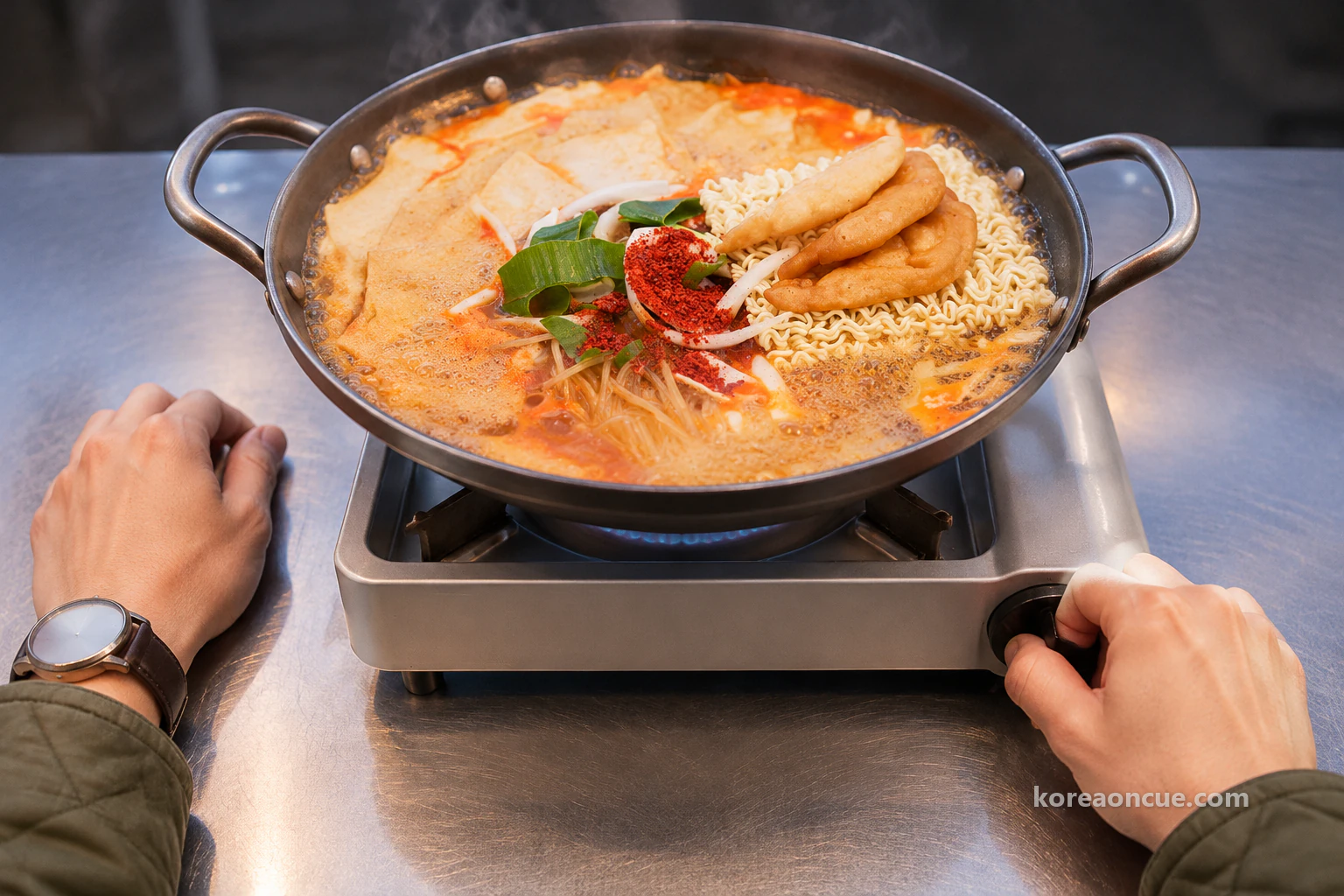
After about 8 minutes the sauce was bubbling up and the ramen had started to loosen. Lulu lifted a strand with her chopsticks to show him. “Ethan, I think you could turn it down now.” Ethan didn’t take his eyes off his watch. “Two minutes left. The guide says 10 minutes.” Lulu opened the guide on her phone again and read it out. “It says ‘about’ 10 minutes, and earlier you put a ± on about 3 minutes.”
Ethan shook his head. “‘About’ is not a unit.” And so he saw out the full 10 minutes. In that time the sauce shrank noticeably, and the sound coming from the bottom of the pan changed. When he turned down the heat and put in a spoon, a few rice cakes had stuck to the bottom. While Ethan scraped them off with a sheepish look, Lulu silently filmed that too.

Both answers had been in the table all along. The high heat is for “about” 10 minutes, and you turn it down when the ramen is “fairly well” cooked. So keep the clock in the region of 10 minutes while your eyes stay on the ramen as well. It is easier still if one person has the clock and the other has the pan. Ethan added “about + ramen” after the “10 minutes” in his notebook, then wrote a small addition to the rule that the heat was his: “Lulu watches the ramen.”
Once you have turned down the heat, you start eating. This is food you eat as it reduces, so the pan keeps changing while you eat. Lulu served the ramen into Ethan’s bowl first and said, “Ramen first. I told you I decide the order.” Ethan took a mouthful and said nothing for a moment. Then he noted the way the deep flavour of the chunjang followed the heat of the gochujang as “Heat + depth, a two-storey structure”.
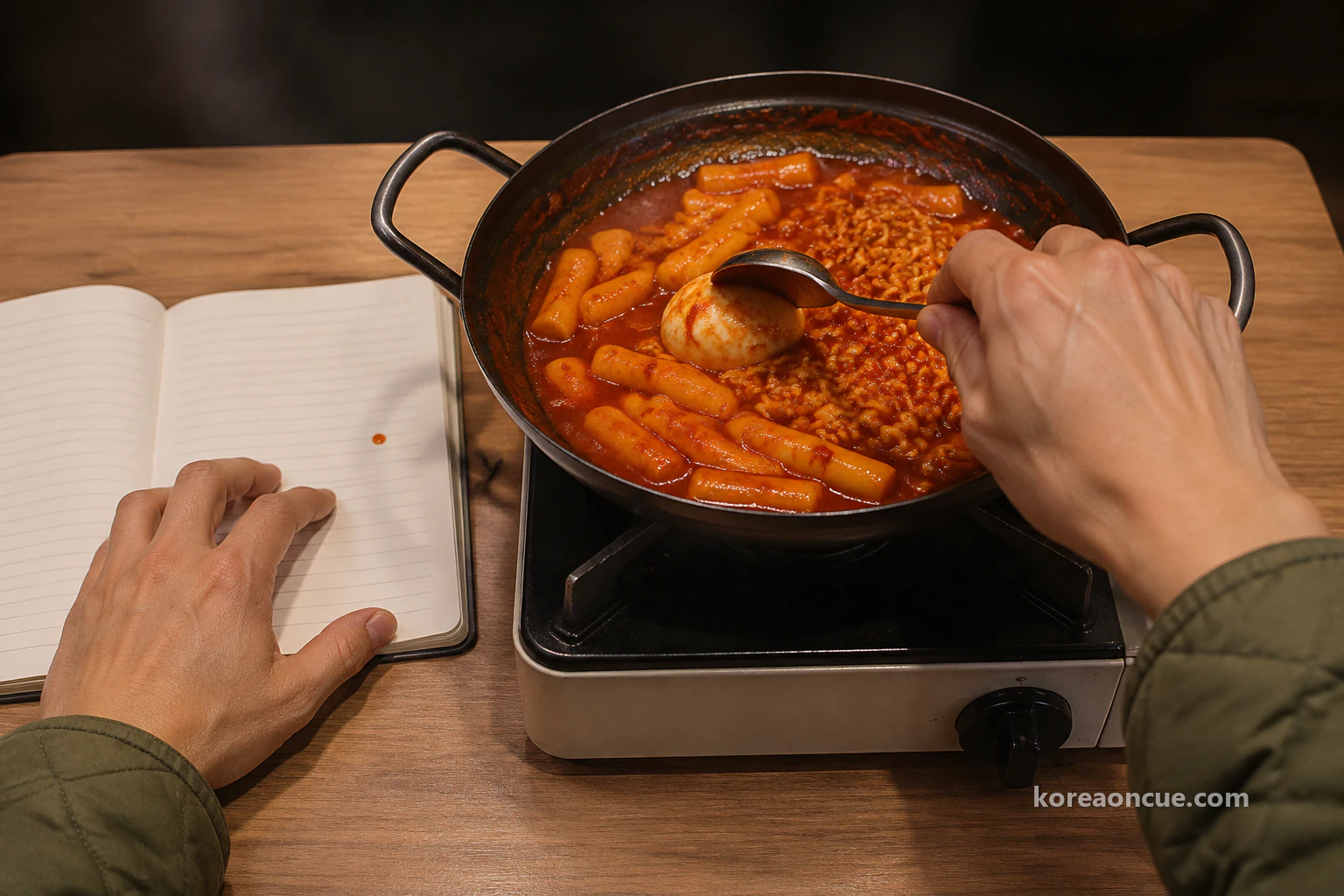
When the sauce has gone down enough to lie low across the bottom of the pan, it is the boiled egg’s turn. At the table, that is what “cooked down” looks like. Don’t eat the egg as it is: break it finely and mix it into the remaining sauce. Spoon in hand, Ethan asked another question. “‘Finely’ would be about how many millimetres?” Once again Lulu didn’t look up. “I’ll decide that.”
Ethan’s spoon slipped as he pressed down on the egg, and a drop of sauce flew out. It landed, of all places, on the “10 minutes” line of his open notebook, as a red dot. He picked up a napkin, put it down again, and in small letters beside the dot wrote “Measured data”. It was the first stain the notebook had ever had. If you plan to keep a notebook open while you eat, leave it a hand’s width from the pan.
If you are coming to film food, feel free to borrow Lulu’s habits. Ask the shop before you take out your phone, and keep the frame on the pan so the faces of people at the next table don’t get in. When the steam is rising, film from an angle rather than straight above the pan, and the lens fogs up less. Moving shots such as a hand turning down the heat go better if you call them out first, and then one take is enough. Ethan’s habit of saying the time aloud that day turned out to be rather useful to Lulu as well.
Why did Sindang-dong become a tteokbokki street? 1953, and a story about fuel
This street began in 1953. After the Korean War ended, refugees flocked to Sindang-dong, and the tteokbokki trade that began that year settled into a shop. Reading up on this history while the pan cooked down, Ethan wrote the formula “2026 − 1953 = 73” in the corner of his notebook, then looked at the pan for a long time rather than the number. The street has also been designated Seoul Future Heritage.
Ethan’s eyes widened when the story reached fuel. In the mid-1970s, as propane gas spread, tteokbokki in a pan became popular far and wide. Food that had been boiled over briquette fires moved over to gas flames. Ethan pointed at the burner on the table. “So this dish came about once you could turn the heat down.” Briquettes can’t be turned down in a hurry, he supposed, so in his view it was gas that created the order of high heat, then low.
The street took on its present form in the late 1970s. In those days every tteokbokki shop had a DJ box that played music. Hearing this part, Lulu opened her notes app at once. “Back then the DJ box, now the stage.” As a line for the video, that was all she needed. There are fewer visitors than there used to be, but this is still counted among Korea’s leading bunsik (snack food) streets.
The street’s festival is held between September and October each year, so for travellers coming in November it has already been and gone. There’s no need to feel disappointed, though. The fun of this street lies less in events than in the pan on the table, and that stays the same on an ordinary evening. On a day with a cold wind, a steaming pan is, if anything, all the more welcome. Ethan and Lulu’s Friday wasn’t a special day either, just an evening with a chill in the wind.
Can you go in a wheelchair? Look at the step and the toilets first
Getting into the restaurants on this street by wheelchair is difficult. The access information for the Town as a whole, the set place and the jjajang place is the same, as the table below shows. The rows to look at first are the top two. The step stops you on the way in, and the toilets stop you right after you’ve eaten. If this applies to even one person in your party, go through this table together before you pick a date.
| Item | Information |
|---|---|
| Main entrance | There is a step |
| Accessible toilet | None |
| Accessible lift | None |
| Subway and low-floor bus access | Not possible |
| Wheelchair hire | None |
This piece does not present this stretch as an accessible route. Lulu copied these five lines straight to the very top of her video description. When Ethan asked why they went above the tteokbokki, she answered without looking up from her phone. “Some friends need these lines before they need to hear it’s delicious.” Ethan glanced down at the order in his own notebook, and only then noticed that everything he had written at the top was a number.
Where to go after eating: towards Chungmu Arts Center, or back to the station
If you’d like to walk a little more after your meal, Chungmu Arts Center is close, 300 m from the Town. It is an easy distance for walking off the meal in the cold wind. If you are planning to see a show, this street fits well before or after it. If you are eating after the show, look at the clock first, and if it is late, think of the two 24-hour shops. To go back, just return to Sindang Station the way you came.
It was a little before 9 p.m. when the two of them came out into the street. After the warmth, the wind felt even colder. Ethan pulled the zip of his padded jacket up to his chin, and Lulu, hunching her shoulders, brought up the story of the neighbourhood’s name. Long ago, shamans gathered outside Gwanghuimun Gate, where there was a sindang (神堂), a shrine to the spirits, and in the Gabo Reform the characters were changed to the same-sounding sindang (新堂). Calling it a conversion that kept the sound and swapped only the characters, Ethan wrote it down in his notebook on the spot.

Turning “about 10 minutes” into a video: Ethan’s watch and Lulu’s screen
That night Lulu joined up the shots she had filmed, in order. First the arch, then the pan starting to boil, the hand turning down the heat, and last the spoon breaking the egg. For captions she used the times Ethan had said, just as they were. “0 min 0 s — high heat” came first, then “About 10 min — watch the ramen”, and finally “Cooked down — egg”. Ethan scraping off the rice cakes stayed in too, because that one shot showed what a first-timer needs to watch out for.
The video went up in the group chat of four after Ethan had returned to his hotel. Beneath it he posted one more photo, of the red dot in his notebook. Rina’s reply came first. “Please give that dot a box of its own too.” Ethan liked this, so he drew a small square around the dot in pencil. To the eye of someone who divides things into boxes, it seems even a stain must have its place.

Ethan went back over the lines he had corrected in his notebook that day, one at a time. “1 person”, “Monday” and “10 minutes” made three. The plan to eat alone had become an evening with two at the table, and the dish he had timed by the second hand had become something to look into together. It had been an evening when the values a friend corrected turned out more useful than the ones he had measured alone. Closing his notebook, Ethan thought that next time someone asked about Sindang-dong, he would tell them to sort out a friend before a clock.
Common Mistakes
Planning to go alone first
Ethan’s “1 person” was struck out after five minutes of reading. If the set place is your target, find a friend first.
Writing down just the day
Write only “Monday” and you won’t know which shop is closed. Note which Monday of the month it is as well.
Believing the whole street is open all night
The set place’s day ends before 11 p.m. Late at night, it is the two 24-hour shops.
Relying only on “the area around”
Ethan read those words as a margin of error, until Lulu stopped him in his tracks.
Watching only the second hand
Ethan saw out his 10 minutes and got rice cakes stuck to the pan. Watch the clock and the ramen together.
FAQ
How do we order if there are three or four of us?
The set place has three-person and four-person sets.
Is there anything besides tteokbokki?
The stage place has fried rice, and the jjajang place has spicy chicken feet.
Can we add ingredients as we go?
At the set place you can add all sorts of extras as it boils.
Is there a guide I can send to a friend who reads English?
The Seoul Tourism Organization’s English pages list the addresses and hours of all three shops together.
Recap — 30 seconds before you go
- If there are two of you, the set place — if you’re alone, start with “한 명도 되나요?” at the door
- On a Monday, count which Monday it is — late at night, head for the two 24-hour shops
- At the pan, watch the clock and the ramen together
Sources
- Seoul Tourism Organization — Sindang-dong Tteokbokki Town (Korean)Where cook-it-yourself tteokbokki at the table began · hours and opening days differ by shop · a street of tteokbokki shops that grew up around one shop · Chungmu Arts Center 300 m awaychecked 2026-11-05
- Seoul Tourism Organization — Sindang-dong tteokbokki street (Korean)The stage place: 24 hours, closed 1st and 3rd Mondays, fried rice, stage at 7, 9 and 11 p.m. and 1 and 3 a.m. · the jjajang place: 24 hours every day, jjajang and seafood tteokbokki, spicy chicken feet · 50 Toegye-ro 76-gil · valet parking at the set placechecked 2026-11-05
- Seoul Tourism Organization — The set place’s page (Korean)5 Dasan-ro 35-gil · 09:00–22:50, closed 2nd and 4th Mondays · sets for 2, 3 or 4, two or more to order · sauce of gochujang mixed with chunjang · extras to addchecked 2026-11-05
- Seoul Tourism Organization — Sindang-dong Tteokbokki Town (English)Addresses and hours of all three shops on one page in English · the set place closed 2nd and 4th Mondays · the jjajang place open 24 hours every daychecked 2026-11-05
- Jung-gu Culture and Tourism — 100 Story Trips, Sindang-dong tteokbokki street (Korean)The area around 50 Toegye-ro 76-gil · about 10 minutes on high heat, low heat once the ramen is fairly well cooked, egg at the end · refugees in 1953 and propane gas in the mid-1970s · festival each year in September or October · Cheonggu Station Exit 1checked 2026-11-05
- Korea Tourism Organization, VisitKorea — Sindang-dong Tteokbokki Town (Korean)Seoul Future Heritage designation · the street taking shape in the late 1970s and its DJ booths · a step at the main entrance, no accessible toilet or lift, no subway or low-floor bus access, no wheelchair hirechecked 2026-11-05
- Seoul Metropolitan Government, Seoul Mediahub — “There’s more to Sindang-dong than tteokbokki” (Korean)How the shrine (神堂) outside Gwanghuimun became the same-sounding 新堂 during the Gabo Reform (a 2013 article, used for the history only)checked 2026-11-05
A Seoul story told with our AI characters. Place details are checked against public sources; the photos are AI-made illustrative images. How we use AI
More from this area

Seoul K-Content Week: choosing your experiences by date
The night she saw the announcement, Mali, a beauty-magazine writer, opened the makeup class first.

Dongdaemun markets on Sunday: open and closed
Lulu had planned to buy wrapping supplies at Bangsan Market on Sunday morning for the small year-end gift boxes she wanted to fill.