
SEOUL · YEONNAM
Mali’s second work trip to Seoul: her first walk with Rina through Gyeongui Line Forest Park in Yeonnam-dong
From the pine tree at Hongik University Station Exit 3 to the ginkgo path and old railway tracks — with the bread finished before they go in
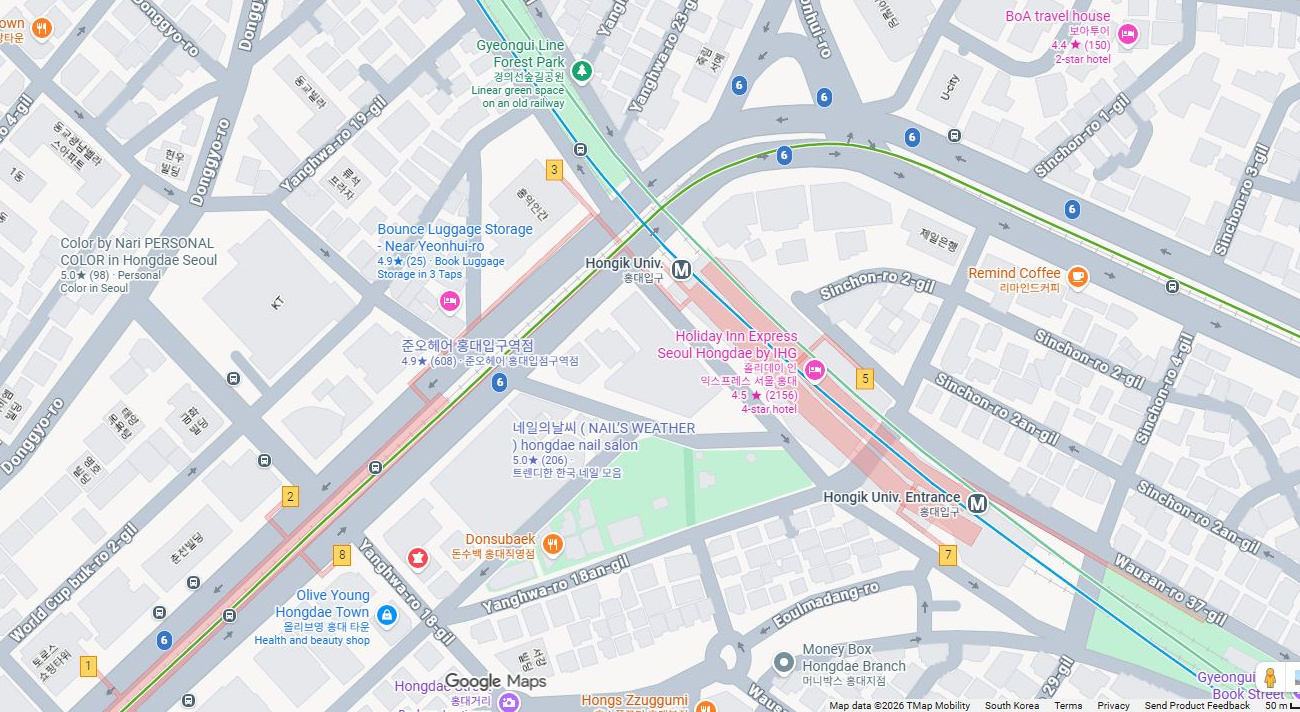
Back in Seoul after a month, Mali messages Rina: “I’d like to see some autumn colours.” Rina chooses an old railway route that starts at a single pine tree outside Hongik University Station Exit 3.

How to get there
It has been a month since Mali was last in Seoul. She works for a beauty magazine in Bangkok, and her work trips usually leave little time to spare. Meetings and shop research fill the days, then sorting through her photographs takes up the evenings. This time, though, the whole of her final afternoon is free. She messages Rina, who helped her find the fabric floors at Dongdaemun Shopping Complex on her last visit. “Are you free on Thursday afternoon? I’d like to see some autumn colours. The real ones in Seoul, rather than in a magazine shoot.”

Rina’s reply arrives almost straight away. “Come out of Hongik University Station Exit 3. There’s a tall pine tree outside. Let’s meet there.” No map link or shop name, just a tree. Mali thinks she might be joking until another line appears. “That pine tree marks the start of the Yeonnam-dong section of Gyeongui Line Forest Park.” Under “Things to look at for work” in her notes, Mali writes “Pine tree — start”.
There is a reason she asks for “the real ones in Seoul”. On the final evening of her last trip, Mali ate alone in Jongno 3-ga Galmaegi Alley and sent Rina a photograph of the grill. Rina replied, “Let’s go for a walk in the daytime next time. The colours are different at night.” Mali copied the line into her notes exactly as it was. The moment a free afternoon appeared in her schedule, she thought of it. After a month of looking at colours under shop lighting, she missed seeing them in sunlight.
This is the story of that Thursday afternoon, with a guide to walking the Yeonnam-dong section for the first time. Along the way, we’ll cover which station exit to use, the rules to know before entering, and where the ginkgo path, waterway and remaining railway tracks fit into the walk. This is the stretch people call “Yeontral Park”.
The Cue
The Yeonnam-dong section of Gyeongui Line Forest Park starts straight outside Hongik University Station Exit 3, served by Line 2, the Gyeongui Line and the Airport Railroad. The tall pine tree outside marks the beginning. Built over the old Gyeongui railway after it moved underground, the park has about 1 km of earth path between ginkgo trees, lawns, a waterway fed by groundwater and stretches of preserved track. Check the rules before going in. Food is prohibited to protect wildlife, as are drinking alcohol, camping and lighting fires, and you must take your rubbish away. With no car park of its own, the subway is the easier way to arrive.
- Where: Yeonnam-dong, Mapo-gu, Seoul. Hongik University Station Exit 3, served by Line 2, the Gyeongui Line and the Airport Railroad, leads straight to the path. The tall pine tree marks the start of the Yeonnam-dong section.
- What to see: About 1 km of ginkgo-lined path, with earth underfoot between the trees · lawns · a waterway recreating Segyocheon, fed by groundwater from the underground Airport Railroad section · remaining railway tracks.
- Rules: No food, to protect wildlife · no camping, cooking or fires · no drinking alcohol, singing, dancing or causing a disturbance · take your rubbish away · no smoking · visitors are asked to refrain from bringing pets.
- Busking: Daily, 11:00–20:00. It is not permitted after 20:00.
- By car: None of the park’s sections has its own car park. Come by public transport.
- Information: For the Hongik University Station–Yeonnam-dong section, ask at the Yeonnam park office in front of Yeonnam Police Substation. Leaflets are available there.
Meeting at the pine tree outside Exit 3
At two o’clock on Thursday afternoon, Mali passes through the ticket barriers at Hongik University Station and follows the signs for Exit 3. With Line 2, the Gyeongui Line and the Airport Railroad all stopping here, the station has plenty of exits and plenty of people. On a first visit, it is easy to pause and wonder which way to go. For the Yeonnam-dong walk, just remember Exit 3. At the top of the stairs, Mali finds that there really is a tall pine tree. Beside it, Rina waves with her notebook open.
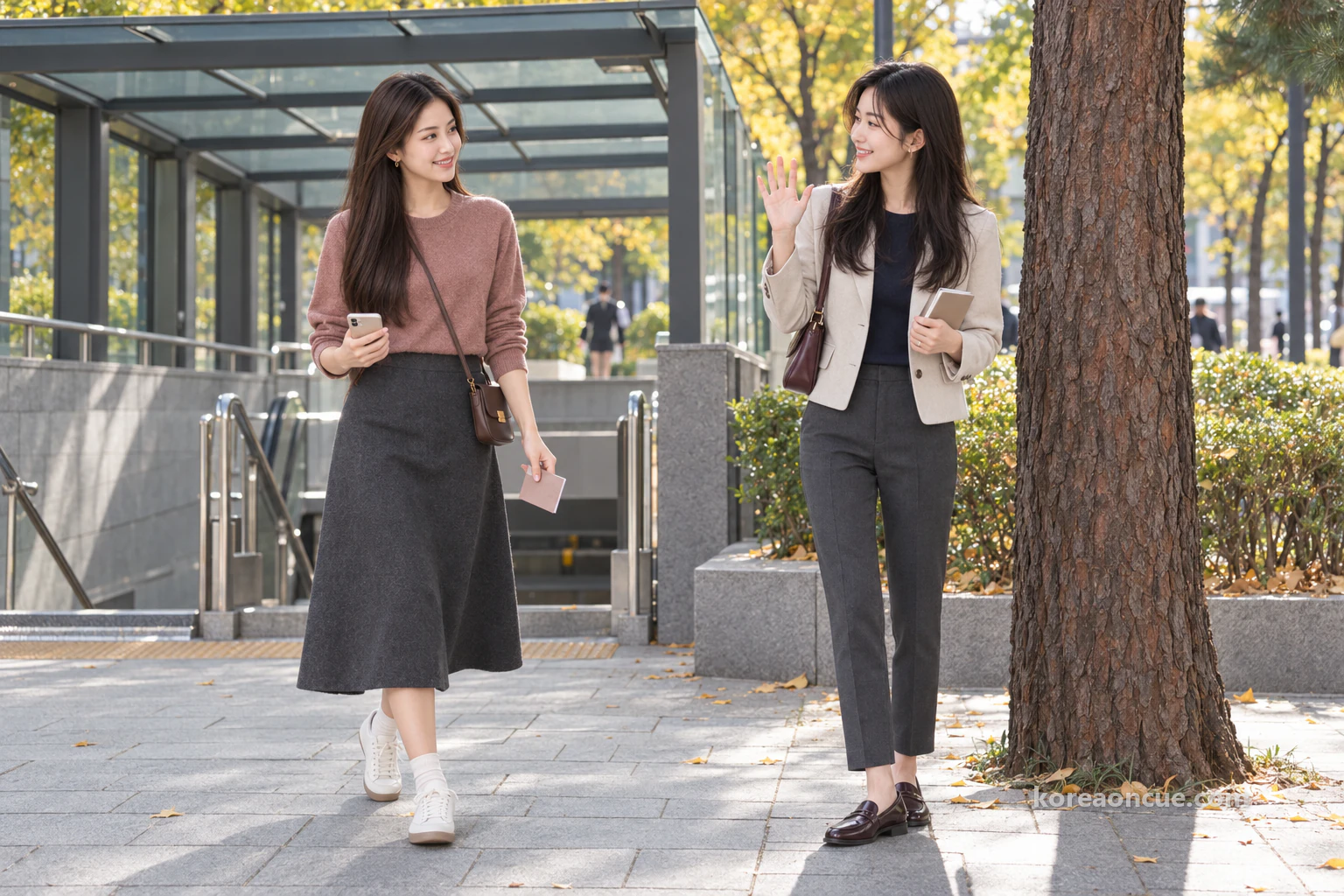
“So we really are meeting at a tree.” Mali laughs, and Rina turns the notebook towards her. The first line reads “Exit 3 — pine tree — start”. Whenever she comes to Seoul, Rina explains, she records her walks in little groups of three words. It is the same notebook she used in Dongdaemun for “5th floor”, “Building B, 2nd floor” and “2nd and 3rd floors”. Mali is pleased to see it again. A month ago, it belonged to someone she had just met. Today, it belongs to someone she knows.
The path is not Rina’s only reason for choosing Exit 3. Mali needs to reach the airport that night, and the Airport Railroad stops at this station. After their walk, she can catch it from the same place. “Meeting at the station you’ll leave from makes the last day less of a rush.” Rina asked about Mali’s schedule before choosing their meeting point. For a work trip to Seoul, it is a useful arrangement to keep in mind. Leave your luggage at your accommodation, spend the afternoon near Hongik University Station, then collect your bags before taking the Airport Railroad.
Rina has a reason for choosing this particular walk, too. Gyeongui Line Forest Park runs for 6.3 km from Mapo-gu to Yongsan-gu. The Yeonnam-dong section cuts through the middle of the neighbourhood and is the liveliest stretch of the park. It is also the part nicknamed “Yeontral Park”, a nod to New York’s Central Park. “When you said autumn colours, I thought of this place straight away,” Rina says. “Trees, grass, water and railway tracks, all along one path.”
Before they set off, Rina gives Mali a little background. Yeonnam-dong opened during the second phase of the park project on the disused Gyeongui railway, alongside the Saechanggogae and Yeomni-dong sections. Across the park as a whole, the width varies from 10 m to 60 m. Here in Yeonnam-dong, ginkgo trees and the waterway run through the middle, with lawns on either side. The walk keeps changing from a narrow path into a wide open space. “It’s like turning the pages of a magazine,” Mali says.
Finish the bread before entering the park
Before the walk, there is one small complication. On her way to the station, Mali stopped at a bakery for two butter buns and a coffee. She thought they could sit on the grass and share them. Rina notices the bag and, looking apologetic, holds out her phone. She has brought up the first line of the park rules. “Food is prohibited to protect wildlife.”

Mali looks briefly embarrassed, then laughs. “I saw the lawns and assumed it was a picnic spot.” It is an easy mistake on a first visit. A wide stretch of grass can have people reaching for a picnic mat, but food is prohibited in Gyeongui Line Forest Park. Camping, cooking and lighting fires are prohibited too, as are drinking alcohol, singing, dancing and causing a disturbance. Visitors must take their rubbish away, and smoking is not allowed. They step back towards the station exit and eat a bun each. Mali folds the empty bag into her own bag before they enter.
Rina is someone who reads a notice to the end, so she points out the line about pets as well. Visitors are asked to “refrain” from bringing pets into Gyeongui Line Forest Park, to protect the ecosystem and avoid inconveniencing others. It is a request rather than an outright ban, but read it first if you are planning to walk here with a dog. Mali writes “Eat before going in” in her notes, then adds underneath, in smaller letters, “The bread was good.”
The reason behind the rules deserves a moment’s thought. Although the park is in the middle of the city, its trees and grass are also home to small animals. Protecting wildlife is why food is prohibited, and the rules also ask visitors to look after the plants and trees. “It helps to think of it as a park for walking rather than sitting down to eat,” Rina says. Mali nods. That, she says, is much more useful than anything in her work notes.
About 1 km of earth path between ginkgo trees
Once they enter the park, Mali is the first to slow down. Ginkgo trees line both sides of a straight earth path. This is one of the section’s most noticeable features: about 1 km of mature ginkgo trees following the old railway, with a path between them that feels quite different underfoot from a city pavement. It is late October, and the leaves are beginning to turn yellow at the edges.

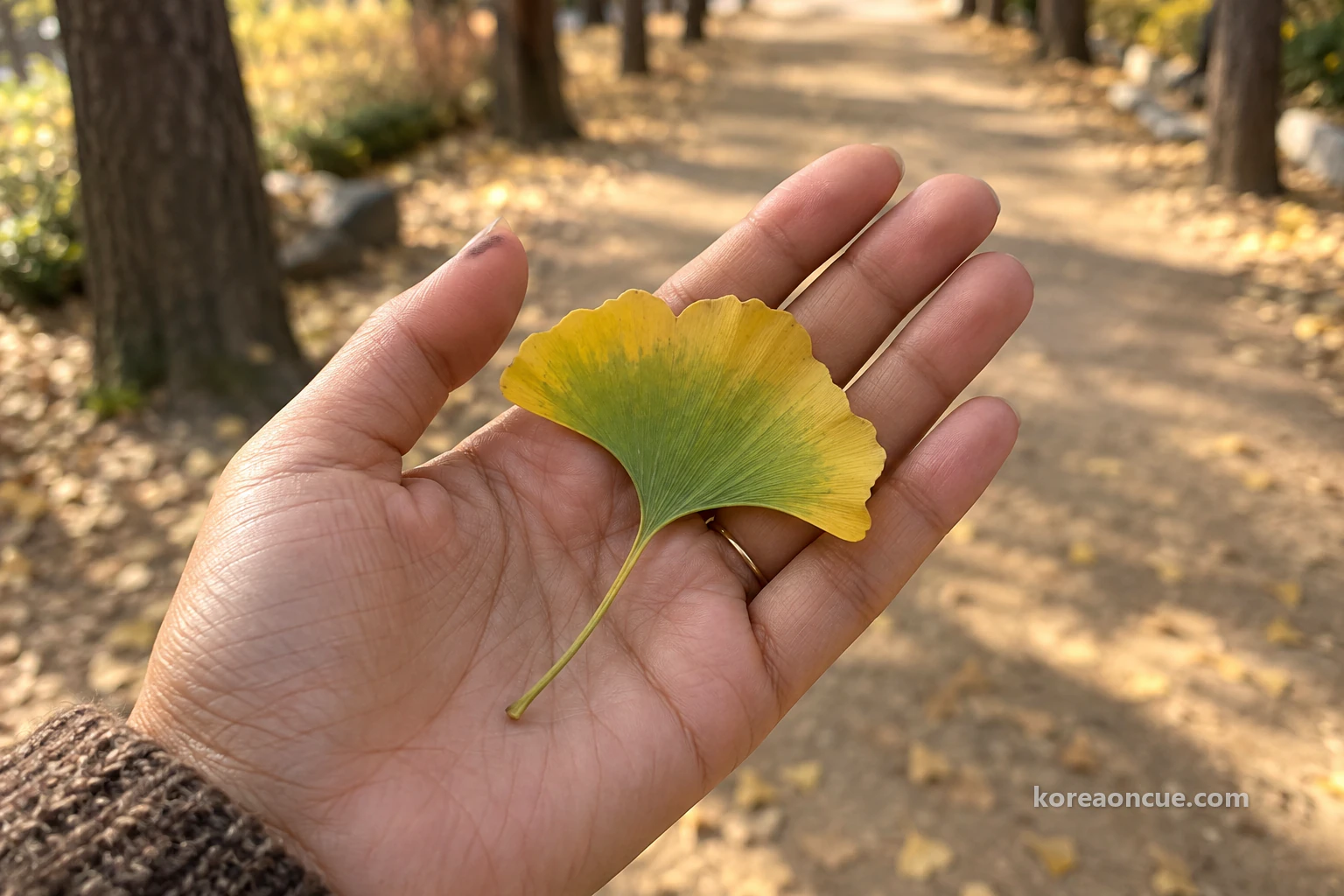
Mali takes out her phone, then puts it away again. Instead, she picks up a ginkgo leaf and spends a while looking at it on her palm. The centre is still pale green, with yellow spreading in from the edges. “In a magazine shoot, we’d make this all one shade of yellow. But there are about three colours in a single leaf.” Under “Things to look at for work”, she writes “Ginkgo leaf — edges first”. Rina suggests keeping the leaf between the pages of her notebook.
Having walked the ginkgo path several times, Rina suggests a pace. “Walk quickly and that kilometre is over in no time. Slow down and it feels much longer.” The whole Yeonnam-dong section is about 1.3 km, short enough to walk from end to end in one go. That makes it all the more worthwhile to take your time. Autumn, when the yellow deepens, is the season most often associated with this path. The leaves change at a different pace each year, though, and Mali likes catching them halfway through, as they are today.
Around the middle of the ginkgo path, they pass a rest area built to resemble a small railway station. Even the place to pause recalls the railway that became the park. “Wait here and people arrive instead of trains,” Rina jokes. Laughing, Mali traces the roofline in the air with her finger. It is something she does without thinking when she looks at a possible background for a magazine shoot. They do not stay long, moving on towards the sound of water.
A waterway fed by groundwater from the Airport Railroad
Along the ginkgo path, a shallow waterway runs through the middle of the park. Rina says this is her favourite part. It recreates the old Segyocheon stream, using groundwater from the underground Airport Railroad section. Trains still run beneath their feet, while water brought up from below flows through the park above.

“There are trains running underneath us?” Mali asks. Rina nods. Work to move the railway underground began in 2005, and the land left above became Gyeongui Line Forest Park, a place for people to spend time outdoors. There are still railway tracks below, with trees, water and grass above. Rina writes “Above — water, below — trains” in her notebook. Mali says it sounds like the title of a magazine shoot and photographs the line.
Beside the waterway, lawns and open squares of different sizes appear along the route. Follow only the ginkgo path and it can feel like a narrow walkway. Turn your head and another broad patch of grass opens up beside it. That makes it easy to find somewhere to sit when you need a break. They stop for a little while with a view of the water, laughing about the bread they ate before coming in. With nothing in her hands, Mali says, she has spent longer looking at the path.
While they sit, Mali asks about Rina’s notebook. Why does she always keep things to three words? Rina says that when she first came to Seoul, she wrote everything down at length. Back home, she read it all again and found she could barely picture the actual routes. Since then, she has kept to short notes such as “Where — what — next”. That way, on her next walk, she remembers which way to go before she even opens the notebook. Mali opens her own notes and smiles at the screen full of long sentences. “I’m the opposite. I only relax once I’ve written everything down.”
Counting sleepers on the old railway tracks
A little further on, rusty railway tracks emerge between the earth and grass. Parts of the original track have been left in Gyeongui Line Forest Park. Rina stops and opens her notebook. She has a habit of counting the sleepers as she walks along them. Mali laughs at first, then finds herself counting too.

These tracks belonged to the old Gyeongui Line. The railway linked Yongsan and Sinuiju in the early 1900s and opened in 1906. After it moved underground, the land above became a park. The park opened in stages, beginning with the Daeheung-dong section in March 2012, and the whole route was completed in 2016. Yeonnam-dong opened to the public in June 2015, between those two dates. “Last time in Dongdaemun we were counting floors,” Rina says with a laugh. “Here we’re counting years.”
Mali works it out on her fingers. From the start of the underground railway work in 2005 to this section opening as a park in 2015, a full ten years passed. “And I complain that three months is a long time to put together a magazine shoot.” Rina wonders what the people who used this route during those ten years make of the ginkgo path now. As they walk, someone pushing a pram passes them, then someone carrying a book, then someone holding a plant pot rather than walking a dog. It soon becomes clear that this is a path people use every day in their neighbourhood.
For Mali, the tracks register first as colours. She likes the rusty reddish brown of the rails beside the yellow of the fallen ginkgo leaves. “I couldn’t recreate this for a shoot. When something has fallen into place by chance, copying it always looks staged.” She takes one photograph and puts her phone away. Rina writes “Don’t copy chance” on one side of her notebook. It strikes a chord with her own habit of collecting small details.
For a while, they walk in step beside the tracks. On the track itself, the spacing of the sleepers makes their strides a little shorter and more regular. Mali finds this amusing enough to go back and forth several times. Watching her, Rina writes “Stride — shorter”. Around the tracks, though, it is easy to concentrate on the ground ahead and bump into someone. Look around from time to time when taking photographs or counting sleepers. Plenty of people use this neighbourhood park for a walk.
Busking beside the lawns, with the volume low
Around the middle of the section, they hear a guitar. Someone is singing at one side of a lawn. Busking is permitted in Gyeongui Line Forest Park every day from 11 a.m. to 8 p.m., and must stop by 8 p.m. Keeping the volume low is part of the park’s busking etiquette, with homes and shops close by. The song they hear is quiet enough for other walkers to keep going without breaking stride.
There is a little etiquette for listeners, too. A crowd in front of a performer can quickly narrow the walking path. If you want to stay for a few songs, stand at the edge of the lawn rather than in the middle of the route. Mali and Rina step aside from the ginkgo path towards the grass. Mali claps softly after each song, while Rina counts them in her notebook using the five-stroke character 正 as a tally. They listen to three songs before setting off again. Busking finishes at 8 p.m., so arriving before sunset is a better choice if you hope to hear a performance.

Mali checks the time as they listen. It is past three, and there are noticeably more people about. Weekend afternoons bring much larger crowds around the lawns and along the paths. If a weekday afternoon is this busy, Rina says, anyone hoping for a quiet weekend walk would be better off arriving a little earlier. When taking photographs, step towards the lawns rather than standing in the middle of the path for a long time.
Rina asks a small question. “When you’re working in Seoul, what colour do you see most?” Mali thinks for a moment. “Shop lighting.” She spends so much time looking at cosmetics under bright white lights. Today is the first time she has spent this long looking at colours in sunlight. Rina does not copy that into her notebook. She just says, “Come in the morning next time. The light’s different.”
Mali pauses at that. Her work schedules are always filled with meetings and shop research, while mornings disappear into hotel breakfasts and getting from place to place. Next time, she says, she will keep an hour free in the morning. She adds a little sun symbol beside her next work trip in her phone calendar. Rina leaves the difference between morning and afternoon unexplained. Mali can discover it herself. She wants to leave that small pleasure for someone who has only just walked the path for the first time.
The Yeonnam park office and plans for another walk
As they head towards the far end of the Yeonnam-dong section, Rina adds one more useful detail. The stretch from Hongik University Station through Yeonnam-dong is the park’s most visited section. For questions about directions or using the park, ask at the Yeonnam park office in front of Yeonnam Police Substation. There are leaflets there too. Mali says that on a work trip, this is the sort of information she appreciates most: somewhere to ask without having to find a separate map.
The park does not end with Yeonnam-dong. Gyeongui Line Forest Park continues for 6.3 km from Mapo-gu to Yongsan-gu, so on a day with more time, the walk can carry on through other sections. Today, though, they have an Airport Railroad train to catch. “We don’t have to walk it all at once,” Rina says. “Yeonnam-dong today, another section next time.” She leaves a blank line in her notebook. On a first visit, choosing just one section gives you time to look around without rushing.

Sitting on a bench, Rina turns the pages and stops at an entry about the sky-blue decoration she chose in Dongdaemun. She tells Mali that she gave Maya the bag charm made in that colour, and later spent a day with her in Jongno. “I’m meeting Maya in Hongdae again this evening. We’re going to walk along Red Road.” Mali listens to the unfamiliar name, then remembers. This must be the friend Rina mentioned in Dongdaemun, the one she was going to meet for the first time the following week.
Mali has an evening flight, so she cannot join them. Instead, she asks Rina to write her name in small letters beside the ginkgo leaf tucked into the notebook. “Next trip, I’ll come in the morning and see if the light really is different. With Maya as well.” Rina writes Mali’s name and today’s date beside the leaf, then adds another line below: “Morning — next time”.
Before they part, Mali sends Rina a photograph to pass on to Maya when they meet. It is a close-up of the ginkgo leaf she held on her palm earlier. “Yellow coming in from the edges. It would be nice to see it alongside Red Road’s red.” Rina smiles at the message. Someone she met for the first time in Dongdaemun a month ago is now sending a colour to a friend she has yet to meet.
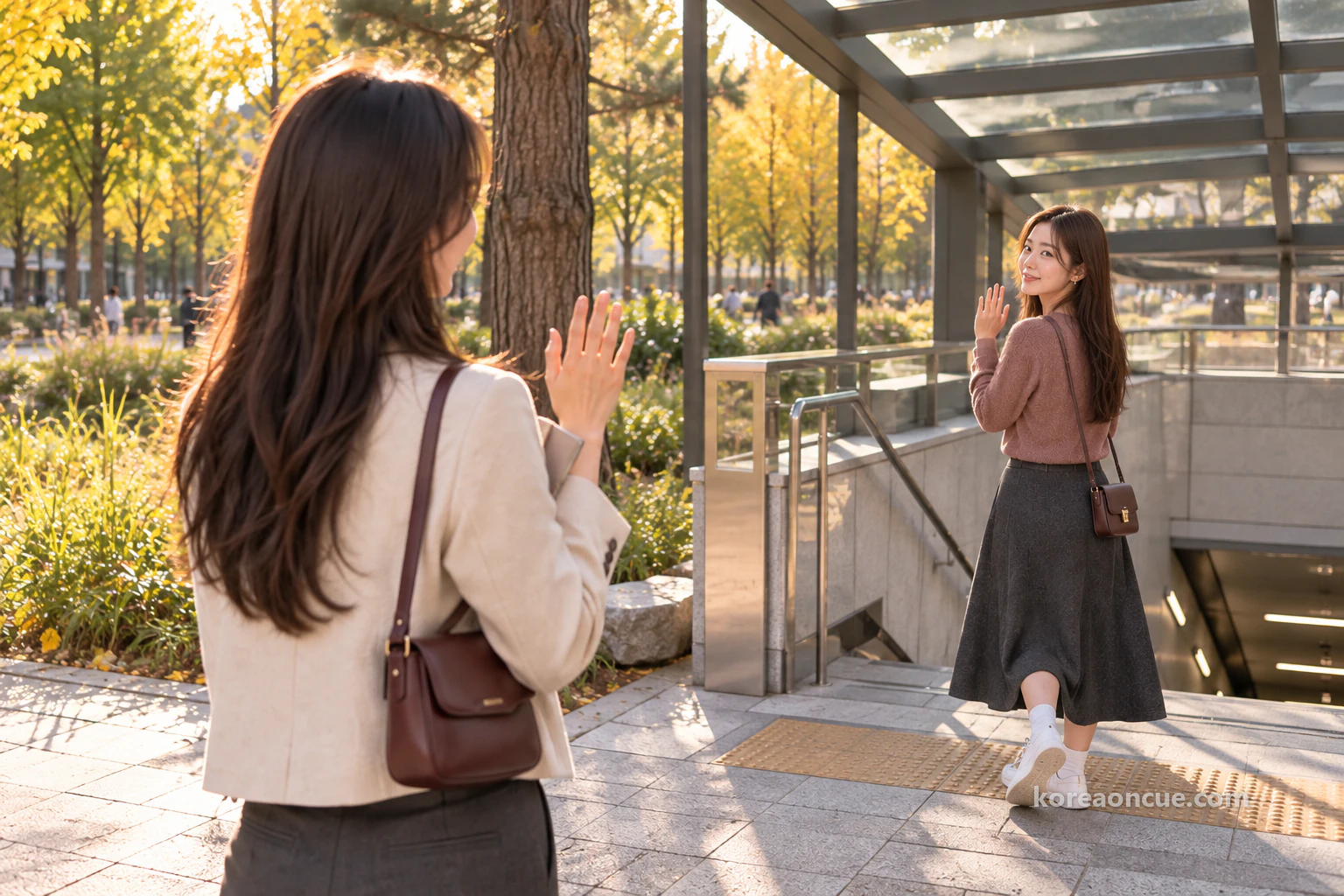
They say goodbye beside the pine tree at Exit 3, where they met at the start of the walk. On the train to the airport, Mali opens “Things to look at for work” again. “Pine tree — start”, “Eat before going in”, “Ginkgo leaf — edges first”, “Don’t copy chance”. It reads more like a diary than work notes. At the next meeting about a magazine shoot, though, the first thing she talks about will probably be the colour of a ginkgo leaf in afternoon sunlight rather than shop lighting.
As the Airport Railroad train from Hongik University Station goes underground, Mali remembers what Rina said beside the water. Above the ground this train is passing through, water is flowing and people are walking between ginkgo trees. At the bottom of her notes, Mali copies Rina’s habit of keeping things to three words. She writes, “Above — water, below — me.” Then she checks the little sun beside her next work trip once more.
Common Mistakes
Seeing the lawns and planning a picnic
food is prohibited in Gyeongui Line Forest Park to protect wildlife. Finish anything you want to eat before entering.
Packing a picnic mat, camping chairs and something to light a fire
camping, cooking and lighting fires are all prohibited.
Bringing a car
none of the park’s sections has its own car park. Come via Hongik University Station Exit 3.
Assuming pets are welcome without checking
visitors are asked to refrain from bringing pets. Read the notice first if you plan to come together.
Arriving late in the evening for busking
busking is permitted only from 11:00 to 20:00.
Expecting a quiet walk on a weekend afternoon
the paths and areas around the lawns get crowded. Arrive early if you want a quieter walk.
FAQ
How do I get to the Yeonnam-dong section of Gyeongui Line Forest Park, or Yeontral Park?
Hongik University Station Exit 3, served by Line 2, the Gyeongui Line and the Airport Railroad, leads straight to the path. The tall pine tree outside marks the start.
How long is the walk?
The Yeonnam-dong section is about 1.3 km, including about 1 km of ginkgo-lined path.
Can I bring food?
No. Food is prohibited to protect wildlife. Drinking alcohol, camping, cooking and lighting fires are also prohibited.
Can I bring a pet?
Visitors are asked to refrain from bringing pets to protect the ecosystem and avoid inconveniencing other park users.
When can I hear busking?
Daily, 11:00–20:00. Busking is not permitted after 20:00.
Is there parking?
The park has no car park of its own. Use public transport.
Where can I ask for directions?
For the Hongik University Station–Yeonnam-dong section, ask at the Yeonnam park office in front of Yeonnam Police Substation. Leaflets are available there.
Recap — 30 seconds before you go
- Start at the tall pine tree outside Hongik University Station Exit 3.
- Eat before entering. No food, alcohol, camping or fires, and take your rubbish away.
- About 1 km of earth path between ginkgo trees → the groundwater-fed waterway → remaining railway tracks.
- Busking 11:00–20:00, with the volume low.
- No car park of its own. For information and leaflets, use the Yeonnam park office in front of Yeonnam Police Substation.
Sources
- Seoul Parks — Gyeongui Line Forest Park6.3 km linear park and its history · lawns, ginkgo path, recreated Segyocheon stream and railway on the Yeonnam side · park rules (no food, camping, cooking, drinking or smoking; please keep pets out) · busking 11:00–20:00 · no car park · leaflets at the Yeonnam postchecked 2026-10-22
- Seoul Metropolitan Government — Yeonnam, Yeomni and Saechang Gogae sections openedThe tall pine by Exit 3 marks the start · ginkgo trees and lawns · stream made with Airport Railroad groundwaterchecked 2026-10-22
- Seoul Metropolitan Government — old Gyeongui line turned into a 2 km forest pathAbout 1 km earth path between ginkgo trees · lawns of all sizeschecked 2026-10-22
- Seoul Media Hub — a walk along the railway in the cityUndergrounding began in 2005 · the Yeonnam section called "Yeontral Park"checked 2026-10-22
- Seoul Media Hub — from old railway to a forest path (2026)Yeonnam section about 1.3 km · preserved track · busy weekend afternoonschecked 2026-10-22
A Seoul story told with our AI characters. Place details are checked against public sources; the photos are AI-made illustrative images. How we use AI
More from this area

A Thursday evening before Halloween: walking Hongdae’s Red Road from R1 to R7 with Maya and Rina
In her second week in Seoul, Maya visits Hongdae for the first time.

The night before the concert: Hina explores Hongdae’s busking zones on her own
Back in Seoul a month later, Hina has kept the night before her concert free.