
SEOUL · MAGOK
One dotted line between free and paid: Noah walks Seoul Botanic Park’s Greening Days with a map full of times
From Magongnaru Station Exits 3 and 4 through the Open Forest and Lake Garden to the free specimen exhibition on the second floor of the Plant Culture Center (rare plants in November), then the greenhouse and theme gardens — closing at 5 p.m. from November, last entry 4 p.m.
The same botanic park has one area you buy a ticket for and another you can simply walk into. Noah draws a single dotted line in his notebook and decides to walk the side with the clocks first.
How to get there
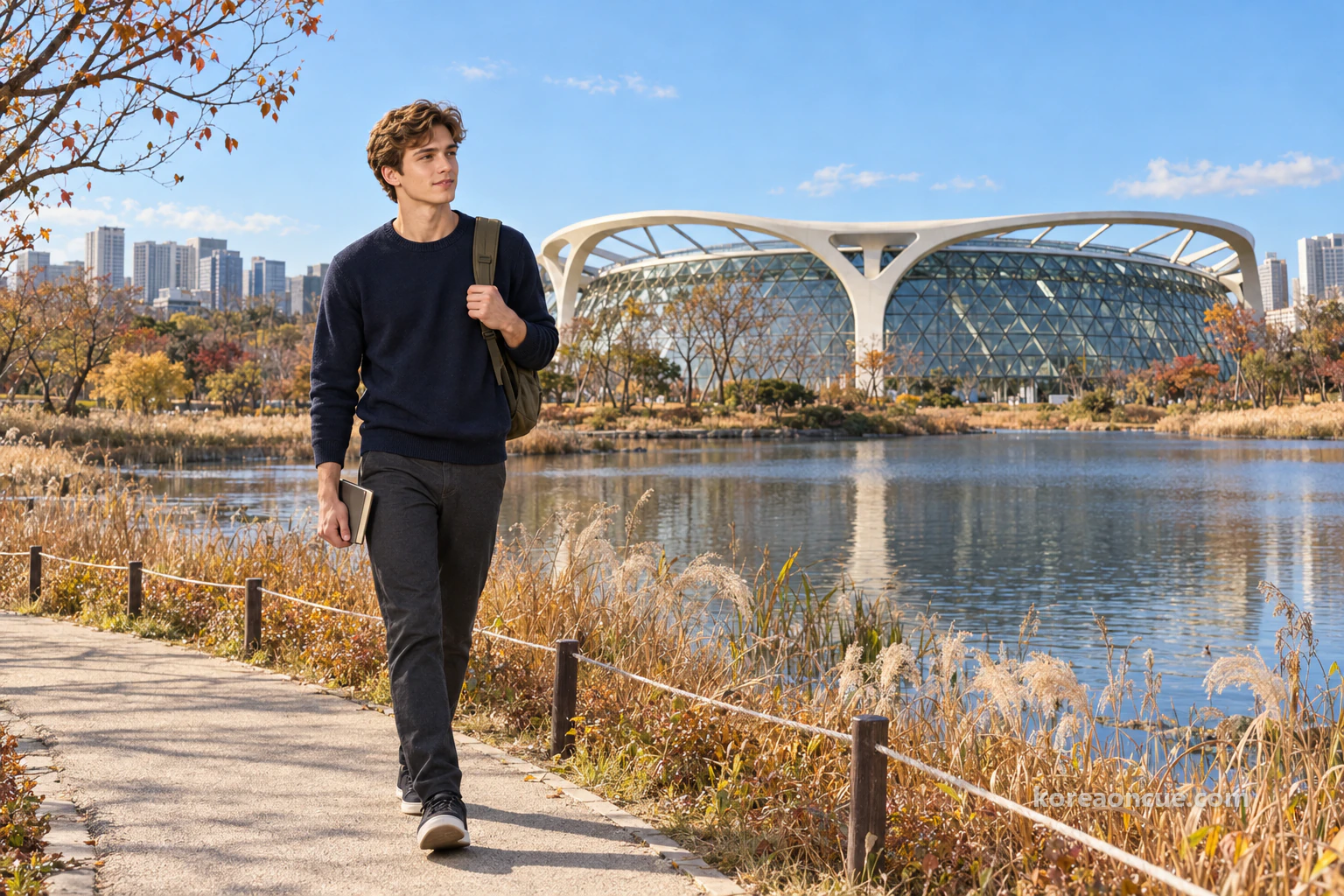
On the afternoon of the first Friday in November, Noah gets off Line 9 at Magongnaru Station and opens his notebook before he even reaches the ticket gates. At the top of the map he plans to draw today, there is already one line. It is not a long, unbroken stroke but a row of short dashes, a dotted line. Noah is twenty, from Canada, and whenever he goes somewhere new he draws it as a map in his notebook, and lately he adds the times too. Today, though, before any times, he is more curious about where on the map this one dotted line belongs.

The place he has picked is Seoul Botanic Park in Magok-dong, Gangseo-gu. It opened to the public in October 2018, officially opened in May 2019, and in 2021 became Seoul’s second registered public arboretum. What caught Noah’s attention is how it is split. The Open Forest, Lake Garden and Wetland Garden are free at all times, and only the greenhouse and theme gardens charge admission. Once he knew that the same park had an area you buy a ticket for and an area you can just walk into, he wanted to draw that boundary himself and see what shape it makes on a map.
There is one more reason Noah is here. From 23 September to 31 December 2026, a corridor on the second floor of the Plant Culture Center holds a free specimen exhibition called “Greening Days: Plants Become Everyday”, and November’s theme is rare plants. The label beside each specimen even says where in the park you can see that plant growing. A guide that links specimens on a wall to plants rooted in the garden feels, to someone who draws routes, like being handed a map that is already half finished.
This piece follows Noah through that Friday afternoon as a guide to Seoul Botanic Park. He enters the Open Forest from Magongnaru Station, crosses the deck over the Lake Garden to the Plant Culture Center, sees “Greening Days” on the second floor, then walks the greenhouse and theme gardens. After they close, he comes back out into the free areas and keeps walking towards the Han River. From November to February the greenhouse and theme gardens close at 5 p.m., with last entry at 4 p.m., so the order you walk the areas in shapes the whole day. Here is how Noah worked out that order, page by page.
The Cue
Seoul Botanic Park (161 Magokdong-ro, Gangseo-gu) keeps the Open Forest, Lake Garden and Wetland Garden free at all times, and charges admission only for the greenhouse and theme gardens (₩5,000 for adults). In winter, from November to February, the greenhouse and theme gardens open 09:30–17:00, with entry and ticket sales ending at 16:00, and they close on Mondays (or the following day when Monday is a public holiday). From 23 September to 31 December 2026, the wall display space on the second floor of the Plant Culture Center hosts the free specimen exhibition “Greening Days: Plants Become Everyday”, and in November it shows 16 specimens of 15 rare plants designated by the Korea Forest Service, including Abelia spathulata. Exits 3 and 4 of Magongnaru Station (Line 9 and AREX) lead straight into the Open Forest.
- Where: Seoul Botanic Park, 161 Magokdong-ro, Gangseo-gu, Seoul. Enquiries 02-2104-9716.
- By subway: Magongnaru Station (Line 9 and AREX) Exits 3 and 4 connect directly to the Open Forest. Yangcheon Hyanggyo Station (Line 9) Exit 8 is a 10-minute walk from the Theme Garden, and Magok Station (Line 5) Exit 3 is a 20-minute walk from the Open Forest.
- Free areas: The Open Forest, Lake Garden and Wetland Garden are always free and open every day of the year. “Greening Days” on the second floor of the Plant Culture Center is free too.
- Paid areas: The greenhouse and theme gardens. Adults (19 to 64) ₩5,000 · youth (13–18) ₩3,000 · children (6–12) ₩2,000. Tickets are valid only on the day you buy them.
- November hours: Greenhouse and theme gardens 09:30–17:00, last entry and ticket sales 16:00. Closed Mondays (the following day when Monday is a public holiday).
- Exhibition: “Greening Days”, 23 September – 31 December 2026, in the corridor beside Project Hall 2 on the second floor of the Plant Culture Center. November: 16 specimens of 15 rare plants. December: 18 specimens of 15 endemic plants.
- Bags: The lockers run 09:30–17:00 in winter, and you cannot store or collect anything outside those hours. The greenhouse is warm, so if you leave your coat in a locker, collect it before 5 p.m.
From Magongnaru Station Exits 3 and 4 into the Open Forest entrance plaza
The way into Seoul Botanic Park runs from Exits 3 and 4 of Magongnaru Station, on Line 9 and AREX, into the Open Forest. The Open Forest’s entrance plaza connects directly with the subway exits, so the moment you leave the station you are already in the park, with no route to work out. Noah marks his starting point as a small circle in the bottom corner of the page. Most of his maps so far have needed a long line from the exit to wherever he was going, but today the circle and the park are almost touching, which leaves him feeling slightly short-changed.
Open in Kakao Map — Magongnaru Station
The Open Forest is both the park’s entrance and its visitor information area. Step into the plaza and a wide lawn opens up in the middle of the surrounding woodland, ringed by oaks, cherry trees and maples. The visitor centre and the Forest Culture School are here in the Open Forest too. The shallow mirror fountain in the entrance plaza is there to cool people down on summer days, so for Noah in November it is the trees around the lawn that catch his eye first.

There are other ways in. From Exit 8 of Yangcheon Hyanggyo Station on Line 9, the Theme Garden side is a 10-minute walk, and from Exit 3 of Magok Station on Line 5, the Open Forest is a 20-minute walk. Noah picked Magongnaru Station purely for the sake of his map. Starting in the Open Forest lets him draw the route as one line, through the free area first and into the paid area after. First-time visitors who start at Magongnaru Station also get to see how the park is laid out in order from the entrance, which makes finding your way much easier.
Free and paid areas: Open Forest, Lake Garden and Wetland Garden free at all times, greenhouse and theme gardens ₩5,000 for adults
Stopping at the edge of the lawn, Noah first decides where today’s dotted line should go. At Seoul Botanic Park, only the greenhouse and theme gardens charge admission, while the Open Forest, Lake Garden and Wetland Garden are free at all times. The free areas are open every day of the year, and the greenhouse and theme gardens close every Monday, or the following day when Monday is a public holiday. Noah lightly shades the free areas in pencil and draws the dotted line only around the greenhouse and theme gardens.
Admission is ₩5,000 for adults (19 to 64), ₩3,000 for youth (13–18) and ₩2,000 for children (6–12), and a ticket can be used only on the day you buy it. Inside the dotted line, Noah draws a little ticket and writes “5,000”. Looking at the map again, he notices something that makes him smile. Outside the dotted line, in the free area, there is no reason to draw a clock, but inside it the clocks have to line up one after another. For Noah, today’s dotted line is less a line about paying than a line between places that have times and places that do not.
In winter, from November to February, the greenhouse and theme gardens open from 9:30 a.m. to 5 p.m., with last entry at 4 p.m. The greenhouse ticket office on the basement level also stops selling tickets at 4 p.m. in winter. In a corner inside the dotted line Noah writes “16:00 entry / 17:00 close”, and outside it, instead of a clock, simply “always”. Once that is written down, the order settles itself. He will walk the inside of the line, where the clocks are, first, and leave the clockless outside for a slow walk after the gates have shut.
This is exactly the order to use if you visit Seoul Botanic Park on a November afternoon. The free areas are open whenever you come, but once it passes 4 p.m. you cannot get into the greenhouse or theme gardens that day. Noah draws one bold arrow inside the dotted line and decides to take in the free areas by eye only on the way through.

Crossing the Lake Garden wetland boardwalk to the Plant Culture Center
Beyond the Open Forest lies the Lake Garden. Walking paths and waterside viewing decks run around the lake, and it is a place to rest, where you can sit on the lake steps looking across the park or watch the wetland plants and resident birds. The Lake Garden fountain runs from 20 April to 31 October, so in November the lake has no fountain going. As he draws the lake, Noah starts to add a fountain symbol, remembers that its season is over and lifts his pen again. Instead he calmly draws a few horizontal lines across the water.
The footbridge across the lake is the wetland boardwalk. Because it links the Lake Garden with the Theme Garden, anyone coming in from the Open Forest crosses it towards the Theme Garden side. The Theme Garden is made up of outdoor theme gardens that recreate traditional Korean gardens with native plants, and a greenhouse showing plants from 12 tropical and Mediterranean cities. On the boardwalk Noah slows down and draws a bridge on his map. From the far side of the bridge, the dotted line is getting closer.

The Plant Culture Center, which he reaches across the boardwalk, is made up of the greenhouse, with plants from 12 cities in Mediterranean and tropical regions around the world, and a support building with spaces for events and exhibitions such as Botanic Hall, the plant library and the project halls. Facilities such as a gift shop and a café are inside as well. The second floor holds the plant library, Project Hall 2, Botanic Hall and a set of rooms named after flowers — lily, clematis, four o’clock and azalea. Reading the floor guide, Noah draws the building as a vertical stack of floors in his notebook and marks today’s first stop on the second floor.
“Greening Days” on the second floor of the Plant Culture Center: a free specimen exhibition with rare plants as November’s theme
“Greening Days: Plants Become Everyday” is set up in the wall display space along the corridor beside Project Hall 2 on the second floor. It runs from 23 September to 31 December 2026, and entry is free. It is a plant specimen exhibition held alongside the plant showroom that the garden support room on the first floor dresses with a new theme every month. The specimens were made by the park’s own plant research institute from plants propagated in its cultivation greenhouses, and they introduce native plants that need protection and attention. Seeing that the exhibition sits on the free side, outside the dotted line, Noah lightly shades in the second floor.
The exhibition starts from very ordinary scenes. Trees by the road, flowers in a bed, a small pot on a windowsill: plants we brush past every day but rarely get the chance to look at closely. Reading that line, Noah thinks of his own maps. On them a tree is always a single circle and a flowerbed just a few dots. It feels a little awkward to realise he has walked past countless trees while drawing routes around Seoul and never once written one down by name.
The theme of the specimens changes every month. November brings 16 specimens of 15 rare plants designated by the Korea Forest Service, including Abelia spathulata, and December brings 18 specimens of 15 endemic plants designated by the Korea Forest Service, including Aruncus aethusifolius. So someone visiting in November and someone visiting in December will meet different specimens in the same corridor. Next to the second floor on his page, Noah writes “Nov = 15 rare plants, 16 specimens”, and underneath, in smaller letters, “Dec = endemic plants”. Come back in a month, and the same wall becomes a different map.

“Where to see it in the park” on the specimen labels: a map from specimen to garden
The label beside each specimen gives the plant’s name, its key features, a photo of it in flower and the place in the park where you can see it. It is an invitation to look at the specimen and then go and find the living plant in the garden. For Noah, that last line is the heart of today’s exhibition. It means every specimen on the corridor wall is paired with a point somewhere on the park map.
In front of each specimen, Noah reads the viewing spot before the name. Then, on the park map in his notebook, he puts a small leaf-shaped mark at every place the labels mention. The more leaves he adds, the more it feels as if today’s route is being drawn in advance, from the corridor out to the gardens. Only then does he turn back to the specimens and look in turn at the grain of the leaves, the shape of the stems and the arrangement of the flowers. Knowing the place first makes even a dried specimen look like a plant that is growing somewhere right now.
On a first visit, it is handy to note these viewing spots on your phone. Once you have seen the specimens and head out into the gardens, it is easy to feel lost about where to start, but with the places written down you can match them up one by one as you walk the greenhouse and gardens. The exhibition runs along the corridor wall, so Noah waits at each label until the person in front has finished reading before opening his notebook. If everyone shifts aside a little for one another, everyone gets a comfortable look.
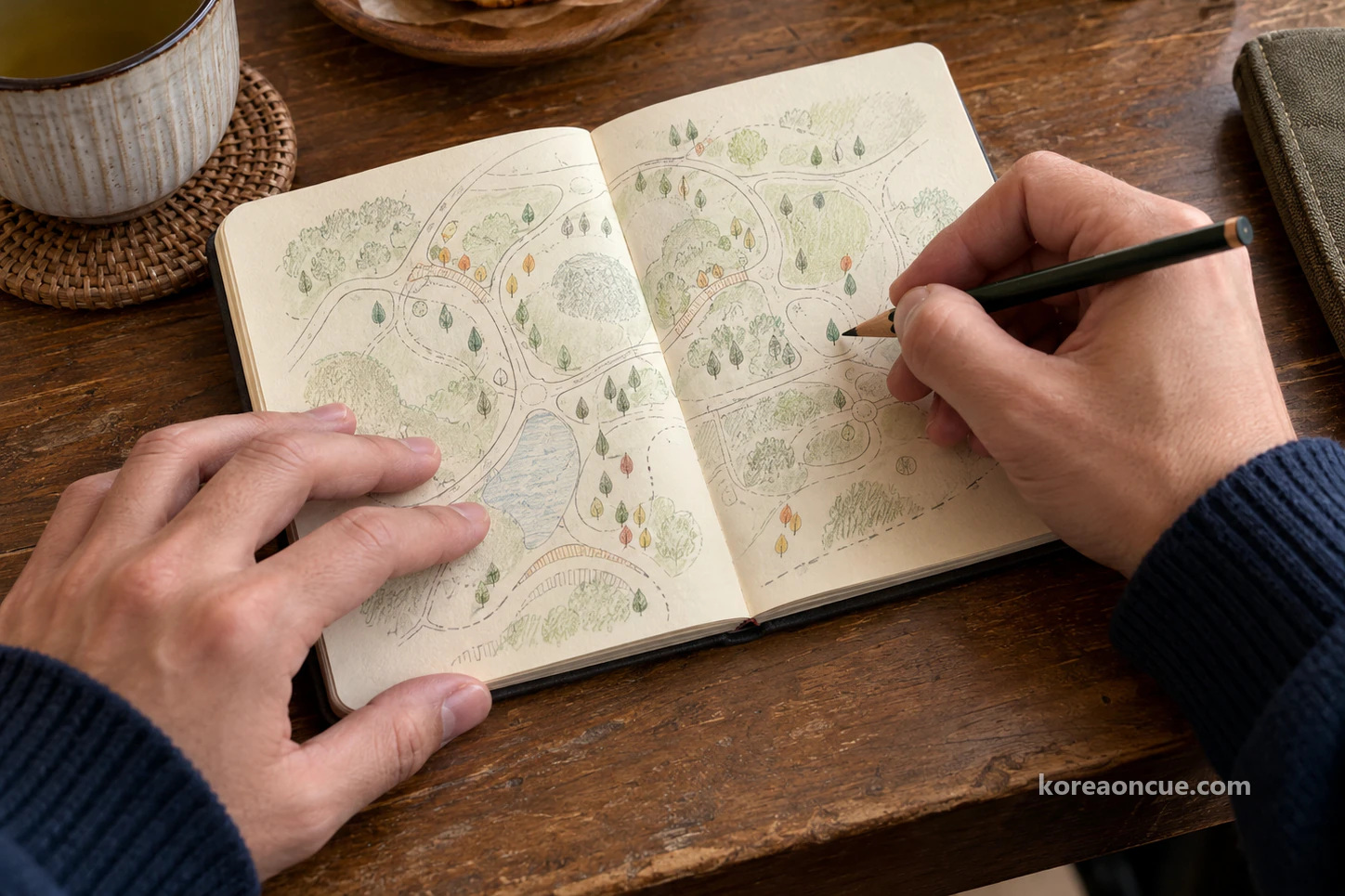
On the same floor, “Family of the Botanic Park” by donor artist Lee Seong-geun runs until 31 December 2026, and “A Tender Balance: Reflecting Each Other” continues until 16 May 2027 across Project Hall 2 in the Plant Culture Center, the greenhouse, the Theme Garden and the Magok Cultural Center. A workshop linked to that exhibition, artist Lee Ji-yeon’s “My Rainbow, Our Rainbow”, takes place on Saturday 7 November, the day after Noah’s visit, from 2 to 4 p.m. Bookings are taken through the public service reservation system listed in the park’s news. Noah writes these names in small letters beside the second floor on his page.
On the first floor, the garden support room has the plant showroom “Green, Within” until 8 November. It shows ideas for growing plants in water using clear takeaway cups, and the garden support room is open Tuesday to Sunday from 10 a.m. to 5 p.m. There is also a garden advice desk here, where you can ask the park’s gardeners when something puzzles you about the plants you grow. In the first week of November you can see the second-floor specimens and the first-floor showroom in one go, so Noah adds one more “17:00”, this time on the first floor.
The greenhouse ticket office on the basement level: winter ticket sales end at 4 p.m., lockers close at 5 p.m.
Leaving the second floor, Noah heads down to the basement level. Here are the greenhouse ticket office and entrance, the information desk, and the special and permanent exhibition rooms. Tickets for the greenhouse and theme gardens are sold here, and in winter sales end at 4 p.m. It is about half past two when Noah reaches the ticket office. Only after putting a small tick next to “16:00” in his notebook does he take his ticket.
With his ticket in hand, Noah starts to worry about his coat. The greenhouse is very warm inside, and a coat chosen for November air is bound to become a burden in there. Lockers are at the greenhouse ticket office entrance and in front of the car park lift (Nos. 13–40), on both sides of the first-floor greenhouse exit (Nos. 41–68), and at the Open Forest visitor centre (Nos. 1–12). Noah is about to put his coat in a locker by the ticket office entrance when he sees the opening hours and stops.
In winter the lockers can be used only from 9:30 a.m. to 5 p.m., and they close on Mondays. Outside those hours you cannot leave or collect anything. With today’s plan of walking the free areas after closing, that means he has to get his coat back out before 5 p.m., without fail. Noah writes “17:00 coat” in the clock column and underlines it twice before he hands the coat over to the locker.
If you leave bags on a November afternoon, remember this one thing. The greenhouse and theme gardens close at the same time as the lockers, 5 p.m., so if you stay in the gardens until the very end, it is easy to end up hopping anxiously in front of a locked locker. Setting aside the few minutes before closing for the lockers, as Noah does, takes the pressure off. Today his habit of writing times on maps has saved a whole coat.

Twelve cities in the greenhouse: four in the tropical zone and eight in the Mediterranean zone, on a world map
As he steps into the greenhouse, hot, humid air is the first thing to greet Noah. Seoul Botanic Park’s greenhouse shows plants from 12 cities around the world with tropical and Mediterranean climates. The tropical zone has Hanoi, Jakarta, São Paulo and Bogotá, and the Mediterranean zone has Barcelona, San Francisco, Rome, Tashkent, Athens, Perth, Istanbul and Cape Town. A greenhouse that sorts its plants by city names makes Noah grin from the entrance onwards.
Noah turns to a fresh page and draws a very rough world map. The outlines of the continents are wobbly, but good enough for marking cities. He puts the four tropical cities in as green dots and the eight Mediterranean cities as orange ones, and at a glance he can see how far apart on the globe these twelve cities are, gathered here under a single glass roof. There is not a single dot near Canada, but when he marks San Francisco he feels a small pang of fondness just because it is on the same continent.
The greenhouse holds about 3,700 kinds of flowers, leaves and fruit. Rather than trying to see all of them, try Noah’s approach and walk the twelve cities one after another, following their names. If you cross off each city as you finish it on the way from the tropical zone to the Mediterranean zone, you will not lose track of how far you have got. Noah writes the time he entered each city in small figures next to its dot, and later the gaps between those times show exactly where he lingered longest.
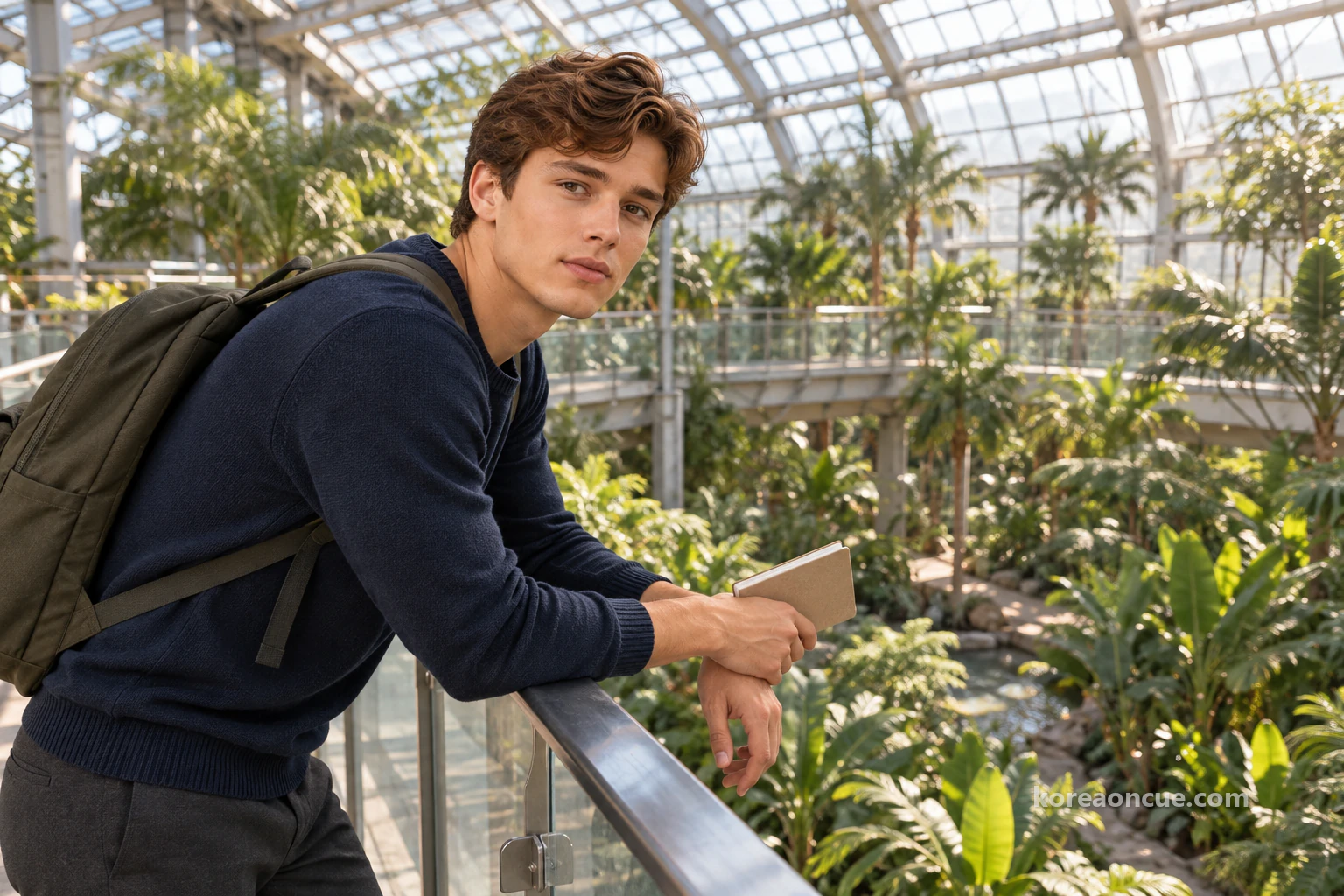
Do not miss the Skywalk, which runs across the top of the greenhouse. It is a footbridge passing above the greenhouse, a viewing route where you can look down over the tropical plants in one sweep. For Noah, this bridge is the most welcome spot of the day. Someone who draws maps always has to imagine the view from above, and here he can actually see it. On the bridge he copies down exactly how the paths inside the tropical zone link up.
It really is hot in the greenhouse. There are cooling fans at the entrances to the tropical and Mediterranean zones and at the Rome Square fountain, and air conditioning at the Rome Square rest area in the Mediterranean zone. Even with his coat left behind, Noah rolls up his sleeves while walking through the tropical zone. Cooling off for a moment at the Rome Square rest area, he draws a small snowflake beside the Rome dot on his world map. It is his own symbol for a cool spot, and the first thing he would want to tell the next visitor.
Eight theme gardens and the Magok Cultural Center: meeting December’s theme early in the Forest Garden
Leaving the greenhouse, Noah heads out into the theme gardens at around twenty to four. He wants to be inside the second area within the dotted line before the 4 p.m. entry cut-off. The theme gardens are divided into eight: the Wind Garden, Today’s Garden, Memory Garden, Contemplation Garden, Invitation Garden, Healing Garden, Gardener’s Garden and Forest Garden. Writing the eight names on his map, Noah realises that if the greenhouse is named after cities, these gardens are named after feelings and time.
The Wind Garden shows off the faraway feel created by grasses such as silver grass and reed grass, and the Memory Garden takes you back in time through plants that were once common but are now being forgotten. The Forest Garden recreates a traditional Korean forest with native and endemic species of the Korean Peninsula that are not widely known. The word “endemic” reminds Noah of December’s theme in the second-floor corridor. He has met the theme of next month’s specimens in the garden first.
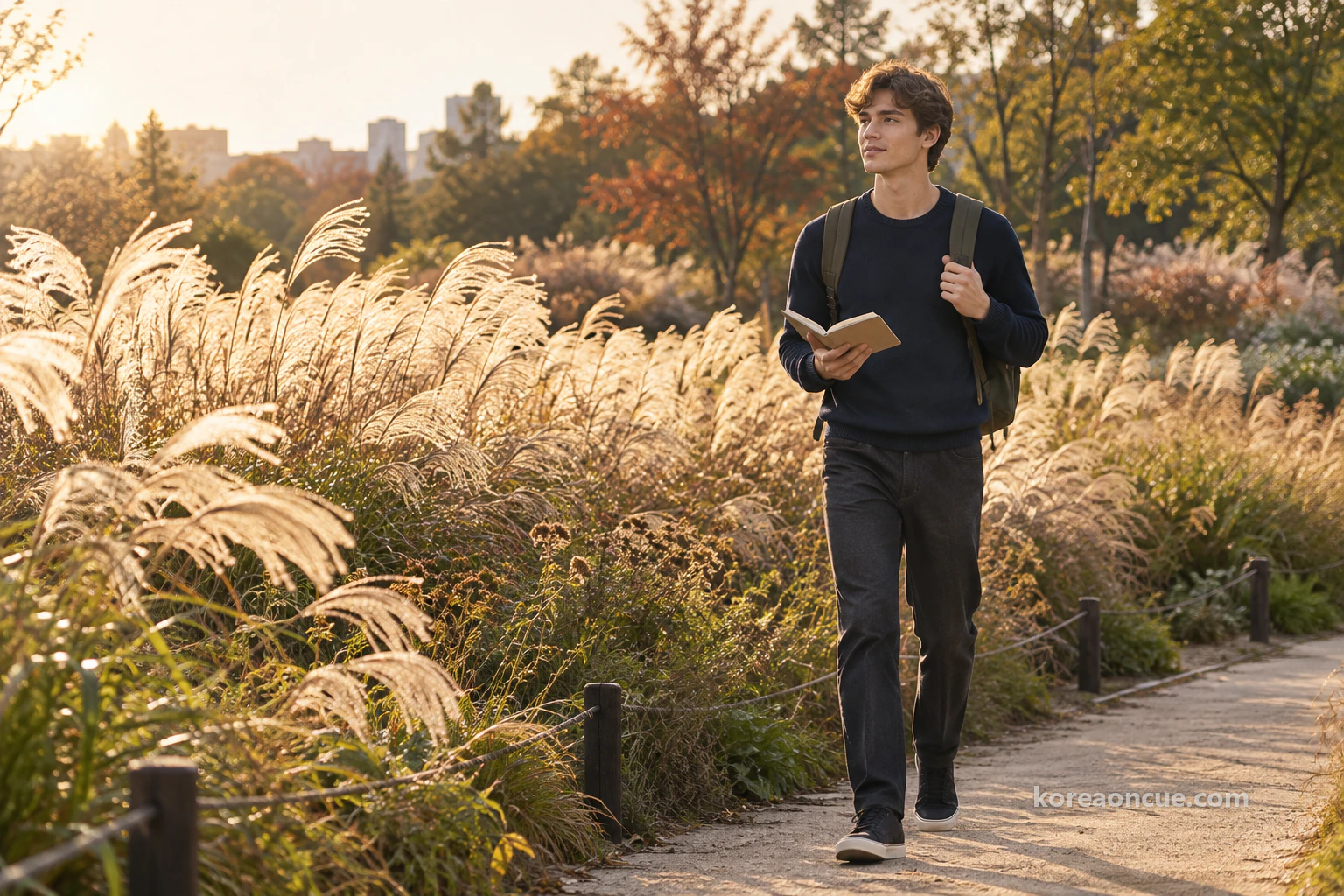
As he walks the gardens, Noah keeps checking the leaf marks he brought down from the second floor. Following the viewing spots on the labels, he watches thin lines appear one by one on his map, linking specimens on the wall to plants rooted in the ground. With the leaf shapes from the specimens in mind, he finds himself slowing down even in front of flowerbeds he would otherwise have walked straight past. The exhibition talked about looking closely at the plants we brush past every day, and this is how Noah is doing it, on his map.
The Theme Garden is also home to the Magok Cultural Center, a registered heritage building. It is the former drainage pumping station of the Yangcheon irrigation association, built in 1927–28 during the Japanese occupation, with a timber structure set on top of a concrete base up to four metres high. It fell out of use with urbanisation in the 1980s, and from 2017 it was reinforced and repaired and restored to its original form and structure. Drawn to the idea of a building that once pumped out water still standing inside a botanic park, Noah draws a small square on his map and labels it “old pump house”. On Noah’s maps, buildings that tell you what a piece of land used to be are always marked in bold.
In the Theme Garden you must not collect plants or soil or step off the visitor paths, and food and camera tripods are not allowed in. Each time he goes close to a flowerbed, Noah takes care not to let his feet stray off the path. Once it is past half past four, he closes his notebook and turns back towards the ticket office entrance to collect his coat.
The free areas after 5 p.m.: the seed library, the Lake Garden waterfront and the Wetland Garden’s Han River viewing deck
At about ten to five, Noah takes his coat out of the locker and crosses out “17:00 coat” in his notebook. Back up on the first floor, the seed library is still open. It is a library where you borrow seeds like books, grow them and then return seeds, with about 400 kinds of native seeds on display, and it opens from 9:30 a.m. to 5:30 p.m. Charmed by the idea of lending out seeds, Noah writes “17:30” on the first floor of his page and adds a single seed-shaped dot beside it. The door next to the seed library opens straight onto the sunken garden, with its benches and plants, which makes a good place to sit for a minute when your legs feel heavy.
Out of the Plant Culture Center, Noah’s map moves back outside the dotted line. The Lake Garden waterfront is a good place to take in the park’s scenery, the greenhouse included, at a single glance. From the waterfront Noah looks back towards the greenhouse he has just left. The glass building where he walked through twelve cities looks like one single block from outside, and Noah laughs to himself that he has drawn the same place twice, from inside and out.
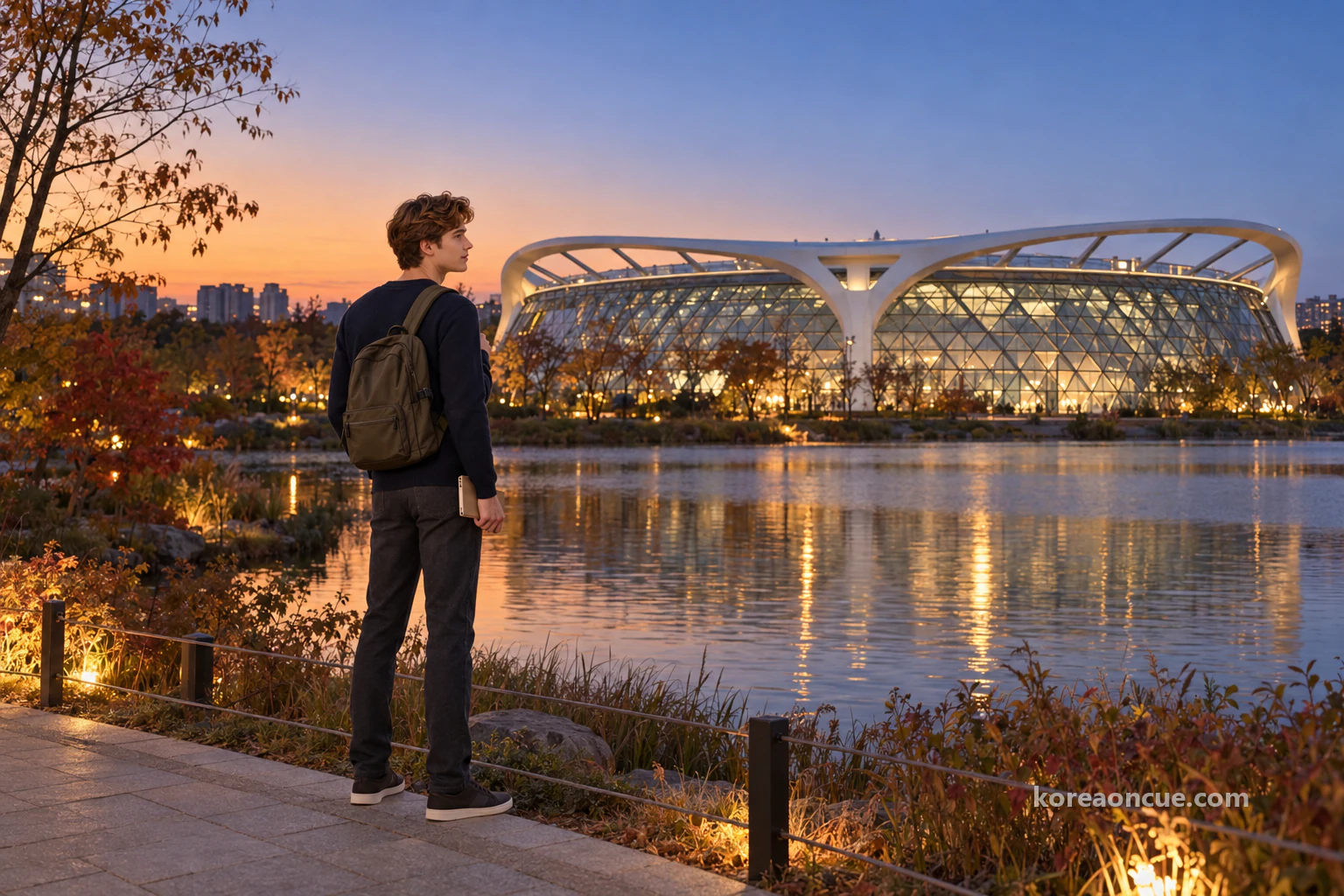
The Wetland Garden is where Seoul Botanic Park meets the Han River. It preserves natural succession as a space where many kinds of living things share the same ground, and you can also reach the park from the river through the Han River access tunnel. The Han River viewing deck is a footbridge passing over Olympic-daero, so from the deck you can watch the birds that live on the river. There is a bird-watching post in the Wetland Garden as well. At the very edge of his map, the spot furthest from the dotted line, Noah draws the Han River as a long stroke.
The free areas are open at all times with no closing days, so Noah does not draw a single clock on this outer route. Instead he just links arrows in the order he walks. That there is still this much to walk after the gates shut at 5 p.m. is the most useful thing today’s dotted line has taught him. If you visit Seoul Botanic Park on a short November afternoon, try walking the paid areas first and the free areas afterwards.
Back to Magongnaru Station: sending Hina the third time map, the one with a dotted line
Back in the Open Forest, Noah stops at the edge of the lawn and runs his eye over today’s map from the beginning. The line that started at the little circle for Magongnaru Station passes the lawn and the Lake Garden boardwalk, goes up and down through the floors of the Plant Culture Center, slips inside the dotted line, comes back out just before 5 p.m. and stretches all the way to the Han River. Inside the dotted line the clocks are packed tight, and outside there are only arrows. The second floor has its leaf marks, and the world map has twelve dots and a single snowflake.
Tucked into the very back of Noah’s notebook is still the map Hina gave him at Ttukseom on Halloween night, the one with times written along the route. Since then, Noah has stacked closing times like stairs on the Gyeongchun Line Forest Trail, and at Yangnyeongsi he kept the rubbed-out line and the corrected one on the same page. Today is the first time he has split places with times from places without them using a single line. He takes a photo of the page and sends it to Hina in Tokyo. “This time I used a dotted line to split the places with clocks from the places without.”

The reply arrives before Noah reaches the entrance plaza by the station. “The outside of the dotted line is bigger. That’s the part where you can take your time, right?” Before closing his notebook, under “Dec = endemic plants” beside the second floor, Noah leaves a blank space for the leaf marks he will add in the same corridor a month from now. If you visit Seoul Botanic Park in November, walk the inside of the dotted line first, before 4 p.m., and after the gates close, wander slowly out past the lake and towards the Han River, outside the line.
Common Mistakes
Spending all your time in the free areas
the Open Forest, Lake Garden and Wetland Garden are free at all times, but the greenhouse and theme gardens stop entry and ticket sales at 4 p.m. from November to February. Walk the paid areas first.
Turning up at the ticket office at half past four
winter ticket sales end at 4 p.m. Do not confuse this with closing time (5 p.m.).
Leaving bags in a locker and staying in the gardens until the end
the lockers run 09:30–17:00 in winter, and you cannot collect anything outside those hours.
Walking into the greenhouse in a heavy coat
it is very warm inside. There are cooling fans at the tropical and Mediterranean zone entrances and the Rome Square fountain, and air conditioning at the Rome Square rest area in the Mediterranean zone.
Going on a Monday
the greenhouse and theme gardens close every Monday (the following day when Monday is a public holiday). The free areas are open every day of the year.
Taking snacks or a tripod into the Theme Garden
inside the Theme Garden, bringing in or eating food, camera tripods and pets (except guide dogs) are not allowed.
Assuming “Greening Days” needs a ticket
the specimen exhibition in the wall display space on the second floor of the Plant Culture Center is free.
FAQ
How do I get there?
Exits 3 and 4 of Magongnaru Station (Line 9 and AREX) lead straight into the Open Forest. For the Theme Garden side, it is a 10-minute walk from Yangcheon Hyanggyo Station (Line 9) Exit 8. The address is 161 Magokdong-ro, Gangseo-gu, Seoul.
Which parts are free?
The Open Forest, Lake Garden and Wetland Garden are free at all times and open every day of the year. Admission applies only to the greenhouse and theme gardens. “Greening Days” on the second floor of the Plant Culture Center is free as well.
How much is admission?
For the greenhouse and theme gardens, adults (19 to 64) pay ₩5,000, youth (13–18) ₩3,000 and children (6–12) ₩2,000. Tickets are valid only on the day of purchase.
How late can I go in during November?
From November to February the greenhouse and theme gardens open 09:30–17:00, with entry and ticket sales ending at 16:00. They close on Mondays.
When and where is “Greening Days”?
From 23 September to 31 December 2026, in the wall display space along the corridor beside Project Hall 2 on the second floor of the Plant Culture Center. November has 16 specimens of 15 rare plants, and December has 18 specimens of 15 endemic plants.
Can I see the real plants after the specimens?
Each specimen’s label lists the plant name, key features and a photo in flower, along with where to see it in the park. Note those places and look for the plants in the gardens.
Can I borrow a pushchair or wheelchair?
Both are available at the visitor centre and the Plant Culture Center information desk (ID required). Pushchairs go first come, first served to visitors with children under 36 months, and wheelchairs go first to disabled visitors with limited mobility.
Who do I contact with questions?
Seoul Botanic Park, 02-2104-9716.
Recap — 30 seconds before you go
- Magongnaru Station Exits 3 and 4 → straight into the Open Forest entrance plaza → Lake Garden wetland boardwalk → Plant Culture Center.
- Free: Open Forest, Lake Garden and Wetland Garden (open every day) + “Greening Days” on the second floor of the Plant Culture Center.
- Paid: greenhouse and theme gardens, ₩5,000 for adults, November–February 09:30–17:00 · entry and ticket sales until 16:00 · closed Mondays.
- “Greening Days” until 31 December, November: 16 specimens of 15 rare plants — note “where to see it in the park” on the labels.
- Paid areas first, free areas after closing · collect locker bags before 17:00.
Sources
- Seoul Botanic Park news — “Greening Days: Plants Become Everyday”23 September – 31 December 2026 · wall display space on the 2nd floor of the Plant Culture Center (corridor beside Project Hall 2) · free · a specimen exhibition alongside the garden support room’s plant showroom · November: 16 specimens of 15 rare plants designated by the Korea Forest Service; December: 18 specimens of 15 endemic plants · labels with plant name, key features, a flowering photo and where to see the plant in the parkchecked 2026-10-27
- Seoul Botanic Park — Visitor information and admissionAdmission applies only to the greenhouse and theme gardens; the Open Forest, Lake Garden and Wetland Garden are always free and open every day · adults ₩5,000, youth ₩3,000, children ₩2,000, valid on the day of purchase · winter (November–February) 09:30–17:00, last entry 16:00 · closed Mondays · items not allowed in the Theme Gardenchecked 2026-10-27
- Seoul Botanic Park — Getting here by subwayMagongnaru Station (Line 9 and AREX) Exits 3 and 4 connect to the Open Forest · Yangcheon Hyanggyo Station (Line 9) Exit 8, 10 minutes on foot to the Theme Garden · Magok Station (Line 5) Exit 3, 20 minutes on foot to the Open Forestchecked 2026-10-27
- Seoul Botanic Park — Plant Culture CenterGreenhouse and support building (Botanic Hall, plant library, project halls) · Project Hall 2 on the 2nd floor · greenhouse ticket office, information desk and exhibition rooms on B1 · the Skywalk · the seed library (about 400 native seed varieties, 09:30–17:30) · the sunken gardenchecked 2026-10-27
- Seoul Botanic Park — GreenhouseFour tropical cities (Hanoi, Jakarta, São Paulo, Bogotá) and eight Mediterranean cities · cooling fans at the tropical and Mediterranean entrances and the Rome Square fountain, air conditioning at the Rome Square rest areachecked 2026-10-27
- Seoul Botanic Park — Theme GardenOutdoor gardens recreating traditional Korean gardens with native plants, plus the greenhouse · eight theme gardens (Wind Garden, Memory Garden, Forest Garden and more) · Magok Cultural Center, a registered heritage former drainage pumping stationchecked 2026-10-27
- Seoul Botanic Park — LockersWinter (November–February) 09:30–17:00 · closed Mondays · no storing or collecting outside opening hourschecked 2026-10-27
- Seoul Botanic Park — HistoryOpened to the public 11 October 2018 · officially opened 1 May 2019 · registered in 2021 as Seoul’s second public arboretumchecked 2026-10-27
A Seoul story told with our AI characters. Place details are checked against public sources; the photos are AI-made illustrative images. How we use AI
Next Cue
Rina walks Gyeonghuigung on a late-autumn afternoon, six boxes from Heunghwamun to Seoam
At Changdeokgung, Rina learned the name “Eastern Palace”, and she has wondered ever since about its partner, the “Western Palace”.

The first walk for three: Rina brings Maya and Mali together at Boramae Park in late autumn
To the message “Next trip, a morning, the forest path, the three of us”, Maya replied, “Let’s choose somewhere new for the first walk of the three of us.” The place they chose was Boramae Park, on the site of the old Korea Air Force Academy, where eight aircraft stand beside the lawn.

Harmony on the 1st floor, Network on the 2nd: Noah’s time map of the Seoul Science Center, drawn floor by floor
Noah’s time maps have always been drawn on streets.