
SEOUL · JEONGDONG
Rina walks Gyeonghuigung on a late-autumn afternoon, six boxes from Heunghwamun to Seoam
About 460 m from Seodaemun Station Exit 4 — how to see Seoul’s free “Western Palace” in the order Heunghwamun → Geumcheongyo → Sungjeongjeon → Jajeongjeon → Taeryeongjeon → Seoam
At Changdeokgung, Rina learned the name “Eastern Palace”, and she has wondered ever since about its partner, the “Western Palace”. The day after the three friends first walk a park together, Rina goes to Gyeonghuigung on her own and decides to write down each building’s name and use, one box at a time.

How to get there
Rina is the kind of traveller who reads the name on every building first when she visits a palace. She is 23 and from Japan, and her notebook is divided into boxes, a set for each place. At the top of each box she writes the building’s name, and underneath, one line on what the building was for. With name and use written side by side, even a palace she is seeing for the first time soon turns into a map in her head. That is why, on the palace pages of Rina’s notebook, the squares catch the eye before the writing does.
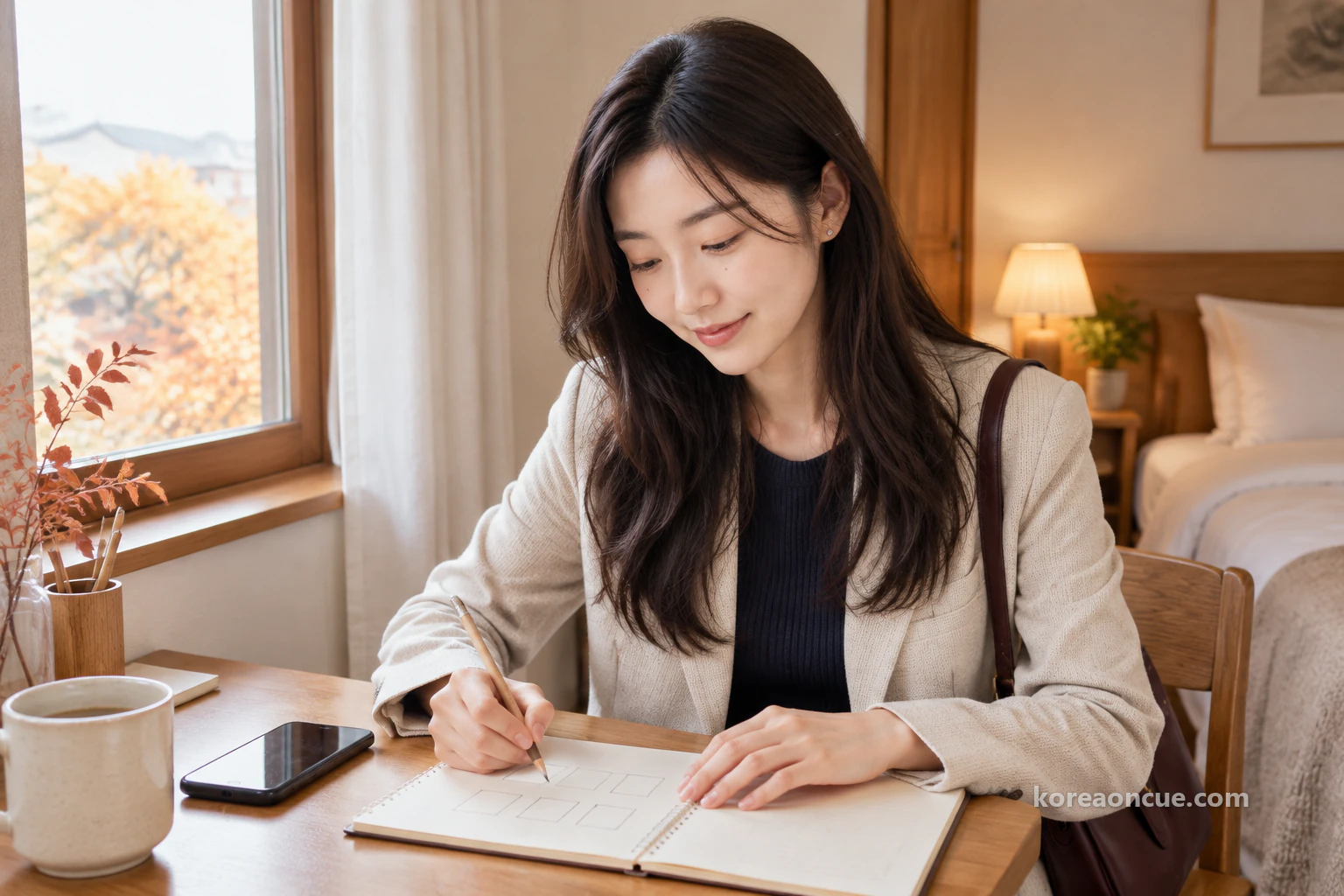
Yesterday, Rina walked Boramae Park with Mali and Maya, the first time the three of them had been out together. It was the day she introduced Mali and Maya to each other, and she spent the whole day listening to the two of them, so her notebook stayed almost empty. Today, leaving yesterday’s happy noise behind, she has decided to spend the day filling boxes slowly on her own. Leafing through the notebook, Rina finds a line she once wrote at Injeongjeon in Changdeokgung. It is a short note that has stayed with her for a long time: Changdeokgung and Changgyeonggung together were called the “Eastern Palace”.
If there was an east, she thought, there ought to be a west, so back then she put a question mark beside that line. The answer to that question mark, and the place Rina is heading for today, is Gyeonghuigung. Because it stood in the west of the walled capital, Gyeonghuigung was also called “Seogwol”, the Western Palace. It is the partner of “Donggwol”, the Eastern Palace, the name given to Changdeokgung and Changgyeonggung together. Having already walked the Eastern Palace, Rina wants to walk its western partner herself and compare the two.
Today’s walk covers just one place, Gyeonghuigung. You come out of Seodaemun Station Exit 4 on Line 5, walk to the main gate, Heunghwamun, and then see Heunghwamun → Geumcheongyo → Sungjeongjeon → Jajeongjeon → Taeryeongjeon → Seoam in that order. These are the six places introduced by the Seoul Museum of History, which runs Gyeonghuigung, and they appear here in that same order. This piece splits the six into separate boxes, like Rina’s notebook, and gives each one’s name and use together. It also covers how late it is open, which days have guided tours, and what not to bring in.
The Cue
Gyeonghuigung, at 45 Saemunan-ro, Jongno-gu, Seoul, is a Historic Site. It was a secondary palace where kings stayed in the late Joseon period, and because it stood in the west of the capital, it was also called the Western Palace. The Seoul Museum of History runs it as a branch, and admission is free. It opens from 9 a.m. to 6 p.m., with last entry at 5:30 p.m. It is closed every Monday and on 1 January. From Seodaemun Station Exit 4 on Line 5 to Heunghwamun is about 460 m, roughly a 7-minute walk.
- Station and exit: Seodaemun Station (Line 5) Exit 4 → about 460 m to Heunghwamun, roughly a 7-minute walk. From Gwanghwamun Station (Line 5) Exit 7, about 720 m, roughly a 10-minute walk.
- Address: 45 Saemunan-ro, Jongno-gu, Seoul. Right next to the Seoul Museum of History.
- Hours: 09:00–18:00, last entry 17:30.
- Closed: Every Monday, and 1 January.
- Admission and enquiries: Free. 02-724-0274 to 0276.
- Worth seeing: ① the stone beasts on the railings of Geumcheongyo ② the main hall, Sungjeongjeon, and the council hall, Jajeongjeon, one after the other ③ Seoam, the rock behind Taeryeongjeon.
- Guided tours: Fridays at 2 p.m. and 3 p.m., Saturdays at 1, 2 and 3 p.m., and Sundays every 30 minutes from 1 p.m. to 3 p.m.
- Leave behind: Visitors are asked not to bring in food or drink such as coffee, soft drinks and snacks.
Which exit? About 460 m from Seodaemun Station Exit 4, roughly a 7-minute walk
For Gyeonghuigung, the nearest exit is Seodaemun Station Exit 4 on Line 5. From Exit 4 to the main gate, Heunghwamun, is about 460 m. It takes roughly 7 minutes on foot. The first line in Rina’s notebook is her usual three-part note of station, exit and time. It reads “Seodaemun — 4 — about 7 min”, and beside it she writes a small 6, the number of boxes for today.
Open in Kakao Map — Gyeonghuigung
Rina comes out of Exit 4 a little after 2 p.m. As this is her first time on this route, she pins “Gyeonghuigung Heunghwamun” on her phone map before she leaves the ticket gates. If you search by address in a map app, enter “45 Saemunan-ro”. 55 Saemunan-ro is the address of the main Seoul Museum of History building, so use 45 to avoid any mix-up. Rina writes the two numbers side by side in her notebook too, and circles only 45, Gyeonghuigung’s address.
If you are coming from the Gwanghwamun side, you can also use Gwanghwamun Station Exit 7 on Line 5. From Exit 7 to Heunghwamun is about 720 m, roughly a 10-minute walk. It is a little further than from Seodaemun Station, but it works well if you are finishing other plans near Gwanghwamun. Whichever way you come, if you are going late in the afternoon, check the time first. Gyeonghuigung closes at 6 p.m., and last entry is at 5:30 p.m.
What kind of palace is Gyeonghuigung? The Western Palace, and its first name, Gyeongdeokgung
In front of Heunghwamun, before filling in any boxes, Rina first sorts out the name of the palace as a whole. Building work on Gyeonghuigung began in 1617, the 9th year of Gwanghaegun’s reign. Before that, this site held the house of Prince Jeongwon, the father of King Injo. A story has come down that the land carried the energy of a king, so the house was taken and a palace built in its place. Rina writes this story not inside a box but separately, in the margin.
Today it is called Gyeonghuigung, but the palace’s first name was Gyeongdeokgung (慶德宮). In Korean, though, that sounded the same as “Gyeongdeok (敬德)”, the posthumous title of Wonjong, King Injo’s father. So in 1760, the 36th year of Yeongjo’s reign, the name was changed to Gyeonghuigung. Seeing the two sets of characters side by side on the information board, Rina cannot help a small laugh. 慶 and 敬 are both read “kei” in Japanese too, so the idea of the sounds overlapping makes sense to her straight away.
At the top of her notebook, Rina writes “慶 = 敬 = けい”. A name changed because two different characters sounded the same is a story Rina, who reads kanji by their sound, finds especially fun. At Unhyeongung last time, too, she spotted the 老 in all three building names by its Japanese reading first. Reading a name once by sound and once by meaning is how Rina reads a palace. Today, she decides to fill all six boxes that way.
Gyeonghuigung was once quite a large palace, and kings used it as a secondary palace for ten reigns, from Injo to Cheoljong. A secondary palace, or igung, is a palace kept apart from the main palace where the king lived. It had some 100 buildings, large and small, including Sungjeongjeon, the jeongjeon or main hall, Jajeongjeon, the pyeonjeon or council hall, and Yungbokjeon and Hoesangjeon, the chimjeon or royal living quarters. In that sentence, Rina underlines three words: jeongjeon, pyeonjeon and chimjeon. They will be how she divides up today’s boxes.
Box one, Heunghwamun: the main gate, and a gate that has moved twice
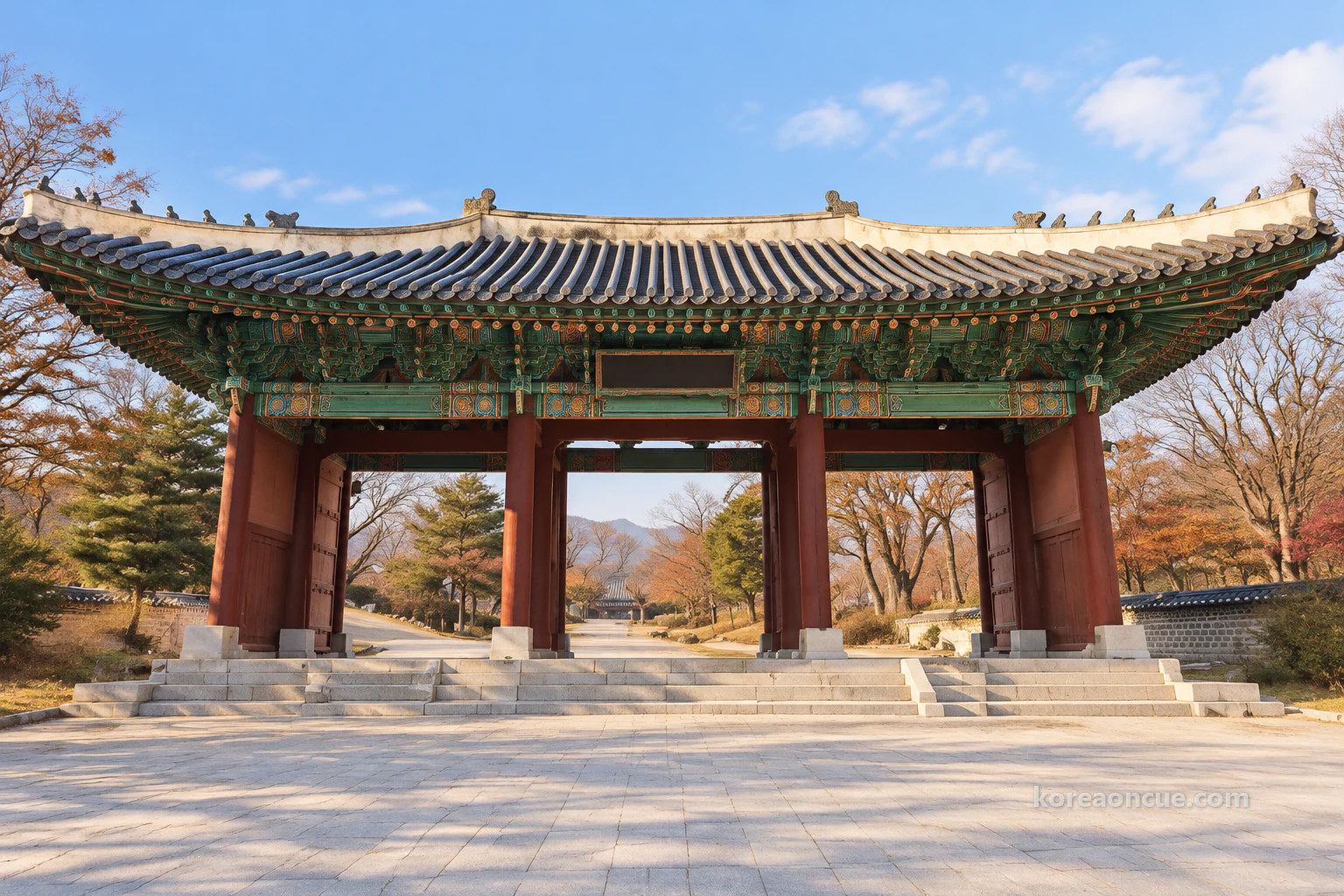
The first box is the main gate, Heunghwamun. It is the main gate of Gyeonghuigung and is designated a Seoul Metropolitan City Tangible Cultural Heritage. Rina writes “Heunghwamun” at the top of the box and “main gate” underneath. But this gate has more history than a single box can hold. That is because where it stands now is not where it first stood.
Heunghwamun originally stood east of Geumcheongyo, facing east. That spot is where the Salvation Army building stands today. But in 1932, Japan took the gate away to use as the main gate of Bakmunsa, a shrine to Itō Hirobumi. After Korea’s liberation, Bakmunsa was abolished, and Yeongbingwan, a guesthouse, went up on the site, followed by the Shilla Hotel. All that time, Heunghwamun stayed on as the main gate of places that were not a palace.
Heunghwamun came back to the Gyeonghuigung site during the palace restoration project. But the Salvation Army building already stood on its original spot. So there was no choice but to restore it where it is now, about 100 m west of its original position. Rina draws another line under the Heunghwamun box to make it bigger. She writes “The gate that moved”, and draws three arrows for the places the gate has been.
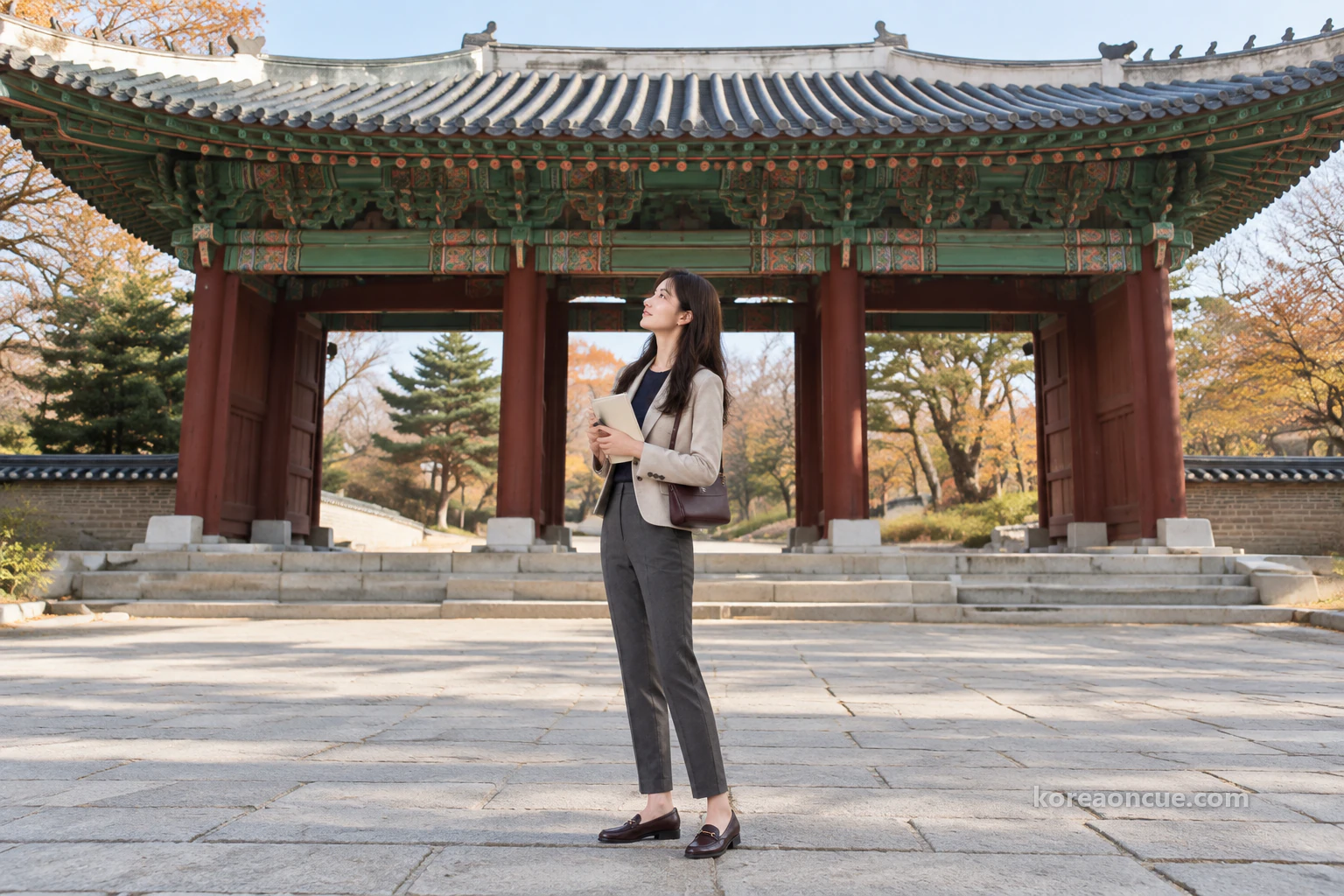
Rina stands under the gate and looks up at the eaves first. Heunghwamun is a large gate, open between its pillars, so walking under it is a good moment to look up at the eaves and the dancheong, the painted decoration. The same red pillars and blue-green dancheong appear again at Sungjeongjeon, Jajeongjeon and Taeryeongjeon further in. On a first visit, stop under the gate for a moment and look up at the eaves. It gives you something to compare the halls you see later against.
Box two, Geumcheongyo: a stone bridge guarded by stone beasts and dokkaebi faces
The second box is the stone bridge you reach after the main gate, Geumcheongyo. It is a stone bridge laid over the Geumcheon, a stream that once flowed through the palace. Today it is right in front of the Seoul Museum of History, so it is easy to find. It was first built in 1619, the 11th year of Gwanghaegun’s reign, but Japan buried it underground. The Seoul Metropolitan Government restored it as it is today, based on old stones found in excavations in 2001.
What to see at Geumcheongyo is the railing. Stone beasts sit on the railing, and dokkaebi faces — goblin figures from Korean folklore — are carved between the hongye arches under the bridge. A hongye is a stone structure built up into a rounded arch, like a rainbow. The stone beasts and dokkaebi faces were meant to keep bad energy from outside the palace from getting in. Rina crouches in front of the stone beast at the end of the railing and looks it in the face for a long time.

In the Geumcheongyo box, Rina writes “Stone bridge / gatekeeper”. It strikes her that the main gate is where people come and go, while Geumcheongyo is a bridge that filters out bad energy. With the two boxes side by side, she sees she has crossed a boundary twice on the way into the palace. On a first visit, do not just walk across the bridge — look for the stone beast at the end of the railing first. That is where you first see how this palace divided the outside from the inside.
Box three, Sungjeongjeon: the main hall for royal audiences and coronations
The third box is the biggest building of the day, Sungjeongjeon, the main hall of Gyeonghuigung. The jeongjeon is the most central building in a palace. It is where the king held audiences with his officials, hosted court banquets, received envoys and carried out other official ceremonies. Step through Sungjeongmun, the gate in front, and Sungjeongjeon is straight ahead. Rina stops just inside the gate and takes in the whole hall, standing on its two-tier stone terrace at the far end of a wide stone courtyard.

Sungjeongjeon is also where three kings, Gyeongjong, Jeongjo and Heonjong, held their coronations. It was first built around 1618, the 10th year of Gwanghaegun’s reign. It was a building five bays wide and four bays deep. Rina writes “Sungjeongjeon” at the top of the box and “main hall — where everyone gathers” underneath. Beside it, in small writing, she adds the names of the three kings crowned here.
But the Sungjeongjeon in front of Rina now is not the building first put up here. In 1926, Japan sold the original Sungjeongjeon to a Japanese Buddhist temple. That building is used today as Jeonggakwon at Dongguk University. The Sungjeongjeon on this site was restored in 1991, using platform stones found in excavations, among other things. In a corner of the box, Rina writes small: “The original is somewhere else”.
As befits a main hall, the inside of Sungjeongjeon is arranged around the king’s seat. Inside, on the raised dais called a dangga, is the yongsang, the throne where the king sat. Behind it, a curved screen called a gokbyeong and the Irworobongbyeong screen enclose the seat. The Irworobongbyeong is a screen painted with the sun, the moon and five peaks. And on the coffered ceiling, laid out like the character 井, two dragons facing each other are carved.
In front of Sungjeongjeon, try changing where you stand twice. First, stand just inside Sungjeongmun, and the courtyard, the two-tier terrace and the hall on top fit into one view. Then walk a little closer, and the red pillars and green lattice doors and windows come up close. From far away you see the size of the main hall, and from close up its colours and grain. Rina, too, stops once at each spot and draws two small pictures in the Sungjeongjeon box.
Looking up at Sungjeongjeon’s roof from the courtyard, Rina thinks of Injeongjeon at Changdeokgung. The main hall she saw at the Eastern Palace also stood high at the end of a wide stone courtyard like this. But the main hall of the Western Palace is a building that once left and now stands again on excavated stones. Before closing her notebook, Rina takes in the red of the pillars and the green of the lattice one more time. She wonders what name Mali would give this green.
Box four, Jajeongjeon: the council hall where the king worked with his officials
The fourth box is the council hall, Jajeongjeon. The pyeonjeon was where the king held meetings with his officials or gyeongyeon sessions, dealing with affairs of state day by day. A gyeongyeon was a session where the king read and studied books together with his officials. If the main hall is the big stage where everyone gathers, the council hall is closer to the room where the king worked every day. So as not to forget the difference, Rina writes the two boxes right next to each other.
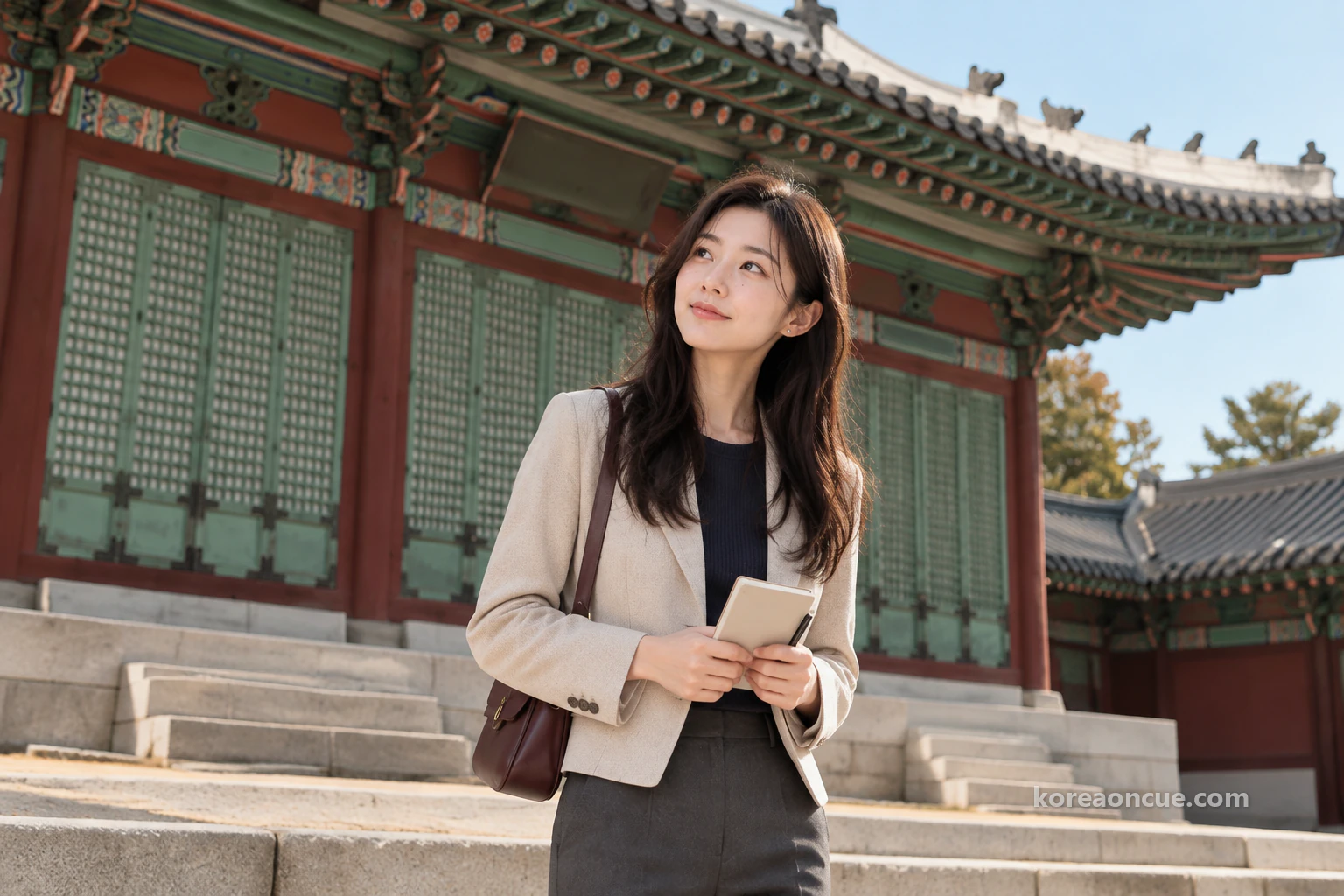
A new line appears in the notebook: “Main hall = where everyone gathers / council hall = the room where work gets done”. Rina decides this is the most useful line she has written today. At another palace next time, if she finds the main hall and the council hall first, she can picture the king’s day there. Even on a first palace visit, know just these two words and the buildings feel far less unfamiliar. Remember the tall building at the end of the big courtyard as the main hall, and the building you reach next as the council hall.
Jajeongjeon had other uses too. After King Sukjong died, it served as the binjeon, where the coffin rested during the royal funeral. Portraits or memorial tablets of earlier kings were also kept here for a time. A royal portrait is called an eojin, a word that comes up again at Taeryeongjeon, the next stop on the walk. Adding one use after another under the council hall box, Rina laughs when she sees how quickly it has filled up.
Jajeongjeon was built between 1617 and 1620, the 9th to 12th years of Gwanghaegun’s reign, and was damaged by Japan. The present building was restored in 1998 following “Seogwoldoan”, an old drawing of the palace. The covered corridors around it were restored in the same year. West of Jajeongjeon, jeondol, the bricks once laid on the floor, turned up during excavation. So that spot was restored to keep the look it had when it was excavated.
Box five, Taeryeongjeon: where King Yeongjo’s portrait was kept
The fifth box is Taeryeongjeon, introduced after Jajeongjeon. Taeryeongjeon is where the portrait of King Yeongjo was kept. At first, it was a building with no particular use assigned. Then, when a new portrait of Yeongjo was painted, the building was repaired in 1744, the 20th year of Yeongjo’s reign, and the portrait was enshrined here. After Yeongjo died, it was also used as a honjeon.
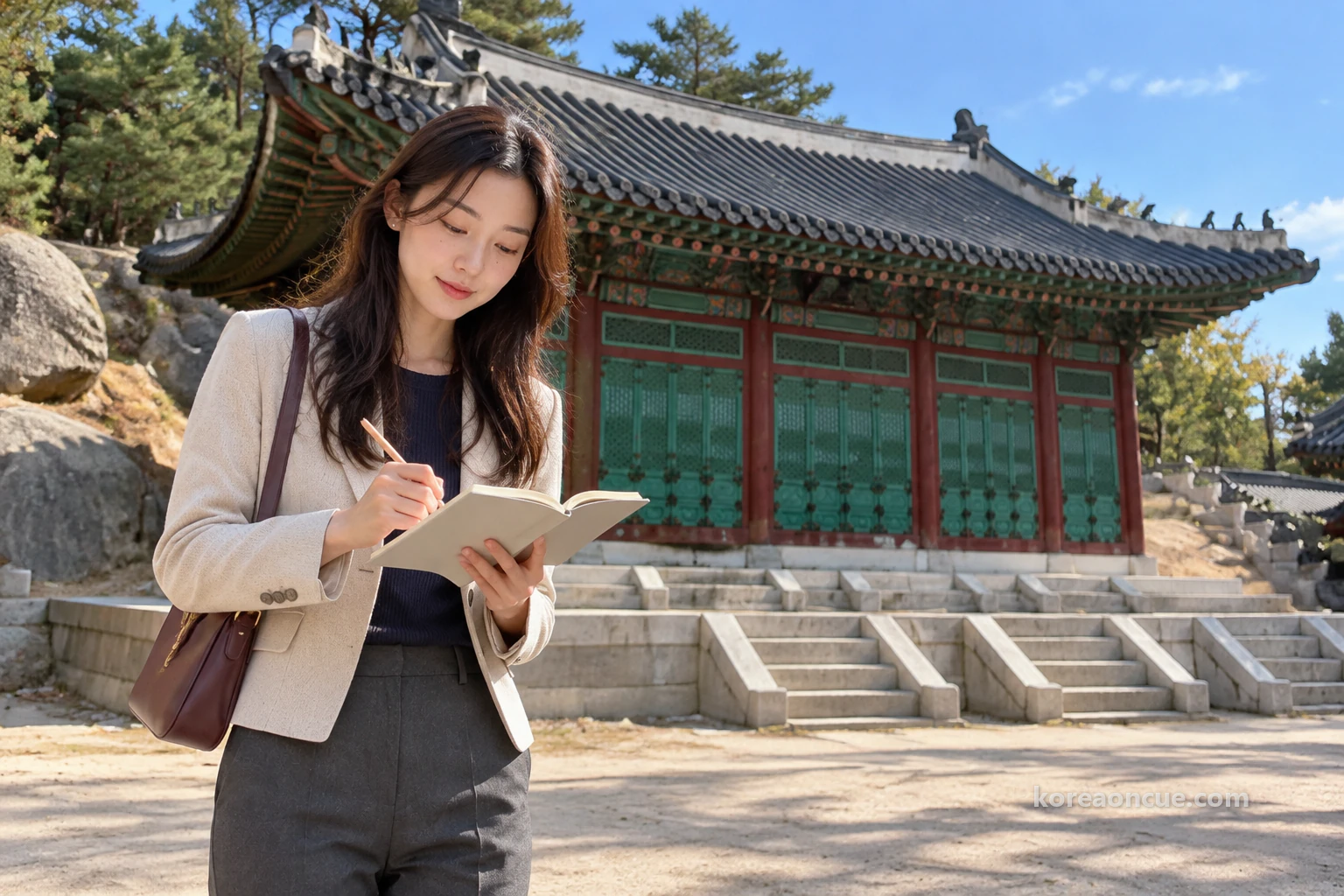
A honjeon was where the spirit tablet was kept after the funeral. In the Taeryeongjeon box, Rina writes “A building whose use came later”. The three boxes before it, whether gate, bridge or main hall, were places with a job set from the start. But Taeryeongjeon’s name and use only became clear together once the portrait arrived. Rina likes that, and goes over the edge of the box once more.
The present Taeryeongjeon was restored in 2000, together with the compound around it. It is a building five bays wide and two bays deep. Once again, the basis for restoration was “Seogwoldoan”, the same as for Jajeongjeon. It is much smaller than Sungjeongjeon, which she has just seen, so standing in front of it, the whole area feels quiet. Here Rina closes her notebook for a moment and looks towards the rock visible behind the building.
Box six, Seoam: the rock with a spring behind Taeryeongjeon, from Wangam to Seoam
The sixth box is Seoam, the rock behind Taeryeongjeon. It is a strangely shaped rock, and inside it is a spring called Amcheon. That is why it has long been counted as one of Gyeonghuigung’s famous sights. The lower part of the big granite rock is hollowed in like a cave, and finding that gap is part of the fun. Before writing the name of the box, Rina stands in front of the rock, pencil in hand, and just looks at it for a long time.

The rock’s original name was Wangam (王巖), “King Rock”. There is also a popular belief that Gwanghaegun built a palace here because of that name. In 1708, the 34th year of Sukjong’s reign, the name was changed to Seoam (瑞巖). Sukjong wrote the two characters “瑞巖” large in his own hand and had them carved. The square stone base, the sabangseok, that bore those characters is not beside the rock now but at the National Palace Museum of Korea.
In the Seoam box, Rina writes “王 → 瑞”. In Japanese, 王 is read “ō” and 瑞 “zui”. The sounds are nothing alike, but read by meaning, a rock that once stood for “king” has become an auspicious rock that brings good fortune. Set beside the story of Gyeongdeokgung becoming Gyeonghuigung, this palace turns out to have two stories of changed names. Rina joins this line to “慶 = 敬” in her first line with an arrow.
From some 100 buildings to the six places that remain
With all six boxes filled, Rina draws three more boxes on the back page. They are for the three words she underlined today: jeongjeon, pyeonjeon and chimjeon. In the main hall box she writes Sungjeongjeon, and in the council hall box Jajeongjeon. But there is no building for the chimjeon box among the six places she walked today. The names of the living quarters, Yungbokjeon and Hoesangjeon, survive, but no living quarters are among the six places the Seoul Museum of History introduces.
Leaving the living-quarters box empty, Rina looks up how a palace of some 100 buildings came to this, and notes it down. When Heungseon Daewongun rebuilt Gyeongbokgung, he moved a large share of Gyeonghuigung’s buildings there. When Japan built a school inside the palace, most of the remaining buildings, Sungjeongjeon among them, were torn down. At that time, the palace grounds were also cut to about half. Later, more than 25,000 pyeong (a Korean unit of area) of the Gyeonghuigung site was split off to build official residences for the Monopoly Bureau, and Gyeonghuigung faded from people’s memory.
The fading palace began to recover its shape in the 1980s. In September 1980, the Gyeonghuigung site was designated a Historic Site. In 1986, the Seoul Metropolitan Government decided to build a city museum here and took over the site. Excavations followed several times from 1985, and the main hall area, Sungjeongjeon included, was restored and opened to the public in 2002. The Seoul Museum of History was also built within the Gyeonghuigung site that same year.
After reading this history, Rina looks again at what she wrote in the Heunghwamun and Sungjeongjeon boxes: “The gate that moved” and “The original is somewhere else”. Each of the six places she saw today came by its own road, and each lets you picture something of the palace as it once was. Perhaps that is why, to Rina, the empty living-quarters box looks less empty than still waiting. She writes nothing in it, leaving just the outline, runs her eyes over today’s six boxes once more and closes the notebook.

When are the guided tours? Friday to Sunday afternoons, and one thing to keep in mind as you walk
To join a guided tour at Gyeonghuigung, go on a Friday, Saturday or Sunday afternoon. On Fridays, tours are at 2 p.m. and 3 p.m. On Saturdays, they are at 1, 2 and 3 p.m. On Sundays, they are at 1, 1:30, 2, 2:30 and 3 p.m. Fridays and Saturdays are led by Korea Rediscovery’s Uri Gunggwol Jikimi (02-723-4206), and Sundays by Uri Munhwa Sumgyeol’s Gunggwol Gilrajabi (02-735-5733).
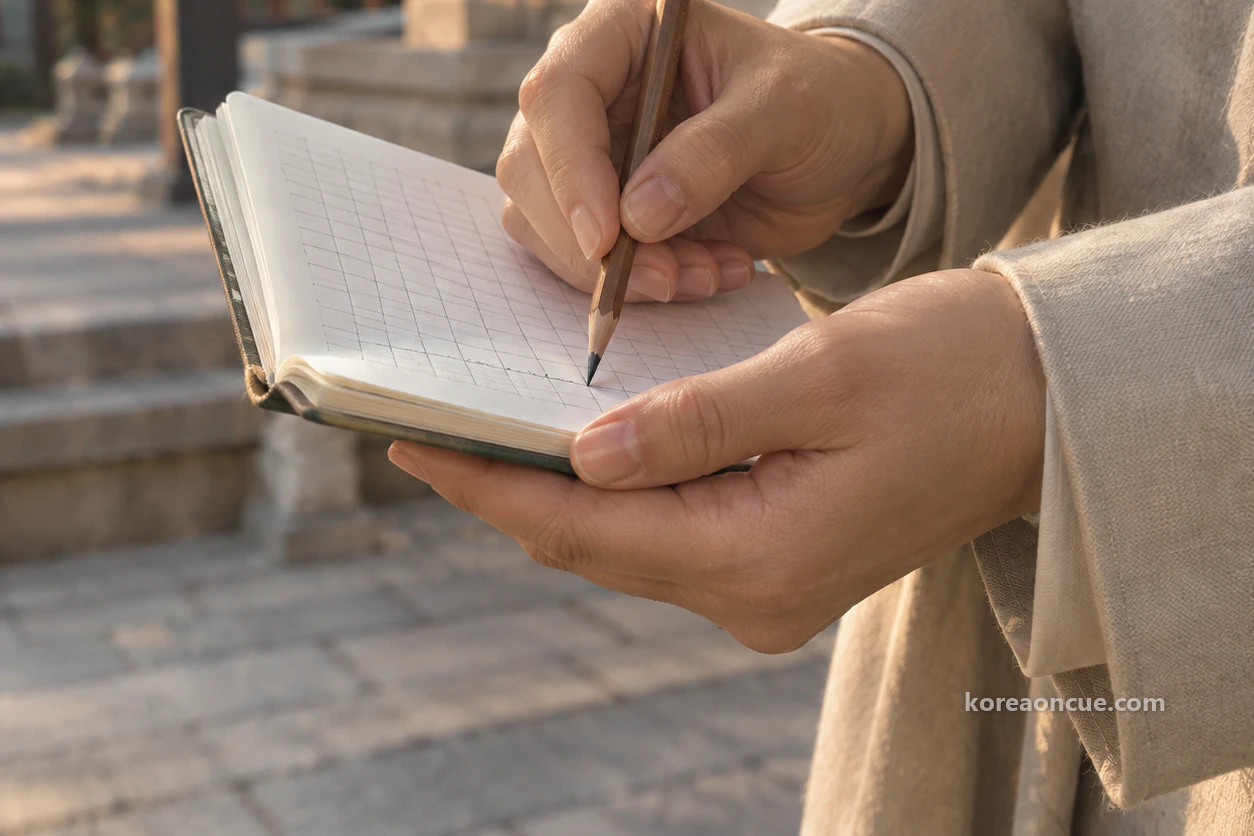
Rina copies the tour times she looked up in advance onto the bottom line of her notebook. At the end, she adds a question mark: “Fri, Sat, Sun 2 p.m.?”. A question mark is something Rina only adds to places she might come back to. Today she filled the boxes alone, so next time she plans to come for an official tour time and read the same boxes again. If you go on a weekday, write down the order of the six places beforehand, as Rina did, and walking round on your own is easy.
There is also one thing to keep in mind as you walk. When you look round Gyeonghuigung, you are asked not to bring in food or drink such as coffee, soft drinks and snacks. Rina, too, leaves the drink in her bag where it is and walks without taking it out. With no admission charge, it is easy to drop in, but closing time is fixed. Last entry is at 5:30 p.m., so to see all six places, it is better to arrive a little early.
Back to Heunghwamun: the way back to Seodaemun Station, and a photo sent to two friends
As the sun goes down, Rina walks from Seoam back out towards Heunghwamun. On the way out, she deliberately crosses the Sungjeongjeon courtyard once more. When she came in, the main hall was just a big building, but with every box filled, it now looks like the place where three kings were crowned. From Heunghwamun to Seodaemun Station Exit 4, you simply retrace the roughly 460 m you came by, leaving no chance of getting confused.
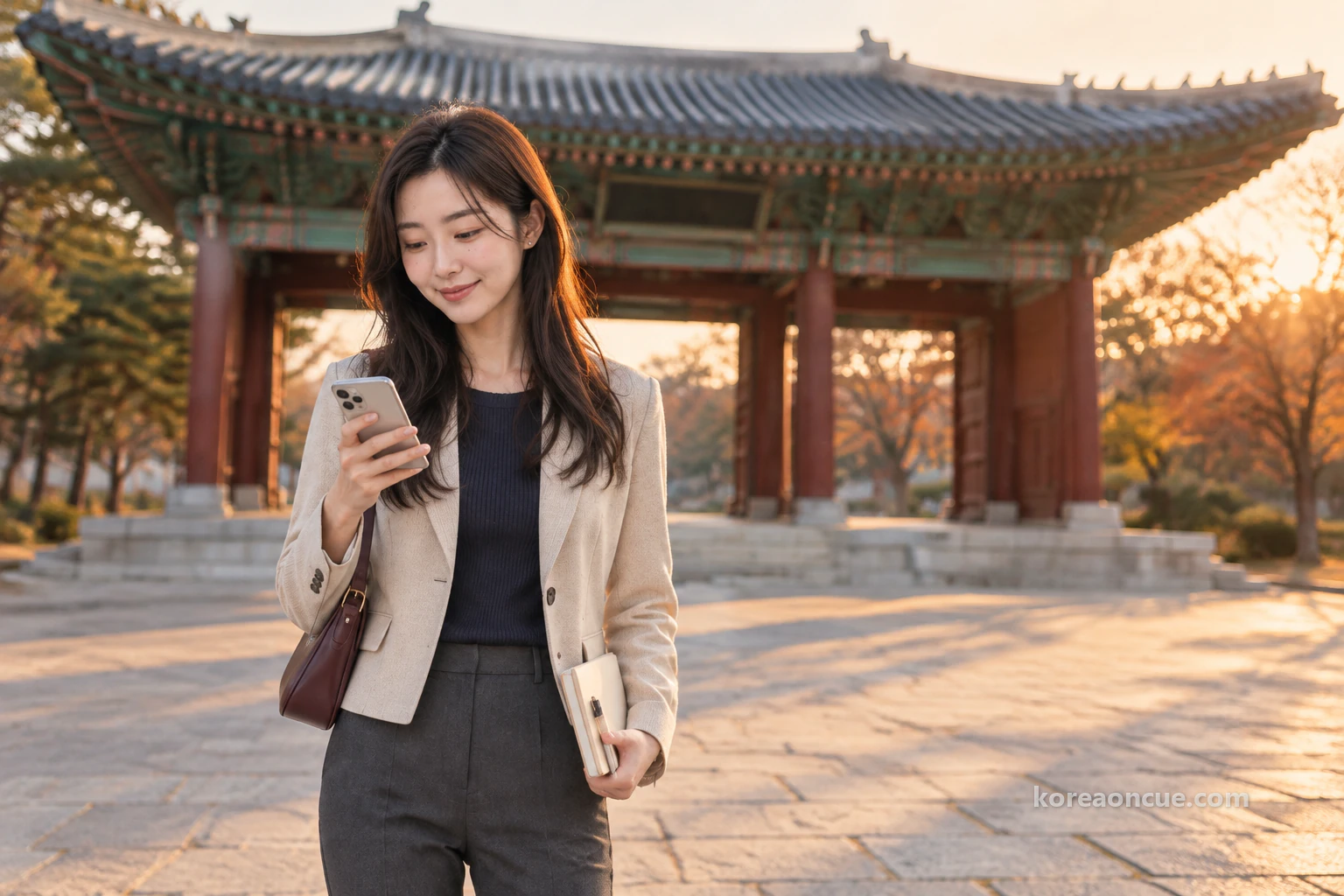
In front of the main gate, Rina flicks through the photos she took today and picks one. It is a wide shot of Sungjeongjeon at the end of the stone courtyard, taken from just inside Sungjeongmun. The red pillars and green lattice come out clearly, so she thinks both Mali, who notices colours, and Maya, who looks at wide compositions, will like it. Rina sends the same photo to each of them separately. “Yesterday the three of us in the park, today just me at a palace. The main hall of the Western Palace — the green lattice is lovely.”
After sending the message, Rina puts her phone away and opens her notebook again. The six boxes are each filled with two lines, a name and a use. Below them, “慶 = 敬 = けい” and “王 → 瑞” are joined by an arrow. On the back page is the living-quarters box with only its outline, and at the very bottom, a single question mark beside the tour times. Rina puts the notebook in her bag and heads for Seodaemun Station, walking the same roughly 460 m in reverse.
Back at her room, Rina opens the page she wrote at Changdeokgung and rubs out the question mark she had put beside “Eastern Palace”. In its place she writes “Western Palace — Gyeonghuigung”, and draws a long arrow to the page with today’s six boxes. She has rubbed out one question mark today, but a new one has appeared beside the tour times. Rina does not mind that new question mark at all. Reading a place she has been to once again on another day is her favourite kind of trip.
Common Mistakes
Going on a Monday
Gyeonghuigung closes every Monday and on 1 January.
Arriving after 5:30 p.m.
it closes at 6 p.m., but last entry is at 5:30 p.m.
Searching for 55 Saemunan-ro
55 is the address of the main Seoul Museum of History building. Gyeonghuigung is at 45 Saemunan-ro.
Walking straight across Geumcheongyo
the stone beasts on the railing and the dokkaebi faces between the arches are symbols meant to keep bad energy out of the palace. Stop on the bridge for a moment.
Seeing only Sungjeongjeon and leaving
carry on to the council hall Jajeongjeon, to Taeryeongjeon, where Yeongjo’s portrait was kept, and to the rock Seoam behind it, and the palace’s uses come into view one by one.
Bringing in drinks and snacks
visitors are asked not to bring in food or drink such as coffee, soft drinks and snacks.
FAQ
Which station and exit should I use?
From Seodaemun Station Exit 4 on Line 5 to Heunghwamun is about 460 m, roughly a 7-minute walk. From Gwanghwamun Station Exit 7 on Line 5, it is about 720 m, roughly a 10-minute walk.
Is there an admission fee?
No. Gyeonghuigung is free to visit.
What are the opening hours?
It opens from 9 a.m. to 6 p.m., with last entry at 5:30 p.m. It is closed every Monday and on 1 January.
When are the guided tours?
Fridays at 2 and 3 p.m., Saturdays at 1, 2 and 3 p.m., and Sundays at 1, 1:30, 2, 2:30 and 3 p.m. Fridays and Saturdays are led by Korea Rediscovery’s Uri Gunggwol Jikimi (02-723-4206), and Sundays by Uri Munhwa Sumgyeol’s Gunggwol Gilrajabi (02-735-5733).
Why is it called the Western Palace?
Because it stood in the west of the capital. The name pairs with the Eastern Palace, the name given to Changdeokgung and Changgyeonggung together.
What was its first name?
Gyeongdeokgung. It sounded the same as Gyeongdeok, the posthumous title of Wonjong, so in 1760, the 36th year of Yeongjo’s reign, it was renamed Gyeonghuigung.
Is Sungjeongjeon the original building?
No. The original was sold in 1926 and is now used as Jeonggakwon at Dongguk University. The Sungjeongjeon on the site today was restored in 1991, using platform stones found in excavations, among other things.
Who do I contact with questions?
02-724-0274 to 0276.
Recap — 30 seconds before you go
- Seodaemun Station (Line 5) Exit 4 → about 460 m, roughly a 7-minute walk → Heunghwamun (45 Saemunan-ro)
- 09:00–18:00, last entry 17:30 · closed Mondays and 1 January · free
- Order: Heunghwamun → Geumcheongyo → Sungjeongjeon (main hall) → Jajeongjeon (council hall) → Taeryeongjeon → Seoam
- The stone beasts of Geumcheongyo, the different uses of Sungjeongjeon and Jajeongjeon, and Seoam behind Taeryeongjeon
- Guided tours on Friday to Sunday afternoons · no food or drink inside
Sources
- Seoul Museum of History — Gyeonghuigung visitor informationOpening hours 09:00–18:00 (last entry 17:30) · closed on 1 January and every Monday · free admission · enquiries 02-724-0274 to 0276 · guided tours on Fridays (14:00, 15:00), Saturdays (13:00, 14:00, 15:00) and Sundays (13:00–15:00, every 30 minutes) and the two groups that run them · visitors asked not to bring in food or drink such as coffee, soft drinks and snackschecked 2026-10-29
- Seoul Museum of History — Branch museumsGyeonghuigung’s address, 45 Saemunan-ro, Jongno-gu, Seoul · opening hours · phone numberchecked 2026-10-29
- Seoul Museum of History — About GyeonghuigungHistoric Site · secondary palace of the late Joseon period · construction begun in 1617 (9th year of Gwanghaegun) · the story of Prince Jeongwon’s house on the site · first name Gyeongdeokgung and the 1760 renaming (36th year of Yeongjo) · Western Palace and Eastern Palace · a secondary palace for ten generations of kings from Injo to Cheoljong · some 100 buildings · a school built during Japanese rule and the site cut to about half · restoration of the main hall area and opening to the public from 2002 · address 45 Saemunan-rochecked 2026-10-29
- Seoul Museum of History — History of GyeonghuigungBuildings moved for the rebuilding of Gyeongbokgung under the Heungseon Daewongun · Monopoly Bureau housing · designated a Historic Site in September 1980 · acquired by the Seoul city government in 1986 for a city museum · excavations from 1985 · Sungjeongjeon restored in 1991, Jajeongjeon and its corridors in 1998, the Taeryeongjeon compound in 2000 · Heunghwamun restored some 100 m west of its original sitechecked 2026-10-29
- Seoul Museum of History — Gyeonghuigung buildingsHeunghwamun (main gate, Seoul Tangible Cultural Heritage, original site, gate of Bakmunsa and later of the Shilla Hotel) · Geumcheongyo (1619, stone beasts and dokkaebi faces, restored after the 2001 excavation) · Sungjeongjeon (uses of the main hall, coronations of Gyeongjong, Jeongjo and Heonjong, sold in 1926 and now Jeonggakwon at Dongguk University, the throne dais and coffered ceiling inside) · Jajeongjeon (council hall, use as a mourning hall, Seogwoldoan, floor bricks) · Taeryeongjeon (King Yeongjo’s portrait, 1744, spirit hall, five bays by two) · Seoam (Amcheon spring, the name Wangam, renamed in 1708, the inscribed stone now at the National Palace Museum of Korea)checked 2026-10-29
- Seoul Museum of History — NoticesThe list where temporary closures and changes to opening at the museum and its branches are announcedchecked 2026-10-29
A Seoul story told with our AI characters. Place details are checked against public sources; the photos are AI-made illustrative images. How we use AI

