
SEOUL · BANGI-DONG
Rina rubs out a question mark: four friends follow Ethan’s plan through Bangi Matgol one evening
From Jamsil Station Line 8 Exit 10, one minute to Songpa-gu Office, then from the old food street opposite KT Plaza to the new one opposite Olympic Park South Gate 2 — which exit and which bus to choose
At Dream Forest, Rina drew a small question mark beside “Bangi-dong” on the last page of her notebook. On the Monday of the last week of his business trip, Ethan arrives at Bangi Matgol with a route drawn from the district office’s directions — and Rina turns up with the question mark rubbed out.

How to get there
Ethan’s second business trip to Seoul has reached its final week. A 44-year-old engineer from Seattle who designs machinery, he spent last Friday at Seokchon Lake with Lulu and Maya, watching the Luminarie switch on for the first time. By the time they had walked almost all the way round the lake, he had offered to lead the next evening out himself, and the place he chose was Bangi-dong Food Street. They settled on Monday evening in his final week, the day his meetings finish earliest.

There was a chance one more person would join them. When Maya invited her at Dream Forest, Rina, who is 23 and from Japan, did not answer straight away. Instead she drew a small question mark beside “Bangi-dong” on the last page of her notebook. Rina always adds a question mark to a plan she cannot yet promise. Underneath was another line, “Bring notebook”, written on the day Maya told her about an engineer who drew the lake in his notebook at Seokchon.
On Monday afternoon, a message from Rina arrives on Maya’s phone. It is a single photograph of the last page of her notebook. The question mark beside “Bangi-dong” has been rubbed out, leaving only a faint smudge. Maya posts the photo straight into the group chat she shares with Lulu and Ethan. Ethan studies it for a long moment, then says it is the shortest and surest reply he has had on the whole trip.
This is the story of that Monday evening, when the four of them sit at one table for the first time, and a guide for anyone visiting Bangi Matgol for the first time. Bangi Matgol, in Bangi-dong in Songpa-gu, is often called Bangi-dong Food Street, and it falls into two main parts: the old food street, starting opposite KT Plaza beside Songpa-gu Office, and the new food street opposite Olympic Park South Gate 2. Following the four friends’ footsteps, this piece covers which Jamsil Station exit to use, where to get off the bus, how the two streets differ and how to pair them with the Seokchon Lake Luminarie in a single evening.
The Cue
Bangi Matgol is a food street in Bangi-dong, Songpa-gu, so packed with restaurants that it could fairly be called a street of flavours, and it is widely known as Bangi-dong Food Street. It starts opposite KT Plaza beside Songpa-gu Office and divides into two parts: the old food street, which grew up from the early 1990s, and the new food street that appeared later opposite Olympic Park South Gate 2. Songpa-gu Office is a one-minute walk from Jamsil Station Line 8 Exit 10 and five minutes from Line 2 Exit 1, and turning right at the Songpa-gu Office crossroads brings you into Bangi Matgol. It lies inside the Jamsil Special Tourist Zone, which makes it easy to pair with the Seokchon Lake Luminarie on the same evening.
- Where: Bangi-dong, Songpa-gu, Seoul. The starting point is opposite KT Plaza, beside Songpa-gu Office (326 Olympic-ro).
- Subway: Jamsil Station (Line 8) Exit 10 → 100 m straight ahead to Songpa-gu Office, one minute on foot. Jamsil Station (Line 2) Exit 1 → five minutes on foot to Songpa-gu Office. Turn right at the Songpa-gu Office crossroads for Bangi Matgol.
- Bus: Buses 3216, 3313, 3315 and 3414 to Songpa-gu Office. There are two stops: “Songpa-gu Office, KT Songpa Branch” immediately outside, and the one opposite.
- Two streets: The old food street (Songpa-gu Office side, from the early 1990s) and the new food street (opposite Olympic Park South Gate 2). Songpa-gu Office to Olympic Park South Gate 2 is about 23 minutes on foot (just over 1.7 km).
- Busy times: Lunchtime is packed with local office workers.
- Pair it with: Seokchon Lake Luminarie, 30 October 2026 (Fri) to 28 February 2027 (Sun), in the same Jamsil Special Tourist Zone.
- Enquiries: Tourism Planning Team, Tourism Promotion Division, Songpa-gu, 02-2147-2107.
Choosing an exit from the Songpa-gu Office directions, and Ethan’s plan
From the day he offered to lead, Ethan has treated the job like an engineer. The first thing he opened was the Songpa-gu culture and tourism page on Bangi Matgol. The street starts opposite KT Plaza, next to Songpa-gu Office, and by subway you leave Jamsil Station by Line 2 Exit 1 or Line 8 Exit 10 and turn right at the Songpa-gu Office crossroads to reach it. From those two sentences, Ethan worked out that the reference point for the whole street is Songpa-gu Office.
Open in Kakao Map — Jamsil Station
So to choose an exit, he turned to the directions for Songpa-gu Office itself. From Jamsil Station Line 8 Exit 10, it is 100 m straight ahead, a one-minute walk, and from Line 2 Exit 1 it takes five minutes on foot. Ethan drew two lines in his notebook starting from the two exits, labelling the short one “Line 8 — 10 — 1 min” and the long one “Line 2 — 1 — 5 min”. Where the lines met was Songpa-gu Office, and at the end of the line that turned once from there, he marked a small cross and wrote “Start”.
Jamsil is a large station served by both Line 2 and Line 8, so the exit to use depends on which line you arrive on. Remember Exit 10 if you come by Line 8 and Exit 1 if you come by Line 2. On a first visit, it helps to pin “Songpa-gu Office” on your phone map first, then once you reach the front of the office, turn right at the crossroads.
There was also a line for anyone arriving by bus. Buses 3216, 3313, 3315 and 3414 stop at Songpa-gu Office, and there are two stops: “Songpa-gu Office, KT Songpa Branch” immediately outside, and the one “opposite”. Lulu had said she would come from home by bus, so Ethan copied out both stop names exactly and sent them to her. He added a line explaining that either way she would be outside the office, so they could meet there.
Ethan did not leave the plan on paper. When his Monday morning meeting near Jamsil finished early, he left Jamsil Station by Line 8 Exit 10 at lunchtime and walked to the starting point on his own. It was the same order he follows before installing new equipment in a factory: take the drawing and walk the site first. At lunchtime the street was absolutely heaving with office workers, so he stepped aside to the edge of the pavement and took a single photograph of the street, its vertical signboards stacked floor upon floor.

One minute from Jamsil Station Line 8 Exit 10: the four meet outside Songpa-gu Office
At half past six in the evening, Ethan comes out of Jamsil Station Line 8 Exit 10 again. Once more he is ten minutes early. Having walked it at lunchtime, he knows the front of the office really is just a minute away, and with the sun down, the lights are on in the office building and the shops across the road. Rather than asking where Lulu’s bus has got to, he presses his pencil once more onto the cross in his notebook.
Lulu is next to appear. Stepping off the bus, she spots Ethan within a few paces of the stop, and laughs that, just as at Seokchon Lake, tall Ethan is the first thing she sees. Born and raised in Seoul, 20-year-old Lulu plans to film short videos on her phone again today. When she says she would like the first shot to be the plan Ethan has drawn, he looks a little embarrassed but opens his notebook to show her the lines leading from the two exits.
Last of all, Maya and Rina walk over together from the Line 2 side. They came out of Exit 1, they say, and chatted all the way along the five-minute walk to the office. Maya, 21 and from Singapore, gently draws Rina forward by the arm and introduces her first: “This is Rina. She’s brought her notebook.” Rina gives a little bow and half lifts the notebook in her hand towards the two people she is meeting for the first time.

Ethan and Rina have never met before, and nor have Lulu and Rina. Lulu’s eyes go round, as if it is strange to see someone she has only heard about standing right in front of her, and Ethan greets Rina slowly in Korean: “I’m Ethan. I’m in charge of directions today.” Rina looks slightly surprised and asks, “So it’s all right to speak Korean?” and so the four friends’ first conversation begins with deciding which language to use. In the end, all four nod in agreement: Korean it is.
Before filming, Lulu checks with Rina first. Would she mind her face appearing, or would she rather Lulu filmed only her hands and notebook? Rina thinks for a moment and asks for just her hands and notebook today, and Lulu lowers her phone angle on the spot. Ethan remembers how, at Mangwon Market, Lulu asked the stallholders before raising her phone, and smiles quietly as he watches.
Turning right at the Songpa-gu Office crossroads: the start opposite KT Plaza and the lit arch
Ethan leads the way. Turning right at the Songpa-gu Office crossroads takes you into Bangi Matgol, which starts opposite KT Plaza next to Songpa-gu Office. Just as he did at lunchtime, Ethan turns at the crossroads and points to the mouth of the street across the road. “This is the first point on the plan.” As soon as she hears it, Rina opens her notebook and writes in the first box: “Start — opposite, beside the office”.
As they enter the street, a large illuminated arch spanning the road comes into view. Two bands of white light rise from multicoloured striped pillars and meet in the middle, where an orange speech-bubble sign lights up the street’s name. On both sides, the commercial buildings have signboards lit floor upon floor, the lights running far down the street. The lit arch looks just like a gateway to the street, Ethan says, half to himself.
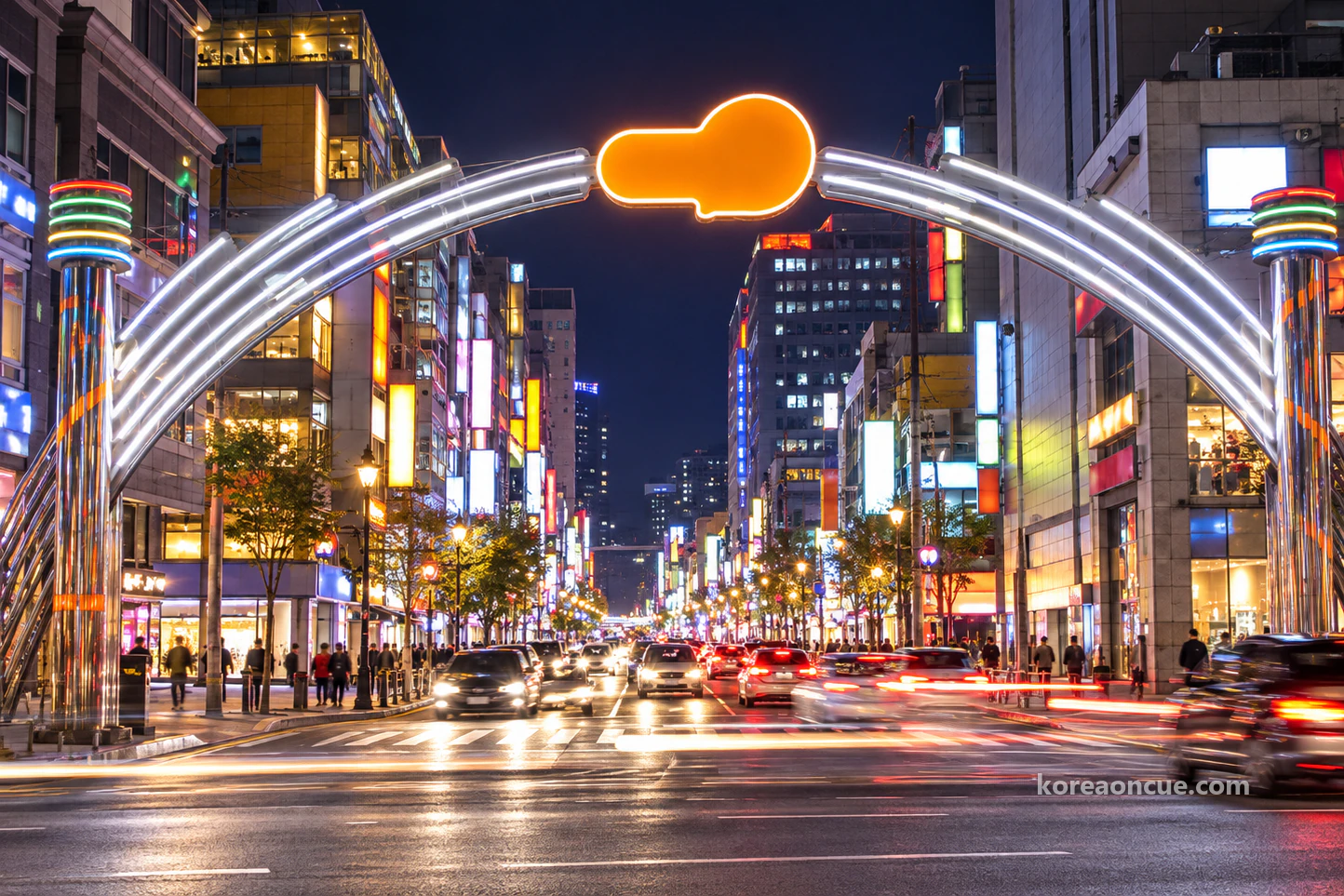
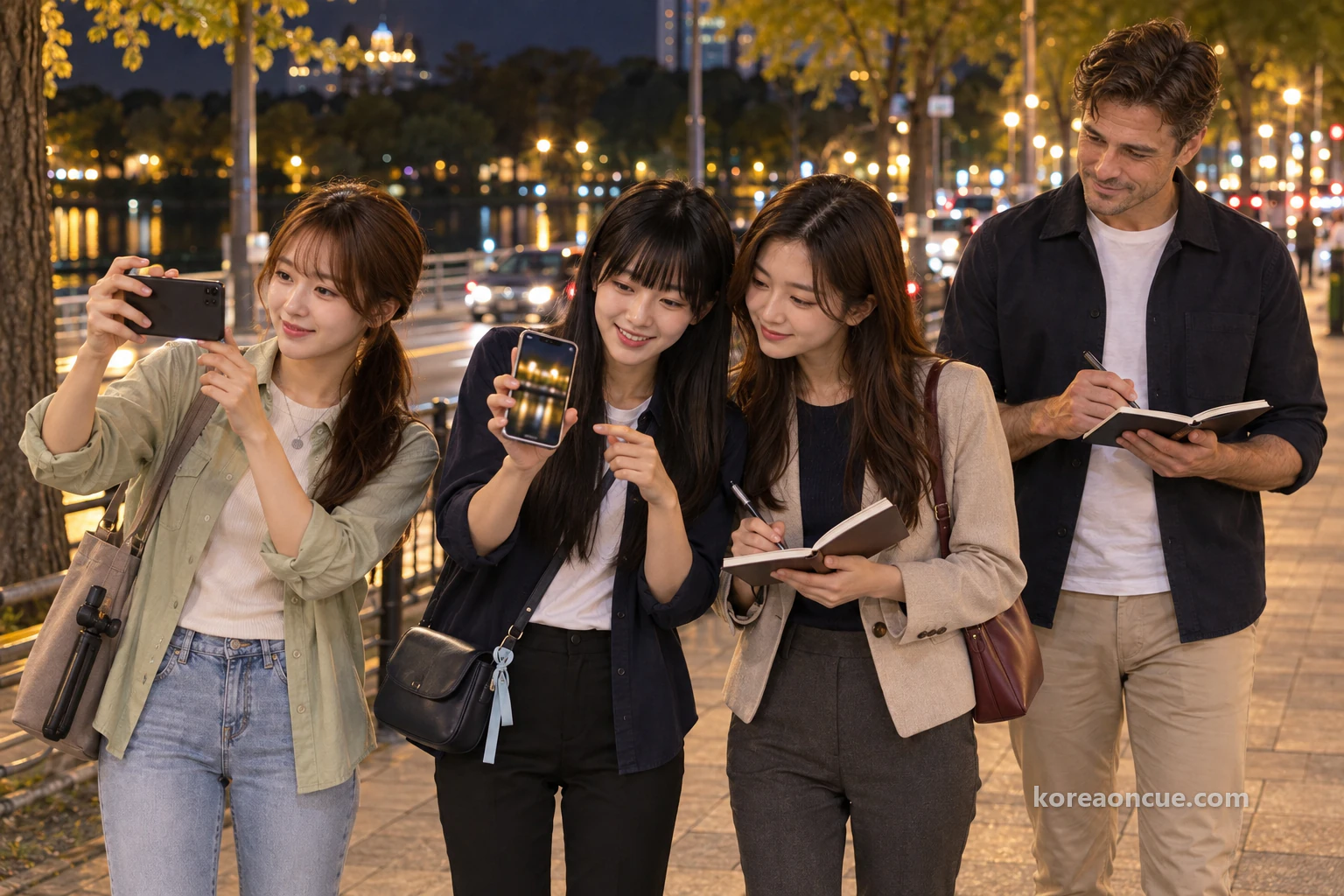
Maya stops the moment she sees the arch. As always, she starts with the overall composition, and rather than filling the top of the frame with the arch, she steps back a few paces so the signboard lights running beneath it gather in the middle of the picture. This is a road with traffic, so she stays off the carriageway, bending her knees slightly at the edge of the pavement to find her angle. To photograph the arch, crouch on the pavement as Maya does. Because the lights hang over the road, you do not need to step into the middle of it — a low angle fits the arch and the glowing street into one frame.
Rina copies the shape of the arch into her notebook instead of taking a picture. She draws the two pillars, the curve above them and the small circle in the middle, and beside it writes a single word: “Gate”. Glancing over at the drawing, Ethan realises his own plan has no arch on it. A plan drawn only with lines and numbers never had room for something like a gateway to the street.
The old food street: lunch and dinner on a street that grew up with Songpa-gu Office in the early 1990s
As they walk on past the arch, Ethan brings out the photograph he took at lunchtime. It is the same street, but by day the red, yellow and green projecting signboards were crowded beneath a grey sky, and now those same signboards are lit up. This is Songpa-gu’s best-known food street, feeding local office workers at lunch and dinner. Close to Jamsil Station and packed with restaurants, it is always busy, and at lunchtime the crowds are close to overwhelming.
Maya puts Ethan’s lunchtime photo and her own new shot of the arch side by side on her phone screen. The composition is almost identical, she says, but in the daytime photo the colours of the signboards catch your eye first, while at night it is the lines of light. “It’s the same street, but by day you look at colour and by night you look at lines.” Lulu says she has to put that in her video description, and films the screen with the two photos side by side once more.

The history of this street was a story Ethan had prepared. The old food street began to take shape in the early 1990s, when Songpa-gu Office opened. Songpa-gu itself was created on 1 January 1988, when it split off from Gangdong-gu, so the street has more or less grown up alongside the district office. Hearing this, Rina writes “1988 — Songpa-gu” and “Early 1990s — old food street” side by side next to the first box.
Whether to come at lunch or dinner depends on what you want to see. For the buzz of a street packed with office workers, come at lunchtime, and to walk the street with the arch and signboards lit up, come after dark. Even after dark, though, it is crowded with people heading out after work, so if you are in a group, walk slowly and keep each other in sight. Even while filming, Lulu leaves out shop interiors and customers’ faces, pressing close to the building walls each time she films, shooting briefly and then stepping aside.
The old and new food streets: Bangi Matgol divided across two notebooks
After walking for a while, Ethan slows down. His plan has nothing more than a starting point and a few lines of street branching from it, but Bangi Matgol falls into two main parts. Where they are walking now is the so-called old food street, and the new food street appeared later, opposite Olympic Park South Gate 2. Ethan had read that part and still thought he could fit both onto a single drawing, but Songpa-gu Office and Olympic Park South Gate 2 are about 23 minutes apart on foot, just over 1.7 km.
“I got the scale of my drawing wrong,” Ethan says with a sheepish laugh, and Rina silently opens her own notebook and turns it towards him. On the night she wrote that she would bring her notebook, Rina read that Bangi Matgol has two parts and divided the page into boxes before anything else. The left-hand “Old” box says “Starts opposite, beside the office”, and the right-hand “New” box says “Opposite Olympic Park South Gate 2” and “Later”. This time it is Ethan who holds out his own plan, with a number of minutes beside every line.
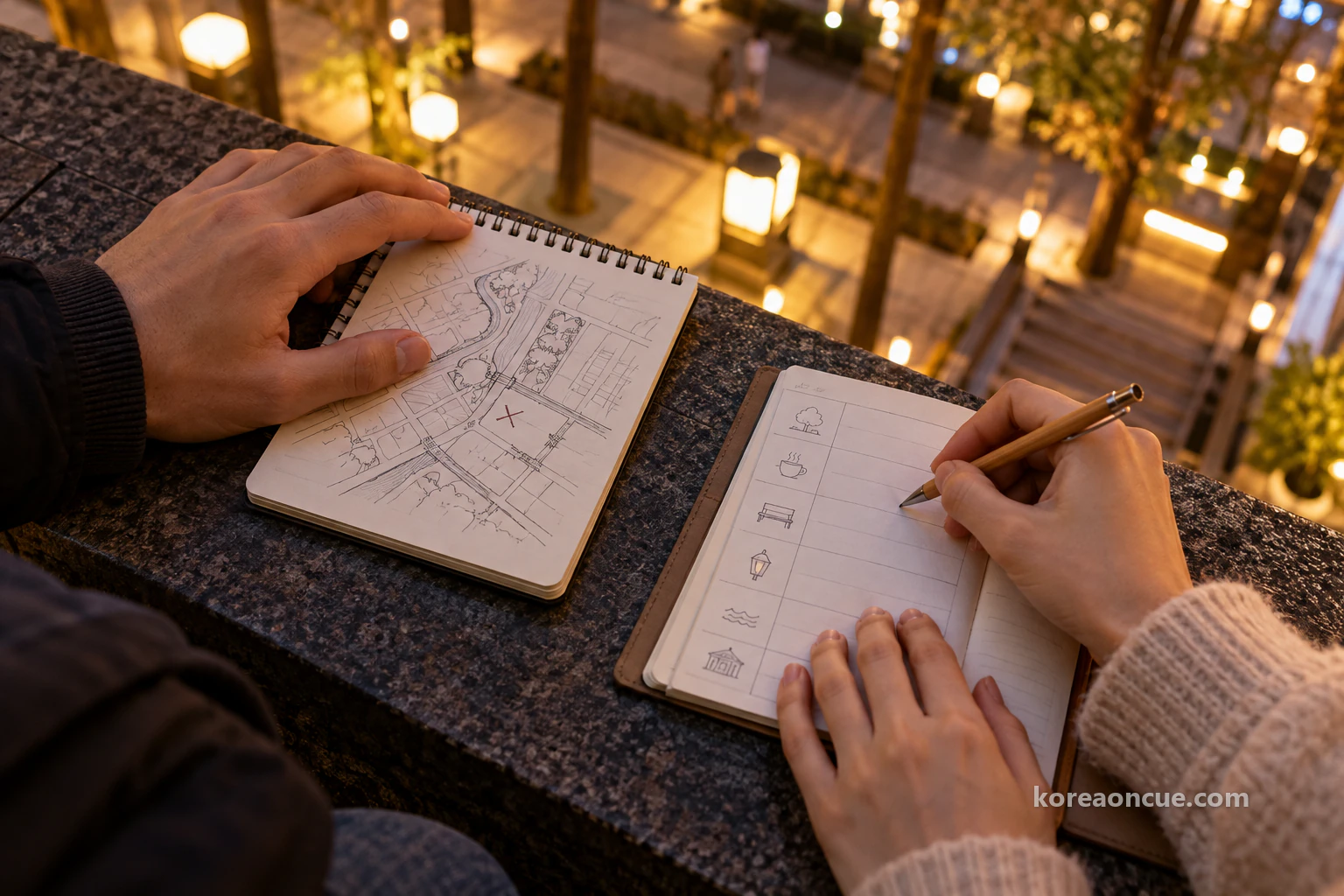
They leaf through each other’s notebooks, page by page. Ethan’s holds the two lakes of Seokchon and the oval of Nodeul Island, and Rina’s holds the boxes of the Dongdaemun fabric floors and the colour names she collected at Dream Forest. Rina is surprised that not one line on Ethan’s plans is missing a number, and Ethan is surprised at how packed Rina’s boxes are with dates and names. Watching them, Maya whispers to Lulu that this is exactly the scene she pictured on the bus home from Dream Forest.
Looking at Rina’s two boxes, Ethan draws another line on his plan. It runs a long way from the office towards Olympic Park South Gate 2, and after marking a second cross at its end, for the first time he labels a line with a name instead of a number: “New”. Rina, the other way round, writes a single number under her “New” box: “23 min”. Meeting for the first time, the two of them are still careful with each other and speak formally, but on paper they are already borrowing one thing each from the other’s way of working.
Knowing that there are two parts before you arrive will save you some wandering. The old food street is the part that starts opposite KT Plaza beside Songpa-gu Office, and the new food street is opposite Olympic Park South Gate 2. If you are getting off at Jamsil Station for a quick dinner, the old food street by the office is closer, and if you are linking dinner with plans at Olympic Park, the new food street is worth considering. To walk both, build the roughly 23-minute walk from Songpa-gu Office to South Gate 2 into your evening plans.
Twenty-three minutes on foot from Songpa-gu Office towards Olympic Park South Gate 2, and the two stories behind the name Bangi-dong
The four decide together whether to go on to the new food street. Ethan’s original plan was dinner on the old food street, but Rina’s empty “New” box seems to have been bothering him too. Maya says she likes seeing a neighbourhood on foot, and Lulu wants to film the walk as well. So the four agree to have dinner on the new food street, pin “Olympic Park South Gate 2” on a phone map and set off.
Songpa-gu Office to South Gate 2 is about 23 minutes on foot, a comfortable distance for an evening stroll. If walking is difficult or you are short of time, you could take a bus. Buses 3216, 3412, 3413, 3414, 30, 30-5 and 35 serve Olympic Park South Gate 2, and of these, 3216 and 3414 also stop outside Songpa-gu Office.
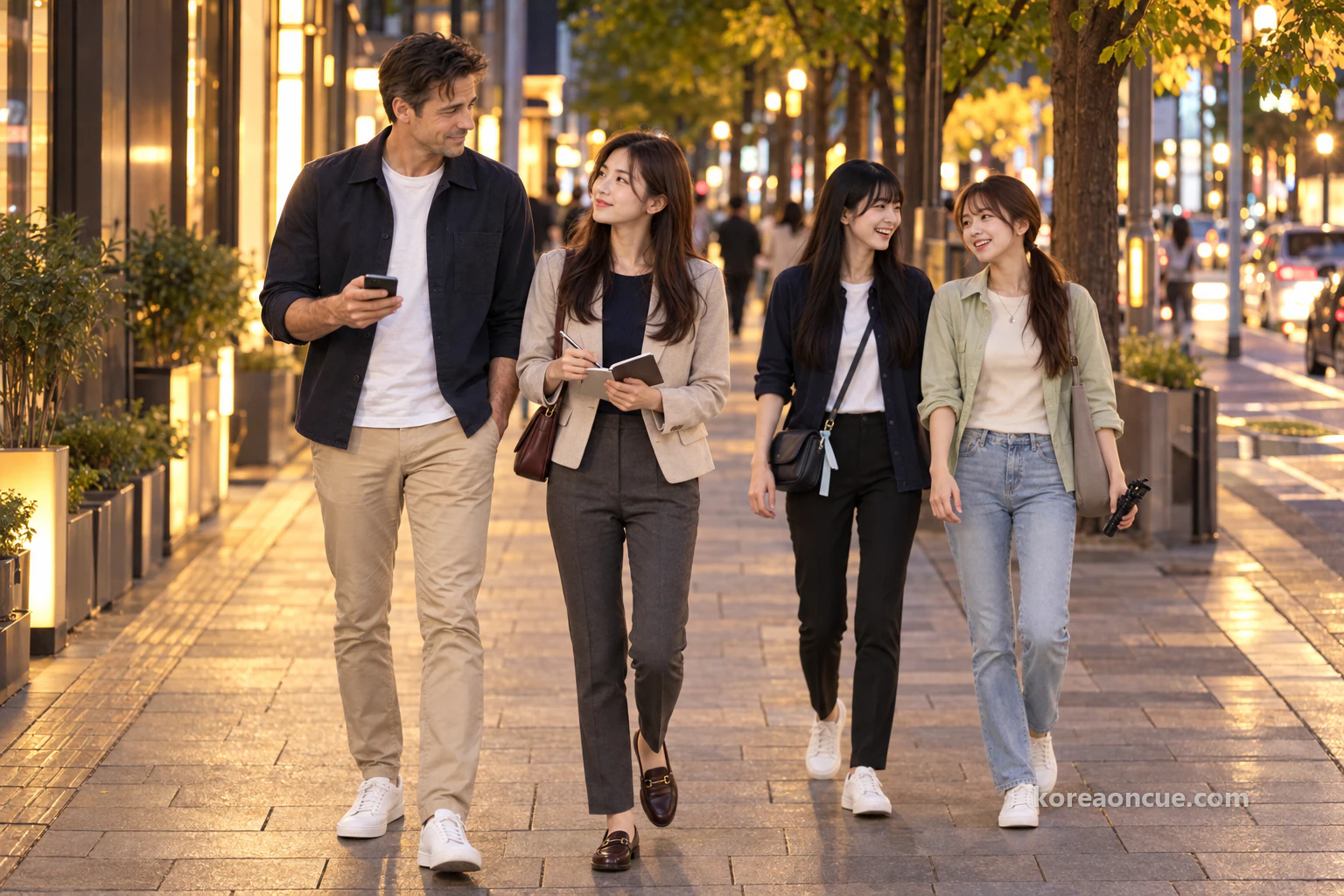
As they walk, Ethan brings out another story he has prepared. It is about the name Bangi-dong, and it comes in two versions. In the first, during the Qing invasion of 1636, Qing troops tried to pass through the village on their way to Namhansanseong Fortress, but the young men of the village drove them back, so the place was called Bangi-dong (防夷洞), meaning the village that kept the invaders out. In the second, local scholars later rewrote the name as Bangi (芳荑), using the character 芳 for “fragrant”, because it was a sheltered, beautiful spot where forsythia bloomed in abundance.
When Rina copies the story into her notebook, she does not put the two names in one box but splits them top and bottom. At the top she writes “防 — to keep out”, at the bottom “芳 — fragrant”, and draws an arrow between them. Ethan says he finds it fascinating that a name with the same sound changed its meaning just by changing its characters, and that with every revision of a drawing, the same line can come to mean something different too. Lulu, who says she has lived in Seoul all her life without hearing this story, adds “The village that kept them out, the village of flowers” to her list of possible titles for today’s video.
South Gate 2, where they are heading, is one of the gates of Olympic Park. The park was created to commemorate the 1988 Seoul Olympics and divides into two main areas: a sports area with six stadiums, and an area centred on Mongchontoseong, an early Baekje earthen fortress. When Ethan mentions this, Rina opens her notebook again. With “1988 — Olympic Park” added beneath the “1988 — Songpa-gu” she wrote earlier, she shows Ethan the box with the same year appearing twice and, for the first time, laughs out loud.
Choosing dinner on the new food street opposite Olympic Park South Gate 2
When they reach the new food street, Rina starts filling in her empty “New” box. The new food street appeared opposite Olympic Park South Gate 2 after the old food street had become established. Ethan adds a small tick next to the second cross on his plan, and Maya looks around for a moment for a spot where the darkness of the park across the road and the lights of the street fit into one frame. Light on one side, darkness on the other, Maya says — it is the same Bangi Matgol, but her photos here carry a different weight from those by the office.
Before choosing where to eat, Ethan suggests walking the length of the street once. It is the “First lap: just look” approach he used the day he first met Lulu at Mangwon Market. Lulu laughs that he still remembers that note, and Rina says the approach is like the way she divides her notebook into boxes. After the full lap, the four pick a restaurant with a table where all of them can sit together.
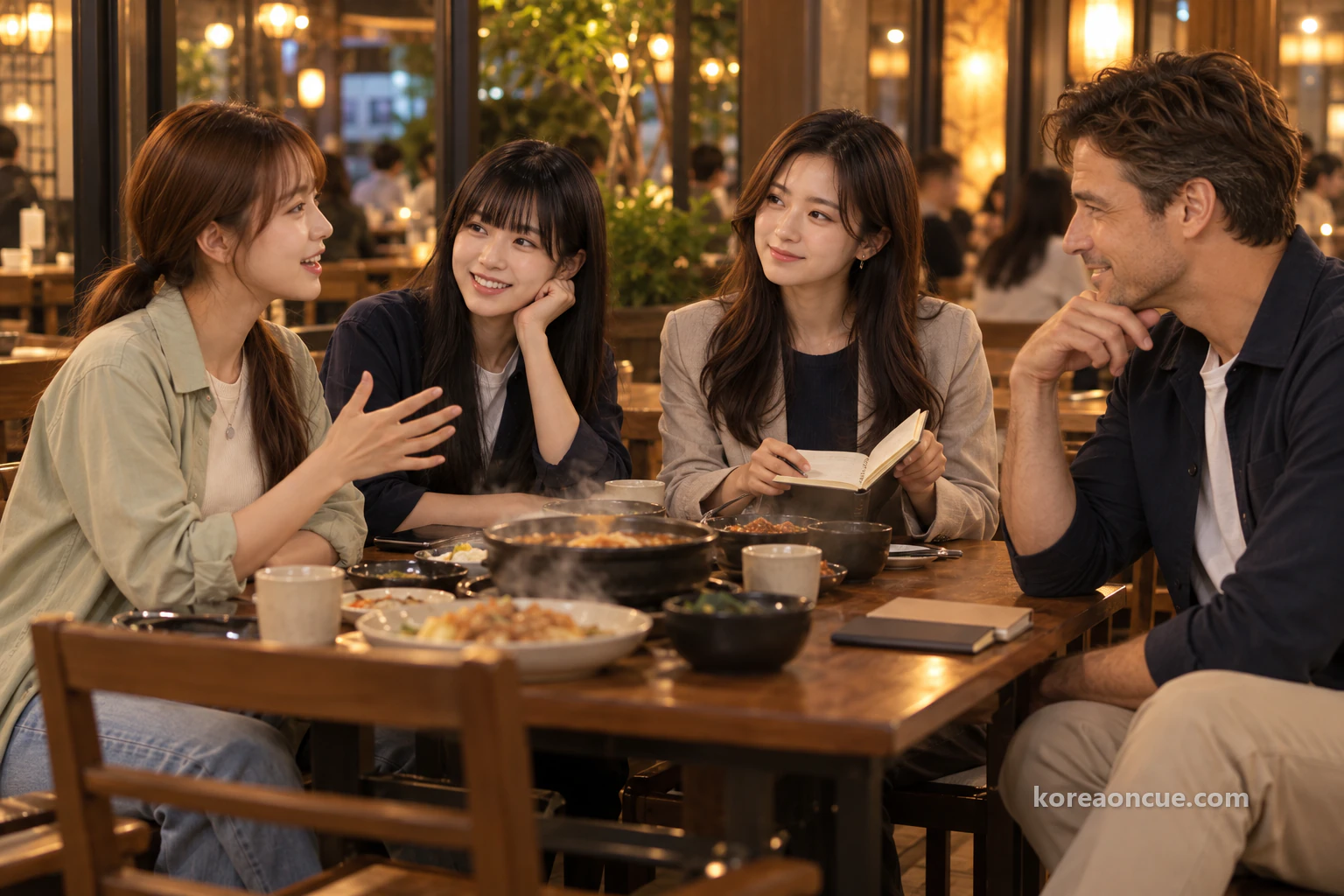
While they wait for the food, Lulu asks Rina about the page with the rubbed-out question mark that Maya posted in the group chat. Looking a little shy, Rina opens the last page of her notebook to show them. Below “Bangi-dong”, with its faint smudge, a small tick now sits beside “Bring notebook”. “I heard there was someone who draws in a notebook. I felt I had to see that for myself.” At Rina’s answer, Maya gives Lulu’s sleeve a little tug under the table.
Ethan laughs at that and says he has learnt something today from Rina’s boxes too. A plan shows a route precisely, he says, but it cannot record what you saw along the way. Rina’s boxes hold things that are not on his plan, like “1988”, “防·芳” and the “Gate” where she drew the arch. Instead of replying, Rina says that from now on she will try writing one of those minute counts, like the ones beside Ethan’s lines, in each of her boxes.
While the four eat, people who look as if they have just finished work keep coming into the street. With so many restaurants packed together, Bangi Matgol offers plenty of choice, which also makes it easy to spend a long time hesitating over where to go in on a first visit. If you are in a group, do what Ethan did: walk a lap first, noting places that look as if they have room for four or five of you to sit together, and choose once you have been all the way round.
The same evening as the Seokchon Lake Luminarie: Bangi Matgol in the Jamsil Special Tourist Zone
When they come out after dinner, Maya shows Rina the photos she took at Seokchon Lake last Friday. Rina has not seen the Luminarie yet. The Seokchon Lake Luminarie event, “Autumn and Winter at the Lake, and Luminarie”, runs at the east and west lakes of Seokchon Lake from 30 October 2026 to 28 February 2027. Leafing through the photos one by one, Rina writes “Seokchon Lake — until February” in her notebook, and this time she adds no mark beside it at all.
Bangi Matgol and Seokchon Lake are both inside the Jamsil Special Tourist Zone. The zone covers 2.75 km², running from Lotte World through Seokchon Lake, Songnidan-gil, Bangi Matgol and Bangi Market to Olympic Park, and Bangi Matgol is listed among its main attractions. Walk once round Seokchon Lake and Bangi-dong Food Street becomes part of the scenery too, along with the cherry trees, Lotte World, the café street and Songnidan-gil. Copying the list of the zone’s sights into his notebook, Ethan notices that Friday’s lake, tonight’s food street and Olympic Park across the road all sit on a single line. “It wasn’t a one-page drawing after all. It was a route map.”
If you visit the area during the Luminarie, try linking the order Ethan walked over Friday and Monday into a single evening. Watch the lights come on at Seokchon Lake around sunset, then have dinner in Bangi Matgol. On the way to the food street, pin “Songpa-gu Office” on your map and turn right at the office crossroads, and even on a first visit you will not miss the starting point.
The route for the next trip: the line Rina writes on the last page of Ethan’s notebook
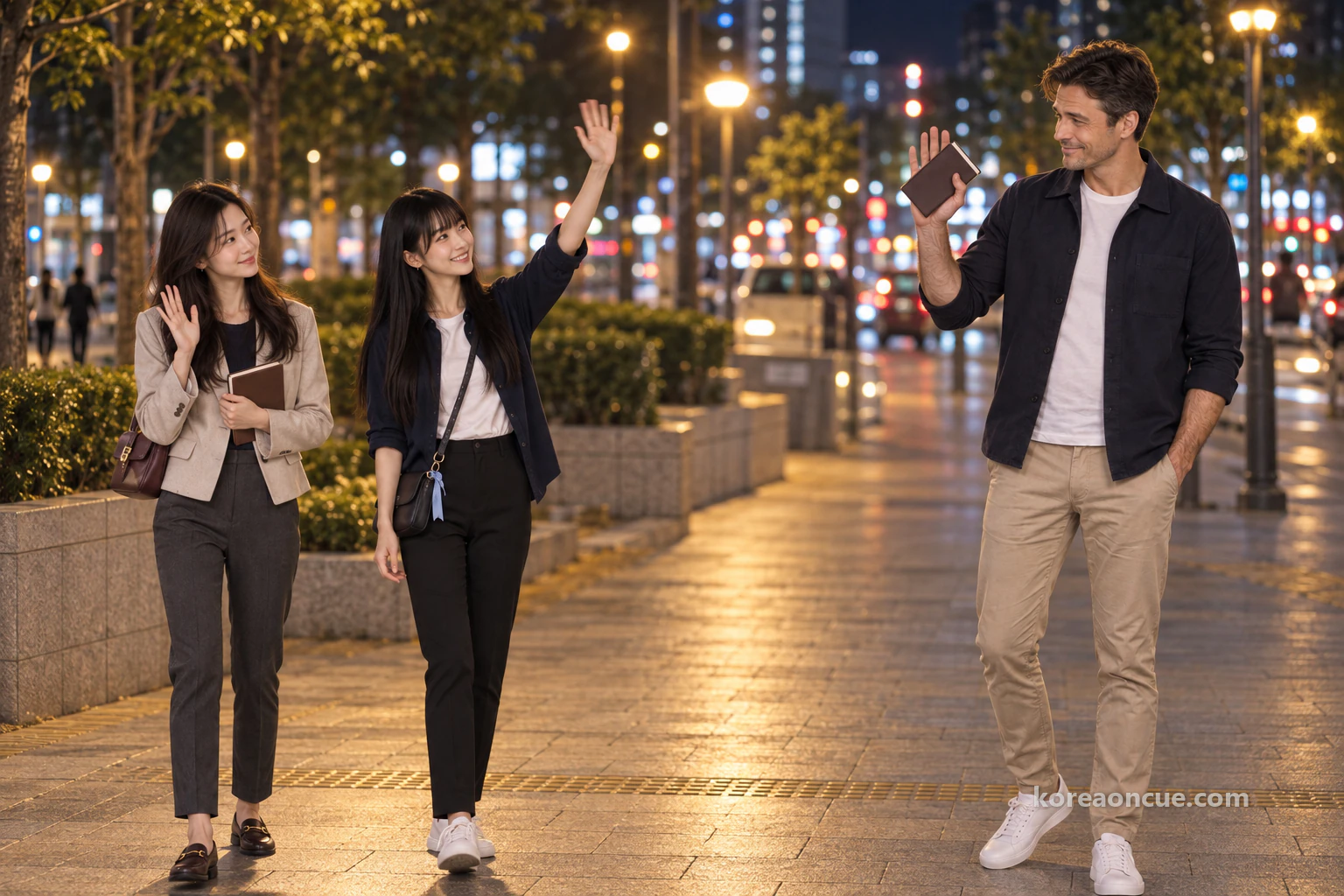
On the way home, the group splits in two. Lulu, whose home is on a bus route, decides to take the 3216, while Ethan offers to walk Maya and Rina back to Jamsil Station, so they head towards the office again. Waiting for her bus, Lulu tells Rina she will send her today’s videos of her hands and notebook first. Rina bows her head in thanks and adds, very quietly, that next time it might be all right for a little of her face to appear.
On the walk back towards the office, Rina asks Ethan when his next business trip will be. Ethan says it has not been decided yet, laughing that whenever he comes to Seoul, he spends his evenings looking for nothing but markets and side streets. Rina thinks for a moment, then asks if she may borrow his notebook. When Ethan opens it to the last page and hands it over, Rina writes a single line in pencil, neatly and carefully.
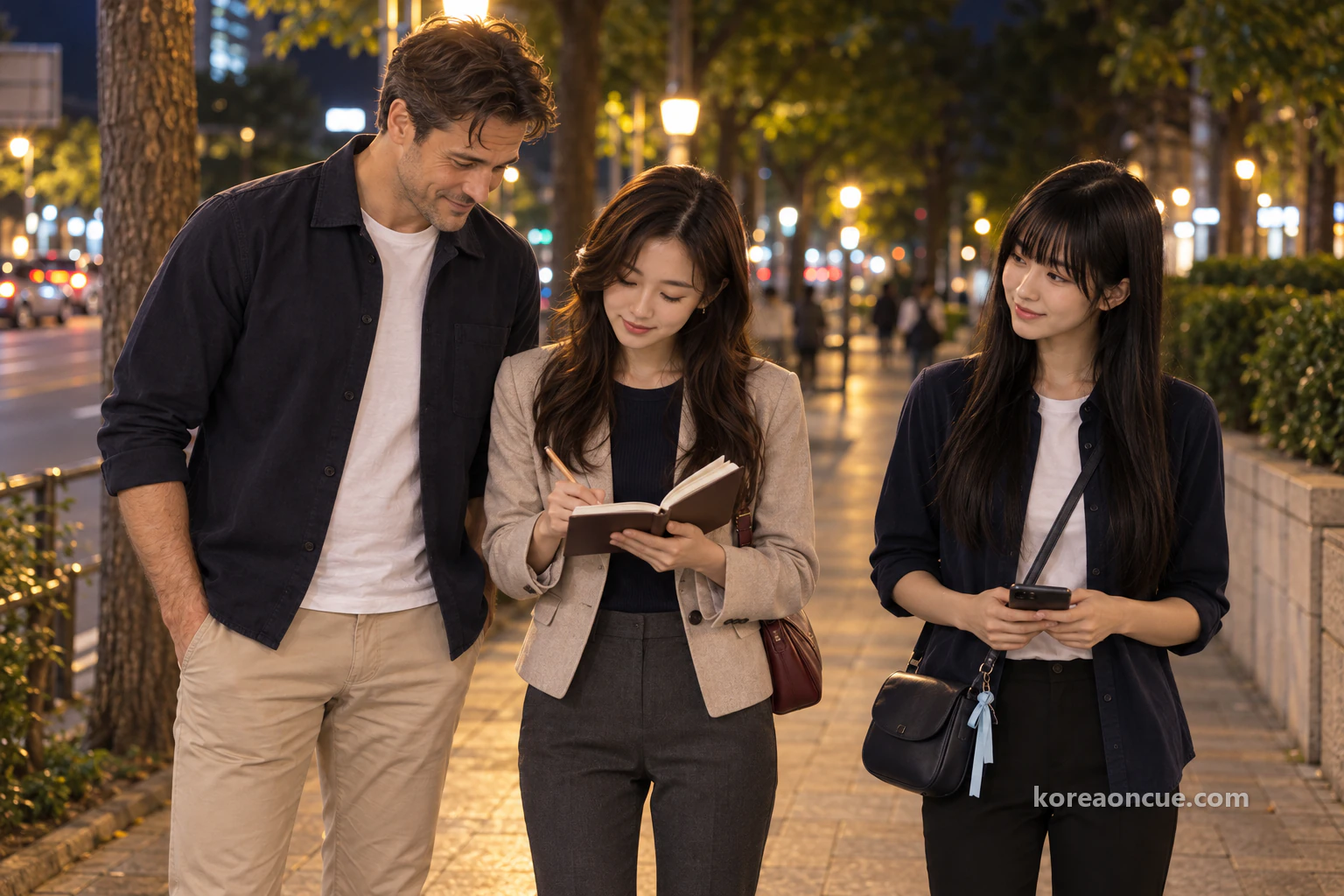
“Jongno 3-ga — Seosulla-gil — morning”. It is a morning route Rina has walked on her own. She tells him she wanted to show Ethan, who only goes out to markets and side streets in the evening, what Seoul is like to walk just as the sun comes up. Ethan looks down at the line for a long time, then takes the pencil from Rina and draws a small question mark beside it. His next trip has not been decided yet, he explains, so it is the most honest answer he can give for now.
Rina cannot help laughing at the question mark. It is exactly the same shape as the one she rubbed out before coming today. “Rub that question mark out when you come back.” Ethan nods and closes the notebook, and Maya keeps the moment with her eyes instead of her camera. None of the three opens a notebook again before they reach Jamsil Station.
That night, Maya names her photo folder. The Seokchon Lake folder was “Promise”, and they had agreed to choose the next folder’s name in Bangi-dong. The name Maya picks is “Two Notebooks”. Lulu titles her hands-and-notebook video “The village that kept them out, the village of flowers” and posts it in the group chat for the four of them, and below it Rina posts one more photo of the notebook page she filled in today. Both the “Old” and “New” boxes are full, and at the very bottom of the “New” box is the number she borrowed from Ethan: “23 min”.
Common Mistakes
Using any exit regardless of your line
Line 8 uses Jamsil Station Exit 10 (one minute to Songpa-gu Office), and Line 2 uses Jamsil Station Exit 1 (five minutes to Songpa-gu Office).
Setting off without knowing the starting point
It starts opposite KT Plaza, beside Songpa-gu Office. Pin “Songpa-gu Office” on your map and turn right at the office crossroads.
Thinking of Bangi Matgol as one place
There are two parts: the old food street (Songpa-gu Office side) and the new food street (opposite Olympic Park South Gate 2). Songpa-gu Office to South Gate 2 takes about 23 minutes on foot.
Stepping into the road to photograph the arch
The illuminated arch hangs over the road. Crouch down on the pavement to take your picture.
Expecting a leisurely stroll at lunchtime
At lunchtime the street is packed with local office workers.
FAQ
How do I get to Bangi Matgol?
From Jamsil Station Line 8 Exit 10, Songpa-gu Office is 100 m away, a one-minute walk. On Line 2, it is five minutes from Jamsil Station Exit 1. Turn right at the Songpa-gu Office crossroads to reach Bangi Matgol.
Can I get there by bus?
Take bus 3216, 3313, 3315 or 3414 and get off at Songpa-gu Office. There are two stops: “Songpa-gu Office, KT Songpa Branch” immediately outside, and the one opposite.
How do the old and new food streets differ?
The old food street, on the Songpa-gu Office side, grew up from the early 1990s, when the office opened. The new food street appeared later, opposite Olympic Park South Gate 2.
Can I combine it with the Seokchon Lake Luminarie?
Both are inside the Jamsil Special Tourist Zone. The Luminarie runs at the east and west lakes of Seokchon Lake from 30 October 2026 to 28 February 2027.
Where does the name Bangi-dong come from?
Two stories are told: that the village became Bangi (防夷) after its young men held off Qing troops during the 1636 invasion, and that the name was later written Bangi (芳荑) because it was a beautiful place where forsythia bloomed in abundance.
Who can I contact with questions?
The Tourism Planning Team, Tourism Promotion Division, Songpa-gu, on 02-2147-2107.
Recap — 30 seconds before you go
- Jamsil Station Line 8 Exit 10 → Songpa-gu Office, one minute. Line 2 Exit 1 → five minutes.
- Turn right at the Songpa-gu Office crossroads. Bangi Matgol starts opposite KT Plaza.
- Buses 3216, 3313, 3315 and 3414 to Songpa-gu Office.
- Old food street (office side) · new food street (opposite Olympic Park South Gate 2). Office → South Gate 2 about 23 minutes on foot.
- Lunchtime is packed with office workers. Pair it with the Seokchon Lake Luminarie (until 28 February 2027) on the same evening.
Sources
- Songpa-gu Culture and Tourism — Bangi MatgolAlso known as Bangi-dong Food Street · lunchtime office crowds · starting point opposite KT Plaza beside Songpa-gu Office · older food street formed from the early 1990s and a newer one later developed opposite Olympic Park South Gate 2 · right turn at the office crossroads · buses 3216, 3313, 3315 and 3414 outside the office · enquiries 02-2147-2107 · official photographs of the daytime street and illuminated arch at nightchecked 2026-10-26
- Songpa-gu Office — Getting here326 Olympic-ro · Jamsil Station Line 8 Exit 10: 100 m straight ahead, one minute on foot · Line 2 Exit 1: five minutes on foot · bus stops immediately outside and opposite “Songpa-gu Office, KT Songpa Branch”, served by buses 3216, 3313, 3315 and 3414checked 2026-10-26
- Songpa-gu tourism guidebook — Songpa, Between Everyday Life and FantasyBangi Matgol described as a major food street serving local office workers at lunch and dinner · cherry trees, Lotte World, the café street, Bangi-dong Food Street and Songnidan-gil among the sights around Seokchon Lakechecked 2026-10-26
- Songpa-gu Culture and Tourism — Jamsil Special Tourist ZoneDesignated on 27 August 2026 · area 2.75 km² · extends through Lotte World, Seokchon Lake, Songnidan-gil, Bangi Matgol, Bangi Market and Olympic Park · Bangi Matgol and Seokchon Lake listed among its main attractionschecked 2026-10-26
- Songpa-gu Bangi 1-dong Community Service Centre — GreetingName-origin traditions: villagers repelling Qing troops during the 1636 invasion, giving the name 防夷, and local scholars later changing the characters to 芳荑 for a sheltered place with abundant forsythiachecked 2026-10-26
- Songpa-gu Office — History of SongpaSongpa-gu established on 1 January 1988 by separating from Gangdong-guchecked 2026-10-26
- Seoul Metropolitan Government, Seoul Parks — Olympic ParkCreated to commemorate the 1988 Seoul Olympics · sports area with six stadiums and an area centred on Mongchontoseong · opened in 1988 · South Gate 2 buses 3216, 3412, 3413, 3414, 30, 30-5 and 35checked 2026-10-26
- Songpa-gu Culture and Tourism — Autumn and Winter at the Lake, and LuminarieLuminarie event at Seokchon Lake’s east and west lakes · 30 October 2026 to 28 February 2027checked 2026-10-26
A Seoul story told with our AI characters. Place details are checked against public sources; the photos are AI-made illustrative images. How we use AI
More from this area
A museum with two tickets: Maya chooses between Building 1 and Building 2 at SOMA Museum of Art in Olympic Park on a weekday afternoon
SOMA Museum of Art has two buildings, and each one has its own ticket.

A business trip that ran a week over: Ethan and Lulu spend a Saturday morning at Garak Market and Garak Mall
On the day an email tells him his trip has been extended by a week, Ethan asks Lulu where their next market should be after Mangwon Market.