
SEOUL · OLYMPIC PARK
A museum with two tickets: Maya chooses between Building 1 and Building 2 at SOMA Museum of Art in Olympic Park on a weekday afternoon
From Hanseong Baekje Station Exit 2 underground to Building 2 — From Commemoration to Landscape in Building 1 for 5,000 won, Gunrak: Six Gardens in Building 2 for 8,000 won, 1,000 won off if you see both, last entry 17:00
SOMA Museum of Art has two buildings, and each one has its own ticket. Maya comes to Olympic Park because of one line, “a long window unfolding like a twelve-panel folding screen”. First, though, she has to decide which building to see.
How to get there
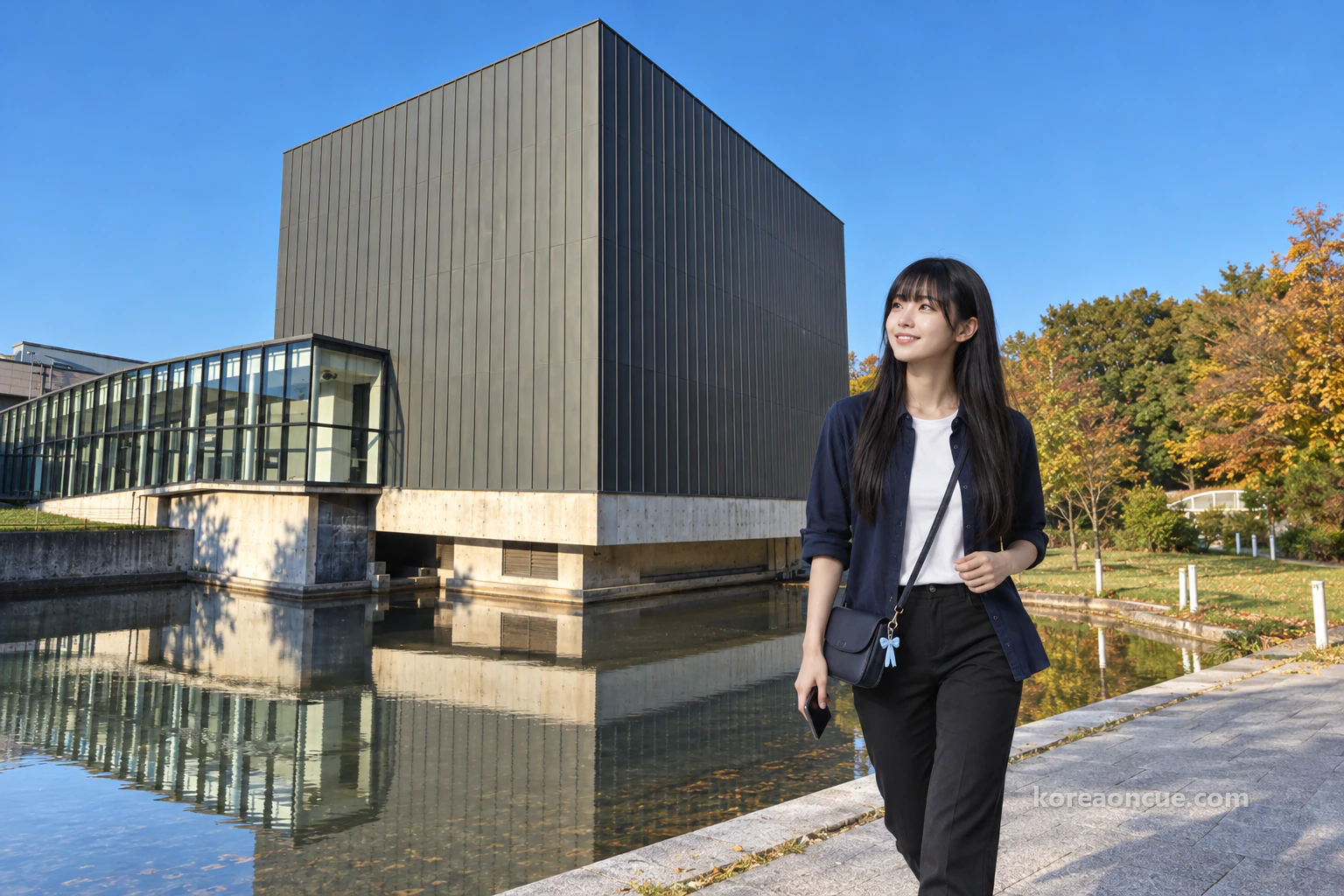
Maya is twenty-one and from Singapore, and she looks at the whole frame before she takes a photo. Even when she picks one picture for Instagram, she checks the background before the person in front. Then she checks the frame around them both. For a few days now, one line has sat at the top of the notes on her phone. It comes from the Building 1 facilities page of SOMA Museum of Art: “a long window unfolding like a twelve-panel folding screen”. The page says the sculpture park fills the window, and Maya wants to stand in front of it herself.

SOMA Museum of Art is in Olympic Park, in Songpa-gu, Seoul. It sits right in the middle of the sculpture park. Maya first saw the park on the evening she had dinner in Bangi-dong. That night she was there with Rina, Ethan and Lulu, and Olympic Park’s South Gate 2 was just across the street. It was already dark, and the park looked empty, so they walked on. This time she comes alone, on a weekday afternoon in mid-November, while there is still daylight.
When she opens the museum’s website, a question comes up. SOMA Museum of Art has two buildings: Building 1 above ground and Building 2 below ground. Right now each building has a different exhibition. Each one has its own ticket, too. If she does not decide which to see, she will be stuck at the ticket stage. Under the line in her notes, Maya adds one more: “Building 1, Building 2, or both”.
This piece follows Maya through the afternoon as she answers that line. First she takes Line 9 to Hanseong Baekje Station and walks underground from Exit 2 to Building 2. Next she sees From Commemoration to Landscape in Building 1, above ground. Last, she walks out of the museum into the sculpture park. Along the way you will find the fares and hours for each building, the galleries on each floor and how to choose between them. If you have not decided yet, follow Maya’s order as you read. By the end, the right building for you should be clear.
The Cue
SOMA Museum of Art (SOMA) is at 424 Olympic-ro, Songpa-gu, Seoul, inside the sculpture park of Olympic Park. It has two buildings: Building 1, on the 1st and 2nd floors above ground, and Building 2, underground. Each building charges its own admission. Building 1 shows From Commemoration to Landscape (adults 5,000 won), and Building 2 shows Gunrak: Six Gardens (8,000 won). If you see both, you get 1,000 won off. The museum opens 10:00–18:00, last entry is at 17:00, and it closes every Monday.
- Station and exit: Line 9 Hanseong Baekje Station Exit 2 (underground link) → straight into Building 2. Line 8 Mongchontoseong Station Exit 1 → inside the Peace Gate, 200 m to the right.
- Hours: 10:00–18:00, last entry 17:00. Closed every Monday, 1 January and on Seollal and Chuseok days.
- Fares: Building 1: adults (25–64) 5,000 won · youth (13–24) 4,000 won · children (7–12) 3,000 won. Building 2, Gunrak: 8,000 won (all ages). 1,000 won off if you see both.
- Don’t skip: the long window like a twelve-panel folding screen in Gallery 5, Building 1 · Gallery 1, with glass walls on both sides · the permanent exhibition Jogagi Kkum+Teul, free with a Gunrak ticket in Building 2.
- Afterwards: the earthen path of the sculpture park, leading on from the museum. Anything with wheels, such as bicycles and inline skates, is not allowed.
What SOMA Museum of Art is: two buildings inside the Olympic Park sculpture park
SOMA Museum of Art stands in the middle of the sculpture park, and it has two buildings. Building 1 has two floors above ground, with galleries on both. Building 2 is an underground space. Together, the two buildings have a total floor area of 13,216.81 m². The museum calls itself “a space of commemoration and rest that turns the achievements of the Seoul Olympics into art”. From that sentence, Maya copies just two words into her notes: “commemoration” and “rest”.
Open in Kakao Map — Hanseong Baekje Station
The sculpture park around the museum covers 692,367.2 m². Sculptures from around the world sit among the trees and lawns. The museum is the centre that links the park with nearby places such as the Peace Plaza and Mongchontoseong. Maya does not try to memorise the long number. She just keeps two things in mind. The park around this one museum is huge, and there is plenty of room to walk once she leaves.
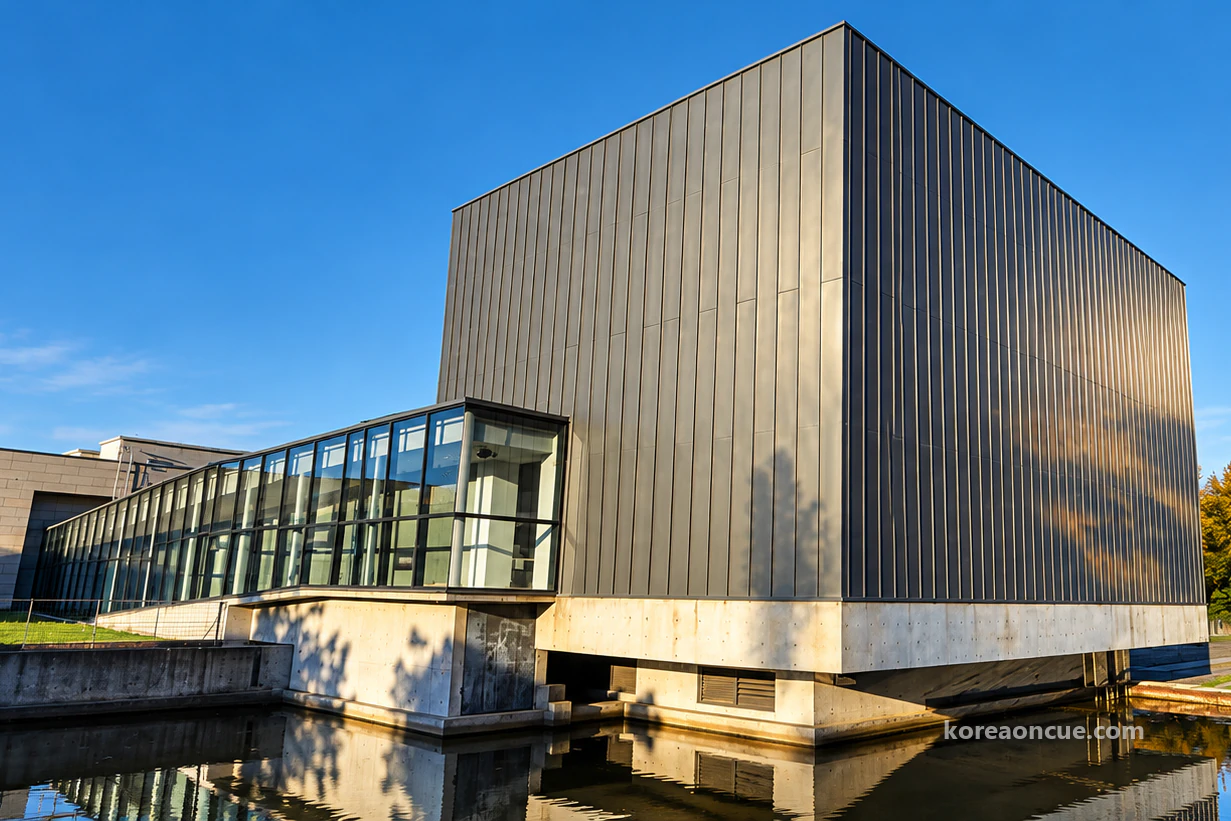
Before the exhibitions, the building materials are worth a look. The building is finished in rough exposed concrete and unfinished wood. Large windows, a corridor and a water garden appear throughout. Here the corridor means a long covered walkway that runs around the building or a garden. The exhibition building has a neat shape, like “a square wooden box”, so its lines look clean even from far away.
Natural light comes straight in through the windows. So the brightness inside changes with the time, the weather and the size of each window. The same room can look soft at one moment and very bright and clear at another. Maya looks at windows before photos, so this description pleases her as much as the exhibition list. It is also why she has chosen to come in November while the afternoon light lasts, even with the days getting shorter.
Which exit: Hanseong Baekje Station Exit 2 leads straight to Building 2
The easiest way to Building 2 is Exit 2 of Hanseong Baekje Station on Line 9. This exit does not go up to street level. It opens into an underground link. Building 2 is an underground space with a direct link to the subway and to the Olympic Park entrance. That makes it much easier to find. On a rainy or chilly November afternoon, this route is especially handy.
Maya takes this exit too. She gets off Line 9, goes through the ticket gates and follows the signs for Exit 2. She reaches Building 2 without going above ground, so she never has to stop and puzzle over a map. In her notes she writes “Hanseong Baekje Exit 2 = Building 2, direct”. On a first visit, that one line on your phone is all you need.

If you take Line 8, come out at Exit 1 of Mongchontoseong Station. This route is above ground. From Exit 1, first go in through the Peace Gate. Then walk 200 m to the right, and you reach SOMA Museum of Art. Maya decides to use Hanseong Baekje Station on the way in and this route on the way out. She wants to see the same park from a different side as she enters and leaves.
Buses 30, 30-5, B340, G3412, G3413 and G3323 stop at the “Mongchontoseong Station, Hanseong Baekje Station” stop. Buses 30, 30-5, G3412, G3413 and G3323 stop at the “Hanseong Baekje Museum” stop. If you drive, enter Olympic Park by South Gate 3 or South Gate 4. The South Gate 3 car park has 254 spaces. Parking is free for the first 10 minutes, then 600 won per 10 minutes, up to 20,000 won a day. With a paid ticket of 5,000 won or more you get one hour free, but you need to register your car at the information desk first.
Buildings 1 and 2 have separate tickets: the fares at a glance
The first thing to know at SOMA Museum of Art is that each building has its own fare. Admission is charged for Building 1 and Building 2 separately, so you pay for each building you want to see. At first Maya thought one ticket would cover both. Then, in front of the ticket gates at Hanseong Baekje Station, she reads the visitor information again and finds the line saying admission is charged “separately for Buildings 1 and 2”. So she leans against the wall by the gates for a moment. She will decide what to see before she goes into Building 2.
The fare for From Commemoration to Landscape in Building 1 depends on age. Adults (25–64) pay 5,000 won. Youth (13–24) pay 4,000 won, and children (7–12) pay 3,000 won. At twenty-one, Maya counts as youth. When she sees “youth up to 24”, she laughs a little at still being a youth.
Gunrak: Six Gardens in Building 2 costs 8,000 won, whatever your age. The permanent exhibition in Building 2, Jogagi Kkum+Teul, has no separate charge. You can see it free with Gunrak. If you see both Building 1 and Building 2, you get 1,000 won off. Groups of 20 or more get 50% off, and the group size is set for each exhibition.
The Building 1 exhibition also has set groups for free and discounted entry. Children aged 6 and under and people aged 65 and over go free. Disabled visitors and one companion also go free. So do national merit recipients, police officers, firefighters, and holders of an Artist Pass, ICOM card or Culture Nuri Card. University students with a student card or ISIC card pay the youth fare, and so do soldiers at the rank of sergeant (hasa) or below. With a ticket for an Olympic Park performance or a Dadungi (multi-child family) card, you get 1,000 won off.
Building 2 first: Gunrak: Six Gardens underground and the free permanent exhibition Jogagi Kkum+Teul
If you come by subway, start with Building 2. You can walk straight in from the station, so you save your legs for the first exhibition. Building 2 is now showing Gunrak: Six Gardens, a special exhibition from the MMCA Art Bank collection. It runs from 9 October 2026 to 30 May 2027. About 80 works of sculpture, installation, media and more fill the Building 2 special exhibition hall.
Building 2 feels quite different from Building 1 above ground. A long, corridor-like multi-hall stretches under a ceiling open to the sky. There are four galleries in all: two linked together and two on their own. An education room and a drawing centre are on the same level. With the galleries and education spaces together, Building 2 covers 1,423 m².
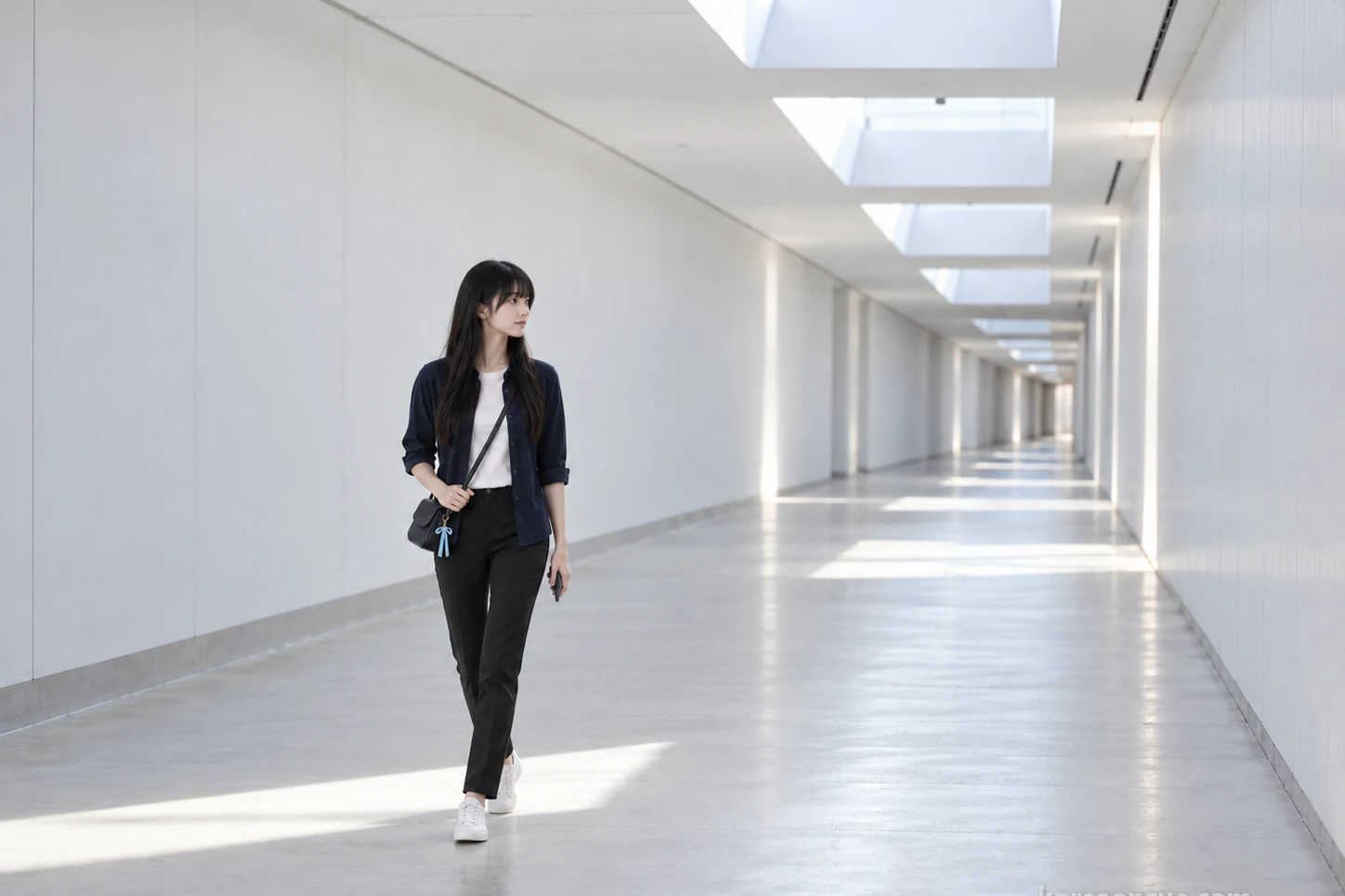
As soon as she steps into the multi-hall, Maya slows down. Before any artwork, she notices the long frame made by the ceiling and walls, like a camera screen. Building 2 is a bright, modern space with white as its base. White walls, a long corridor and light from above make a single scene. Maya looks along the whole frame once, end to end. Only then does she go back to the first gallery and start looking at the works one by one.
Building 2 also has a permanent exhibition, Jogagi Kkum+Teul, in the permanent gallery until 14 February 2027. It is a multisensory permanent exhibition on the theme of the Olympic sculptures. It covers two works: Dennis Oppenheim’s Wijangji and Josep Maria Subirachs’s Haneulgidung. It is open only while a Building 2 special exhibition is on, so stop by the permanent gallery when you see Gunrak. Maya sees both exhibitions, one after the other, with a single Gunrak ticket.
From Commemoration to Landscape in Building 1: Galleries 1–4 on the 2nd floor and Gallery 5 on the 1st floor
From Commemoration to Landscape fills Galleries 1–5 in Building 1. It runs from 17 October 2026 to 14 February 2027. Galleries 1–4 are on the 2nd floor, and Gallery 5 is on the 1st floor. The four galleries on the 2nd floor sit around a central courtyard. The Building 1 galleries add up to 950 m², and you go up and down between the two floors to see them in order.
The exhibition shows about 100 works of many kinds: drawing, painting, three-dimensional work, video, photography and archive. There are nine artists: Kim Chung-up, Moon Shin, Park Mina, Baek Geum-nam and Choi Jeong-hwa. Four more take part as well: Bertrand Lavier, César Baldaccini, Étienne Martin and Jean Messagier. The exhibition is organised by the Korea Sports Promotion Foundation and SOMA Museum of Art. Maya copies all nine names into her notes. In each gallery she looks for them one at a time.
As she copies the title into her notes, Maya stops. The “commemoration” in From Commemoration to Landscape is the same word as the “space of commemoration” in the museum’s introduction. Instead of tying the two together in her head, she puts them side by side on one line. Write the title down briefly, and judge after seeing the work — that is Maya’s way. With that settled, she puts her phone in her pocket and walks into the 2nd-floor galleries.
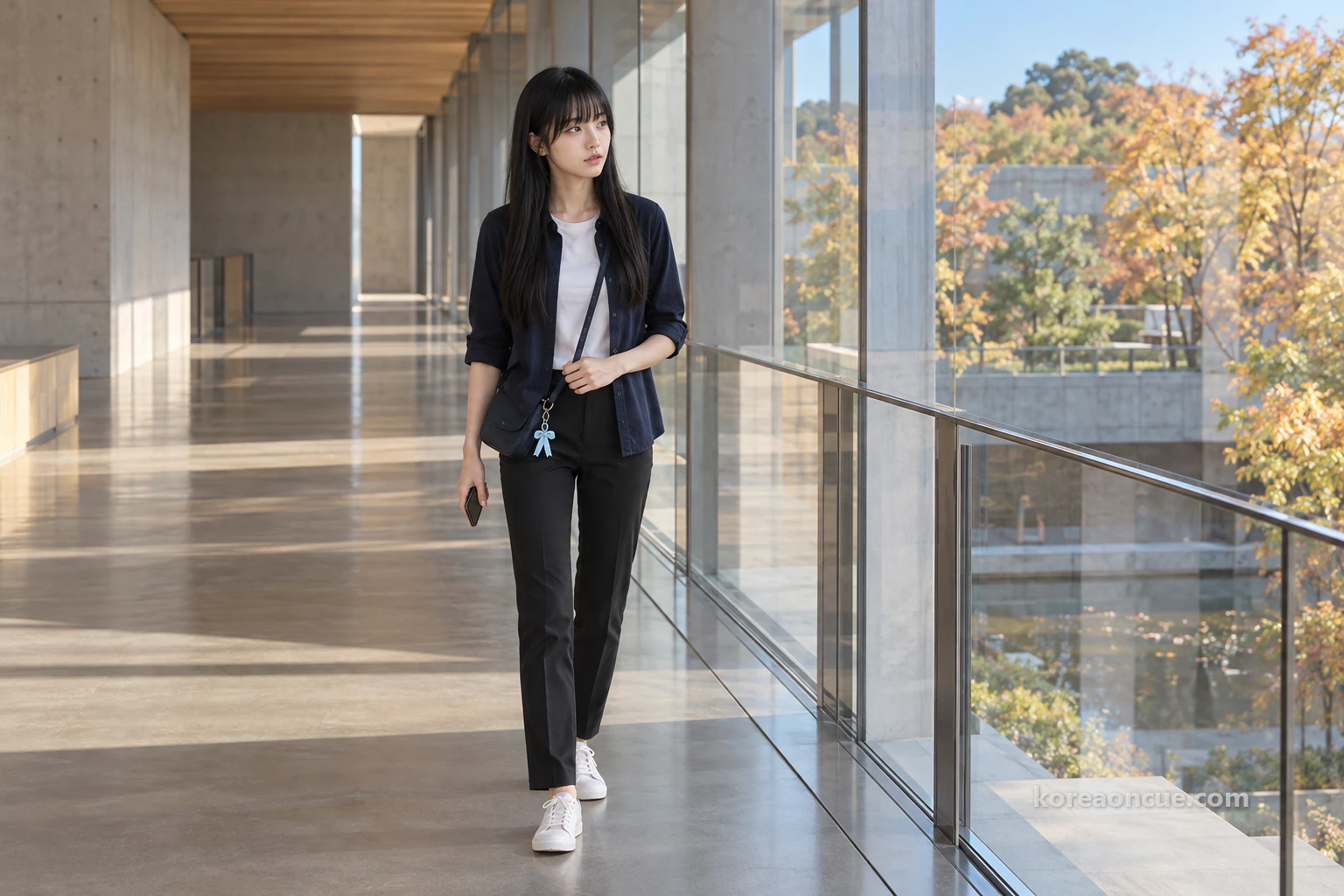
The Building 1 galleries are bright and cosy, but restrained and simple. Instead of showy decoration, concrete walls, wood and window light shape the rooms. When Maya walks into a room like this, she first stands by the door and takes in the whole space. Only then does she step towards the works, one at a time. Remembering a whole room suits her better than staring at one piece for a long time.
What not to miss in Building 1: Gallery 1 with glass on both sides and Gallery 5 like a twelve-panel folding screen
In Building 1, look at the windows as well as the works. Gallery 1 has glass walls on both sides, so the scenery outside comes right into the room in every season. On this mid-November afternoon, the trees and sky outside look like part of the room. Thanks to the natural light, the brightness of the room shifts a little with the time. Maya stands between the window and the wall for a long while. She is looking for the spot where inside and outside fit into one view.
The room Maya has waited for most is Gallery 5 on the 1st floor, the subject of the line at the top of her notes. This room has a long window that unfolds like a twelve-panel folding screen. Through it, the sculpture park around the museum fills your view. As soon as she enters, Maya slowly steps backwards towards the wall opposite the window. To fit the whole long window into one frame, she has to go a long way back.

As she steps back, Maya remembers something Lulu always says. “When you step back, look at your feet first.” Maya stops and turns her head to check there is no one behind her. Other visitors are in the gallery too, so step backwards slowly. If someone is already standing at the window, wait a moment before you move into place, and everyone stays comfortable.
At the window, under “Building 1, Building 2, or both”, Maya writes one more line: “For the windows, Building 1.” If Building 2 is a white frame for the works, Building 1 is a frame that brings in the scenery outside. Neither is better. They simply ask you to look in different ways. On a day when you want to focus only on the works within white walls, you will choose one building. On a day when you want the season outside the windows too, you will choose the other. Maya thinks this difference is the key to choosing.
Building 1, Building 2 or both: how to choose
There are three things to weigh. What you want to see, how much you want to spend and what time you arrive. Maya leaves Building 1 and stands on the approach path between the concrete wall and the wooden wall to sort her notes again. Having walked through both buildings, she can see that the spaces and the exhibitions are clearly different. Below are the points Maya noted there, in order.

Building 1 alone suits people who love architecture and windows. Adults pay 5,000 won, and ages 13–24 pay 4,000 won. You see the 100 or so works of From Commemoration to Landscape, plus the windows of Gallery 1 and Gallery 5. This is also the one to choose if you want many kinds of work at once, from drawing and painting to photography and archive. Afterwards you can walk straight out into the sculpture park and carry on through the scenery you saw from the windows.
Building 2 alone suits people who want to walk straight in from the subway. It costs 8,000 won, whatever your age. You see the 80 or so works of Gunrak, plus the free permanent exhibition Jogagi Kkum+Teul. Choose this if you are curious about the sculpture, installation and media works held by the MMCA Art Bank. It is also good on a rainy day, when you would rather not go above ground.
Both buildings suit people with time to spare. If you see both, you get 1,000 won off. But last entry is at 5 p.m. Arrive late, and there is only time for one building. If you plan to see both, arrive in the early afternoon, and if you come by subway, start with Building 2.
Maya chooses both because of her arrival time. She gets off at Hanseong Baekje Station at about half past one, so she has plenty of time before last entry at 5. She sees Building 2 first, straight from the subway, then moves on to Building 1. If you set off after lunch, try to arrive in the early afternoon like Maya. The museum is closed on Mondays, so leave them out when you pick a date.
Choosing by arrival time makes it a little easier. If you arrive in the morning or just after lunch, you can plan to see both buildings. If you arrive after 3 p.m., it is more relaxing to choose one building and focus on that exhibition. On a rainy day, Building 2 is easiest, reached underground from Hanseong Baekje Station Exit 2. Maya adds these three short lines under the points in her notes.
The sculpture park outside the museum: an 88 Olympics sculpture walk along the earthen path
When you leave the museum, the earthen path of the sculpture park leads straight on. It is a walking path made of yellow-brown earth. Along this path you see sculptures and nature together. The works stand along the walking paths and in the park’s plazas, where people come and go easily. Trees and sculptures take turns appearing as you walk, so it really feels like a sculpture park in the middle of the city.
The sculpture park was created as part of the cultural and arts festival of the 1988 Seoul Olympics. At that time, 36 artists from 32 countries took part in the first and second International Open-Air Sculpture Symposiums. There was also an International Open-Air Sculpture Exhibition with invited works by 155 artists from 66 countries. For the 10th anniversary of the Seoul Olympics, an open-air sculpture symposium added 12 more works. Maya writes “66 countries” in large letters in her notes. It amazes her that so many countries come together in one park.
As she walks, Maya thinks back to the permanent exhibition in Building 2. Jogagi Kkum+Teul took the Olympic sculptures as its theme. So her route has worked out neatly: first a sculpture-themed experience in the underground gallery, then a walk among the sculptures gathered for the Olympics. If you pair Building 2 with the sculpture park on the same day, inside and outside connect like this. Maya thinks this order is the best choice she has made all day.
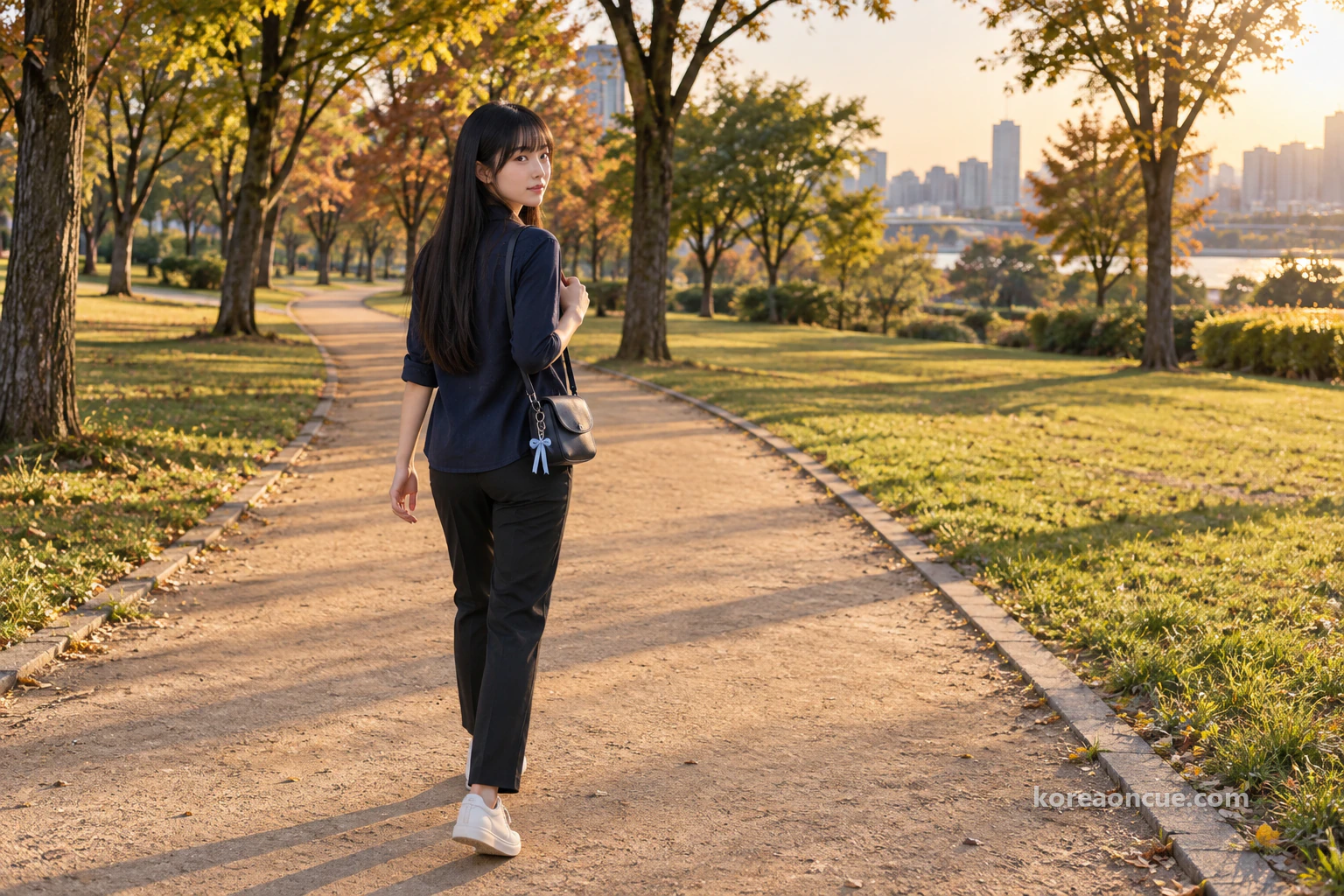
On this path, too, Maya looks at the whole frame first. She sees the curving line of the path, the trees at its end and the wide sky above. It feels as if she has walked into the scenery she saw from inside Gallery 5. Through the window it was framed like a picture. Now she sees it without the frame, and Maya rather likes the difference.
If you want to link the view from the Building 1 windows with the view on foot, head out to this path right after Building 1. Walk with the direction of that window in mind, and the same park looks a little different. Maya hardly lifts her camera as she walks. She already has the one scene she wanted from inside the window. This time, walking through that scene is enough. Instead, she leaves a short line in her phone notes: “Inside the window → outside the window”.
Rules for the sculpture park and the galleries: nothing with wheels
You cannot take anything with wheels into the sculpture park. That includes inline skates, bicycles and motorbikes. Inside the museum galleries, kick scooters and inline skates are not allowed either. If you planned to tour the park by bike, walk through the sculpture park area. Walking on the earthen path, Maya is glad she wore trainers today.
If you use a pushchair or wheelchair, there is something to know. Depending on the safety of the works and the layout of the gallery, some exhibitions limit access for pushchairs or wheelchairs. If you are coming with family or in a wheelchair, it is a good idea to phone the museum before you set off. The number is 02-425-1077, and the museum is closed every Monday, so call between Tuesday and Sunday. The address is 424 Olympic-ro, Songpa-gu, Seoul, inside Olympic Park.
Taking photos in the park, Maya keeps to Lulu’s words. Each time she steps back to widen the frame, she checks her feet and what is behind her first. The earthen path is a dirt path, so it is worth looking down once more before each step. People walk along it, so it is also polite not to stand in the middle for long. Each time Maya takes a photo, she steps to the edge and lets the people behind her pass first.
Back to Mongchontoseong Station Exit 1, and the notes Maya sends Rina
On the way back, Maya walks towards Exit 1 of Mongchontoseong Station on Line 8. Using a different station means a little more of the park above ground on the way out. The route is easy: just follow the directions for the way in, in reverse. Walk 200 m from the museum towards the Peace Gate, and you reach Exit 1. If you need Line 9, go back to Hanseong Baekje Station Exit 2 as you came and reach the station underground.
Walking to the station, Maya sends Rina a screenshot of today’s notes instead of a photo. “It was a museum with two tickets. Building 1 for the windows, Building 2 if you want to walk straight in from the subway.” Rina writes everything into boxes in her notebook, so her reply comes quickly. “Your notes look like my notebook. ‘Twelve-panel folding screen’ is a lovely name.” Reading it, Maya wonders what colour name Rina would give this window.

Maya rewrites the top line of her notes. Next to “Building 1, Building 2, or both” there is now an answer: “Building 1 for the windows, Building 2 from the subway, both if you have time — Building 2 first.” She feels a little proud to have filled that line in a day of walking. Next time she comes to Olympic Park with Lulu, she plans to show her these notes as they are. With Lulu’s words added at the very bottom, of course: look at your feet first when you step back.
Common Mistakes
Expecting one ticket to cover both buildings
admission is charged separately for Building 1 and Building 2. If you see both, you get 1,000 won off.
Paying the adult fare when you are 24 or under
in Building 1, ages 13–24 pay the youth fare of 4,000 won. Gunrak in Building 2 is 8,000 won for all ages.
Arriving late in the afternoon
last entry is at 17:00. To see both buildings, arrive in the early afternoon.
Going on a Monday
the museum is closed every Monday.
Riding a bicycle or inline skates into the sculpture park
nothing with wheels is allowed.
FAQ
Which station and exit should I use?
Line 9 Hanseong Baekje Station Exit 2 (underground link) leads straight to Building 2. From Line 8 Mongchontoseong Station Exit 1, go inside the Peace Gate and walk 200 m to the right.
Are the exhibitions in Buildings 1 and 2 the same?
No. From Commemoration to Landscape in Building 1, Gunrak: Six Gardens in Building 2 and the permanent exhibition Jogagi Kkum+Teul in Building 2 are all separate exhibitions. Their fares and dates differ too.
How much is admission?
Building 1: adults (25–64) 5,000 won, youth (13–24) 4,000 won, children (7–12) 3,000 won. Gunrak in Building 2 is 8,000 won (all ages), and you get 1,000 won off if you see both.
Do I need a separate ticket for Jogagi Kkum+Teul?
No. It is free with Gunrak. It is open only while a Building 2 special exhibition is on.
How long do the exhibitions run?
From Commemoration to Landscape runs from 17 October 2026 to 14 February 2027, and Gunrak: Six Gardens from 9 October 2026 to 30 May 2027.
What are the opening hours and closing days?
10:00–18:00, last entry 17:00. Closed every Monday, 1 January and on Seollal and Chuseok days.
Can I park?
Use Olympic Park South Gate 3 or South Gate 4. Free for the first 10 minutes, then 600 won per 10 minutes, up to 20,000 won a day. With a paid ticket of 5,000 won or more you get one hour free, but register your car at the information desk first.
Who can I contact?
SOMA Museum of Art, 02-425-1077.
Recap — 30 seconds before you go
- Line 9 Hanseong Baekje Station Exit 2 → underground to Building 2 / Line 8 Mongchontoseong Station Exit 1 → inside the Peace Gate, 200 m to the right.
- 10:00–18:00, last entry 17:00, closed Mondays.
- Building 1, From Commemoration to Landscape: 5,000 won (ages 13–24: 4,000 won) · Building 2, Gunrak: 8,000 won · 1,000 won off if you see both.
- For the windows, Building 1 (Galleries 1 and 5). To walk straight in from the subway, Building 2 (including the free permanent exhibition Jogagi Kkum+Teul).
- Afterwards, the earthen path of the sculpture park — nothing with wheels.
Sources
- SOMA Museum of Art — DirectionsAddress: 424 Olympic-ro, Songpa-gu, Seoul, inside Olympic Park · Line 9 Hanseong Baekje Station Exit 2 (underground link) · Line 8 Mongchontoseong Station Exit 1 (inside the Peace Gate, 200 m to the right) · buses at the “Mongchontoseong Station, Hanseong Baekje Station” and “Hanseong Baekje Museum” stops · Olympic Park South Gate 3 (254 spaces) and South Gate 4 · tel. 02-425-1077checked 2026-10-28
- SOMA Museum of Art — Visitor information10:00–18:00, last entry 17:00 · closed every Monday, 1 January and on Seollal and Chuseok days · admission charged separately for Buildings 1 and 2 · group fares · parking free up to 10 minutes, then 600 won per 10 minutes, 20,000 won a day at most, one hour free with a paid ticket of 5,000 won or more (register the car at the information desk)checked 2026-10-28
- SOMA Museum of Art — From Commemoration to Landscape17 October 2026–14 February 2027 · Building 1, Galleries 1–5 · nine artists · about 100 works of drawing, painting, three-dimensional work, video, photography and archive · organised by the Korea Sports Promotion Foundation and SOMA Museum of Art · adults 5,000 won, youth (13–24) 4,000 won, children (7–12) 3,000 won · 50% off for groups of 20 or more · free and discounted admission · 1,000 won off when visiting both buildingschecked 2026-10-28
- SOMA Museum of Art — Gunrak: Six GardensSpecial exhibition from the MMCA Art Bank collection · 9 October 2026–30 May 2027 · Building 2 special exhibition hall · about 80 works of sculpture, installation and media · 8,000 won (all ages) · 1,000 won off when visiting both buildingschecked 2026-10-28
- SOMA Museum of Art — Jogagi Kkum+Teul26 September 2025–14 February 2027 · Building 2 permanent gallery · a multisensory permanent exhibition on Olympic sculptures · works covered: Dennis Oppenheim’s Wijangji and Josep Maria Subirachs’s Haneulgidung · open only while a Building 2 special exhibition is on · free with a Gunrak ticketchecked 2026-10-28
- SOMA Museum of Art — Building 1 facilitiesBuilding 1 galleries total 950 m², Galleries 1–4 around the 2nd-floor courtyard and Gallery 5 on the 1st floor · Gallery 1 with glass walls on both sides · Gallery 5 with a long window like a twelve-panel folding screen facing the sculpture park · bright and cosy but restrained and simplechecked 2026-10-28
- SOMA Museum of Art — Building 2 facilitiesUnderground space linked directly to the subway · a long corridor-like multi-hall under a ceiling open to the sky · four galleries (two linked, two separate), an education room and a drawing centre, 1,423 m² · direct links to the subway and the Olympic Park entrancechecked 2026-10-28
- SOMA Museum of Art — About the museumA museum inside a 692,367.2 m² sculpture park · the earthen path of the sculpture park leading on from the museum · total floor area 13,216.81 m²: Building 1 on two floors above ground and Building 2 underground · rough exposed concrete and unfinished wood · large windows, a corridor and a water garden · natural light · a centre linking the Peace Plaza and Mongchontoseong · a space of commemoration and rest that turns the achievements of the Seoul Olympics into art · Building 2 in bright white toneschecked 2026-10-28
A Seoul story told with our AI characters. Place details are checked against public sources; the photos are AI-made illustrative images. How we use AI
More from this area

A business trip that ran a week over: Ethan and Lulu spend a Saturday morning at Garak Market and Garak Mall
On the day an email tells him his trip has been extended by a week, Ethan asks Lulu where their next market should be after Mangwon Market.

Seoul Sky: Reading the City in Lines from 500 Metres Up
Part three of “Gangnam · Songpa.” Seoul Sky’s website calls this a 500-metre observatory. The Korea Tourism Organization’s English guide gives Lotte World Tower as 123 floors and 555 metres. Noah, who reads streets and routes by eye, looks at a city from above rather than from the side for the first time — to see what a string of corners becomes when you rise high enough.