
SEOUL · SANGAM
The Thursday the tank doors were shut: Mali chose the steel and glass outside at Oil Tank Culture Park
The yard at Oil Tank Culture Park is open 24 hours and free, the tanks have had no everyday viewing since April 2025 and open only for events, it is about 10 minutes on foot from Exit 2 or 3 of World Cup Stadium Station, and from December to February the last Haneul Park shuttle up from Nanjicheon Park leaves at 5.30 p.m.
Mali gets off at World Cup Stadium Station to see the light inside a round tank from a blog post written a few years ago. But the tanks are no longer kept open as a matter of course. Switching her winter-issue homework from “indoor light” to “outside textures”, she starts holding colour cards up to steel and glass, a rusted door and a wide earth yard.

How to get there
At half past two on the afternoon of Thursday 3 December, Mali stepped off the train at World Cup Stadium Station on Line 6 and flicked through her phone one more time. On the screen was a blog post written a few years earlier. Its writer had gone inside a round oil tank to see an exhibition and photographed how light fell in a room ringed by steel walls. Mali, 23, who works for a beauty magazine in Bangkok, felt those photos would fit neatly into a gap in her winter-issue homework. She had come straight to this station after a morning meeting on her eighth work trip to Seoul.
She had first spotted the place two trips earlier. Walking back from the sunset at Haneul Park that evening, she switched her map to satellite view and saw round shapes set into the hillside across from the station. It was called Oil Tank Culture Park (문화비축기지), a park made from tanks that once stored oil. Her winter-issue homework from the last trip, “indoor light”, already had its small room filled, but the big-room line still held only a note: “17 m — the card is too small”. Mali thought the inside of a round tank could be the new room to fill that line.
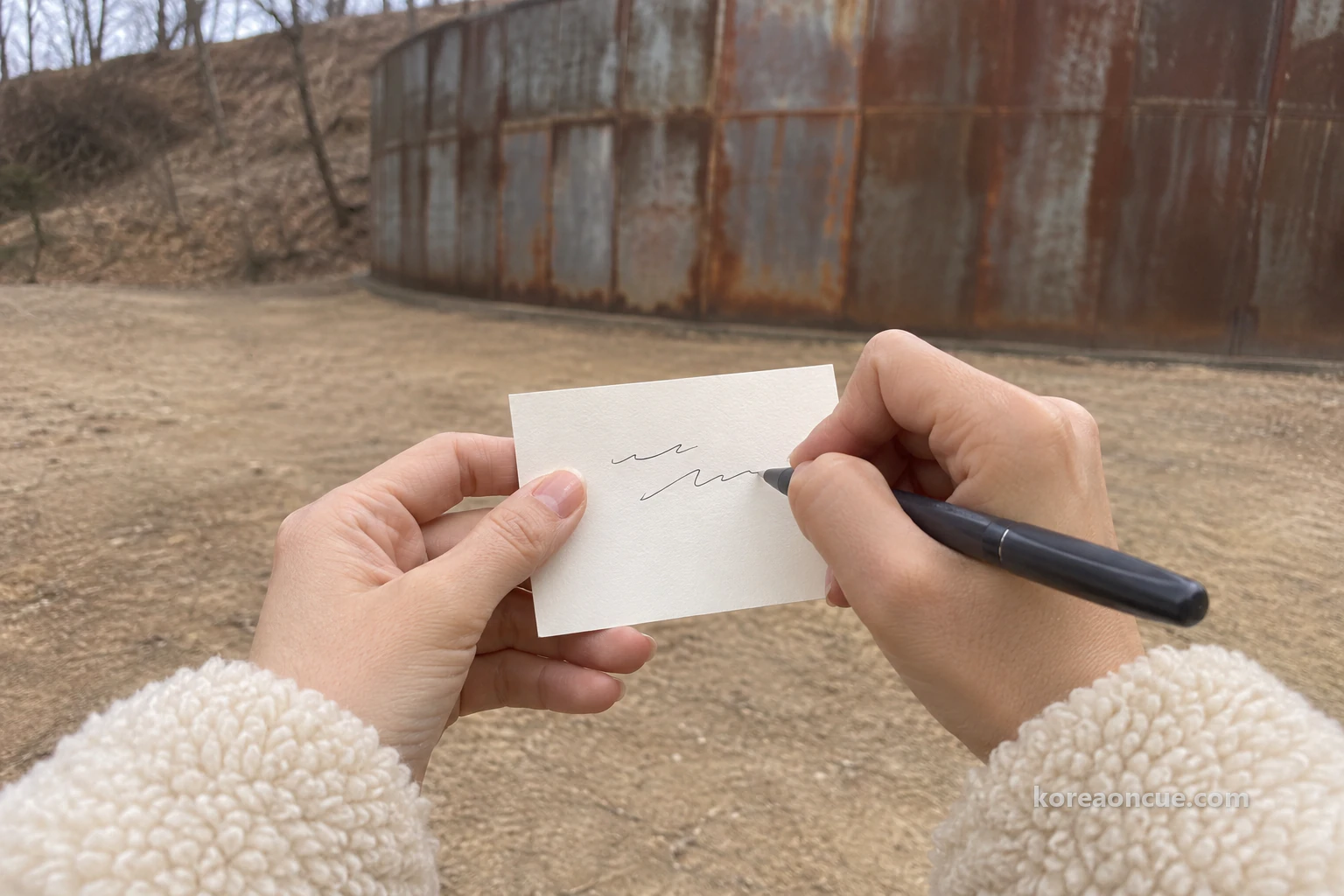
In the pocket of the thick coat she had worn every day since the weather turned cold was a bundle of colour cards. Whenever she found a light or a texture she liked, she held a card up to it and gave it a name on the back, something she did every time she came to Seoul. Today she was curious how many names she would find for the light in a round room. That afternoon, though, Mali would fold that plan away and choose something else instead.

The Cue — At a glance
Go to Oil Tank Culture Park thinking of it not as a place to see inside the tanks but as a place to walk around them, among the steel and glass outside and across the wide earth yard. The yard and paths are open every day without a break and cost nothing to walk, though some paths can be closed on days with big events. The tanks are not open as a matter of course, so time your visit to an event if you want to go in, and in winter, if you add Haneul Park, plan around the last shuttle up from Nanjicheon Park.
- Where: Oil Tank Culture Park, 87 Jeungsan-ro, Mapo-gu, Seoul.
- Getting there: World Cup Stadium Station (Line 6) Exit 2 or 3, about a 10-minute walk. The main-gate side crosses at the pedestrian crossing at the World Cup Stadium junction, and the back-gate side goes over a timber stair boardwalk.
- If you drive: Notices closing the car park come out around big events. Check that week’s news on the Seoul Parks site first.
- If you are going on to Haneul Park: The Maengkkongi electric shuttle to the top leaves from Nanjicheon Park.
- Enquiries: Main line 02-376-8420, use of Tanks T1–T6 (including the outdoor stage) 02-508-2205.
How to get to Oil Tank Culture Park: about 10 minutes on foot from Exit 2 or 3 of World Cup Stadium Station
Oil Tank Culture Park is about a 10-minute walk towards the west gate from Exit 2 or 3 of World Cup Stadium Station on Line 6. The back of the park joins the Maebongsan trail. On the day she went to Haneul Park, Mali had come out of Exit 1, but Oil Tank Culture Park uses different exits, so she had to choose her number again. She kept the blog post open as she climbed out of Exit 2 and walked on with it in her hand. The thought of the light inside the tanks quickened her step a little.
Open in Kakao Map — World Cup Stadium Station
There are two ways from the station into the park. The path to the main gate crosses at the pedestrian crossing at the World Cup Stadium junction. The trail to the back gate goes in over a boardwalk laid as timber steps. If you are pushing a buggy or pulling a suitcase, save the back-gate path, with its steps to climb, for a day when you are travelling light. Mali’s hands were free and she was curious about the grain of the timber, so she took the back-gate side.
The deck stairs climbed between trees that had lost all their leaves. Every few steps Mali stopped and held a card against the colour of the wood under her feet. Dried by the cold wind, the grain looked a shade paler than in the blog photos. Skin shows its texture first in winter, and finding that wood did the same was a happy discovery for her. Today’s homework was inside the tanks, though, so she did not hold the card there for long before walking on.

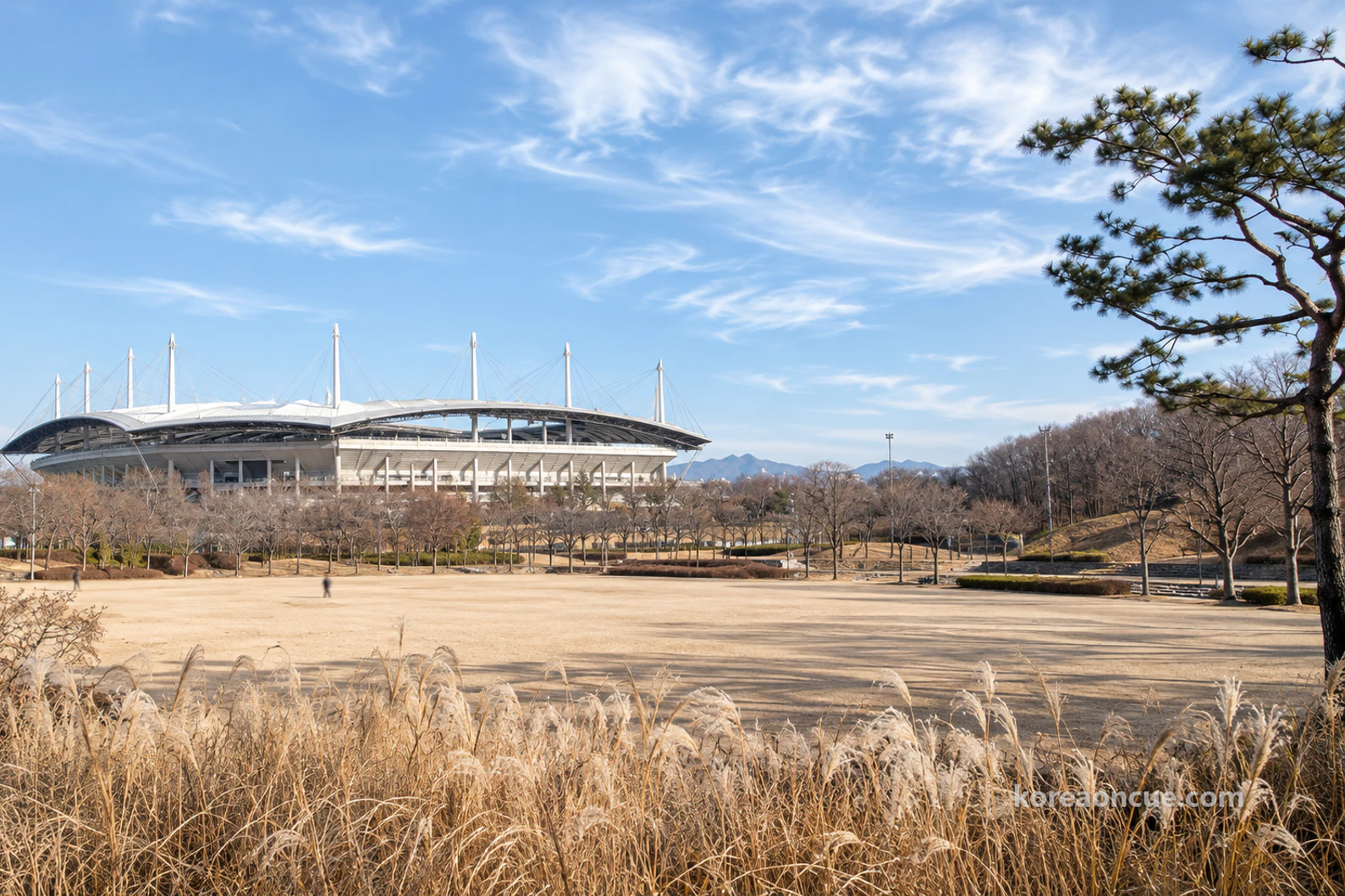
When the boardwalk ended, the view suddenly opened out. A wide earth yard spread in front of her, and round tanks sat half-buried in the hillside around it. Things she had only seen as circles on a satellite map were, up close, huge masses of steel and concrete. Matching the blog photos against the tanks in front of her, Mali walked to the edge of the yard to find the tank with the door from the photo. A distance no bigger than a fingernail on the map turned out to be quite a walk.
Can you go inside the tanks at Oil Tank Culture Park? Since April 2025, not on everyday visits, only during events
The first place Mali went was the door of the tank in the blog photo. But the door was shut. She reached towards the handle, stopped, and looked again at the date on the blog post on her phone. It had been written a few years earlier, and in the meantime the way the tanks here were used had changed. The open door in the blog was a door from a few years ago.
Since Monday 14 April 2025, Tanks T1 to T6 have not been kept open for everyday viewing. From the 1st of that month, a private company has run T1, T2, T4, T5 and part of T6 as event venues under a permit that lasts five years, until 31 March 2030. In other words, this is not a temporary closure that will end in a month or two. Separate programmes run inside the tanks and on the T2 outdoor stage, and the park lists those programmes as paid. If you want to see inside, pick a day when an exhibition or performance is on in there and go in the way that event tells you to.
This is where it is easy to get confused, because old information is still around in several places. Older guides listed tank viewing hours, and introductions and blog posts that copied those lines word for word are still online. The post Mali had brought was one of them. Looking down at the photo of the open door for a while, she noticed only then that the people in it were in short sleeves, with no coats. Even the season in the photo was different from today.
You can sort out old posts by their date. If a post was written before that Monday when tank viewing stopped, read its photos of walking inside the tanks and its viewing hours as things of the past. The blog post Mali had brought was dated before it too. She decided that from now on, when choosing a place, she would look at the date before the post, and at the top of the back of a card she wrote “Date first”.
If you do get inside on an event day, go knowing that each tank is fitted out differently. At T2, a gentle ramp brings you up to the outdoor stage on top of the tank, and below it is an indoor performance hall. T4 keeps the inside of the tank as it was, and T1 lets you see the Maebongsan bedrock through glass walls and a glass roof. Even the same kind of event will look different depending on which tank it is in. Mali made up her mind that the next time she came on an event day, she would choose the tank kept as it was over the performance hall.

Standing at the shut door, Mali let out one long breath. Before disappointment could set in, her first thought was that if she could not see the round room, she would at least see its outside. In shoot work there are days when the studio you wanted falls through, and on those days you rework the plan with the light you have. She closed the blog tab, turned a card over and wrote on the back “Outside textures — steel, glass, rust”. And so, next to “indoor light” in her winter-issue homework, a new outside line appeared.
What time does Oil Tank Culture Park open, and is it free? The yard is open 24 hours and free to walk
Even with the tanks shut, the yard and paths are open day and night with no closing days. You can come on a Monday, and you can walk here early in the morning or late at night. Walking the yard costs nothing. Under the note she had just written, Mali added one more line: “Yard always open, walking is free”. Her shoulders, stiff since the shut door, loosened a little at that line.
| What | When | Cost |
|---|---|---|
| The yard (T0 Culture Yard) and paths | 24 hours, all year | Free to walk |
| Inside Tanks T1–T6 and the T2 outdoor stage | No everyday viewing, only when separate programmes run | Programmes are paid |
| Car park (107 spaces) | 24 hours, charges 09:00–22:00 | Car 150 won per 5 min, mid-size vehicle 300 won per 5 min |
If you are coming by car, there is something to know before the parking charges. The car park is small and traffic is heavy at weekends, so the park asks visitors to come by public transport. Around big weekend events, notices go out closing part or all of the car park for a few days before and after, and closing some sections of the paths on the event days. A past closure notice pointed drivers to the Nanjicheon Park car park or the World Cup Stadium car park instead. If you are driving at the weekend, look for closure notices in that week’s park news before you set off.
If you want a quiet walk, a weekday is better. The park itself treats weekends as the days when the most visitors come. Since the yard is open day and night, dropping in for a morning or evening walk during your trip is easy here. In that sense, the Thursday afternoon Mali had chosen was quite a lucky time.
On Thursday afternoon the yard was wide and empty. Mali stood in the middle and turned to look all the way round. The round tanks circled the yard along the foot of the hill, and beyond them the stadium roof sat low on the horizon. Looking at that wide ground with no roof over it, she read the note in the big-room line, “the card is too small”, in a different way. On the back of a card she wrote, small, “Big room = the yard?”, question mark and all.
T0 Culture Yard and Tanks T1–T6: what each tank once held and what it is now
The spaces at Oil Tank Culture Park go by numbers. The wide yard in the middle is T0, and around it are Tanks T1 to T6. T1 to T5 are tanks that held oil, and T6 is a new building made from the steel plates of a dismantled tank. Knowing what each tank once held gives you far more to look at, even from outside. Mali tapped each number on her phone map in turn and copied what follows, small, onto the back of a card.
| No. | What it once held | Now |
|---|---|---|
| T0 | — | Culture Yard, a wide open plaza where anyone can rest at any time |
| T1 | Petrol | A space covered with glass walls and a glass roof, made so you can see the Maebongsan bedrock that surrounded the tank |
| T2 | Diesel | Outdoor stage on top, indoor performance hall below |
| T3 | Diesel | The original tank from the oil reserve days, kept as it was, Seoul Future Heritage |
| T4 | Kerosene | A multi-purpose cultural space that keeps the inside of the tank as it was |
| T5 | Kerosene | The Story Hall, a kerosene tank brought back to life |
| T6 | — | Community Centre built from old tank steel plates |
If you have come only to look from outside, head for T3 and T6 first. T3 keeps the original tank from the days of the oil reserve just as it was, while T6, the other way round, is a new building made by reusing old tank steel. The same steel stayed put at T3 and became a new wall at T6. T1, covered in glass, sits between them, so going round all three shows you, in one loop, the different ways this park has dealt with its old tanks. Mali drew circles next to the three lines she had copied.
These tanks came after the 1973 oil crisis. Between 1976 and 1978, five tanks were built here and held 69.07 million litres of oil. That was about a month’s worth for the people of Seoul at the time. The Mapo Oil Reserve was closed for safety reasons ahead of the 2002 World Cup. After more than ten years without finding a use for it, the city decided in 2013, through a public ideas competition, to turn it into Oil Tank Culture Park.
“A month of Seoul’s oil,” Mali said to herself, and thought of her own dressing table. Even a month’s worth of skincare lined up on it was enough to run out of space, and here a whole city’s month had been buried in this hillside. Rina was the one who usually held on to numbers, but this one made it onto the back of Mali’s card too. Mali set off along the edge of the yard towards T6.
What to see from outside at Oil Tank Culture Park: the steel walls of T6, the glass of T1 and the rusted door of T3
The loop outside is easiest to start from T0 Culture Yard. All the tanks ring this yard, so from the middle you can see at a glance which way to walk. The yard is a plaza left open for anyone to rest at any time, so do not just go round the edge, but cross it slowly at least once. Mali crouched down, held a card to the dry earth and called it “Yard earth”. It was a calm brown with the red taken out, good for the floor colour at the very bottom of a winter shoot.
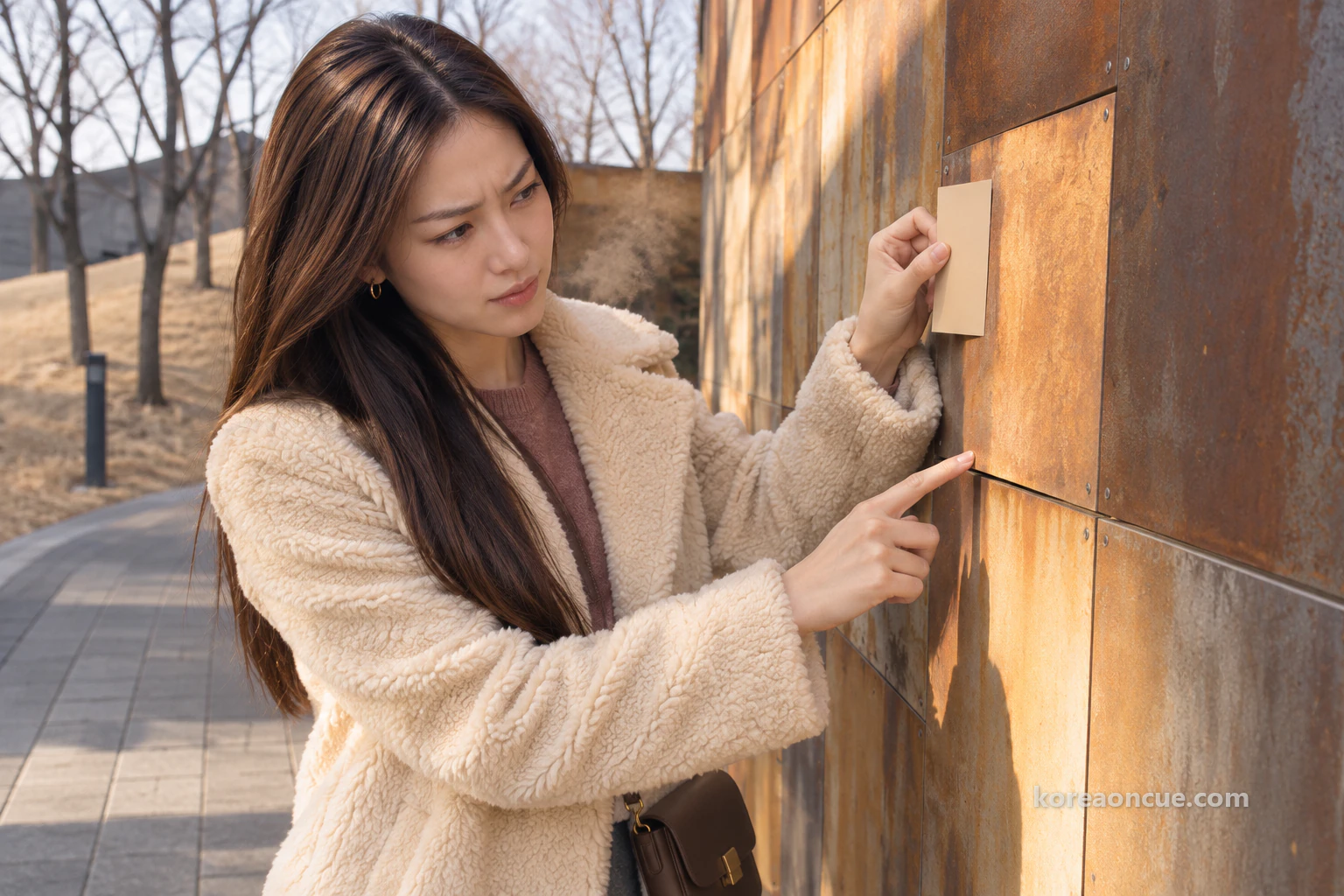
T6 is a building whose outer wall alone is worth a long look. Square steel plates in brown and ochre wrap the round building, and those plates came from a dismantled tank. Inside are rooms such as the operations office, lecture rooms and meeting rooms, and up on 2F there is a rooftop deck where you can look up at a circle of sky, along with a small ecology library, the Eco Lounge. Mali decided to look only at the outer wall today and stood in front of the plates. Each plate was a slightly different colour, so you could see that this was not one sheet of wall but old plates joined together.
Mali ran a card along the gaps between the plates, a finger’s width away. The plates the low winter sun touched at an angle were a bright ochre, while those in shade, the same colour, had sunk towards brown. To Mali it was like seeing the same foundation under warm-toned lighting and in shadow. She named the colour of the sunlit plate “T6 ochre steel”. Its matte surface looked, if anything, easier to use as a backdrop for a winter shoot.
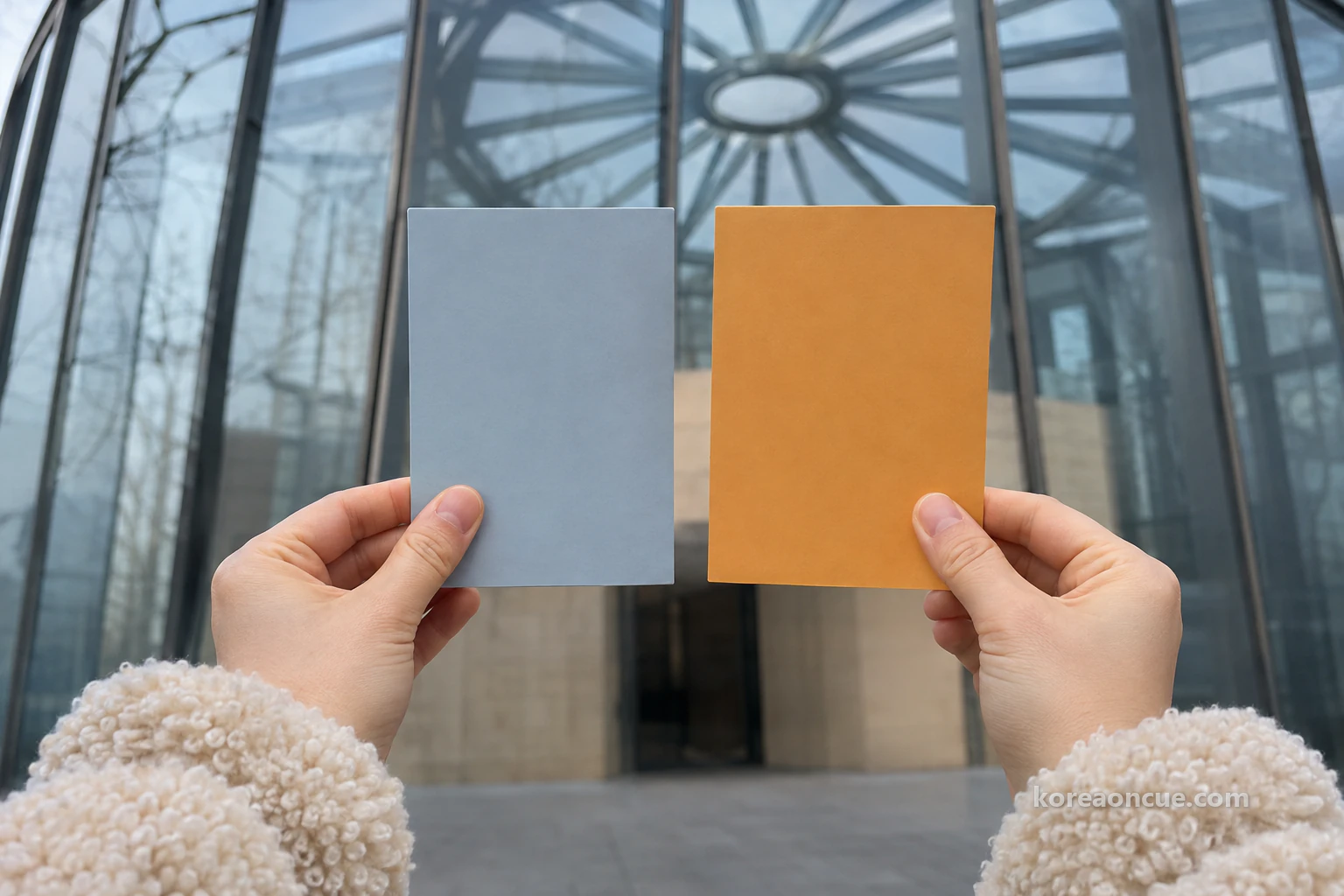
T1, by contrast, is the shiny one. Glass walls and a glass roof were put over a tank that once held petrol, so you can see the Maebongsan bedrock that surrounded the tank for more than 40 years. From outside you see a brown metal entrance between the glass walls, with a steel roof frame spreading out like spokes above. Mali held a card up to the winter sky reflected in the glass and called it “T1 winter glass”. Set next to the matte steel of T6 she had just seen, the contrast was as sharp as matte and gloss in a single frame.
At T3, Mali could not hold back a laugh. T3 keeps the tank’s old look as it was, so a rusted steel door is set between concrete wing walls. The colour of the rust happened to be almost the same as the lipstick Mali had put on that morning. Stopped a little way from the door, she looked back and forth between the rusty door and her own lips reflected on her phone screen, and as she raised a red-brown card beside her face she burst out laughing. The card’s name needed no thought at all: “T3 rust lip”.
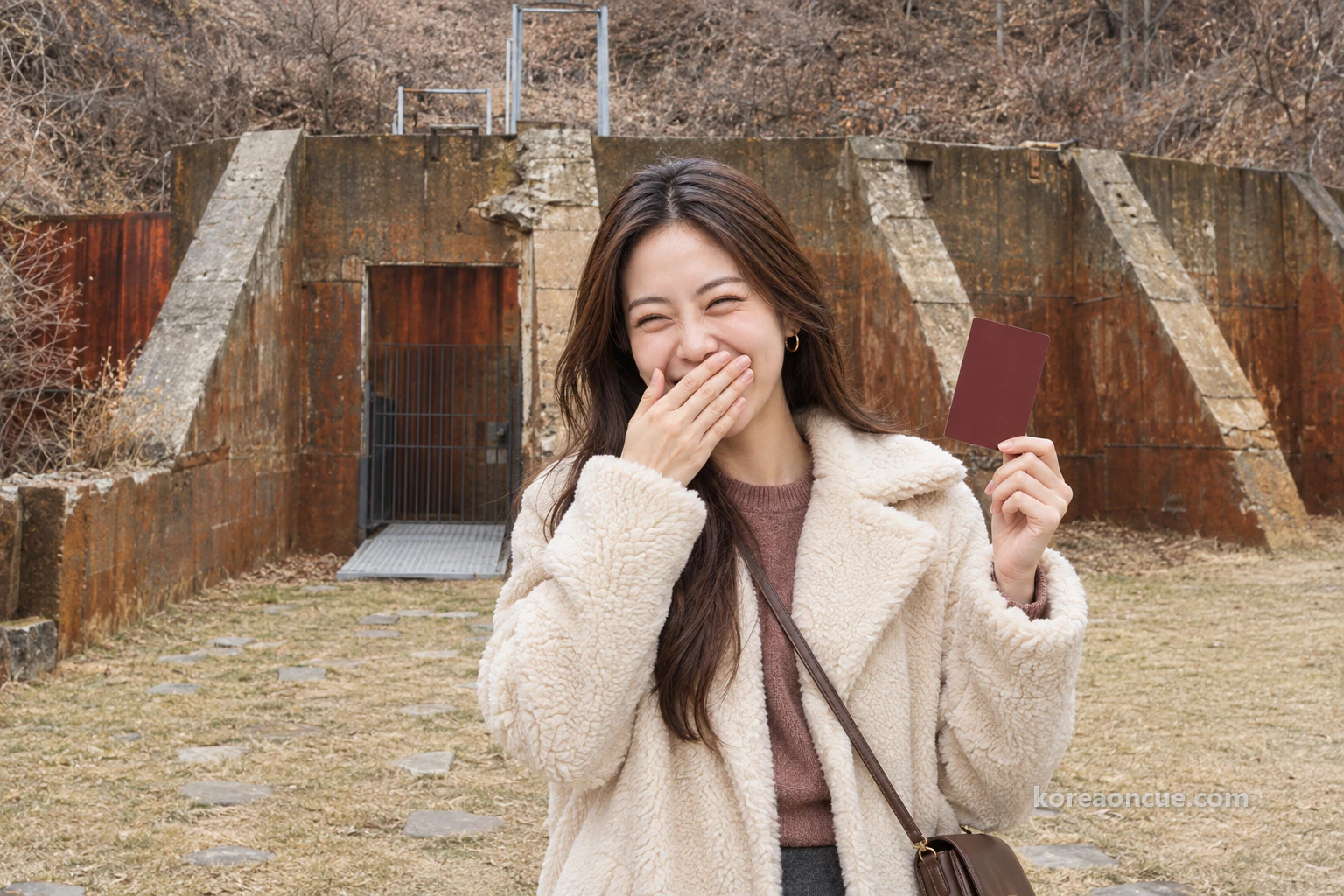
Once the laughter settled, Mali laid the cards from the three spots side by side on her palm. There was matte ochre steel, winter glass reflecting the sky, and red rust. She had come looking for indoor light and found three textures outside, so the open door in the blog did not feel like a loss at all. Even on a day when you cannot go inside the tanks, Oil Tank Culture Park is worth a walk around. Mali stacked the three cards neatly and tucked them into the front of her coat pocket.
Filming and facilities at Oil Tank Culture Park: rules to know before you go
Still laughing at T3, Mali suddenly thought of a shoot. Put a model in front of this steel and rust, bring a photographer, and a page of the winter issue would come together in no time. But commercial filming, such as a magazine shoot, needs approval after the park’s internal review. At weekends, when many visitors come, even small shoots on the paths and in the Culture Yard are not accepted. Outdoor filming applications are listed separately on the Seoul public service reservation site, so for today Mali kept to reference photos on her phone and decided to talk to her editor about applying.
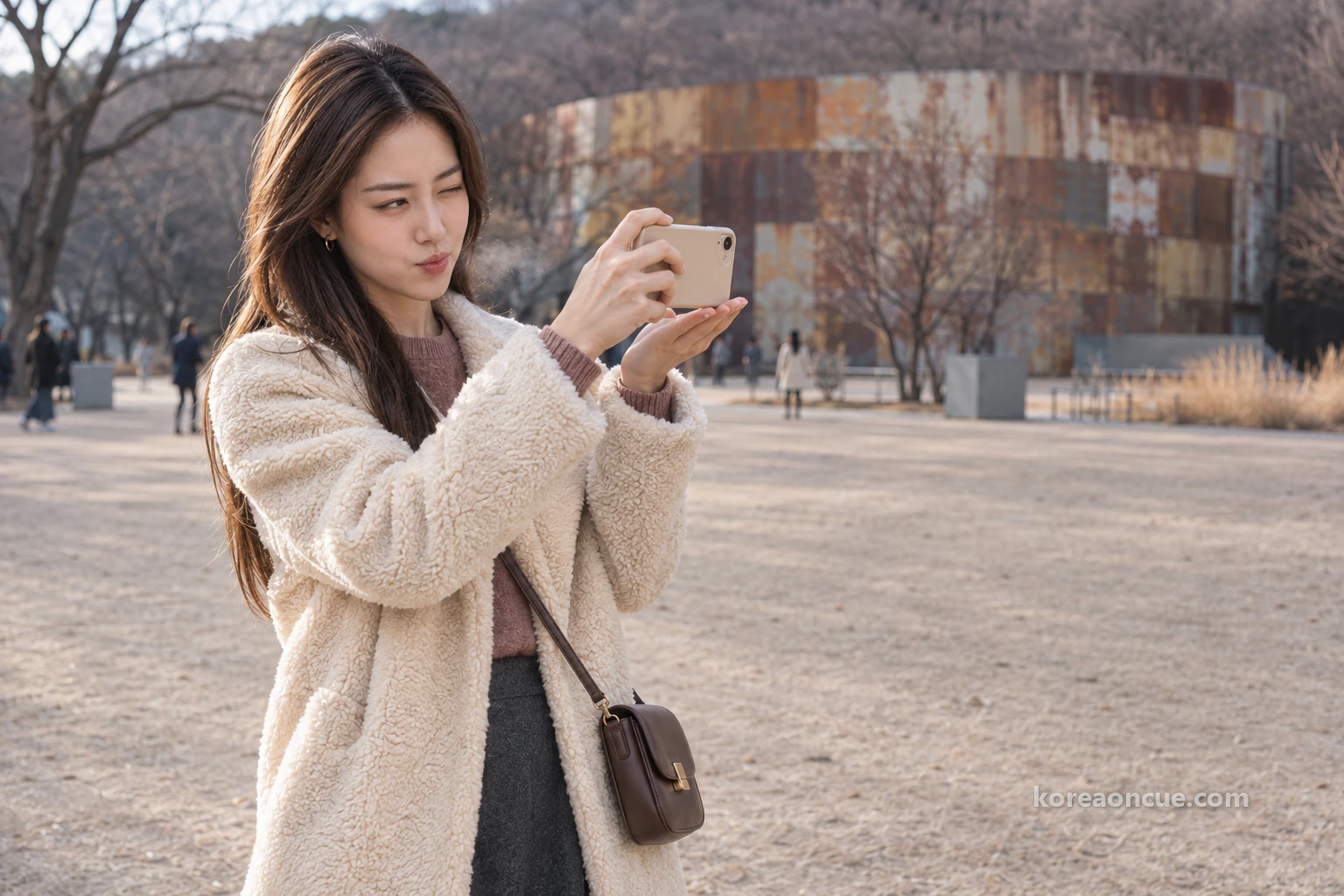
What Mali framed, holding her phone sideways, was T6 across the yard. Up close she had noticed each plate’s colour first, but from the edge of the yard the plates came together into the texture of a single round wall. In shoot terms, she had got the close-up and the full-length shot from one spot. She took a few more from the same place and renamed the reference photo folder she would send her editor “Outside textures”.
There is also what you need if you have limited mobility or are coming with children. The park map marks toilets, accessible toilets, multipurpose toilets, a nursing room, drinking fountains, lifts and bicycle racks. Buggies and wheelchairs can be borrowed at the Information Centre. The Information Centre also lends audio guides in Korean, English, Japanese and Chinese, from 10 a.m. to 5 p.m. On days when you cannot go inside the tanks, having the audio commentary in your ears helps as you go round outside.
Linking Oil Tank Culture Park with Haneul Park in one day: from December to February, the last shuttle up from Nanjicheon Park leaves at 5.30 p.m.
Mali’s original plan had one more line. After seeing the light inside the tanks, she would go up to Haneul Park and look at the silver grass once more as a backdrop for the winter issue. Seoul has pushed back cutting the silver grass at Haneul Park until the following spring for the sake of winter migratory birds, so the fields are still there in December. But Haneul Park is not right next to Oil Tank Culture Park, and getting there is a separate trip. You catch the Maengkkongi electric shuttle to the top at Nanjicheon Park, and the shuttle ticket booth is 803 m from Exit 1 of World Cup Stadium Station.
| Months | Operating hours | Last shuttle up (uphill) |
|---|---|---|
| March–September | 08:00–20:00 | 19:30 |
| October–November | 09:00–19:00 | 18:30 |
| December–February | 10:00–18:00 | 17:30 |
What caught Mali out was the last row. Her visit to Haneul Park two trips earlier had been in November, so the shuttle in her memory ran until 7 p.m. From December the service ends an hour earlier, and the last shuttle up to the top leaves another 30 minutes before that. By the time she had finished laughing at T3, her watch already said past 4 p.m. Thinking of going back to the station and out through Exit 1 again, she could see an afternoon spent chasing the last shuttle.

Haneul Park opens from 6 a.m. to 9 p.m. in November and December, and closes at night to protect wildlife. The closing time is set month by month around sunset, so the park itself stays open into the evening. In winter it is the shuttle, not the park, that sets your time. The shuttle runs frequently, every 10–20 minutes, and an adult fare is 2,000 won one way or 3,000 won return. If you link the two on one winter day, walk Oil Tank Culture Park first in daylight and plan to reach the shuttle ticket booth before 5.30 p.m.
If you have children with you, work out the shuttle fares separately. Children over 48 months up to age 12 pay 1,500 won one way or 2,200 won return, and children aged 48 months or under ride free. The route runs between Nanjicheon Park and the top of Haneul Park, and the round trip is 3.8 km. The service ends at 6 p.m., so if you ride both ways, fit your time at the top and the ride down within that. Last time, Mali had chosen the return ticket because she did not want to walk downhill after dark.
After a moment’s thought, Mali put Haneul Park off until next time. If she rushed for the last shuttle she would see the silver grass, but she would miss how the light on the steel she had just found changed at dusk. The yard was open 24 hours, so she could stay until sunset without worrying about closing time. Next to “Haneul Park” on the back of a card she wrote “December, 17:30” and drew a light line through it. Next time, she meant to write that time at the very top.
Oil Tank Culture Park at dusk, and the answer Mali wrote in the big-room line
As the sun dropped, T6’s steel turned redder than in the afternoon. The sunlit plates moved from ochre towards copper, and the shaded ones became almost chestnut. Mali held the “T6 ochre steel” card she had made in the afternoon to the same spot, then took out a new card beside it. The same wall had become a different backdrop within an hour, and to Mali it was light that would be hard to make with indoor lighting. The new card was called “Steel sunset”.
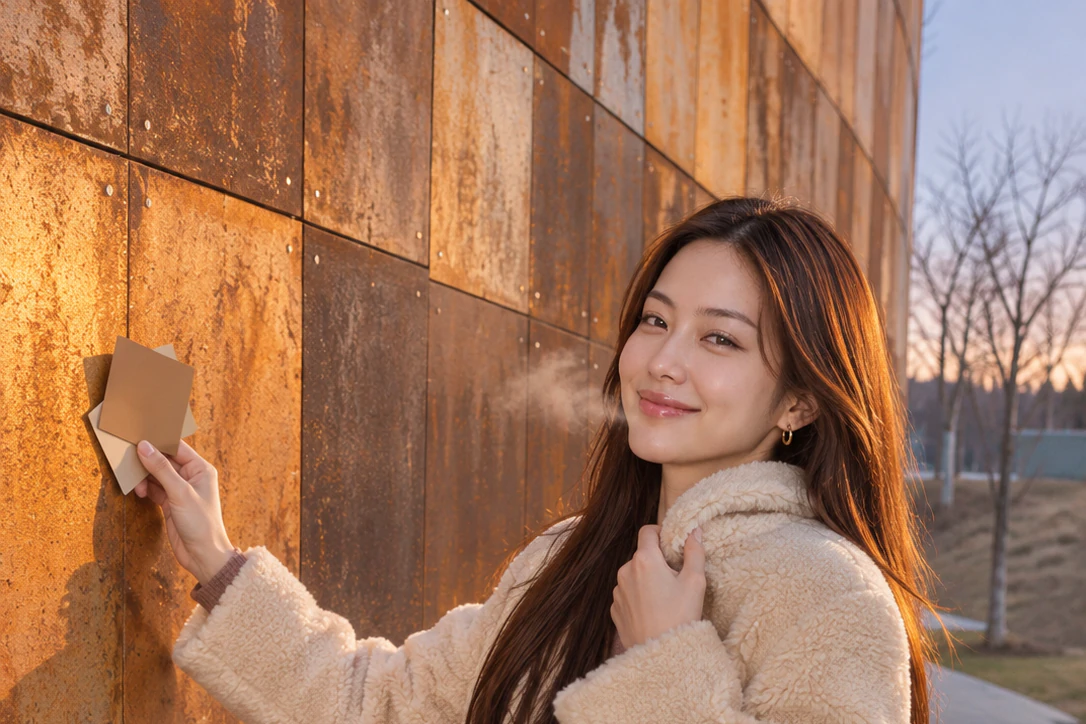
Mali took one photo of the wall and sent it to Rina. “I couldn’t get inside the tanks. But the steel outside turns copper at sunset.” While she waited for a reply, she put her phone in her pocket and walked out to the middle of the yard. Over the wide ground with no roof, the sky was slowly darkening. On the back of the card she crossed out the question mark in “Big room = the yard?” and wrote underneath “The ceiling is the sky”.
On the way back, Mali chose a different path from the one she had come in by. It was the way out through the main gate, across the pedestrian crossing at the World Cup Stadium junction. Now that it was dark, a wide road felt easier than timber steps, and she was curious about the far side of the park she had not seen on the way in. Looking back from the crossing, she saw the tanks under the darkened hillside sinking into the dusk like the circles she had seen on the satellite map. She did not hold a card up to that view and kept it only in her eyes.
Tomorrow was the last day of her eighth trip, and the receipts she had to sort were still in her wallet. Even so, the big-room line in her winter-issue homework now had space for five cards. Stepping off at the station at half past two with a blog post in hand, Mali had no idea the afternoon that began at a shut door would end like this. When the crossing light changed, she pulled her coat collar closed and walked towards the station. Next time she meant to see the steel by day and the silver grass before sunset.
Common Mistakes
Going to see an exhibition inside the tanks because of a post from a few years ago
Mali came trusting a single blog post and stopped with her hand in mid-air at a shut door. Had she looked at the post’s date first, it would have been less of a surprise.
Thinking Haneul Park is right next door
Mali first saw this place on a satellite map on her way back from Haneul Park, so it can look close, but the two are separate trips. The shuttle to the top leaves from Nanjicheon Park.
Working out winter shuttle times from a November memory
The shuttle in Mali’s memory ran until 7 p.m., but in December it stops earlier, so Mali put Haneul Park off until next time.
Driving on an event weekend
Notices closing the car park come out around big events. Taking the train is easier.
Just going ahead with a magazine shoot
Mali, too, imagined bringing a photographer and let the idea go. Commercial filming needs approval in advance.
FAQ
Can I go on a Monday?
Yes, the yard and paths are open all year. Audio guide rental at the Information Centre, though, is closed on Mondays.
Can I bring my dog?
Yes. Keep it on a lead and clean up after it. Indoors, carry your pet, and joining or watching events with a pet is restricted out of consideration for other visitors.
Can I smoke in the park?
No, Oil Tank Culture Park is a no-smoking park.
Recap — 30 seconds before you go
- Go expecting to see the steel and glass outside and the wide yard, not the inside of the tanks.
- If the timber steps on the back-gate side feel like too much, go in by the main-gate path across the pedestrian crossing.
- To add Haneul Park on a winter day, walk here first in daylight and reach the last shuttle up from Nanjicheon Park, at 17:30, in time.
Sources
- Seoul Parks — Oil Tank Culture Park (Korean)87 Jeungsan-ro, Mapo-gu, Seoul, main line 02-376-8420, use of T1–T6 (including the outdoor stage) 02-508-2205 · outdoor park open 24 hours, all year · since April 2025 Tanks T1–T6 have been permitted-use facilities with no everyday viewing inside, and the T1–T6 interiors and the T2 outdoor stage run separate (paid) programmes · Exit 2 or 3 of World Cup Stadium Station (Line 6), 10 minutes on foot towards the west gate, linked to the Maebongsan trail · descriptions and history of T0–T6 · car park 107 spaces, charges 09:00–22:00 · audio guides from the Information Centre in Korean, English, Japanese and Chinese, Tuesday–Sunday 10:00–17:00 · filming and pet ruleschecked 2026-11-11
- Oil Tank Culture Park official blog — “Changes are coming” (Korean, April 2025)From 1 April 2025 a private company runs T1, T2, T4, T5 and part of T6 as permitted-use facilities · permit for five years, until 31 March 2030 · no tank viewing from Monday 14 April 2025checked 2026-11-11
- Seoul Parks — Oil Tank Culture Park leaflet (Korean)T3 once held diesel, Seoul Future Heritage · T4 kerosene tank · T5 a kerosene tank brought back to life · main gate via the pedestrian crossing at the World Cup Stadium junction, back gate via the timber stair boardwalk trail · non-smoking park · map key (toilets, accessible toilets, multipurpose toilets, nursing room, drinking fountains, lifts, bicycle racks) · buggies and wheelchairs to borrow at the Information Centrechecked 2026-11-11
- Seoul Parks news — Using Oil Tank Culture Park during a weekend event (Korean, past notice)Car park partly or fully closed for a few days around the event, some paths closed on event days · Nanjicheon Park car park and the World Cup Stadium car park suggested insteadchecked 2026-11-11
- Seoul Public Service Reservation — 2026 outdoor filming at Oil Tank Culture Park (Korean)Application page for outdoor filming at Oil Tank Culture Parkchecked 2026-11-11
- Seoul Parks — World Cup Park (Korean)Maengkkongi electric shuttle Route 1, Nanjicheon Park ↔ Haneul Park summit, 3.8 km return · March–September 08:00–20:00, October–November 09:00–19:00, December–February 10:00–18:00, on demand or every 10–20 minutes, last shuttle up 30 minutes before service ends · adults 2,000 won single, 3,000 won return, children from just past 48 months to age 12 1,500 won single, 2,200 won return, 48 months and under free · Haneul Park open 06:00–21:00 in November and December, closed at night to protect wildlifechecked 2026-11-11
- VISIT SEOUL — Haneul Park (Korean)803 m from Exit 1 of World Cup Stadium Station to the Maengkkongi shuttle ticket office · 06:00–21:00, closing time changes each month with sunsetchecked 2026-11-11
- Seoul Media Hub — Autumn at Haneul Park (Korean, November 2026)Seoul has pushed back cutting the silver grass at Haneul Park until the following spring for winter migratory birdschecked 2026-11-11
A Seoul story told with our AI characters. Place details are checked against public sources; the photos are AI-made illustrative images. How we use AI
More from this area

Gyeongui Line Forest Park: ginkgo path and old tracks
Back in Seoul after a month, Mali messages Rina: “I’d like to see some autumn colours.” Rina chooses an old railway route that starts at a single pine tree outside Hongik University Station Exit 3.

Hongdae Red Road: a 2 km walk from R1 to R7
In her second week in Seoul, Maya visits Hongdae for the first time.