SEOUL · DEOKSUGUNG
Rina reads Dondeokjeon at Deoksugung box by box, and the “Imperial Banquet of the Korean Empire, Set by AI” laid out in a building that once received guests
A 2-minute walk from City Hall Station Exit 2 — a free special exhibition on the 1st floor of Dondeokjeon until 28 March 2027, and what the building, put up in 1902, was used for
Rina writes down building names and uses in boxes, and today she has ruled one more line in every box. It is the day she sets the “then” of Dondeokjeon, where envoys were received and banquets held, beside the “now” of its 1st floor, where you lay a banquet with magnets.
How to get there
Rina is the kind of traveller who reads a building’s name first when she stands in front of it, and then looks up what the building was for. She is 23 and from Japan, and her notebook is divided into square boxes, a set for each place. At the top of each box she writes the building’s name, and underneath, one line on its use. Written down like that, even a place she has seen only once comes back to her like a map when she gets home. But on the page she opens today, every box has one extra line ruled across it.

Yesterday, Rina walked Maeheon Citizen’s Forest with Mali. She borrowed the names Mali had given her colour cards for the titles of her notebook boxes, and the two of them spent a busy day laughing. So today she has decided to fill boxes slowly on her own. The place she has chosen is Dondeokjeon, inside Deoksugung. On the 1st floor of this building, a special exhibition, “Imperial Banquet of the Korean Empire, Set by AI” (대한제국 황실 만찬, AI로 차리다), has been running since 3 November.
What caught Rina’s eye was less the exhibition title than the building’s old use. Dondeokjeon was where envoys from many countries met the emperor, and where banquets were held. In a building that once received guests and laid tables for them, there is now an exhibition about imperial banquets. That is why Rina has ruled an extra line in every box. On the upper line she plans to write “Use then”, and on the lower one “Use now”.
Today’s walk covers just one place, Dondeokjeon at Deoksugung. You come out of Exit 2 of City Hall Station on Lines 1 and 2, go into Deoksugung, and see the special exhibition on the 1st floor of Dondeokjeon. This piece starts with how long the exhibition runs and until when Deoksugung admission is free. It also covers what time Dondeokjeon’s last entry is and which days in November the palace is closed. After that, it unpacks Dondeokjeon’s name and uses one at a time, like the boxes in Rina’s notebook.
The Cue — At a glance
Dondeokjeon is a brick building with a European-style exterior inside Deoksugung. It was built between 1902 and 1903 for the Chinggyeong ceremony, the celebration of the 40th anniversary of Gojong’s accession. The 1st floor held an audience chamber and the 2nd floor sleeping quarters, and it was where foreign envoys met the emperor and banquets were held. After Gojong died, it was left neglected and then disappeared, and it was rebuilt in 2023. On its 1st floor, the special exhibition “Imperial Banquet of the Korean Empire, Set by AI” runs from Tuesday 3 November 2026 to Sunday 28 March 2027. The exhibition is free and Deoksugung admission is separate, and until Sunday 15 November Deoksugung itself is free to enter.
- Station and exit: City Hall Station (Lines 1 and 2) Exit 2 → 2-minute walk to Deoksugung. From Gwanghwamun Station (Line 5) Exit 6 or 2, a 10-minute walk. There is no parking.
- Exhibition: “Imperial Banquet of the Korean Empire, Set by AI”, Tue 3 November 2026 – Sun 28 March 2027, except palace closing days, Dondeokjeon 1st floor.
- Admission: The exhibition is free. Deoksugung admission is separate — adults KRW 1,000 (foreign visitors aged 19–64, Korean nationals aged 25–64), groups KRW 800. Free entry from Thu 29 October to Sun 15 November.
- Hours: Dondeokjeon 09:00–17:30 (last entry 17:00) · Deoksugung 09:00–21:00 (last entry 20:00).
- Closed: Mondays (in November: the 9th, 16th, 23rd and 30th). If a Monday falls on a public holiday or substitute holiday, the palace opens and closes on the next non-holiday instead.
- Worth seeing: ① the outside of Dondeokjeon — a brick building with a European-style exterior ② the 1st-floor special exhibition — a banquet set by AI from the magnets you combine ③ Daehanmun — a name meaning “Hanyang will flourish”.
- Address and enquiries: 99 Sejong-daero, Jung-gu, Seoul · main line 02-771-9951.
Which exit? City Hall Station Exit 2, then a 2-minute walk
The closest way to Deoksugung is Exit 2 of City Hall Station on Lines 1 and 2. From Exit 2 to Deoksugung is a 2-minute walk. The first line in Rina’s notebook begins with her usual three-part note. It reads “City Hall — 2 — 2 min”. The numbers are far shorter than the “Seodaemun — 4 — about 7 min” she wrote on the way to Gyeonghuigung, so Rina circles the last one.
Open in Kakao Map — City Hall Station
If you are on Line 5, you can get off at Gwanghwamun Station instead. From Exit 6 or Exit 2 of Gwanghwamun Station, Deoksugung is a 10-minute walk. There is no parking at Deoksugung. So the subway or a bus is easier than a car, and you are less likely to lose your way going back, too. Rina also comes by subway from where she is staying, and pins “Deoksugung” on her phone map before she leaves the ticket gates.
If you come by bus, remember the name of your stop first. At the “Sicheong-ap·Deoksugung” (시청앞·덕수궁) stop, get off blue buses 103, 150, 401, 402 and 406, green buses 1711, 7016 and 7022, or buses 790 and 799. At the “Seoul Shinmunsa” (서울신문사) stop, get off blue buses 101, 150, 402, 501, 506 and 708, or green buses 1711 and 7016. Deoksugung’s address is 99 Sejong-daero, Jung-gu, Seoul, and the main phone line is 02-771-9951. Rina copies even the phone number into a corner of her notebook in small writing.
When to go: the exhibition runs until 28 March 2027, and Deoksugung is free to enter until 15 November
The special exhibition “Imperial Banquet of the Korean Empire, Set by AI” runs from Tuesday 3 November 2026 to Sunday 28 March 2027. It does not open on the palace’s closing days. The exhibition space is the 1st floor of Dondeokjeon. The exhibition itself is free, and Deoksugung admission is paid separately. In other words, once you are inside Deoksugung, you can see the exhibition on Dondeokjeon’s 1st floor without buying another ticket or paying anything more.
Until Sunday 15 November, there is no Deoksugung admission charge either. From Thursday 29 October to Sunday 15 November is the “Korea Grand Festival” period, when the four main palaces, Jongmyo and the Royal Tombs of the Joseon Dynasty are free to enter. Deoksugung is one of the four main palaces, and it still closes on its regular closing days during this period. Once the free period ends, admission is charged again. Adults pay KRW 1,000, and groups KRW 800.
So in the exhibition’s first two weeks, days when both the exhibition and Deoksugung are free overlap. Between Tuesday 3 November and Sunday 15 November, the only closing Monday is 9 November. Leave out that one day, and there are twelve days when you can see Dondeokjeon’s 1st floor without paying admission. The first opening day after the free period is Tuesday 17 November, and admission is charged from then on. If you are in Seoul in early November, try to fit a visit into those twelve days.
“Adult” means aged 19 to 64 for foreign visitors and 25 to 64 for Korean nationals. The day Rina goes, the free period is already over. As a 23-year-old foreign visitor, Rina pays the adult fee of KRW 1,000. On the way in, she writes “₩0 until 15 Nov” in her notebook. She thinks it is the first number she will mention when she tells a friend about this exhibition.
Hours are easier if you remember two of them separately. Deoksugung opens from 9 a.m. to 9 p.m., with last entry at 8 p.m. Dondeokjeon opens from 9 a.m. to 5:30 p.m., with last entry at 5 p.m. So if you enter Deoksugung in the evening, you cannot see the exhibition on Dondeokjeon’s 1st floor. Rina writes the two numbers side by side as “17:00 / 20:00”, and underlines the first one twice.
Monday is Deoksugung’s closing day. In November, while the exhibition is on, the Mondays are the 9th, 16th, 23rd and 30th. But when a Monday falls on a public holiday or substitute holiday, the palace opens, and the next non-holiday becomes the closing day instead. If you go in November, just plan around these four dates. Rina, too, only feels at ease once she has marked a small cross on each of the four dates in her notebook calendar.
Through Daehanmun into Deoksugung: a gate meaning “Hanyang will flourish”, and the palace of the Korean Empire
Arriving in front of Deoksugung, Rina stops first at Daehanmun. Before any building inside, she wants the gate’s name in her first box. “Daehan” means “Hanyang will flourish”. Hanyang is Seoul’s old name, so it is a name wishing for Seoul to grow and prosper. At the top of the first box Rina writes “Daehanmun”, and underneath, neatly, “May Seoul grow great”.
But Daehanmun has not always stood on this spot either. Daehanmun originally stood about 33 m further forward than it does now. It was moved to its present spot in the 1970s, when Taepyeong-ro was widened. Rina draws a small arrow beside the Daehanmun box and writes “moved about 33 m”. It reminds her of “The gate that moved”, which she wrote in the Heunghwamun box at Gyeonghuigung, and Rina tilts her head and laughs to herself.
Stepping into the palace, Rina sums up Deoksugung as a whole in a single box. Deoksugung was the imperial palace of the Korean Empire, an empire proclaimed in 1897. Its old name is Gyeongungung. As Western-style buildings began to go up inside the palace, it became a palace where traditional and Western-style architecture sit together. In the palace box Rina writes “An emperor’s palace — traditional buildings and Western-style buildings”, and puts a heavy dot between the two halves.
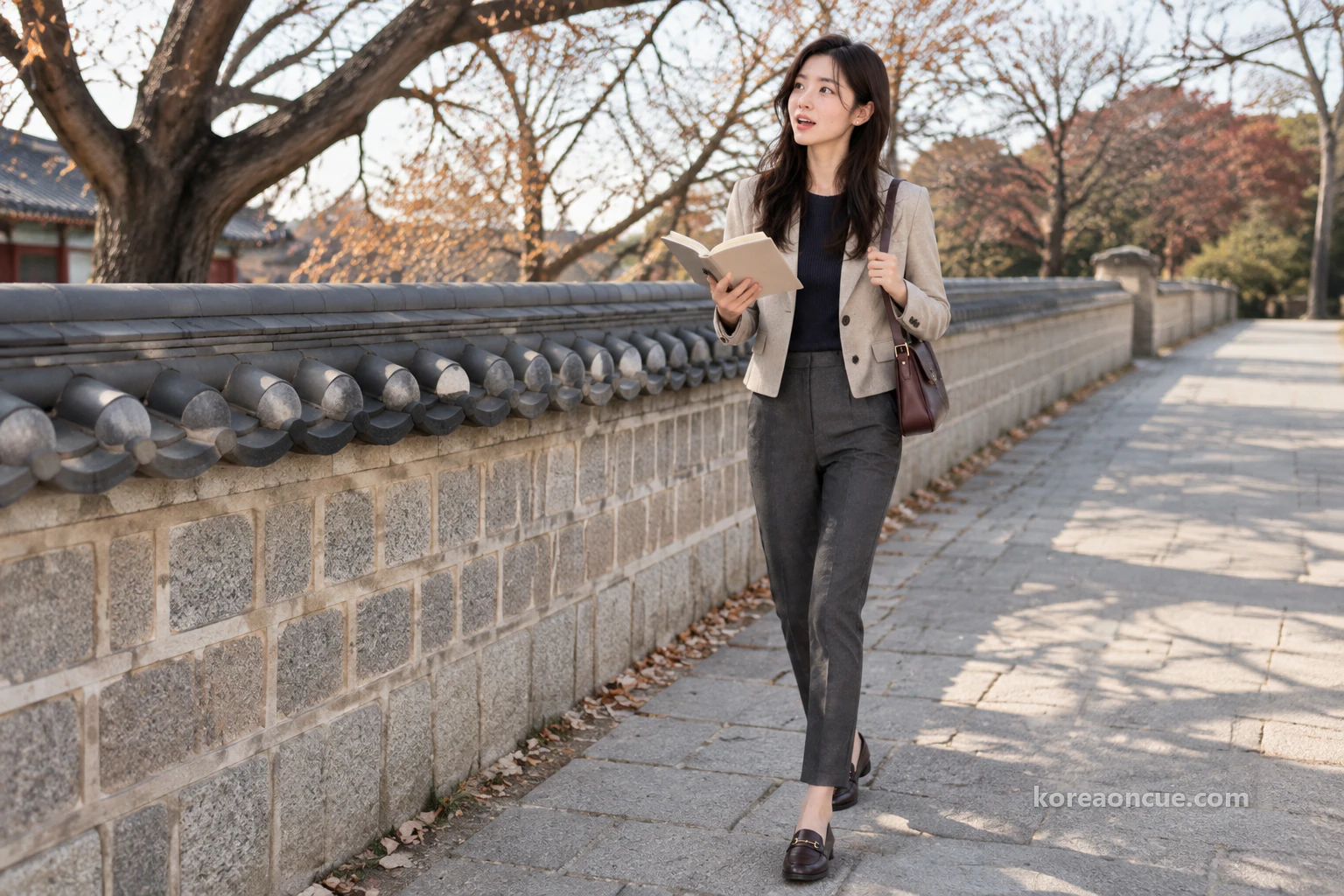
At Gyeonghuigung, Rina divided her boxes with three words: jeongjeon (main hall), pyeonjeon (council hall) and chimjeon (living quarters). It was a way of writing down, in order, the buildings where the king gathered with his officials, worked and rested. But at Deoksugung, she suspects those three boxes will not be enough. Western-style buildings look hard to fit into any of them. That, in fact, is the real reason Rina has ruled an extra line in every box today.
The name Dondeokjeon: “virtue runs deep”, a building for the 40th anniversary of Gojong’s accession
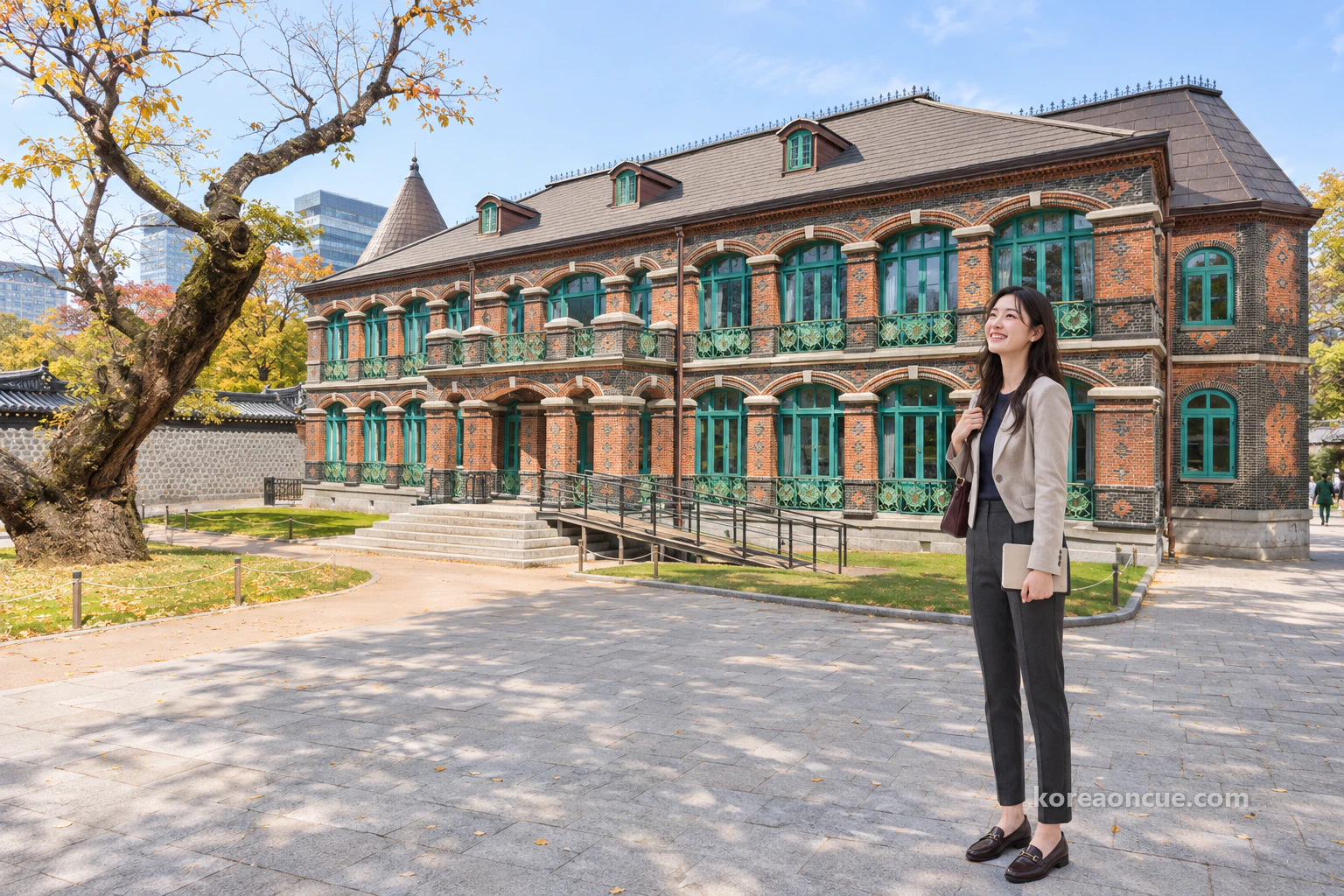
In front of Dondeokjeon, Rina looks up at the building before she looks at her notebook. A brick building with an ornate European-style exterior stands inside the palace. At one corner is a tower topped with a pointed conical roof, and on every floor a row of arched windows runs across. After walking among tiled roofs, it looks quite unfamiliar. Rina stands there for a long time, mouth slightly open, forgetting even the hand that holds her notebook.
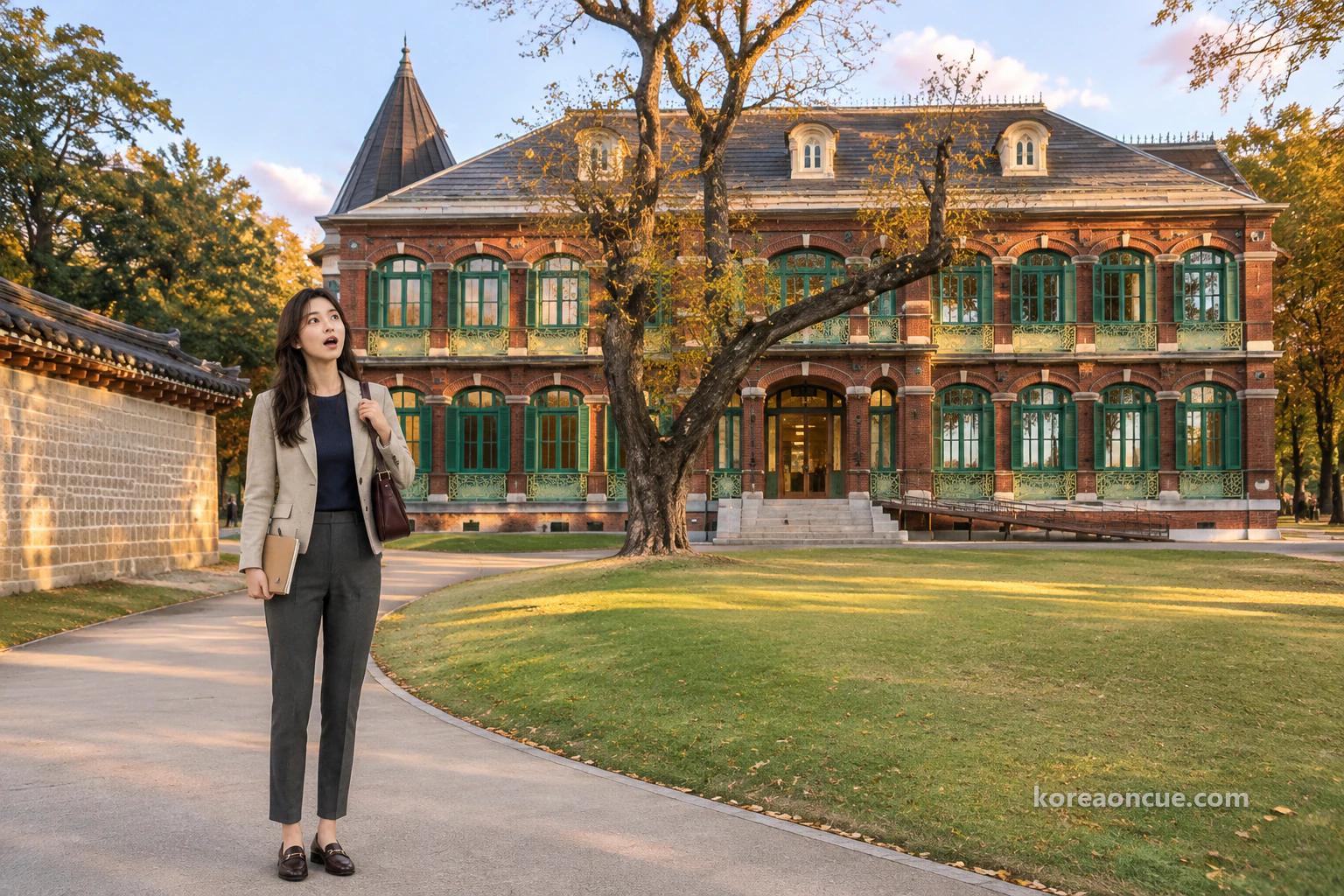
Dondeokjeon is written 惇德殿 in Chinese characters. “Dondeok” means “virtue runs deep”, from a Korean word, dotapda, for care between people that is deep and warm. As always, Rina first reads the name by its Japanese sound. 惇德 is read “tontoku”, so beside “惇德 = とんとく” she writes “virtue runs deep”. Read once by sound and once by meaning, the unfamiliar building name feels a little closer.
Rina takes her eyes off the building and looks slowly round. To its left, a low wall topped with traditional roof tiles runs along, and in front are an old tree and a lawn. With the brick building and the tiled wall in one view, this is exactly the “traditional buildings and Western-style buildings” she wrote down earlier. Beside the heavy dot in the palace box, Rina adds “Here” in small letters. If it is your first walk round Deoksugung, look for the spot in front of Dondeokjeon where you can see both at once.
The building went up between 1902 and 1903. It was for the Chinggyeong ceremony, marking the 40th anniversary of Gojong’s accession. The Chinggyeong ceremony was a grand rite celebrating a happy occasion for the nation. Here Rina stops her pencil for a moment. A house built to celebrate a happy occasion, named “virtue runs deep” — it strikes her as just the name for a house meant to receive guests.
An audience chamber on the 1st floor, sleeping quarters on the 2nd: where envoys met the emperor and banquets were held
Dondeokjeon’s uses differed from floor to floor. The 1st floor was the pyehyeonsil, an audience chamber, and the 2nd floor held sleeping quarters. Pyehyeon means having an audience with the emperor. Envoys from many countries met the emperor in this building, and it also served as a banquet hall. It was used as lodging for foreign guests of state rank too, so one building took care of receiving guests, entertaining them and putting them up.
Rina divides the box by floor. At the top of the 1st-floor box she writes “Audience chamber”, and at the top of the 2nd-floor box “Sleeping quarters”. Then, on the “Use then” line under the building box, she writes in turn: “meeting envoys · banquets · guests stay”. With all three uses written in, the box fills up fast. Rina knits her brows a little and makes her writing smaller still.
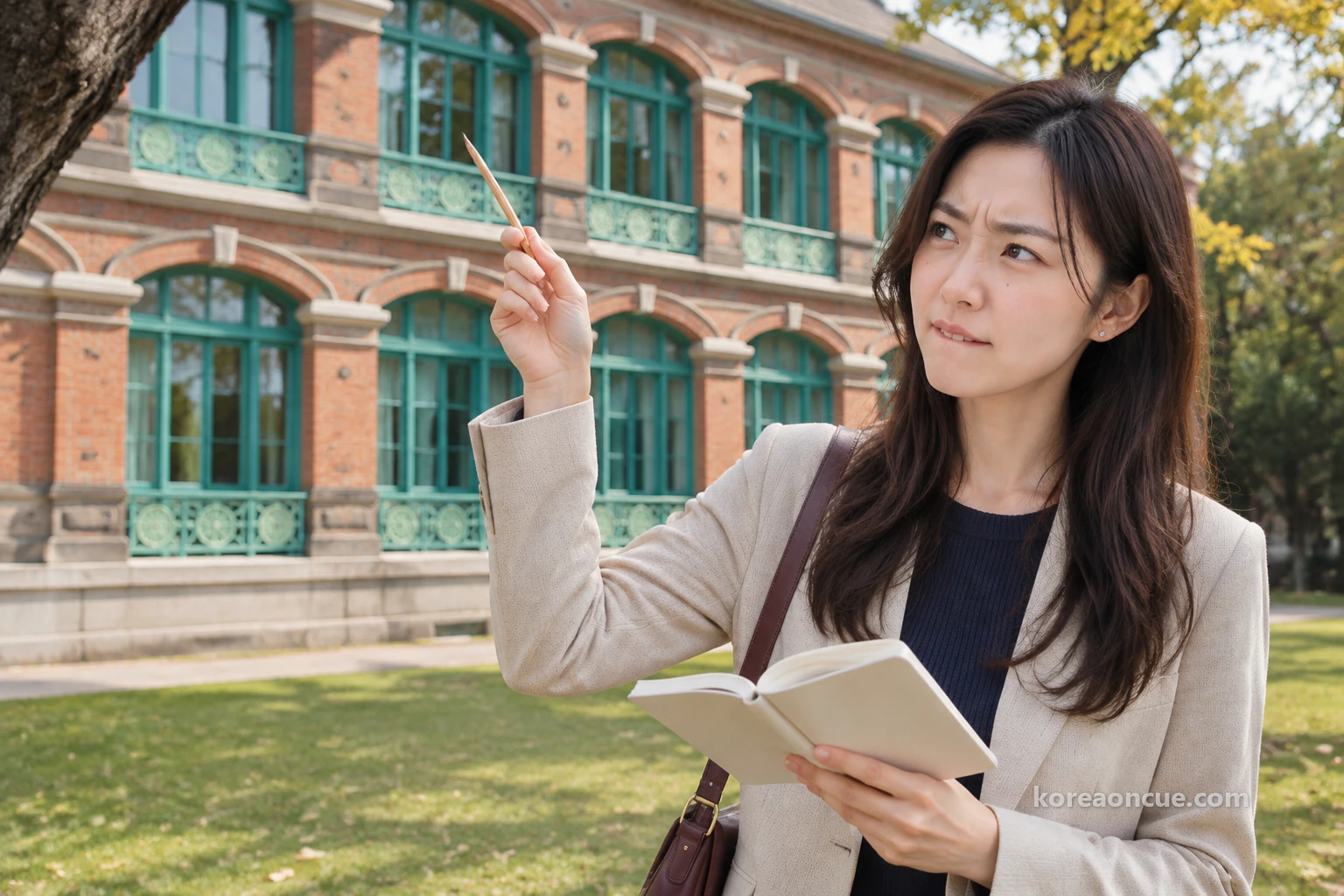
In the word pyehyeon (陛見), Rina recognises the character first. 陛 is read へい (hei) in Japanese, and it is also the character in 陛下 (へいか, heika), “Your Majesty”. So the meaning, an audience with the emperor, comes to her straight away. Sungjeongjeon, the main hall she wrote down at Gyeonghuigung, was also where the king received envoys. That in one palace the main hall received guests, and in another a European-style brick building did, is Rina’s first discovery of the day.
Under “Sleeping quarters” in the 2nd-floor box, Rina copies “guests stay” once more. Reading that it was lodging for foreign guests of state rank, she realises that she too is a foreign guest staying in Seoul. Honoured guests from distant countries once slept in this building. Today’s Rina is going to see an exhibition on the same building’s 1st floor with a Deoksugung ticket. She finds the difference funny, writes “guest → guest” in a corner of the notebook and chuckles to herself.
In the 2nd-floor box, she writes only “Use then” today and leaves the “Use now” line blank. That is because the exhibition she has come to see is on the 1st floor. On the “Use now” line under the 1st-floor box, she leaves plenty of room for the exhibition title. Looking back and forth between the two boxes, Rina taps the 1st-floor box with the tip of her pencil. What might be laid out now in a building that once held banquets? In front of the entrance, Rina pictures it for a moment.
Sunjong’s coronation in 1907, and a building that vanished for a while and stood again in 2023
Dondeokjeon is also where an emperor was crowned. In 1907, Sunjong held his coronation as emperor here. Rina puts a comma at the end of the “Use then” line and adds “1907 coronation”. A building that received envoys and held banquets also became the place where a new emperor took the throne. Under that year Rina draws two short lines.
After Gojong died, Dondeokjeon was left neglected and then disappeared. It was rebuilt in 2023, so the brick building Rina looked up at is the Dondeokjeon rebuilt in 2023. In her notebook Rina joins three numbers and one blank with arrows: “1902 → 1907 → (blank) → 2023”. Laying years out in a single line like this is one of Rina’s favourite ways of filling a box.
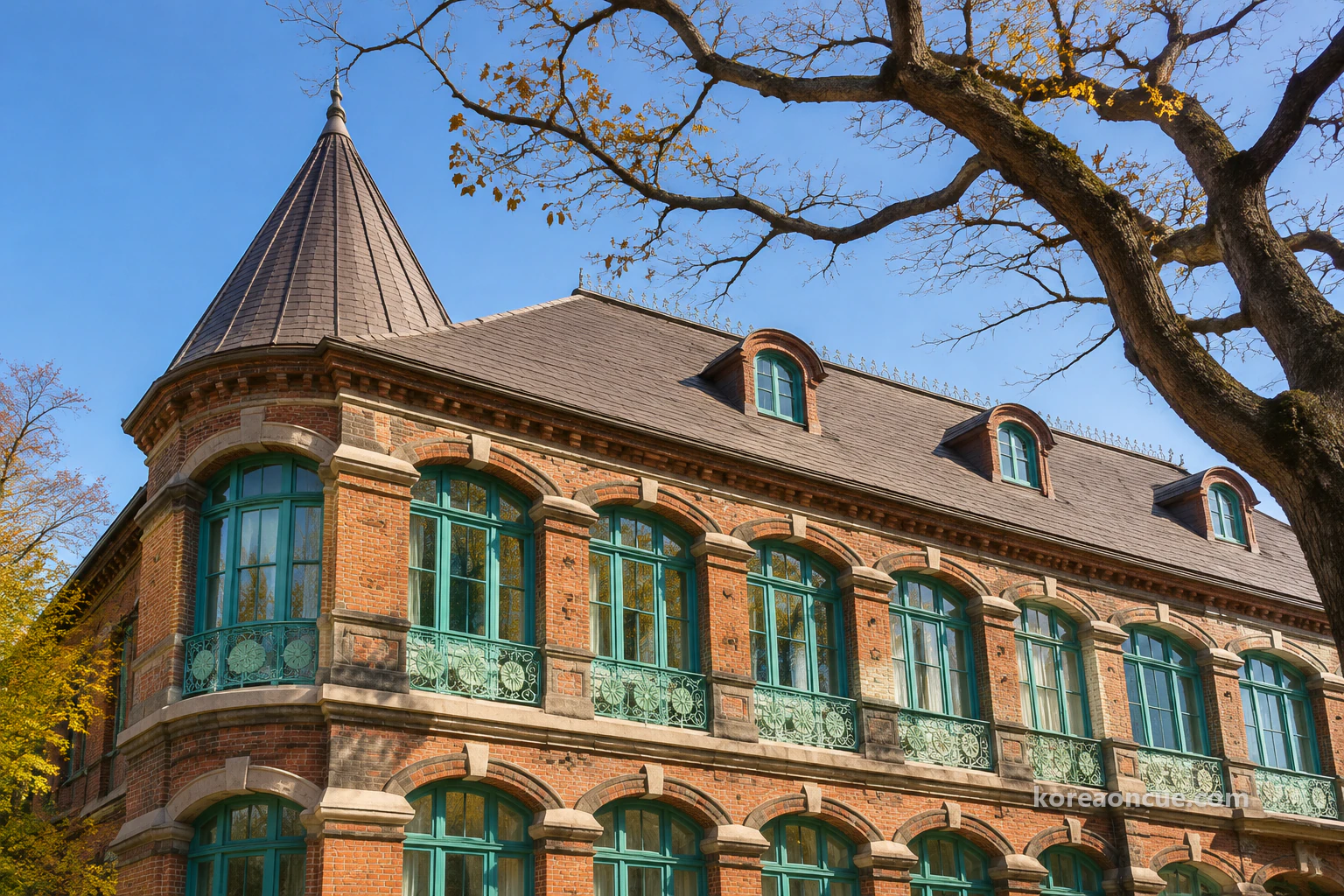
Once the numbers are joined, Rina notices a wide gap between them. From the building’s disappearance to 2023, the time without the building was the longest stretch. In the building that stands again after that long gap, there is now an exhibition based on the imperial banquets of old. From the 2023 at the end of the arrow, Rina draws one line to the “Use now” line. Now it is time to go in to the 1st floor and fill that line.
What is the 1st-floor special exhibition “Imperial Banquet of the Korean Empire, Set by AI”? Ingredient magnets and table projection mapping
The special exhibition on Dondeokjeon’s 1st floor is a hands-on exhibition based on the Western-style banquets of the Korean Empire’s imperial household. Its title is “Imperial Banquet of the Korean Empire, Set by AI”. It is a special exhibition made under the Korea Creative Content Agency’s 2026 AI content production support programme. It is organised by the Deoksugung Management Office of the Korea Heritage Service’s Royal Palaces and Tombs Center, together with Daberoart Co., Ltd. On the “Use now” line of the 1st-floor box, Rina copies the exhibition title carefully.
Rina does not skip past the words “AI Content Production Support Programme” in front of the exhibition title, either. They mean the exhibition was made under a programme supported by the Korea Creative Content Agency in 2026. It is like laying the table again, with 2026 technology, for the old use of a building put up in 1902, and Rina nods. Both lines, “then” and “now”, seem to fit inside this one exhibition. Beside the title, in small writing, she notes “2026 × 1902”.
In short, the exhibition works like this. When you combine ingredient magnets, AI creates a dish image, a menu name and a story on the spot, depending on the combination. The result is shown with table projection mapping. Table projection mapping means projecting moving images in light onto a dining table. So this is an exhibition you look at, and also one where you choose for yourself and set the table.

After reading the description, Rina draws a small picture under the 1st-floor box. Arrows run from a few magnets, and at their ends she writes two lines: “menu name / story”. It looks just like Rina’s own boxes, with a name and a use on two lines. Amused by the likeness, Rina laughs softly out loud. Choose the magnets, and you get a name and a story, just as in her boxes.
What happens when you set down the magnets? A menu name and a story made up by AI
In the 1st-floor exhibition space, Rina cannot choose a magnet for a while. Since the result changes with the combination, she hesitates over which to pick first. Biting her lip a little, she picks magnets up and puts them down again several times. In the end Rina decides to set them down in order, starting with the first ingredient that caught her eye. When she fills boxes, too, she always writes things in the order she sees them.
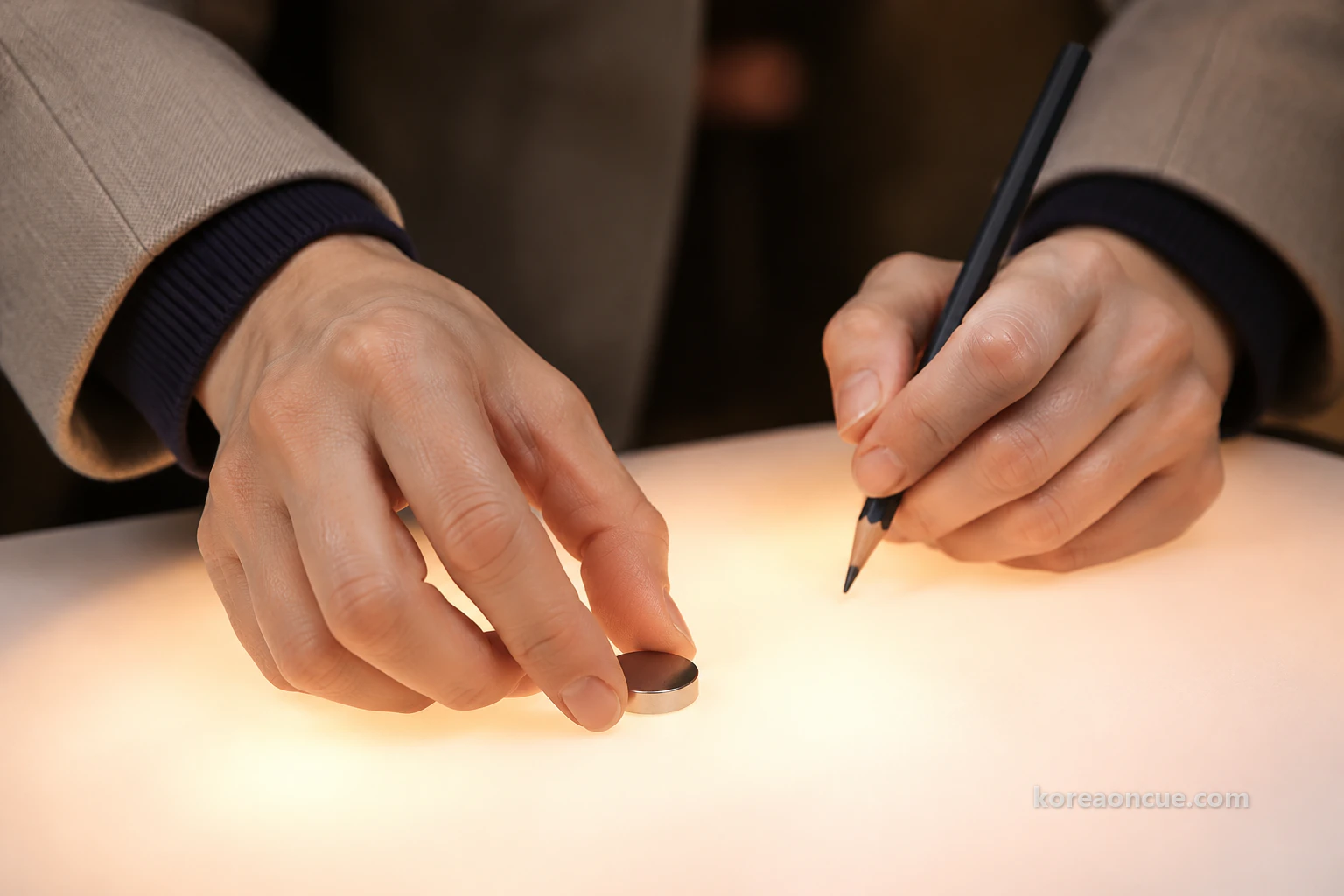
As she sets the magnet down, light spreads across the table and a dish image appears. A menu name and a short story show up with it. Startled, Rina steps half a pace back, then bursts out laughing. She copies the menu name, just as it is, under the “Use now” line. It is a name she has never seen before, but knowing it is a name she received in this building today, her handwriting comes out a little bigger.
Rina swaps one magnet and tries once more. With a different combination, the dish image, the menu name and the story all change. A different banquet is set on the same table, so even on your own you can compare several results by changing the magnet combination. Changing just one magnet changes the result, so try a few times and compare. If you go with a friend, taking turns to choose one each could be fun too.
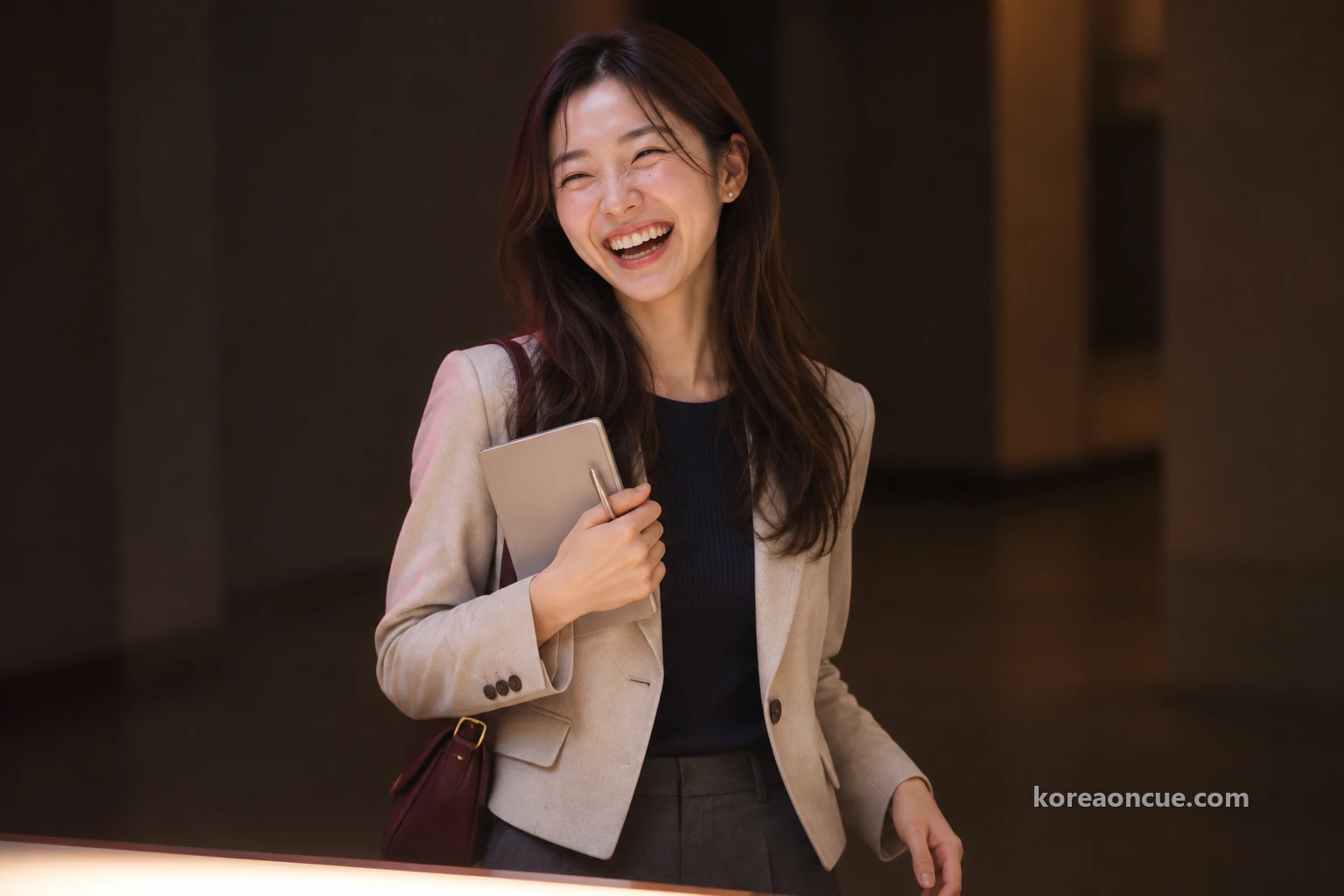
Rina writes the second menu name beside the first. Now there are two names in one box, but this time she deliberately does not widen it. A different name appearing in the same place is, she thinks, exactly what this exhibition is for. Holding her notebook, Rina looks once more towards the table and thinks of the banquets once held in this building. What were the dishes called that guests were served back then? Rina asks the question softly to herself.
After the exhibition: joining “then” and “now”, and keeping Dondeokjeon’s 5 p.m. last entry in mind
Coming out of the exhibition space, Rina rereads the 1st-floor box from the top in front of the entrance. At the top is “Audience chamber”, and on the “Use then” line, meeting envoys and holding banquets. On the “Use now” line, the exhibition title and two menu names sit side by side. In a building where guests were received and tables laid for them, visitors now lay the table themselves. Between the two lines Rina draws one long arrow running up and down.
If you arrive late in the afternoon, see the exhibition on the 1st floor before looking round outside. Last entry to Dondeokjeon is at 5 p.m. Go only by Deoksugung’s 8 p.m. last entry and come late, and you will be turned away at Dondeokjeon. Even if you see the exhibition first, the outside of the building is there to see for as long as Deoksugung is open. That is also why Rina underlined only “17:00” twice in her notebook.
After leaving Dondeokjeon, you can stay on in Deoksugung. Dondeokjeon closes at 5:30 p.m., but Deoksugung stays open after that. Deoksugung is open until 9 p.m., so it also suits anyone who wants to walk the palace after dark. Note, though, that Deoksugung’s last entry is at 8 p.m. Looking at the “17:00 / 20:00” line again, Rina feels quietly pleased that she kept to both numbers today.
If you have time to spare, it helps to know the hours for Seokjojeon and Jungmyeongjeon too. Seokjojeon opens from 9:30 a.m. to 5:30 p.m., and its last guided tour is at 4:30 p.m. Seokjojeon is by advance online reservation, a limited visit led by a guide. Jungmyeongjeon opens from 9:30 a.m. to 5:30 p.m., with last entry at 5 p.m. Rina writes the two names on the back page of her notebook and leaves them as boxes to fill next time.
As the sun sinks, Rina comes back out to the lawn in front of Dondeokjeon. The brick walls she looked up at earlier look a shade deeper in the evening light. She steps back a few paces so the old tree, the lawn and the curving path all fit in one frame, and raises her phone. Mali would probably wait for the light that shows the colours best, she thinks, so Rina waits a moment too before taking one shot. In the photo, the green window frames stand out clearly against the red brick.

A photo sent to Mali, and the way back to City Hall Station Exit 2
Rina sends the photo to Mali. Yesterday at Maeheon Citizen’s Forest, Rina borrowed the names of Mali’s cards for the titles of her notebook boxes. Today, the other way round, she wants to ask Mali for a name. “Yesterday a forest, today a brick building. The green of the window frames — what would it be called on one of your cards, Mali?” After sending the message, Rina puts her phone in her bag without waiting for a reply.
For the way back she chooses the same City Hall Station Exit 2 she came by. From Deoksugung to City Hall Station Exit 2 is a 2-minute walk, so close there is hardly time to open a notebook. Even so, before going down to the station, Rina stops and opens her notebook once more. The 1st-floor box is filled top and bottom with then and now, and only the “now” line in the 2nd-floor box is empty. On that empty line, Rina puts one small dot.
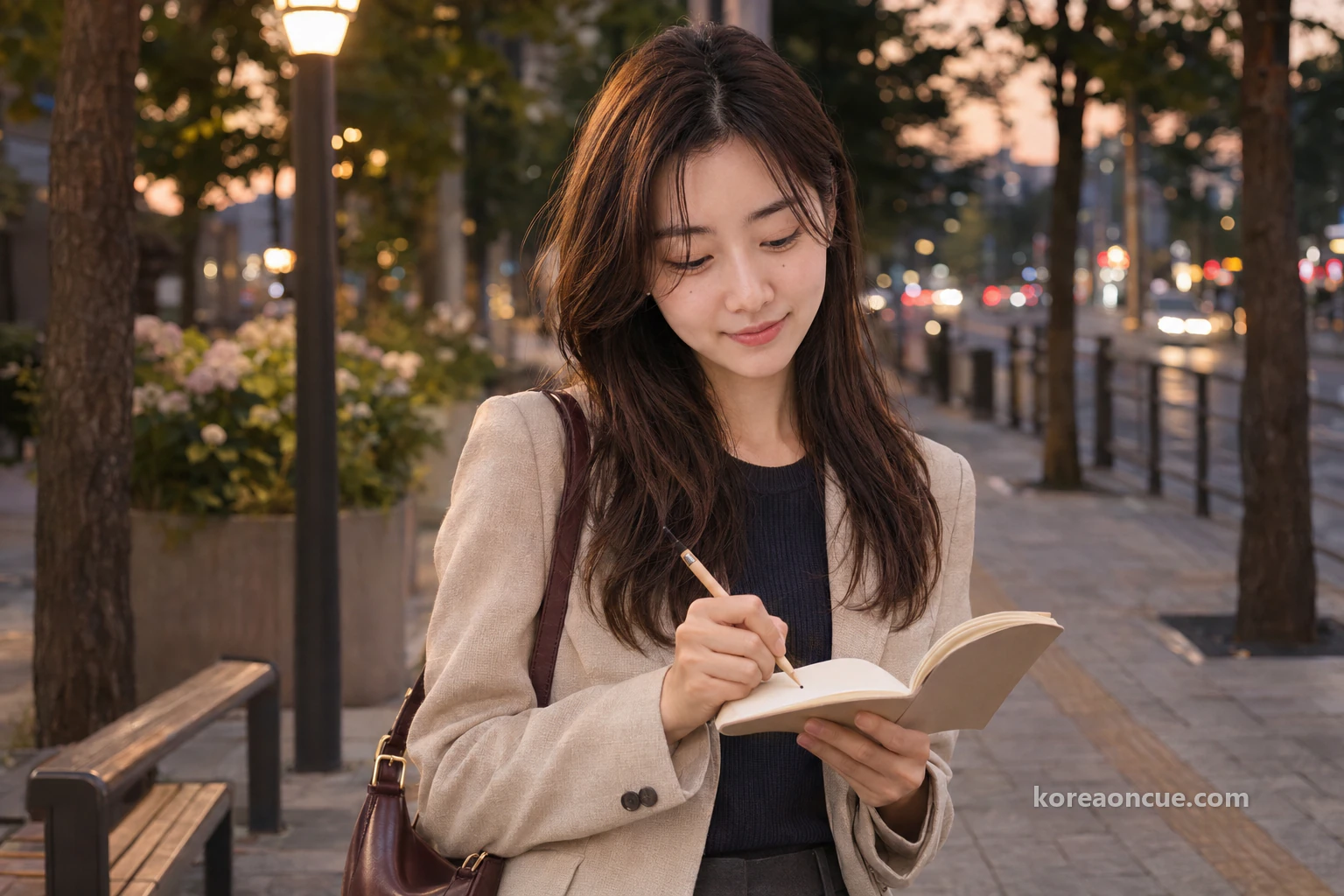
Back at her room, Rina opens the Gyeonghuigung page and draws an arrow beside the main hall box. At the end of the arrow she writes “A house for receiving envoys — Dondeokjeon”. Across two pages, she has linked one palace where the main hall received guests and another where a brick building did. Meanwhile a notification of Mali’s reply appears on her phone, but Rina decides to read that name tomorrow morning. Today’s boxes are full enough with the names she received today.
Common Mistakes
Going to Dondeokjeon after 5 p.m.
you can enter Deoksugung until 8 p.m., but last entry to Dondeokjeon is at 5 p.m.
Going on a Monday
Deoksugung is closed on Mondays. In November: the 9th, 16th, 23rd and 30th.
Thinking the exhibition has its own fee
the exhibition is free. You pay only Deoksugung admission, and until Sunday 15 November there is none.
Going by car
Deoksugung has no parking. It is a 2-minute walk from City Hall Station Exit 2.
Setting the magnets down once and leaving
the dish image, menu name and story change with the combination. Swap just one and try again.
FAQ
Which station and exit should I use?
City Hall Station Exit 2 on Lines 1 and 2, then a 2-minute walk. From Gwanghwamun Station Exit 6 or 2 on Line 5, it is a 10-minute walk.
How long is the exhibition on?
From Tuesday 3 November 2026 to Sunday 28 March 2027. It does not open on the palace’s closing days.
Is there a fee for the exhibition?
The exhibition is free, and Deoksugung admission (adults KRW 1,000) is separate. From Thursday 29 October to Sunday 15 November, Deoksugung is free to enter too.
How late can I visit?
Dondeokjeon is open 09:00–17:30, with last entry at 17:00. Deoksugung is open 09:00–21:00, with last entry at 20:00.
What kind of exhibition is it?
A hands-on exhibition based on the Western-style banquets of the Korean Empire’s imperial household: combine ingredient magnets, and AI creates a dish image, a menu name and a story on the spot, shown with table projection mapping.
What kind of building is Dondeokjeon?
A European-style brick building put up in 1902–1903 for the Chinggyeong ceremony marking the 40th anniversary of Gojong’s accession. The 1st floor was an audience chamber and the 2nd floor sleeping quarters, and it was used for envoys’ audiences with the emperor, for banquets and as lodging for foreign guests of state rank. Sunjong was crowned here in 1907, and the building was rebuilt in 2023.
Who do I contact with questions?
Deoksugung’s main line, 02-771-9951.
Recap — 30 seconds before you go
- City Hall Station (Lines 1 and 2) Exit 2 → 2-minute walk → Deoksugung (99 Sejong-daero), no parking
- Special exhibition “Imperial Banquet of the Korean Empire, Set by AI”, Tue 3 Nov 2026 – Sun 28 Mar 2027, Dondeokjeon 1st floor, free
- Deoksugung admission adults KRW 1,000 · free entry until Sun 15 November
- Dondeokjeon last entry 17:00 · Deoksugung last entry 20:00 · closed Mondays (in November: 9, 16, 23, 30)
- Change the magnet combination and try at least twice
Sources
- Deoksugung Management Office notice — special exhibition “Imperial Banquet of the Korean Empire, Set by AI”3 Nov 2026 – 28 Mar 2027 (excluding closed days) · Dondeokjeon, 1st floor · free (Deoksugung admission separate) · an interactive show in which combining food-ingredient magnets makes AI generate dish images, menu names and storieschecked 2026-11-03
- Royal Palaces and Tombs Center notice — free admission and holiday openings, October–November 2026Free admission during the Korea Grand Festival, 29 Oct – 15 Nov (closed days excluded)checked 2026-11-03
- Deoksugung website — DirectionsLines 1 and 2, City Hall Station Exit 2, 2 minutes on foot · Line 5, Gwanghwamun Station Exit 6 or 2, 10 minutes on foot · 99 Sejong-daero, Jung-gu · no parkingchecked 2026-11-03
- Deoksugung stories — DondeokjeonBuilt in 1902–1903 for the 40th anniversary of King Gojong’s accession · audience hall on the 1st floor and bedrooms on the 2nd · Emperor Sunjong’s accession ceremony in 1907 · appears to have vanished in the 1920s and was rebuilt in 2023checked 2026-11-03
- Deoksugung website — Opening hoursDeoksugung 09:00–21:00 (last entry 20:00) · Dondeokjeon 09:00–17:30 (last entry 17:00) · closed on Mondayschecked 2026-11-03
- Deoksugung website — AdmissionDeoksugung adult 1,000 won (individual) · groups 800 wonchecked 2026-11-03
- Deoksugung website — Introduction and historyImperial palace of the Korean Empire, proclaimed in 1897 · former name Gyeongungung · a palace where traditional and Western-style buildings stand togetherchecked 2026-11-03
A Seoul story told with our AI characters. Place details are checked against public sources; the photos are AI-made illustrative images. How we use AI